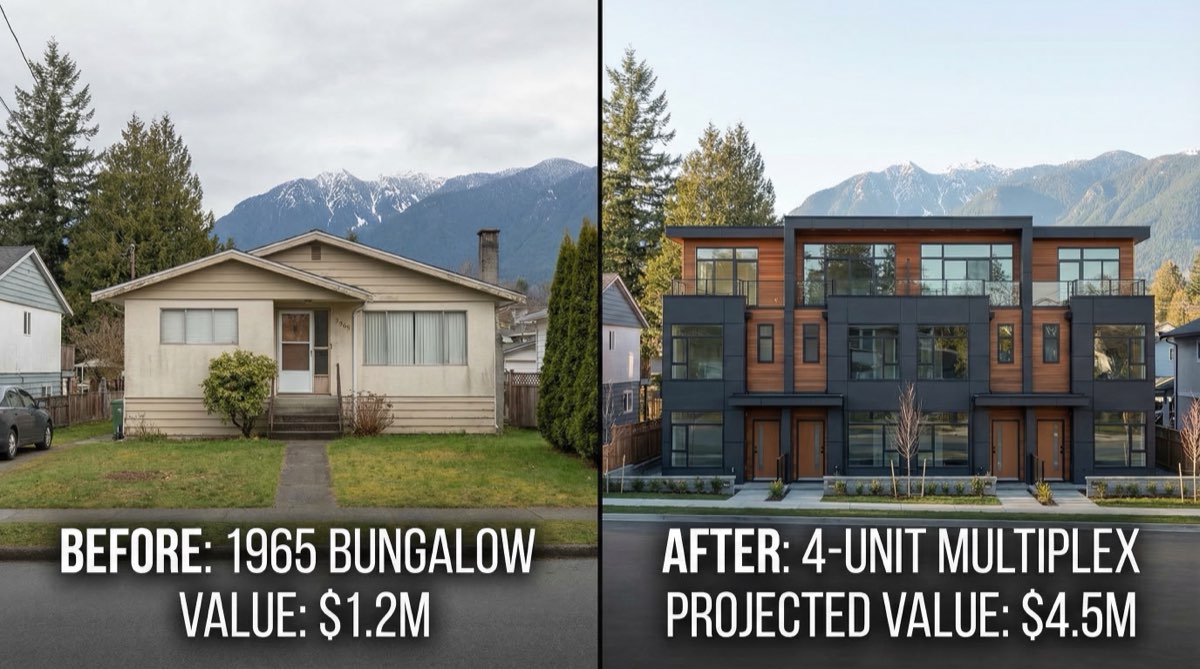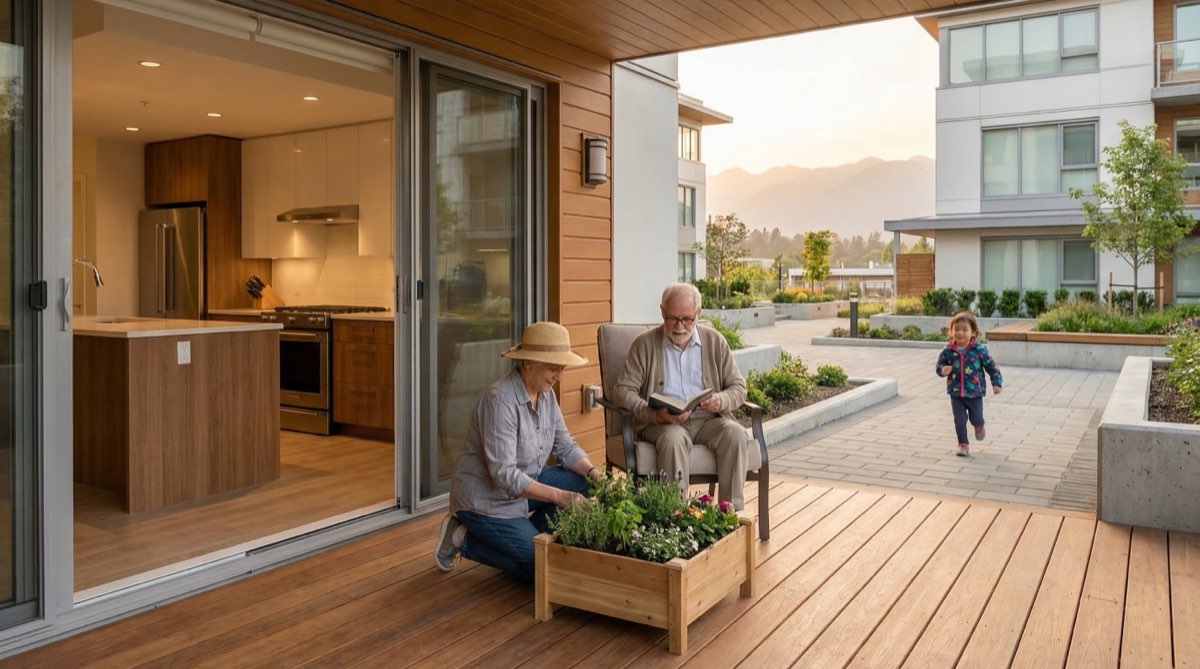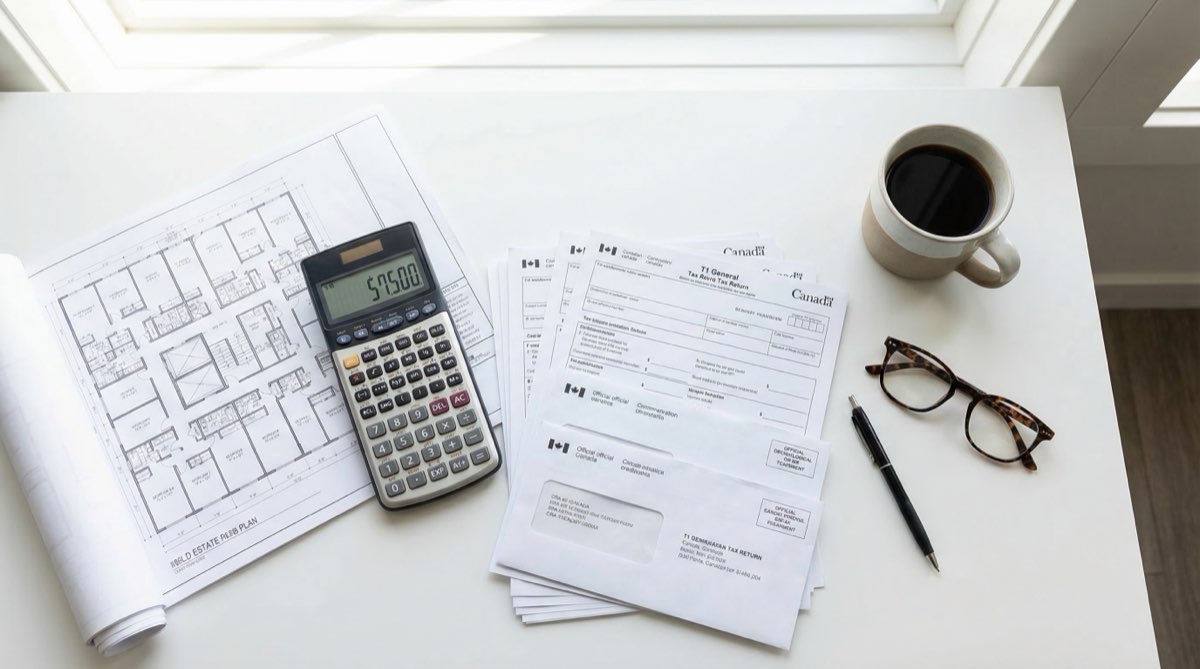
Canada’s Multigenerational Home Renovation Tax Credit (MHRTC) gives families up to $7,000 back for building a secondary dwelling unit for a senior aged 65+ or an adult with a disability. The credit is calculated at the lowest federal personal income tax rate (14% for 2026) on up to $50,000 in eligible construction or renovation costs, it’s fully refundable (you get it even if you owe no tax), and it applies directly to the kind of multigenerational multiplex that Bill 44 now permits on single-family lots across BC. Here’s exactly how to claim it, what qualifies, and how to stack it with other credits for maximum savings.
TL;DR (Key Takeaways)
- The MHRTC provides a refundable tax credit at the lowest federal rate (14% for 2026) on up to $50,000 of eligible costs = up to $7,000 back
- Qualifying relative must be a senior 65+ OR qualify for the Disability Tax Credit
- The secondary unit must have a private entrance, kitchen, bathroom, and sleeping area
- Bill 44 multiplex units meet all MHRTC requirements by default—separate entrance, kitchen, bathroom, bedroom
- Stack with BC’s Home Renovation Tax Credit for Seniors ($1,000/year) for combined $8,000 in year one
- Common mistakes: not keeping receipts, claiming ineligible costs, missing the 12-month residency requirement
- File on your T1 return for the tax year the renovation is completed
What the MHRTC actually is
The Multigenerational Home Renovation Tax Credit was introduced in the 2022 Federal Budget and became effective for the 2023 tax year. It’s a permanent, refundable tax credit—meaning it reduces your taxes owed, and if the credit exceeds your tax liability, the CRA sends you a cheque for the difference.
The formula is simple: the lowest federal personal income tax rate multiplied by eligible renovation expenditures, up to a maximum of $50,000 in expenditures. For 2026, that rate is 14%, yielding a maximum credit of $7,000. (The rate was 15% when the credit launched in 2023, and dropped to 14.5% for 2025 and 14% for 2026 onward following Bill C-4.)
This isn’t a deduction that reduces taxable income. It’s a direct credit against tax owed. A family in the 33% marginal bracket doesn’t get a percentage-of-income benefit from the $50,000—they get exactly $7,000 regardless of income level. The refundable nature makes it equally valuable whether you earn $50,000 or $500,000.
Who qualifies for the MHRTC
The CRA defines two categories of qualifying individuals:
The qualifying relation (who the unit is for):
- A senior aged 65+ by the end of the tax year, OR
- An adult aged 18+ who qualifies for the Disability Tax Credit (DTC)
The claimant (who claims the credit):
- The qualifying individual themselves, OR
- Their spouse or common-law partner, OR
- A qualifying relation: parent, grandparent, child, grandchild, sibling, aunt, uncle, niece, or nephew of the qualifying individual or their spouse
Key detail: The qualifying individual must ordinarily reside in the dwelling—or intend to within 12 months of completion. You can’t build a unit for a parent who plans to stay in another province.
What counts as a qualifying secondary dwelling unit
The CRA requires the secondary dwelling unit to be a “self-contained” living space. The four mandatory features are:
- Private entrance: A separate exterior door, or an interior entrance that can be secured (lockable door from the main dwelling)
- Kitchen: Cooking facilities including a sink, food preparation area, and a means of cooking (stove, cooktop, or oven)
- Bathroom: A toilet, sink, and either a shower or bathtub
- Sleeping area: A dedicated bedroom or sleeping space
A ground-floor unit in a new multiplex built under Bill 44 meets all four requirements by design. Every unit in a fourplex or sixplex has its own entrance, full kitchen, full bathroom, and bedrooms. The MHRTC and Bill 44 multiplexes align perfectly.
| MHRTC Requirement | Bill 44 Multiplex Unit | Meets Criteria? |
|---|---|---|
| Private entrance | Each unit has separate entrance | Yes |
| Kitchen facilities | Full kitchen per unit (standard) | Yes |
| Bathroom facilities | Full bathroom per unit (standard) | Yes |
| Sleeping area | Dedicated bedroom(s) per unit | Yes |
| Self-contained living | Independent unit by design | Yes |
| Occupancy by qualifying person | Parent/grandparent lives in unit | Yes (family decision) |
What costs are eligible—and what’s not
Eligible expenditures (per CRA MHRTC guidance)
- Construction materials: Lumber, concrete, drywall, insulation, roofing, windows, doors
- Electrical and plumbing: Wiring, fixtures, pipe, water heater for the unit
- Kitchen installation: Cabinets, countertops, sink, plumbing fixtures
- Bathroom fixtures: Toilet, bathtub/shower, vanity, grab bars
- Flooring: All flooring materials and installation
- Labour costs: Contractor fees, electrician, plumber, carpenter
- Permits: Building permit fees directly related to the secondary unit
- Architectural/design fees: Professional fees for designing the qualifying unit
Not eligible
- Furniture and appliances: Fridge, stove, washer/dryer, and other household appliances
- Landscaping: Exterior work not structurally part of the unit
- Routine maintenance: Painting, cleaning, general upkeep
- Financing costs: Mortgage interest, loan fees
- Land costs: The value of the lot itself
- Work done by the claimant: Your own labour has no eligible value
The receipt rule
Every dollar you claim must be supported by receipts. The CRA can request documentation at any time within the normal reassessment period (3-4 years). Keep:
- Contractor invoices with GST numbers
- Material purchase receipts
- Permit fee records
- Architectural/design contracts
- Photos documenting the work (dated)
Step-by-step claiming guide
Step one: Confirm eligibility (before construction begins)
Verify your qualifying relation meets the age or DTC requirement. Confirm they intend to reside in the completed unit. Document the relationship (this is straightforward—CRA may request proof of family relationship).
Step two: Track costs during construction
Create a dedicated folder (physical or digital) for all receipts related to the secondary unit. If you’re building a full multiplex, you’ll need to allocate costs specifically to the qualifying unit. A reasonable allocation method: divide total construction costs by number of units, then add any unit-specific costs (accessibility features, etc.).
Step three: Complete construction within the qualifying period
The renovation must be completed during the tax year you’re claiming. If construction spans two calendar years, you claim in the year of completion. The unit must be habitable—not just framed.
Step four: File on your T1 return
Claim the credit on Line 45355 of your T1 Income Tax and Benefit Return. Use Schedule 12 to calculate the amount. Include:
- Total eligible expenditures (up to $50,000)
- The calculated credit (lowest federal rate x eligible expenditures)
- Information about the qualifying individual
Step five: Keep records for 6 years
CRA requires you to retain supporting documents for 6 years from the date of filing. This includes all receipts, contracts, and proof of the qualifying individual’s residency.
Stacking credits for maximum benefit
The MHRTC is not the only credit available. BC residents building multigenerational housing can combine multiple programs:
| Credit/Program | Amount | Frequency | Stacks with MHRTC? |
|---|---|---|---|
| MHRTC (Federal) | Up to $7,000 (2026 rate) | One-time per qualifying renovation | N/A (this is the base) |
| BC HRTC for Seniors | Up to $1,000 | Annual | Yes |
| Home Accessibility Tax Credit (HATC) | 15% of up to $20,000 = $3,000 | Annual | Yes, for different expenses |
| GST New Housing Rebate | Up to $6,300 (federal); phases out above $350K | One-time on new construction | Yes |
Important: The MHRTC and HATC can both be claimed in the same year, but you cannot claim the same expenses under both credits. The MHRTC covers the secondary unit construction; the HATC covers accessibility modifications to existing parts of the home.
A realistic financial scenario
Consider a Vancouver family building a fourplex under Bill 44, with one ground-floor unit designated for aging parents (ages 68 and 71):
- Total fourplex construction cost: $1.8M
- Allocated cost of parent unit: ~$450,000
- MHRTC eligible costs (capped at $50,000): $50,000
- MHRTC credit: $7,000 (at 2026’s 14% rate)
- BC HRTC for Seniors (year one): $1,000
- HATC for accessibility features: Up to $3,000 (non-refundable—offsets tax owed only)
- Total first-year tax credits: Up to $11,000
Over 5 years, the ongoing BC HRTC adds another $4,000 (assuming $1,000/year for years 2-5), bringing cumulative credits to $15,000. Not enough to fund a build on its own—but a meaningful offset that improves the project’s overall returns.
Common mistakes to avoid
Mistake one: Not isolating costs for the qualifying unit. If you’re building a full multiplex, the CRA expects you to identify costs specific to the unit where the qualifying individual will reside. Keep a separate cost tracking sheet from day one.
Mistake two: Claiming appliance purchases. Appliances are generally not eligible under the MHRTC. Consult a tax professional for guidance on specific items.
Mistake three: Missing the completion deadline. If construction wraps up in January 2027, you claim on your 2027 return—not 2026. Plan your construction timeline accordingly.
Mistake four: Forgetting the residency requirement. The qualifying individual must live in the unit (or intend to within 12 months). Building a unit “just in case” without a specific qualifying resident may not meet CRA requirements.
Mistake five: Not consulting a tax professional. The MHRTC interacts with other credits and programs. A CPA familiar with real estate and family tax planning can often identify additional savings. The consultation fee ($300-500) typically pays for itself.
Why this matters more with Bill 44
Before Bill 44, building a secondary dwelling unit for a parent typically meant a laneway house or basement suite—limited in scope and often requiring variance approvals. The MHRTC existed, but the zoning barriers made it difficult to use.
Bill 44 changed the equation. A full multiplex with 4-6 independent units, each with its own entrance, kitchen, and bathroom, is now permitted as-of-right on single-family lots across BC. Every unit in that multiplex is a potential MHRTC-qualifying secondary dwelling.
The policy alignment is deliberate: the federal government incentivizes multigenerational housing through the tax code, and the provincial government removes the zoning barriers that prevented families from acting on it.
Check your property’s eligibility
The first step is knowing what your lot allows. Visit VanPlex.ca and enter your address. You’ll see your property’s PlexRank score, the number of units your lot supports under Bill 44, and a preliminary proforma showing development costs and projected values. From there, you can plan a build that houses your family, generates rental income, and captures every available tax credit. The zoning is ready. The tax incentives are waiting. Your family’s future is the only missing piece.
VanPlex Team
PlexRank(TM) | Profit with Multiplex