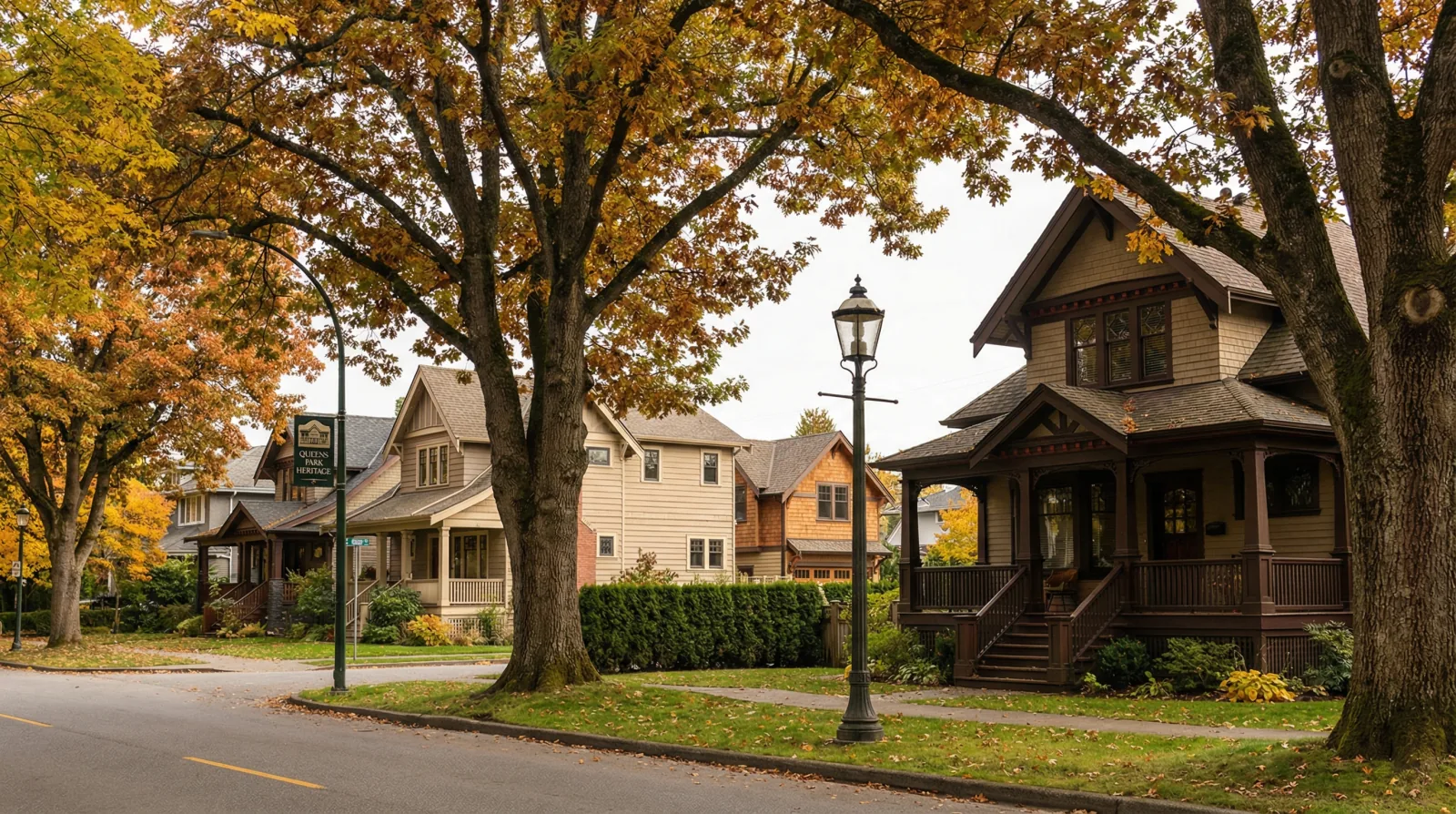

Queens Park in New Westminster is British Columbia’s largest formal Heritage Conservation Area. More than 300 protected homes spread across tree-lined streets that look almost exactly as they did a century ago. The conservation area designation means demolition is essentially off the table — you cannot tear down a contributing heritage home in Queens Park without extraordinary justification.
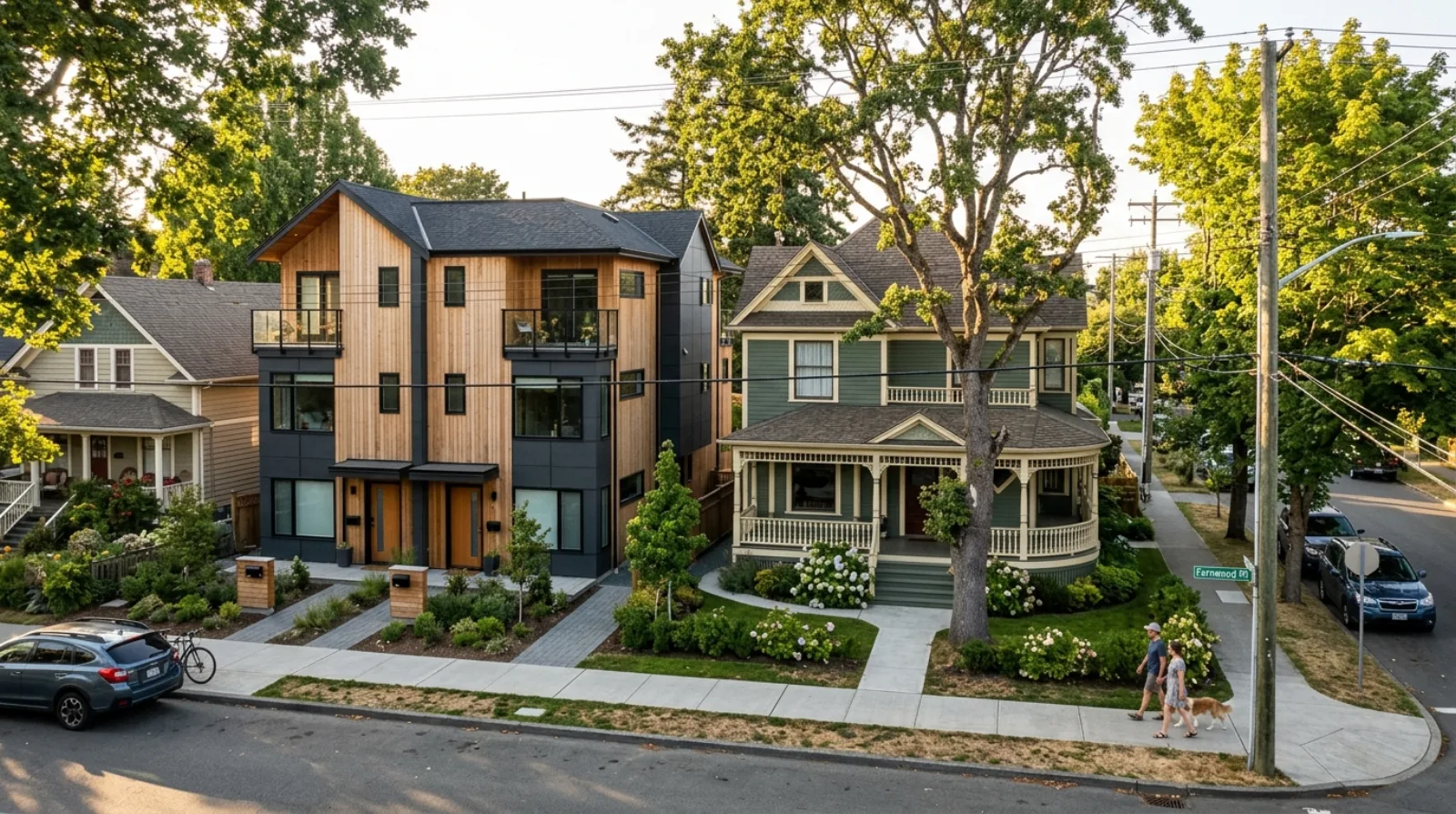
But heritage does not mean frozen. The City of New Westminster is actively encouraging sensitive infill development behind retained heritage homes. Carriage houses, garden suites, and laneway-style units are all permitted, and Heritage Revitalization Agreements can unlock even more.
What Makes Queens Park Different
Queens Park earned its Heritage Conservation Area designation in 2017 after years of community advocacy. The HCA covers roughly 100 blocks bounded by Royal Avenue, Sixth Avenue, First Street, and Eighth Street. Every property within the boundary is classified as either “protected” (contributing to heritage character) or “non-contributing.”
For protected properties — the vast majority — demolition requires a Heritage Alteration Permit that is almost never granted. The exterior character of these homes is permanently preserved. Interior renovations are unrestricted, but the streetscape remains intact.
This is fundamentally different from Vancouver’s approach, where heritage protection is voluntary and incentive-based. In Queens Park, it is mandatory. The conservation area is the law, not a negotiation.
The Infill Opportunity
What most people miss about Queens Park is that the restriction on demolition creates a clear path for infill. You cannot tear down the heritage home, but you can build behind it.
Permitted infill types in Queens Park:
- Carriage houses — Detached units at the rear of the lot, typically 600 to 900 square feet
- Garden suites — Ground-level accessory dwelling units designed to complement the heritage home
- Laneway units — Where lane access exists, smaller units oriented to the rear lane
- Secondary suites — Within the heritage home itself, subject to heritage guidelines
The infill must be architecturally subordinate to the heritage home. That means smaller in scale, simpler in detailing, and clearly distinguished as a secondary structure. You cannot build a three-storey modern box behind an 1890s Queen Anne. The city’s design guidelines are specific and enforced.
For homeowners willing to work within these constraints, the opportunity is real. A carriage house on a Queens Park lot can generate $2,000 to $2,800 per month in rental income while preserving the heritage home that anchors the property’s value.
HRAs in Queens Park vs. Vancouver
Heritage Revitalization Agreements work differently in Queens Park than in Vancouver. In Vancouver, the HRA is the mechanism that triggers heritage protection — the owner voluntarily accepts a covenant in exchange for density. In Queens Park, the heritage protection already exists through the HCA designation. The HRA provides additional density beyond what the infill guidelines already permit.
A Queens Park HRA might allow a larger carriage house than the base guidelines permit, or enable an additional unit that standard zoning would not allow. The negotiation is with the city’s heritage planning department, and the density bonus must be justified by the heritage protection and restoration work being undertaken.
The practical difference: Vancouver HRAs typically grant 0.20 to 0.25 FSR bonus. Queens Park HRAs tend to be more modest because the baseline infill permissions are already relatively generous. But the stacking effect — base infill plus HRA bonus — can produce meaningful total density on larger lots.
The Design Challenge
Building in Queens Park requires an architect or designer who understands heritage context. The Heritage Conservation Area design guidelines specify:
Materials — New construction should use materials compatible with the heritage context. Cementitious siding, wood trim, and traditional roofing materials are preferred. Large expanses of glass, metal cladding, and flat roofs are discouraged.
Scale — Infill structures must be clearly subordinate. Maximum height is typically lower than the heritage home. Floor area is capped relative to the principal dwelling.
Siting — New structures are pushed to the rear of the lot to minimize visual impact from the street. The heritage home remains the dominant element on the property.
Landscaping — Mature trees are protected. New construction must work around existing canopy, which can constrain building footprints.
These requirements add cost. Expect 10 to 20 percent premium over standard construction for heritage-compatible design and materials. A carriage house that might cost $350,000 to $450,000 in a standard zone will run $385,000 to $540,000 in Queens Park.
Timeline and Cost Expectations
A typical Queens Park infill project runs 12 to 18 months from initial design to occupancy:
- Heritage assessment and design: 2 to 4 months
- Heritage Alteration Permit: 2 to 3 months (faster than a Vancouver HRA)
- Building permit: 2 to 4 months
- Construction: 6 to 8 months for a carriage house
Total project cost for a carriage house: $350,000 to $540,000 including design, permits, and construction. For an HRA-enabled larger infill: $450,000 to $700,000 depending on scope.
The return profile is attractive for patient capital. Queens Park properties command premium values precisely because the HCA prevents the demolition-driven development that erodes neighbourhood character elsewhere. Your heritage home appreciates. Your infill unit generates income. The combination outperforms a standard lot in most 10-year scenarios.
Who Should Explore Queens Park Infill?
If you already own a heritage home in Queens Park and have underutilized rear-yard space, the infill opportunity is available today. The permitting process is well-established, the design guidelines are clear, and the city is supportive.
If you are considering purchasing in Queens Park, factor the infill potential into your acquisition analysis. A heritage home with a buildable rear yard is worth more than a heritage home on a fully developed lot — even though both carry the same heritage restrictions.
For detailed neighbourhood analysis and heritage data, see our New Westminster Heritage Multiplex Guide. For the broader context on character home retention strategies, explore our Character Home Retention Guide.
Queens Park proves that heritage conservation and housing supply are not in conflict. The 300+ protected homes are not obstacles to density. They are the foundation on which sensitive, community-supported infill is being built.