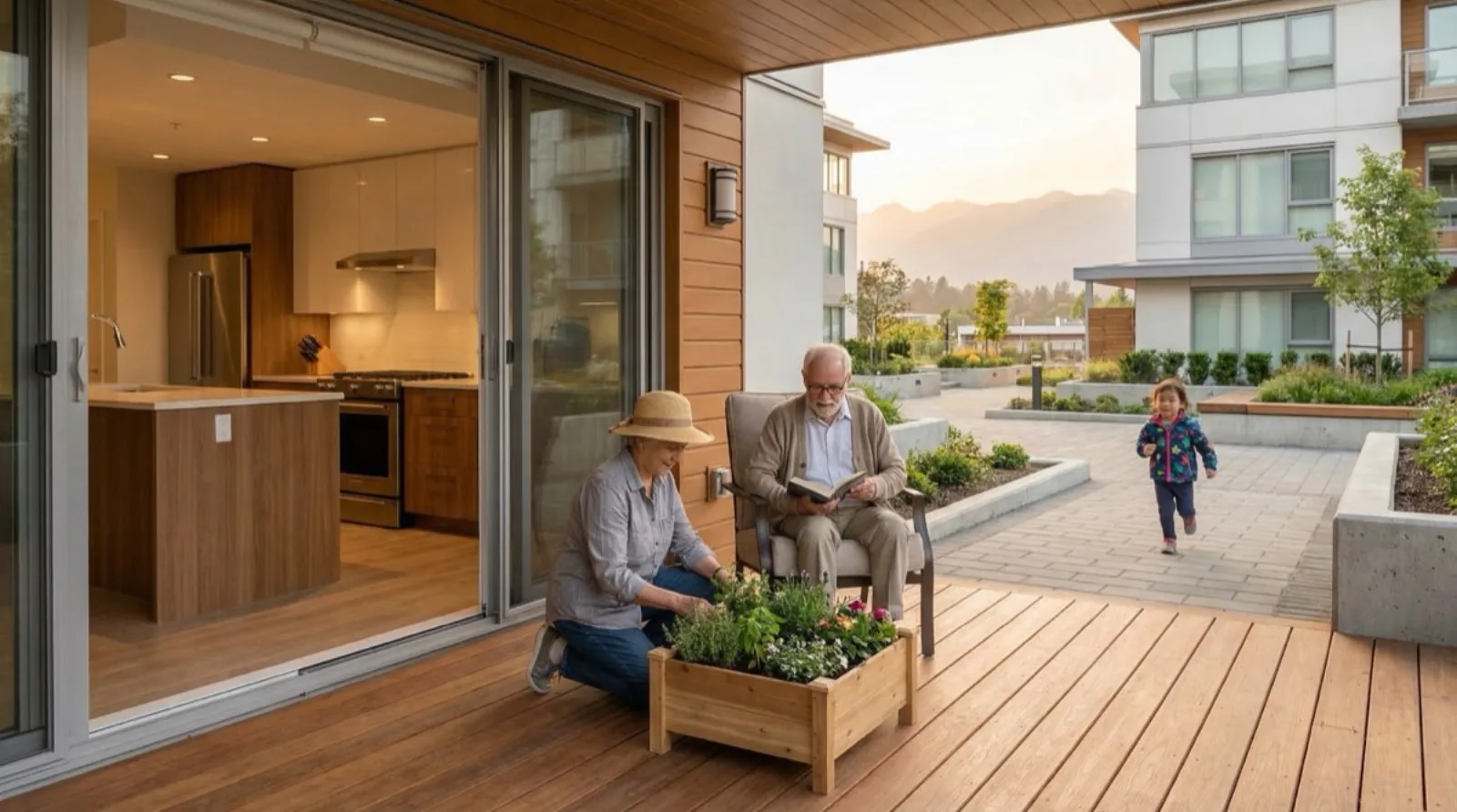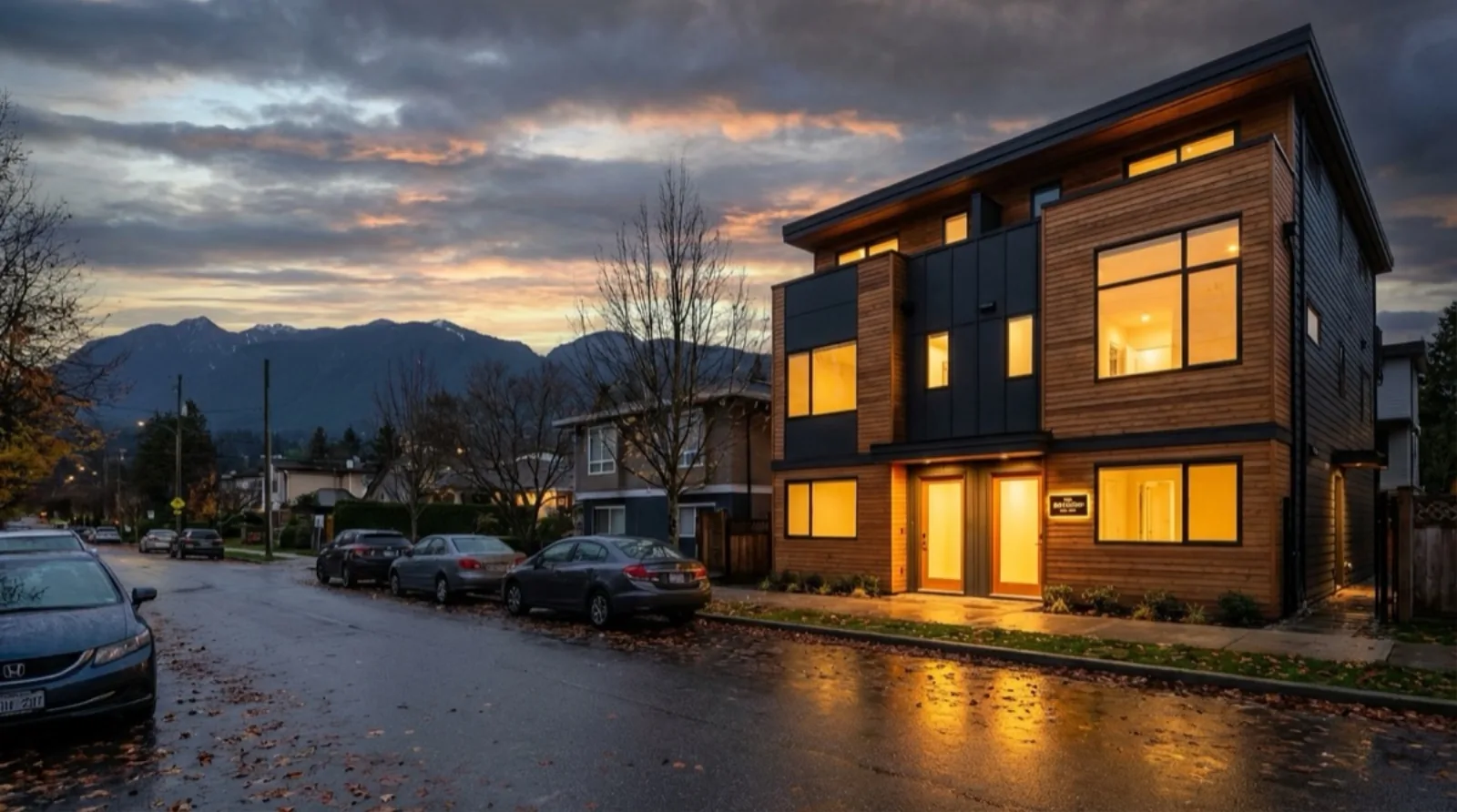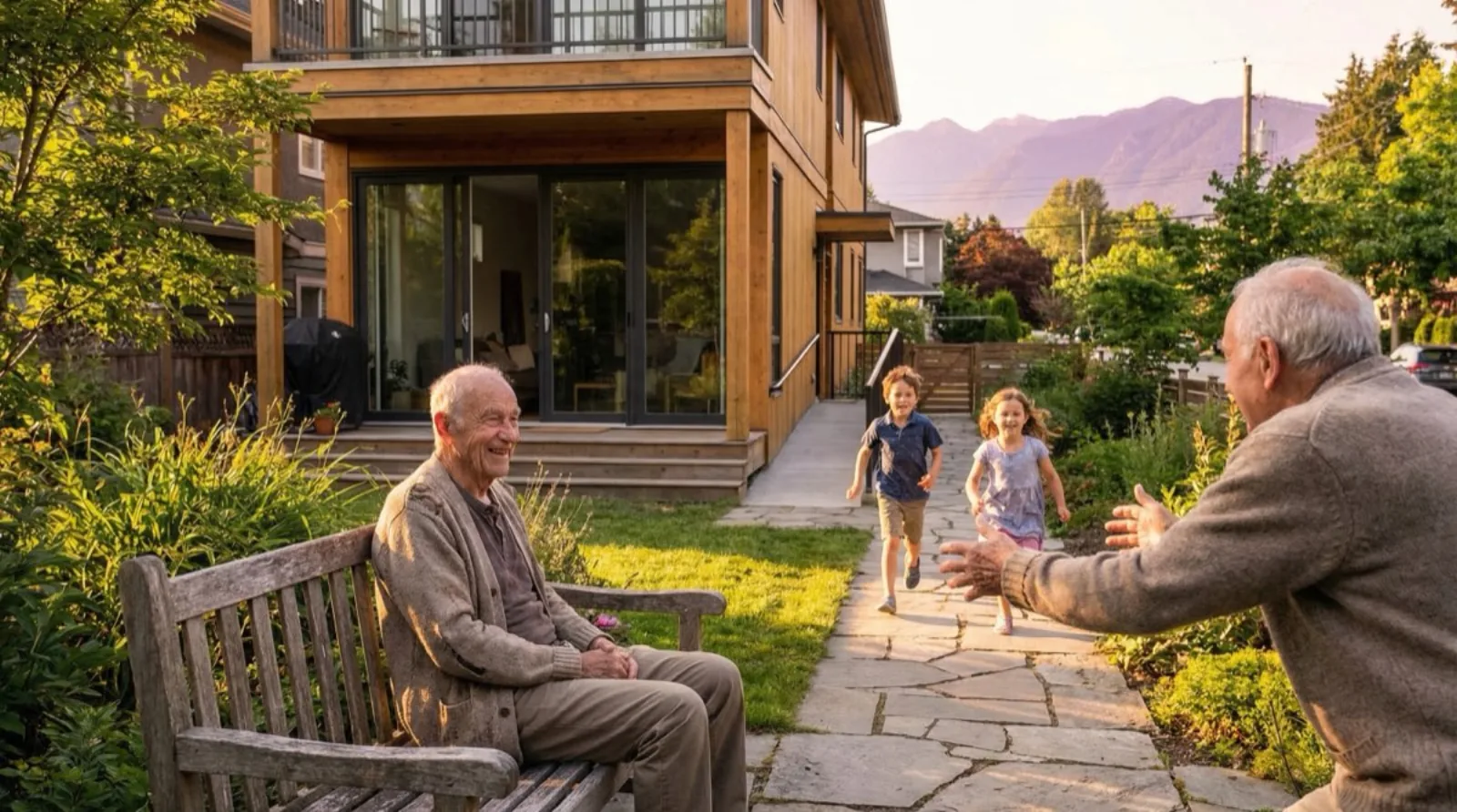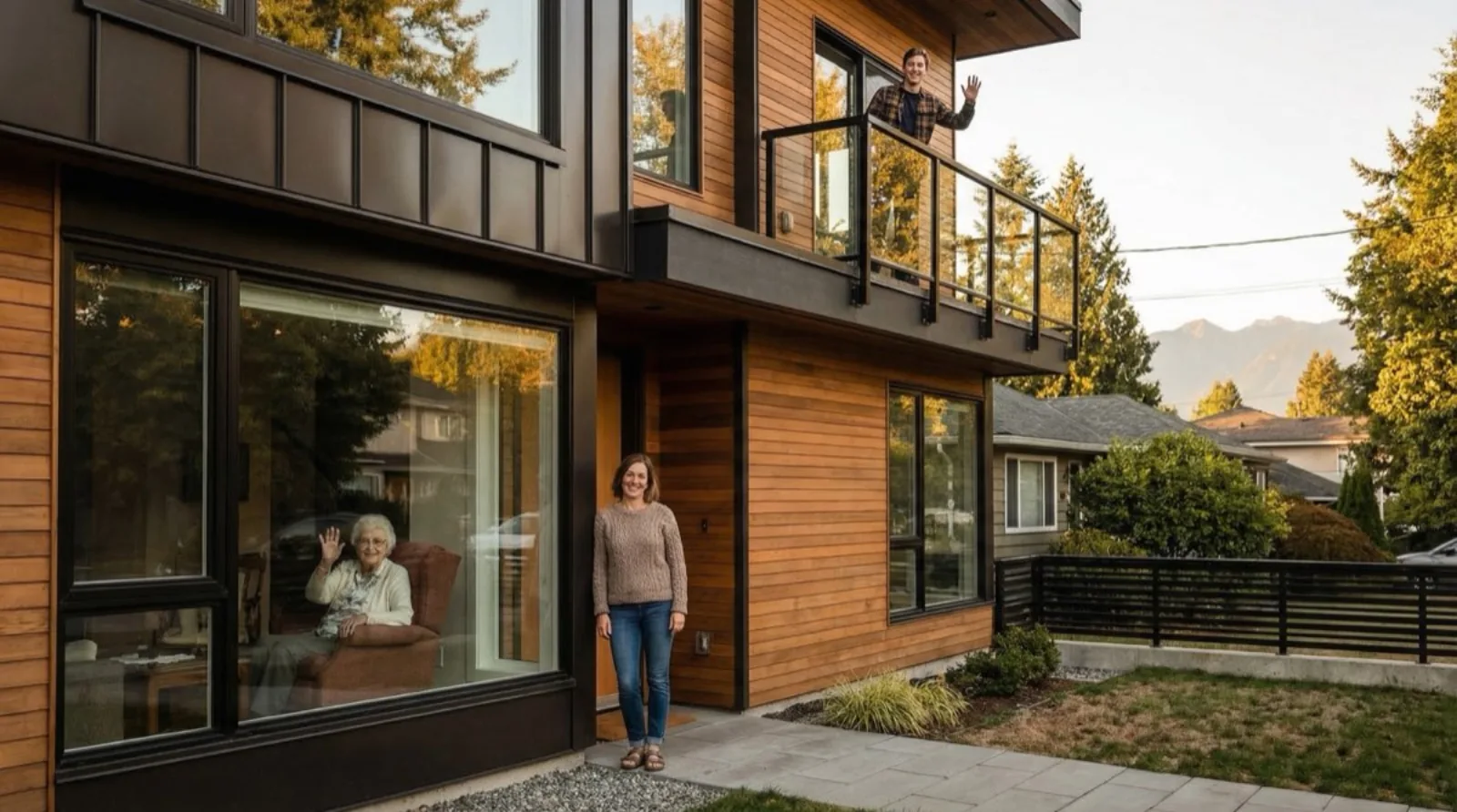

If you are between 40 and 55, caring for aging parents while financially supporting adult children who cannot afford Vancouver housing, you are the sandwich generation—and a multiplex might be your exit plan. The multigenerational living guide explains how families are using one property to solve both directions of this squeeze. Twenty-eight percent of Canadians aged 35-64 provide care to a senior family member (Statistics Canada General Social Survey, 2022). The average caregiver spends $7,600 per year out of pocket on care-related expenses. Meanwhile, 35% of Canadians aged 25-34 still live with their parents (Statistics Canada Census, 2021). One property can solve both problems simultaneously.
The Squeeze from Both Sides
The sandwich generation is not a metaphor. It is a financial and emotional compression that affects 3.8 million Canadian households (Vanier Institute of the Family, 2024). Here is what it looks like in Metro Vancouver in 2026:
Upward pressure (aging parents):
- Private care home: $6,500-$8,000/month in BC (BC Care Providers Association, 2025)
- Home care aide: $28-$35/hour, 20 hours/week = $2,400-$3,000/month
- Lost income from caregiving: average $11,500/year in reduced earnings (Stats Canada, 2023)
- Emotional toll: 46% of family caregivers report high levels of distress (CIHI, 2024)
Downward pressure (adult children):
- Average Vancouver one-bedroom rent: $2,872/month (CMHC Rental Market Report, October 2025)
- Median household income for ages 25-34 in Vancouver: $62,000/year (Stats Canada, 2024)
- Rent-to-income ratio at median: 55%—far above the 30% affordability threshold
- Average age of first home purchase in Vancouver: 36 years (CMHC, 2025)
You are paying for your parents’ care. Your children cannot afford to leave. Your own retirement savings are being consumed from both ends. This is the trap.
Why the Standard Solutions Fail
Most families cycle through the same inadequate options:
Option A: Move Parents into Your Home
- Loss of independence for everyone
- Renovation costs ($80K-$150K for accessible basement suite)
- Zoning restrictions on secondary suites in many municipalities
- No equity creation—just cost absorption
- Relationship strain from shared living spaces
Option B: Help Children with Down Payment
- Average Vancouver condo: $750K (REBGV, February 2026)
- 20% down payment gift: $150,000
- Depletes retirement savings
- Does not solve the parent care problem
- Children still carrying $600K mortgage at 5.2% = $3,560/month
Option C: Do Nothing and Hope
- Parents’ health deteriorates; emergency decisions follow
- Children’s resentment builds as independence remains out of reach
- Caregiver burnout accelerates (average duration of family caregiving: 4.3 years, CIHI)
- Family wealth erodes through rent payments and care costs
None of these paths create value. They all consume it. The multiplex path is different because it converts a single depreciating asset into multiple appreciating ones.
The Multiplex Exit Plan
Here is the framework. You already own the most valuable component: the land.
The Configuration
A typical sandwich generation multiplex on a 5,500+ sf Vancouver lot:
| Unit | Occupant | Size | Features |
|---|---|---|---|
| Ground floor A | Aging parent(s) | 900-1,100 sf | Accessible, zero-step entry, emergency systems |
| Ground floor B | Rental or sale | 750-850 sf | Market-rate, funds the build |
| Upper floor A | You (middle generation) | 1,200-1,400 sf | Family-sized, primary residence |
| Upper floor B | Adult child | 750-850 sf | Starter unit, independent living |
This configuration solves three problems with one building permit.
The Financial Engine
Using a composite scenario based on VanPlex analysis of 86,000+ Vancouver properties:
| Component | Amount |
|---|---|
| Current home value | $2,200,000 |
| Development cost (4,200 sf at $425/sf + soft costs) | $2,050,000 |
| End value (4-unit multiplex) | $5,200,000 |
| Equity created | $950,000 |
| Annual savings captured: | |
| Eliminated care home cost | $78,000-$96,000/year |
| Eliminated adult child rent | $34,000-$42,000/year |
| Rental income (if one unit rented) | $30,000-$36,000/year |
| Total annual financial impact | $142,000-$174,000/year |
Over a decade, that is $1.4M to $1.7M in avoided costs and captured income—independent of property appreciation.
The Emotional Math
The financial case is compelling. The emotional case is transformative.
Before the multiplex:
- You drive 45 minutes each way to check on Mom three times a week
- Your 27-year-old is sleeping in the room they had at age 12
- Sunday dinner requires coordinating three households across Metro Vancouver
- You lie awake wondering how to fund care and housing simultaneously
- You feel guilty in every direction
After the multiplex:
- Mom is 30 seconds away in an accessible ground-floor unit with her own entrance
- Your adult child has a real home—separate entrance, separate kitchen, full independence
- Sunday dinner is a walk downstairs
- Your housing costs are offset by rental income from the fourth unit
- You stopped choosing. You solved.
What Caregivers Report After Multigenerational Builds
Research from CMHC’s multigenerational housing study (2024) found:
- 78% reduction in caregiver stress when elder lives in adjacent (not shared) housing
- 92% of seniors report higher satisfaction in family-adjacent vs institutional settings
- 3.2x more social interaction for seniors in multigenerational builds vs independent living
- $0 transportation cost for daily care check-ins (vs $3,200-$4,800/year driving to a facility)
Proximity without cohabitation is the design principle that makes this work. Separate entrances. Separate kitchens. Shared backyard. Close enough to help, far enough to breathe.
How to Structure It When Three Generations Contribute
The financing is more creative than a standard purchase because multiple generations bring different assets to the table:
| Generation | Contribution | Value |
|---|---|---|
| Parents (70s) | Land equity | $2,200,000 |
| You (40s-50s) | Construction mortgage qualification | $2,050,000 borrowing capacity |
| Adult children (20s-30s) | Sweat equity, future rent savings | $30,000-$50,000 equivalent |
The Ownership Conversation
This is where families need professional guidance. Common structures include:
- Parents retain land ownership; you hold building as tenants-in-common (simplest, preserves estate planning flexibility)
- Family trust holds entire property (best for multi-sibling families, requires legal setup at $5,000-$8,000)
- Strata subdivision (each unit gets separate title, maximizes independence but adds $40K-$60K in strata costs)
Every structure has tax implications. The principal residence exemption applies differently depending on ownership configuration (consult a CPA specializing in real estate before committing).
The Timeline and Decision Points
| Phase | Duration | Key Decision |
|---|---|---|
| Family alignment | 1-2 months | Who lives where? Who owns what? |
| Property feasibility (VanPlex analysis) | 1 week | Does the lot support 4 units? |
| Architectural design | 2-3 months | Unit sizes, accessibility features, parking |
| Permit application | 1 month | Submit to City of Vancouver |
| Permit approval | 4-6 months | Average 6.2 months in Q4 2025 |
| Construction | 10-12 months | General contractor manages build |
| Move-in | 2-4 weeks | Coordinated family transition |
| Total | 18-24 months |
The critical first step is family alignment. The second step is lot feasibility. Everything else follows from those two conversations.
Who This Works For (and Who It Does Not)
Strong Candidates
- Homeowners aged 40-55 with aging parents and adult children
- Families with a paid-off or low-mortgage home on a 5,000+ sf lot
- Situations where care home costs are looming within 2-3 years
- Adult children earning income but unable to save for a down payment
- Families with cultural traditions of multigenerational proximity
Proceed with Caution
- Families with unresolved financial disputes or inheritance conflicts
- Lots under 5,000 sf (limited to 2-3 units, may not pencil out)
- Parents requiring full-time medical care (a multiplex unit is not a care facility)
- Adult children likely to relocate within 3-5 years
- Any family member fundamentally opposed to the project
Your First Step
You do not have to choose between your parents and your children. Bill 44 created a third option that did not exist five years ago: build a property that houses all three generations, creates wealth instead of consuming it, and keeps your family together on their own terms. The for homeowners guide walks through the decision points in plain terms. Use the advanced proforma calculator to see the projected numbers for your specific lot before engaging any professionals.
Visit vanplex.ca to check whether your lot qualifies. Enter your address and see your property’s PlexRank score, estimated development cost, and projected end value. If the numbers work, VanPlex connects you with architects, builders, and financing partners who specialize in multigenerational multiplex design.
The sandwich generation has an exit. It starts with your lot.
VanPlex Team
PlexRank™ | Profit with Multiplex