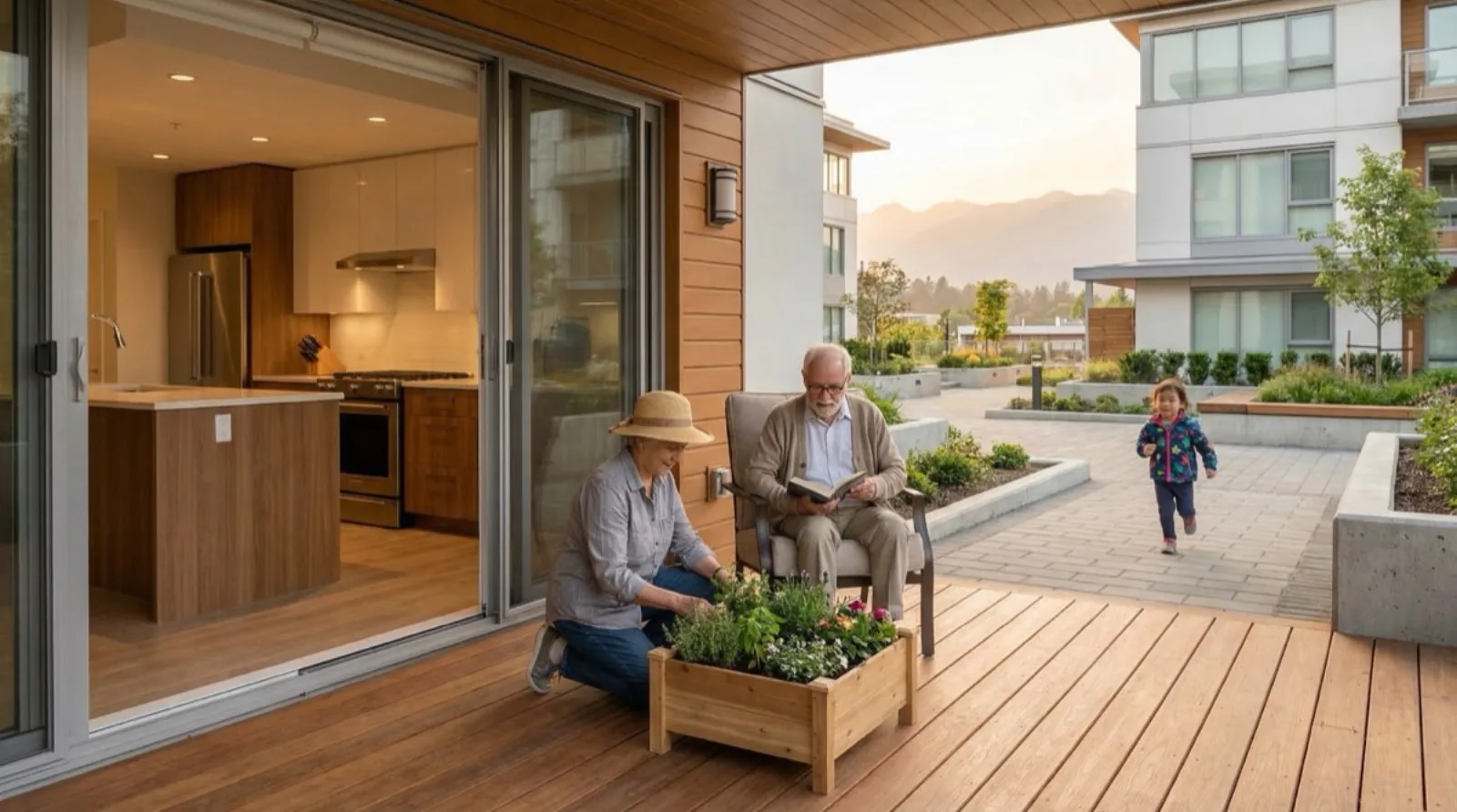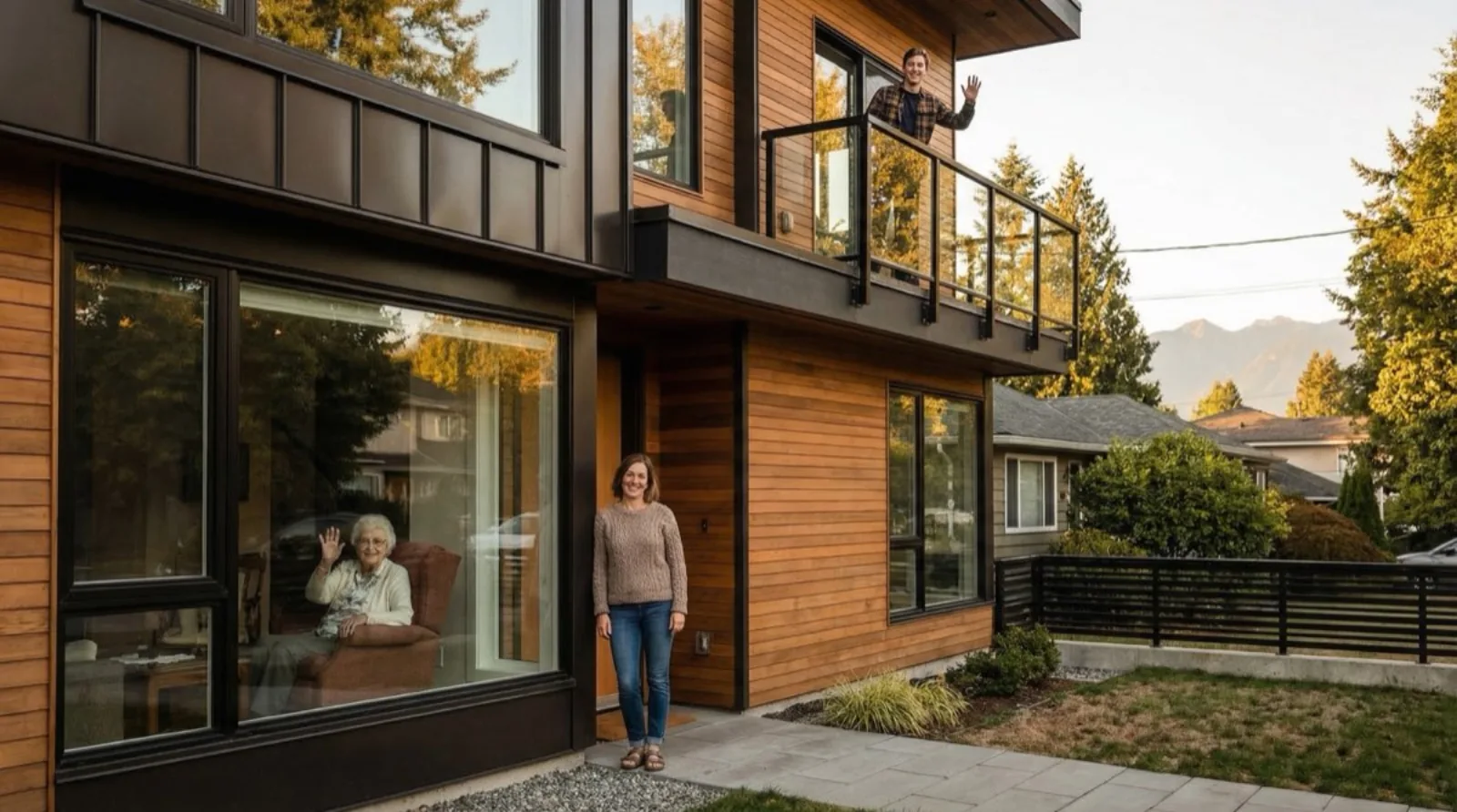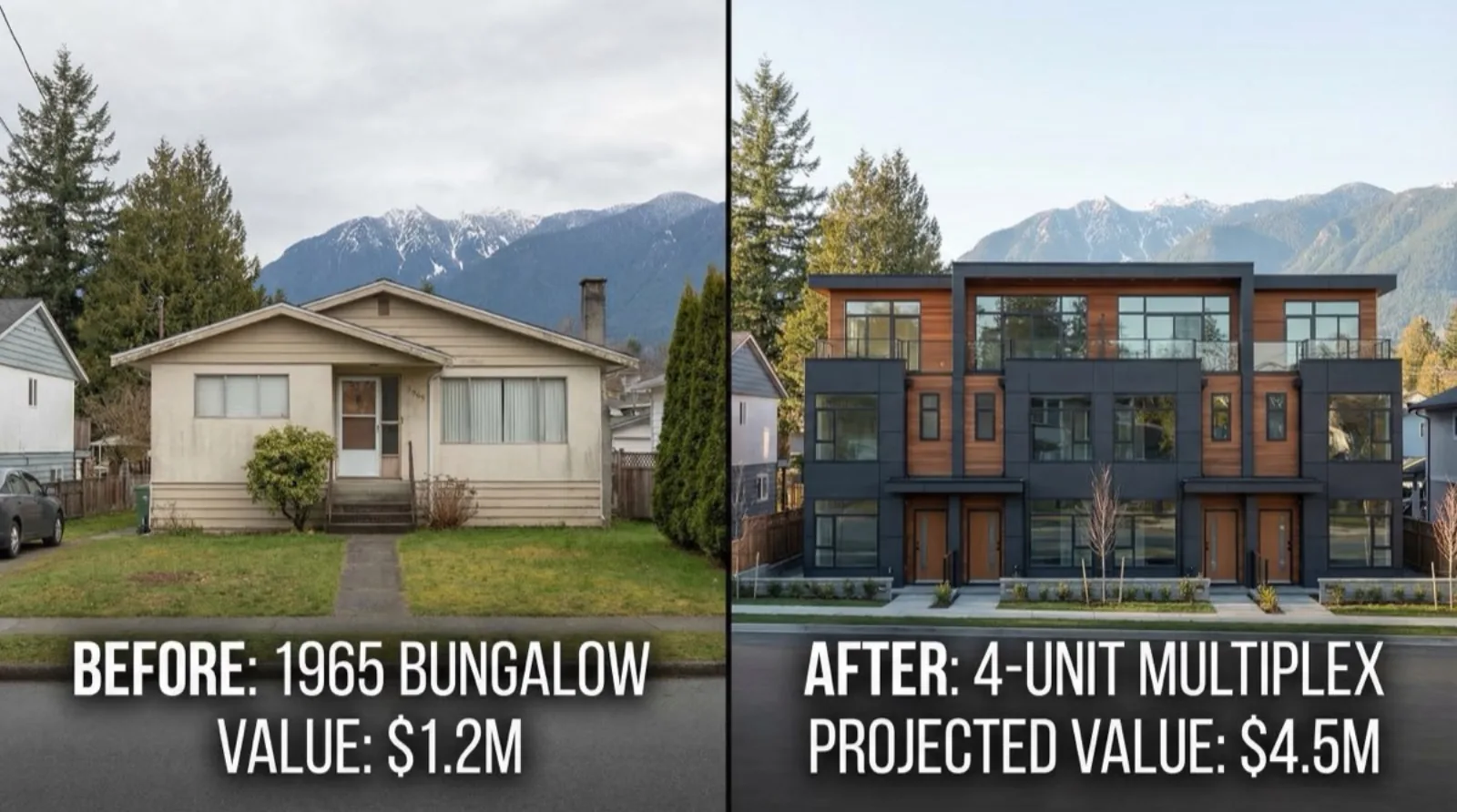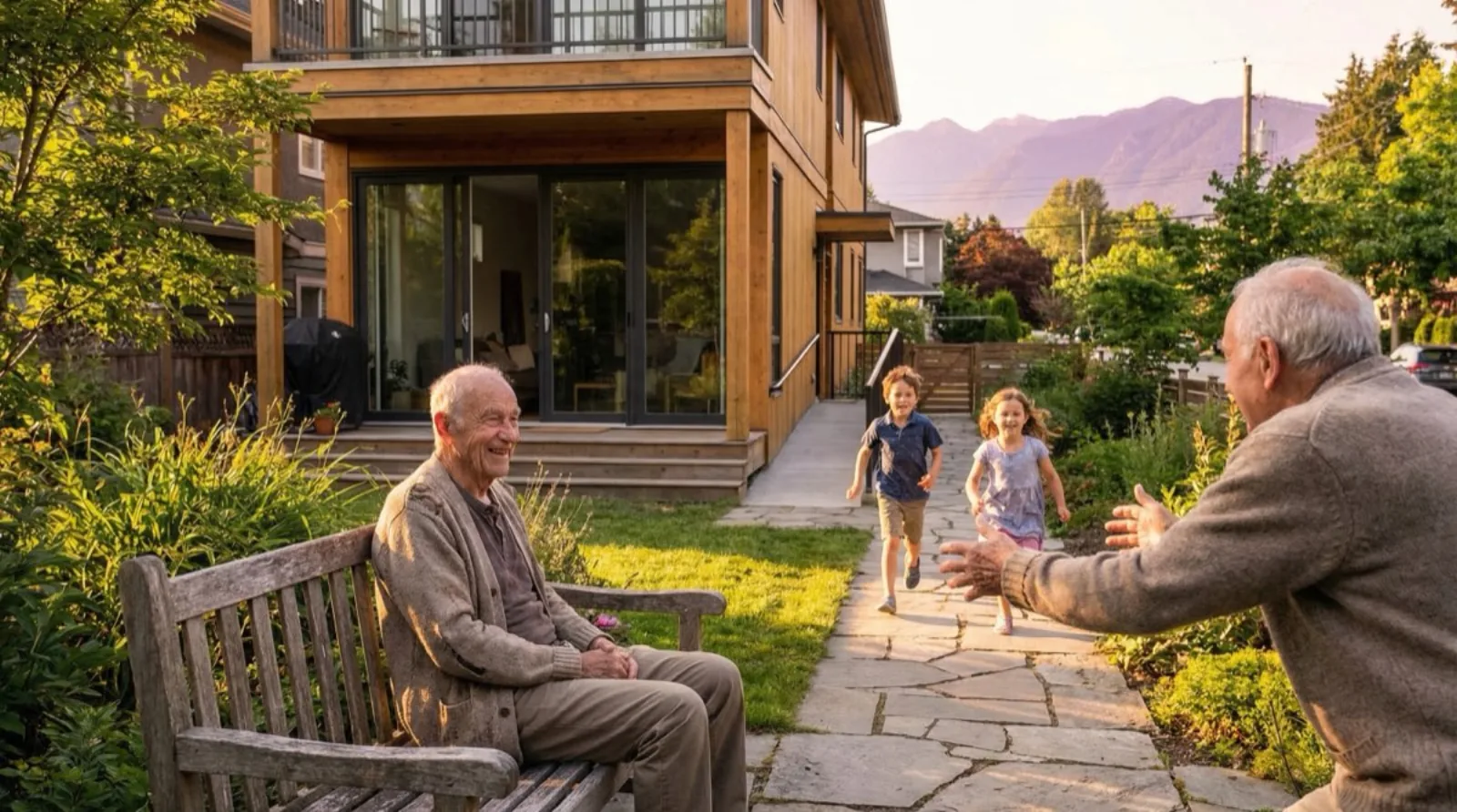

When a Vancouver family faced putting their 78-year-old father into a private care home at $7,200/month, they discovered a better option: building him an accessible ground-floor unit on the family lot under Bill 44. The multigenerational living guide walks through how families structure this kind of project from a financial and design standpoint. The result was $0/month housing costs, grandkids 30 seconds away, and over $2M in new equity. This is the story of how one family turned a heartbreaking decision into a generational wealth event.
The Decision No Family Wants to Make
Every year, roughly 35,000 BC families face the same conversation. Dad is slowing down. The stairs are getting dangerous. The house is too big. The doctor suggests “exploring options.” The options, it turns out, are brutal.
Private residential care in British Columbia costs between $6,500 and $8,000 per month as of early 2026 (BC Care Providers Association). Subsidized beds are cheaper but nearly impossible to access: the BC Office of the Seniors Advocate reported in 2025 that average waitlists run 5 to 10 months, with some regions exceeding 14 months. During that wait, families cobble together home care at $28-$35/hour (WorkSafeBC rate data, 2025), burning through savings while watching their parent’s independence erode.
For the Lawson family in East Vancouver, the math was devastating. George, 78, had suffered a fall in late 2024. His two-storey Kensington-Cedar Cottage home—owned for 41 years—was no longer safe. His daughter Karen, 52, and son James, 48, began touring care facilities in early 2025.
What the Care Home Numbers Actually Look Like
The family gathered quotes from five facilities within a 30-minute drive:
| Facility Type | Monthly Cost | Annual Cost | Waitlist |
|---|---|---|---|
| Private residential care (semi-private) | $6,500 | $78,000 | 3-6 months |
| Private residential care (private room) | $8,000 | $96,000 | 6-10 months |
| Subsidized complex care | $1,200-$3,600 | $14,400-$43,200 | 10-14 months |
| Home care (20 hrs/week) | $2,800 | $33,600 | Immediate |
George’s pension and CPP totaled $2,400/month. Even the subsidized option would consume his entire income. The private option would require the family to subsidize $4,100-$5,600/month—indefinitely.
Then Karen’s husband, a contractor, asked a question that changed everything: “What if we built Dad his own place?”
The Bill 44 Discovery
Under BC’s Bill 44, fully implemented in Vancouver as of June 2024, George’s 5,800 square foot R1-1 lot qualified for up to four units. The family engaged an architect specializing in accessible multiplex design and mapped out a scenario:
- Unit 1 (Ground floor, 950 sf): George’s accessible suite—zero-step entry, roll-in shower, 36-inch doorways, lever handles throughout, emergency pull cords
- Unit 2 (Ground floor, 750 sf): Rental unit
- Unit 3 (Upper, 1,200 sf): Karen and family
- Unit 4 (Upper, 1,100 sf): James or rental/sale unit
Aging-in-Place Design Principles Applied
The architect incorporated BC Building Code accessible design standards and CMHC’s FlexHousing guidelines:
- Zero-threshold entries on ground floor (no steps from grade to door)
- Reinforced bathroom walls for future grab bar installation
- Kitchen with adjustable-height counters and pull-out shelving
- Wider hallways (minimum 42 inches vs standard 36)
- Ground-floor laundry with front-loading machines
- Emergency response system wiring throughout
- Non-slip flooring and high-contrast finish selections
Total additional cost for accessibility features: approximately $18,000-$25,000—a fraction of a single year’s care home fees.
The Full Financial Picture
The family ran the proforma with VanPlex’s analysis tools:
| Line Item | Amount |
|---|---|
| Existing home value (2025 assessment) | $1,950,000 |
| Demolition | $35,000 |
| Hard construction costs (4,000 sf at $425/sf) | $1,700,000 |
| Soft costs (design, permits, engineering) | $165,000 |
| Accessibility upgrades | $22,000 |
| Contingency (10%) | $192,200 |
| Total development budget | $2,114,200 |
| End value (4-unit multiplex, 2026 comps) | $4,200,000 |
| Net equity created | $2,085,800 |
How the Family Funded It
The Lawsons used a common multigenerational financing structure:
- George’s contribution: Land equity ($1,950,000)
- Construction financing: $1.8M construction mortgage (secured against land)
- Sale of Unit 4: $1,150,000 (repaid construction mortgage)
- Remaining mortgage: $650,000 (carried by Karen’s household)
- Rental income (Unit 2): $2,800/month ($33,600/year) offsets mortgage entirely
Net monthly housing cost for the entire family: effectively $0 after rental income offset.
The Before and After
| Factor | Before (Care Home Path) | After (Multiplex Path) |
|---|---|---|
| George’s monthly cost | $7,200 (facility) | $0 (owns unit) |
| George’s proximity to family | 25-minute drive | 30 seconds (same building) |
| Karen’s housing cost | $3,400/month rent | $0 (offset by rental income) |
| Family equity | $1,950,000 (aging home) | $4,200,000 (new multiplex) |
| George’s independence | Institutional schedule | Complete autonomy |
| Grandchildren access | Scheduled visits | Daily, spontaneous |
| Annual family savings | -$86,400 (care costs) | +$33,600 (rental income) |
The swing is $120,000 per year. Over a decade, that is $1.2 million in avoided costs and captured income—before accounting for property appreciation.
What George Says Now
Eighteen months after move-in, George tends a small garden plot behind the building. His grandchildren, ages 9 and 12, stop by after school most days. He cooks dinner for the family twice a week—in his own kitchen, on his own schedule.
“They were going to put me somewhere with 80 strangers,” George told a family friend. “Instead, I hear my grandkids laughing through the wall. I have my own front door. I am home.”
The family avoided an institutional solution that would have cost $86,400 per year, created $2.1M in new equity, and solved three generations’ housing needs with a single project.
The Bigger Picture: Why This Matters for BC Families
George’s story is not unique. The numbers driving families toward this solution are structural:
- Aging population: 23% of BC residents will be over 65 by 2030 (BC Stats, 2024 projection)
- Care home capacity shortfall: BC needs 17,000 new long-term care beds by 2035 (BC Seniors Advocate, 2025)
- Family preference: 92% of Canadian seniors prefer to age near family rather than in institutional care (CIHI, 2024)
- Multigenerational growth: Canadian multigenerational households increased 45% between 2001 and 2021 (CMHC, Census analysis)
- Bill 44 applications: 518 multiplex applications filed in Vancouver as of early 2026 (City of Vancouver Open Data)
The policy infrastructure exists. The financing structures exist. The construction methods exist. What most families lack is awareness that this path is available to them.
Is This Path Right for Your Family?
Not every family situation matches the Lawson scenario. The approach works best when:
- The existing lot is 5,000+ square feet in an R1-1 or equivalent zone
- At least one family member can manage (or hire management for) a construction project
- The aging parent is currently independent or semi-independent
- Family relationships support close-proximity living with separate spaces
- The family can access construction financing against existing land equity
Your Next Step
If your family is facing the care home conversation, run the numbers before making a decision you cannot reverse. The for homeowners guide outlines the process in plain terms. Visit vanplex.ca to check your Vancouver property’s eligibility under Bill 44, see what a multigenerational multiplex looks like on your specific lot, and connect with architects who specialize in accessible aging-in-place design.
The care home is not the only option. For many Vancouver families, it is not even the best one.
VanPlex Team
PlexRank™ | Profit with Multiplex