
Start Here | HRA Guide
Heritage Revitalization Agreements: The Most Powerful Tool for Heritage Lot Owners
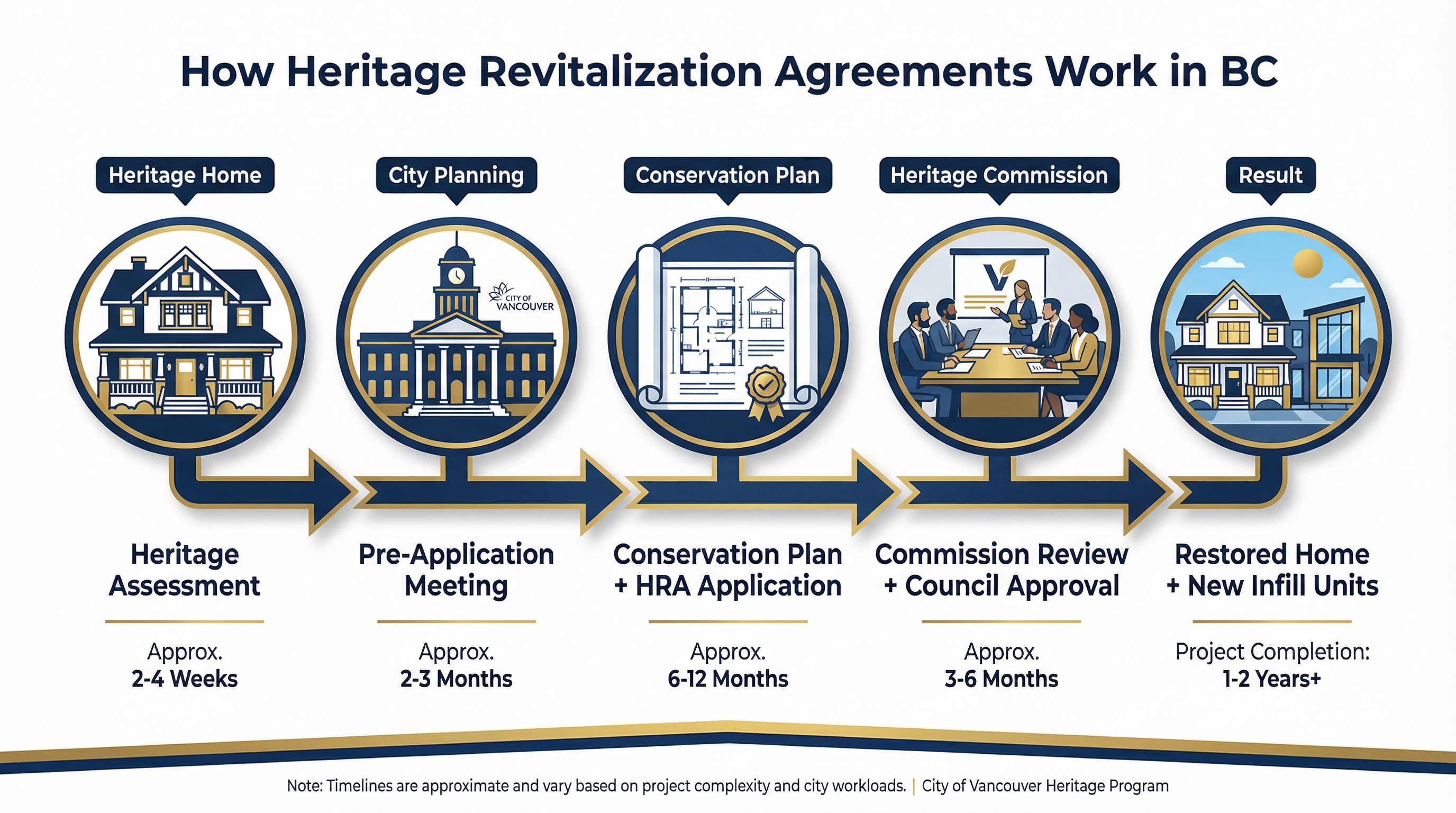
An HRA is a voluntary legal agreement between a property owner and a municipality under Section 610 of the BC Local Government Act. The owner permanently protects a heritage building. The city grants development flexibility that standard zoning does not provide.
Key Takeaways
- ✓An HRA is a negotiated agreement, not a permit application. The density bonus depends on the heritage value offered.
- ✓Typical HRA density bonuses in Vancouver range from 0.15-0.25 FSR — enough for one or two additional units.
- ✓The heritage covenant is permanent and runs with the land. This is not a temporary arrangement.
- ✓Vancouver has completed over 200 HRAs since 2004. The process is established and repeatable.
What an HRA Unlocks
Bonus FSR
Most HRAs add 0.15-0.25 FSR beyond what base zoning allows. On a 4,000 sq ft lot, that is 600-1,000 sq ft of additional buildable area — enough for one or two extra units.
Extra Units
Where base SSMUH might allow 4 units, an HRA can unlock 5 or 6. The extra units are the infill homes built behind or beside the retained heritage building.
Relaxed Setbacks
Heritage homes often sit closer to the street than current zoning allows. The HRA can relax setback requirements for both the retained home and the new infill, making the site plan workable.
Reduced Parking
Some HRAs reduce or eliminate minimum parking requirements, particularly on lots near transit. Parking is expensive to build underground and heritage sites often cannot accommodate it.
Tax Exemptions
Heritage property tax exemptions in Vancouver can reduce the property tax bill by 40-50% through a Heritage Conservation Agreement registered on title. This is a recurring annual benefit.
The Trade-Off
Permanent Heritage Protection Covenant on Title
Every HRA requires the owner to register a heritage conservation covenant on the property title. This covenant is permanent. It survives sale, foreclosure, and estate transfer. The owner commits to:
- •Restoring the heritage building according to the approved conservation plan.
- •Maintaining the building to heritage standards in perpetuity.
- •Not demolishing, significantly altering, or neglecting the heritage building.
- •Seeking heritage approval for any future exterior changes to the protected building.
HRA vs Standard Rezoning
Legal Basis
HRA
Section 610 of BC Local Government Act. A voluntary agreement between owner and municipality.
Standard Rezoning
Standard rezoning application under municipal zoning bylaws.
What Owner Gives
HRA
Permanent heritage protection covenant on title. Commitment to restore and maintain the heritage building.
Standard Rezoning
Compliance with new zone requirements. Sometimes community amenity contributions.
What Owner Gets
HRA
Negotiated density bonus, setback relaxation, parking relief, and potential tax exemption.
Standard Rezoning
Whatever the new zone permits. No negotiation beyond the zone provisions.
Timeline
HRA
12-18 months from application to approval (on top of heritage assessment and conservation plan).
Standard Rezoning
6-18 months depending on complexity and public hearing requirements.
Council Vote
HRA
Required. HRAs are agreements with the city and need council endorsement.
Standard Rezoning
Required for most rezoning applications. Public hearing typically involved.
Permanence
HRA
Heritage covenant runs with the land permanently. Selling the property does not remove it.
Standard Rezoning
Zone change is permanent unless another rezoning occurs.
Vancouver HRA Statistics
Signal Check
Density bonus potential
4/5HRAs routinely unlock 0.15-0.25 FSR above base zoning. On the right lot, that is one or two full units.
Process complexity
4/5Heritage assessment, conservation plan, Heritage Commission, and council approval. Not simple, but repeatable.
Timeline risk
3/518-30 months total. Heritage Commission scheduling and council timing are the main variables.
Financial upside
4/5When the density bonus is strong and the tax exemption is available, the economics can beat standard SSMUH.
Best For
- ✓ Properties on the municipal heritage register with clear heritage significance.
- ✓ Lots where the density bonus adds at least 0.15 FSR beyond what standard SSMUH provides.
- ✓ Owners who accept a permanent heritage covenant in exchange for development flexibility.
Usually Fails When
- ✕ The heritage value is marginal and the city is unlikely to offer a meaningful density bonus.
- ✕ The owner cannot commit to permanent heritage protection on title.
- ✕ Restoration costs are unknown and there is no budget for heritage-specific investigations.
What To Verify Before Spending Money
- → Heritage register status and the property's Statement of Significance (if one exists).
- → Pre-application meeting with the municipal heritage planner to gauge density bonus potential.
- → Comparable HRA outcomes on similar properties in the same neighbourhood.
Frequently Asked Questions
Can I negotiate the terms of an HRA?
What happens if I sell the property after signing an HRA?
Does an HRA require a public hearing?
How does the heritage tax exemption interact with the HRA?
Is an HRA worth it for a property with only minor heritage value?
Check Your Heritage Lot's Multiplex Potential
Enter any BC address to check heritage register status, lot eligibility, and whether an HRA could unlock bonus density on your property.