Zoning & Policy | Bill 44 / SSMUH
Bill 44 SSMUH in Kelowna: The 3, 4, and 6 Unit Rules
Bill 44 is the provincial legislation that pre-zoned residential lots in BC for 3-6 units (BC Laws). Kelowna implemented it in Zoning Bylaw 12375 on March 18, 2024 (City of Kelowna). This page is the plain-English version of what the bill requires, what the Kelowna amendment did, and where SSMUH stops — because it stops a lot sooner than most people assume.
Key Takeaways
- ✓Bill 44 requires minimums of 3 units on lots at or below 280 m², 4 units on lots above 280 m², and 6 units on lots above 280 m² near frequent transit.
- ✓Kelowna adopted these rules in Zoning Bylaw 12375 on March 18, 2024. No rezoning and no public hearing for SSMUH-consistent applications.
- ✓Within 400 m of qualifying frequent transit, municipalities cannot impose parking minimums on SSMUH projects.
- ✓Height, setback, lot coverage, and character still require variances if the design exceeds the base-zone envelope.
- ✓SSMUH does not waive DCCs, FireSmart, Step Code, or the Mill Creek floodplain bylaw. Those are separate requirements that run in parallel.
What Bill 44 Did (Province-Wide)
The Housing Statutes (Residential Development) Amendment Act received royal assent in late 2023 and required every BC community over 5,000 residents to align their zoning by June 30, 2024 (Province of BC). Most communities complied on time; the Province reported over 90% of BC communities had adopted SSMUH by late 2024 (BC Gov News).
Pre-Zoned Small-Scale Multi-Unit Housing
Bill 44 required BC communities over 5,000 residents to pre-zone every residential lot for 3-4 units (and 6 near frequent transit on larger lots). Compliance deadline was June 30, 2024.
Removed the Public Hearing Requirement
Public hearings are no longer required for SSMUH-consistent zoning amendments or permit applications. Decisions happen at staff level against the pre-zoned rules.
Set Minimums, Not Maximums
Bill 44 sets a floor. Municipalities can go further — more units, taller buildings, additional form allowances — but cannot go below the provincial minimums.
Capped Parking Minimums Near Frequent Transit
Within 400 m of qualifying frequent-service stops, municipalities cannot require off-street parking minimums for SSMUH projects.
How Kelowna Implemented It
Council adopted the SSMUH amendments to Zoning Bylaw 12375 on March 18, 2024, ahead of the provincial deadline. The amendments pre-zoned RU1, RU2, RU3, RU5, and eligible MF1 parcels for the Bill 44 minimums (City of Kelowna Planning Legislation).
That same amendment package added the Bill 47 Transit-Oriented Areas framework — a separate but parallel policy, covered on the Transit-Oriented Areas page. The two should not be confused: Bill 44 is about SSMUH unit counts on any qualifying lot; Bill 47 is about forced density around prescribed transit exchanges.
The Unit Count Rules
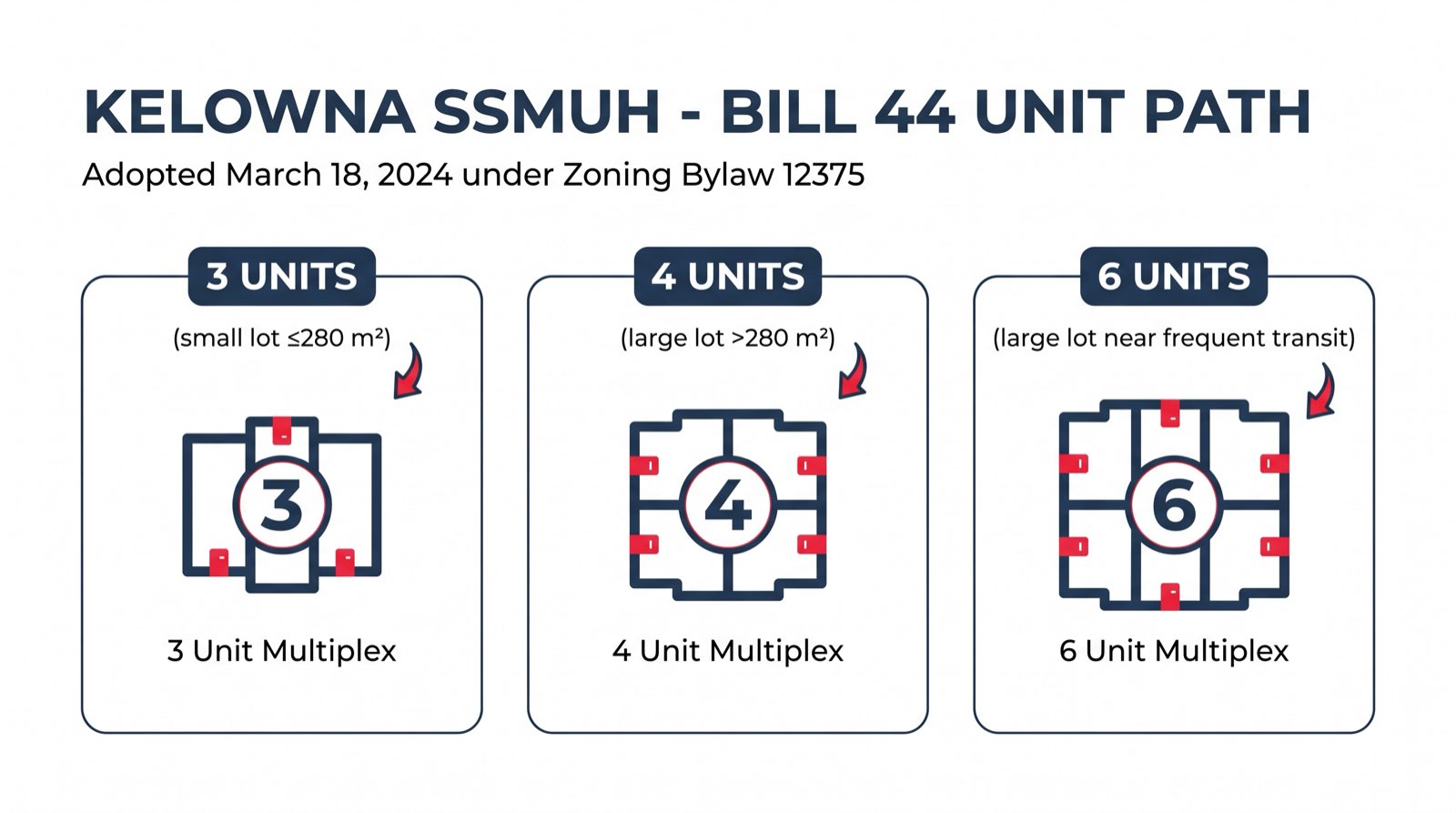
| Rule | Small Lot (≤ 280 m²) | Large Lot (> 280 m²) | Transit-Adjacent (> 280 m²) | Note |
|---|---|---|---|---|
| Minimum permitted units | 3 units | 4 units | 6 units | Small lot = parcel ≤ 280 m². Large lot = > 280 m². Transit lot = > 280 m² within the prescribed walking distance of a qualifying frequent-service bus stop. |
| Minimum off-street parking | Municipal rules apply | Municipal rules apply | None within 400 m of frequent transit | Bill 44 allows municipalities to require up to 1 stall per unit on standard lots; stops parking minimums near frequent transit. |
| Rezoning needed? | No — pre-zoned | No — pre-zoned | No — pre-zoned | Kelowna's March 18, 2024 amendments pre-zoned RU and applicable MF parcels. You go straight to development and building permits. |
| Public hearing? | Not required for SSMUH | Not required for SSMUH | Not required for SSMUH | Bill 44 removed the public hearing requirement for SSMUH-consistent applications. Variance requests are a separate issue. |
Based on Bill 44 and Kelowna's March 18, 2024 SSMUH amendments. Always verify against the current bylaw before underwriting.
The Parking Changes
Within 400 m of Frequent Transit
No off-street parking minimums. The municipality cannot require any. You can still choose to build parking, but it is a commercial decision, not a regulatory one. This is the single biggest design benefit of siting near qualifying transit — parking typically consumes the lot area that a 4th or 5th unit would otherwise occupy.
Outside the 400 m Zone
Standard Kelowna parking rules apply, which can require up to one stall per unit. On tight RU lots that becomes the primary design constraint. Check the current parking schedule in Bylaw 12375 for the specific rate that applies to your zone and unit count.
What Still Requires a Variance
SSMUH unlocks the unit count. It does not unlock the envelope. These four categories still trigger variance requests when exceeded — and variances are what take you off the Infill Fast-Track path.
Height Above the Base Zone
SSMUH unlocks the unit count, not the height envelope. If you need more storeys than RU2 or MF1 allows, you need a variance.
Setback Reductions
The base-zone setbacks still govern. Squeezing 4 or 6 units into a tight lot often pushes a design past the setback — which is a variance request, not an SSMUH right.
Lot Coverage and FAR
If the multiplex form exceeds the zone's maximum lot coverage or floor-area ratio, you need a variance. That is also what takes you off the Fast-Track path.
Character and Form Elements
Kelowna's form-and-character guidelines (Ch. 18 of the OCP) can still drive design changes through development permit review, even on a pre-zoned SSMUH parcel.
What SSMUH Does NOT Do
The most expensive misreadings of Bill 44 come from assuming SSMUH waives other requirements. It does not. These four categories run in parallel and apply fully.
Does Not Waive DCCs
Development Cost Charges under Bylaw 12420 still apply. SSMUH is a zoning tool; DCCs are an infrastructure-cost tool.
Does Not Waive FireSmart
A WUI-exposed parcel still faces the same FireSmart construction requirements — non-combustible cladding, ember-resistant vents, Priority Zone 1 setbacks.
Does Not Waive Step Code or Overheating Rules
The BC Building Code, Zero Carbon Step Code, and the 26 °C overheating limit for at least one living space apply to SSMUH projects exactly as they apply to any other residential build.
Does Not Waive the Floodplain Bylaw
Mill Creek Flood Plain Bylaw 10248 constrains the building envelope on affected parcels. SSMUH does not override hazard bylaws.
Best For
- ✓ RU1, RU2, RU3, or MF1 parcels above 280 m² where the base-zone envelope fits 4 units without variances.
- ✓ Lots within the prescribed walking distance of Route 97 Okanagan or other qualifying frequent-service stops — the 6-unit path plus no parking minimum.
- ✓ Projects that use the pre-zoned path to bypass rezoning and the public hearing entirely.
Usually Fails When
- ✕ The design needs a variance to hit the 4- or 6-unit minimum and the builder still expects Fast-Track timing.
- ✕ The pro forma assumes SSMUH waives DCCs, FireSmart, or Step Code — none of which is true.
- ✕ The 6-unit bonus is assumed without confirming the lot is both above 280 m² and inside the prescribed transit walk.
What To Verify Before Spending Money
- → Lot area against the 280 m² threshold and zone against the list of SSMUH-eligible zones.
- → Transit eligibility against the City of Kelowna's qualifying-stop list, not just the BC Transit route map.
- → Whether the design fits the base-zone envelope or will require variances — and how that changes the permit path.
Frequently Asked Questions
What is the exact unit minimum for my lot under Bill 44?
What does "qualifying frequent-service transit" mean?
Do I need to rezone my RU1 lot to build 4 units?
Does the 6-unit bonus apply to my 260 m² lot near Route 97?
Can Kelowna require off-street parking on an SSMUH project near frequent transit?
Does SSMUH remove the need for a development permit?
What happens if my design needs a variance to hit the 4-unit Bill 44 minimum?
Official Sources Referenced
Screen Your Kelowna Lot for Multiplex
Enter any Kelowna address to check SSMUH unit count, zoning, frequent-transit bonus eligibility, and whether the Infill Fast-Track path applies.