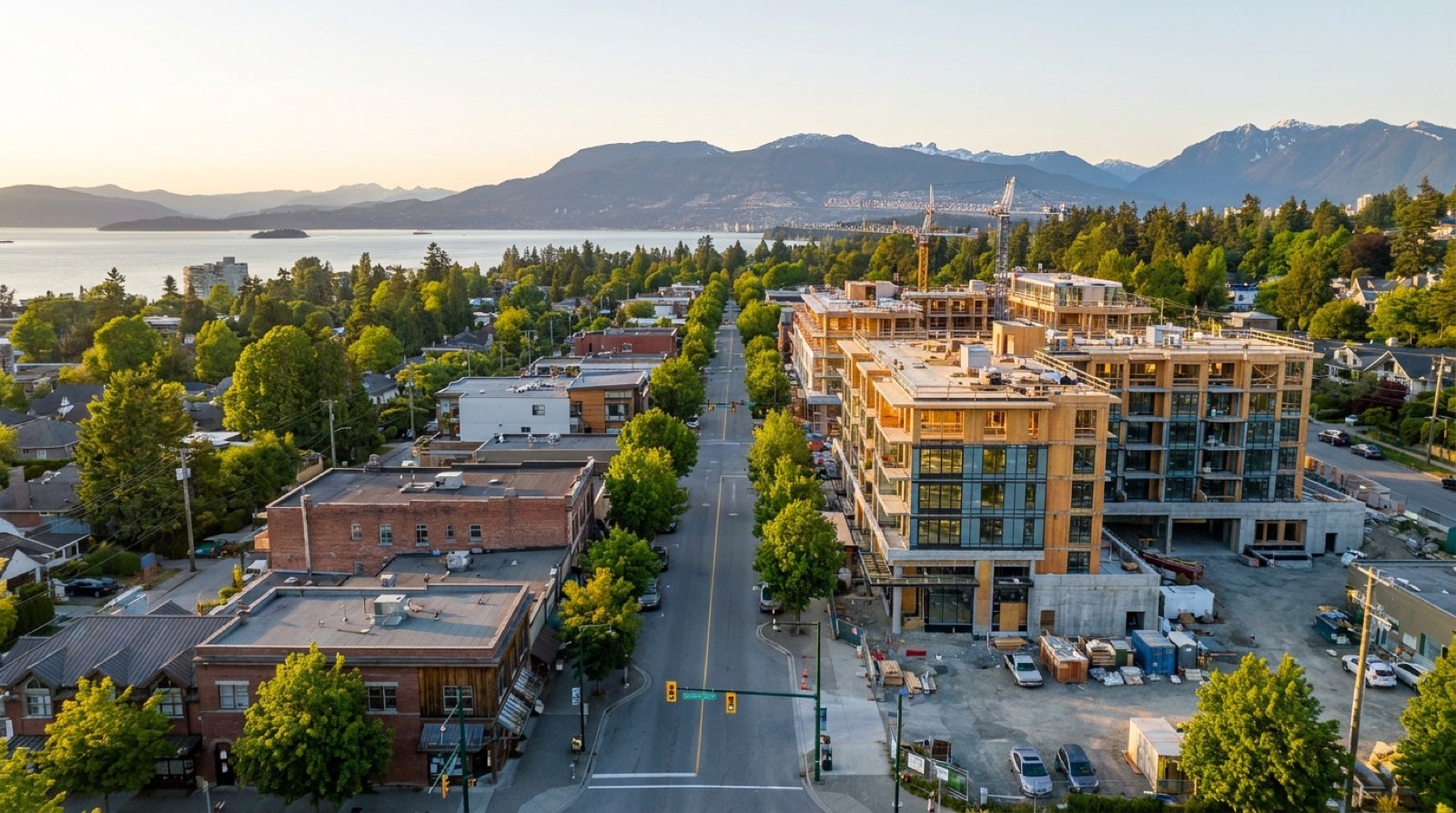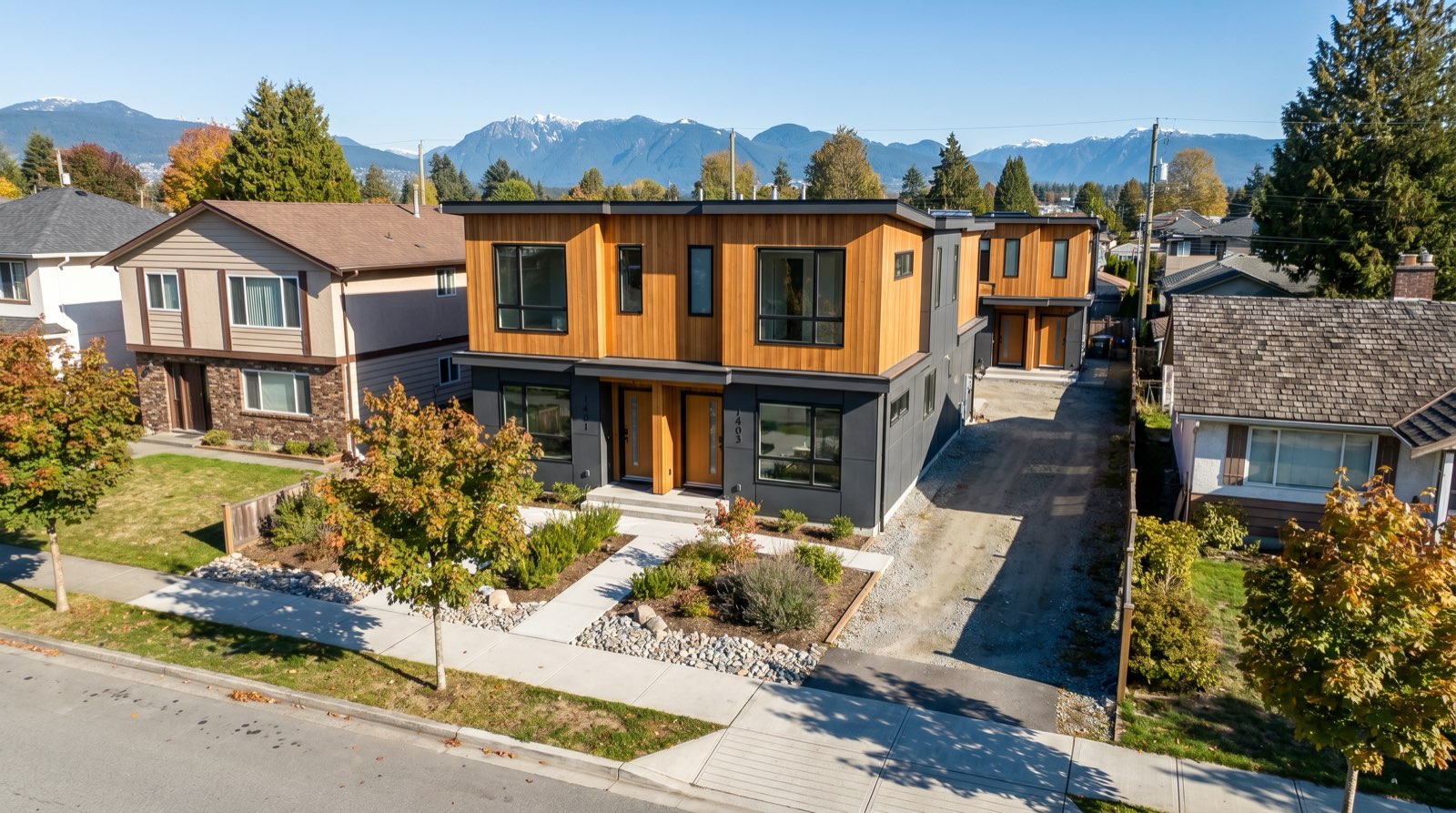

Coquitlam had the same problem every North Shore municipality has been yelling about: old water mains, marginal sewer capacity, and fire flow that was engineered for 1970s single-family density. The District of North Vancouver’s answer, on April 13, 2026, was to pass a motion refusing to implement Bill 25 SSMUH at all. Coquitlam’s answer, ten months earlier on June 9, 2025, was smarter. They said yes to the Province, then quietly built a cost structure that decides for them which lots actually get built on.
TL;DR
- June 9, 2025: Coquitlam Council adopted Zoning Bylaw 5449 to bring SSMUH into effect. Three new zones — R-1, R-2, R-3 — replaced the old RS-series single-family zones across most of the city.
- Three-unit lots under 280 m² (3,014 sq ft), four-unit lots up to 4,050 m² (1 acre). Max 3 storeys / 11 m, 45–50% coverage, 0.5–0.75 FAR.
- The key move isn’t the zoning. It’s the service map. Coquitlam published an SSMUH Available Fire Flow (AFF) map and requires every small-scale residential permit to submit a Fire Flow Requirements Form. If your lot’s AFF is short, you fix it — hydraulic modelling, water main upgrades, hydrant installs, frontage works.
- Developer pays for all required infrastructure upgrades — water, sewer, road frontage — per Coquitlam’s published handout. Costs depend on lot location, frontage length, and current infrastructure capacity.
- Under-serviced lots don’t get refused. They get priced out. The zoning says yes. The servicing bill says “if you can still make the numbers work, go ahead.”
- This is a better template than DNV’s refusal because it complies with Bill 25, avoids ministerial override, and lets the market decide which lots pencil rather than council doing it by motion.
What Coquitlam actually passed on June 9, 2025
Bylaw 5449 collapsed the old single-family RS-series — RS-1, RS-3, RS-6, RS-9, RS-10, RS-11, plus RT-1 Infill — into one new zone called R-1 Small-Scale Residential. Smaller-lot zones (RS-4, RS-5, RS-7, RS-8) moved to R-2 Compact Small-Scale Residential. R-3 Transitional Small-Scale Residential got reserved for properties where lot assembly and rezoning are already preferred. That’s already about 80% of the city’s low-density residential fabric converted in one council meeting.
On those lots:
- Up to 3 units on lots 280 m² (3,014 sq ft) or smaller
- Up to 4 units on lots larger than 280 m² but under 4,050 m² (1 acre)
- 1 principal + 1 accessory unit on anything over an acre
- Max density: 0.65–0.75 FAR in R-1/R-2, 0.5 FAR in R-3
- Max height: 3 storeys or 11 m
- Max coverage: 45–50%
- Parking: 1 space under 850 sq ft, 1.5 spaces 850–1,700 sq ft, 2 spaces over 1,700 sq ft
Transit-Oriented Areas kept their existing zoning (they’re covered separately under Bill 47). Lots not connected to municipal water or sewer were exempt entirely. Everything else got the upgrade. (Coquitlam SSMUH page)
So far, this looks like compliance. The interesting part is what they did to manage the infrastructure problem without trying to block the density.
The SSMUH Available Fire Flow map is the whole game
Every BC municipality wrestling with Bill 44 has the same engineering problem. The water and sewer mains in a neighbourhood built in 1965 were sized for one house per lot. Four units per lot needs more water, more sewer capacity, and critically, more fire flow — the volume of water a hydrant can deliver at minimum pressure during a fire.
The Fire Underwriters Survey sets fire flow requirements based on building size, construction type, and separation from adjacent structures. A 3,000 sq ft single-family house might need 1,000–1,500 litres per minute. A 4-unit, 3-storey multiplex on the same lot can push the requirement much higher, depending on how it’s built.
Coquitlam mapped this. City staff ran the numbers on every parcel in the R-1/R-2/R-3 zones and built an internal SSMUH Available Fire Flow (AFF) map that classifies what each lot has today. Any application for a small-scale residential building permit has to submit a Small-Scale Residential Fire Flow Requirements Form confirming that the lot’s AFF meets what the proposed building needs. If the lot is short, you commission hydraulic modelling, and then you build whatever the modelling says is required to close the gap.

The zoning bylaw lets you build a fourplex. The fire flow bylaw decides whether you actually can.
Developer pays. All of it.
Coquitlam’s published SSMUH handout is unusually direct on this point:
“Developers contribute to these community benefits through: Development Cost Charges, Amenity Cost Charges (proposed), and completing required infrastructure upgrades and property frontage improvements to meet the needs of the proposed development. Required infrastructure upgrades and the costs associated depend on your property location, the length of your frontage, and current infrastructure capacity.”
Break that down. On top of standard DCCs and the proposed ACCs, a Coquitlam fourplex developer is on the hook for:
- Water main upsizing or replacement if AFF is insufficient
- Sewer main capacity upgrades if the downstream pipe can’t take the load
- Fire hydrant installation or relocation
- Frontage works — curb, gutter, sidewalk, street trees, sometimes full lane widening
- Any service connection upsizing from the main to the lot
These are works the developer designs, tenders, and pays for before occupancy. The Latecomer Program exists (Coquitlam Latecomer Program) so that if your upgrade happens to service other lots down the street, you can get proportional reimbursement from whoever builds on them next — but only when and if they build. Your cheque clears years before theirs does, if ever.
In Blueridge or the older pockets of North Coquitlam, Eagle Ridge, and parts of Maillardville, the gap between existing capacity and what a fourplex needs isn’t small. The servicing line item on those proformas can shift the project from pencilling to not pencilling — not because council said no, but because the math did.
Why this is smarter than what DNV did
The District of North Vancouver refused Bill 25 SSMUH on April 13, 2026. Council passed a motion to not support implementation. Mayor Mike Little called Bill 25 “a big problem.” The District’s concerns weren’t fake — DNV’s own internal data showed about 8,500 lots where water, sewer, or road upgrades are needed before a six-unit build works.
That’s a legitimate infrastructure problem. The response wasn’t.
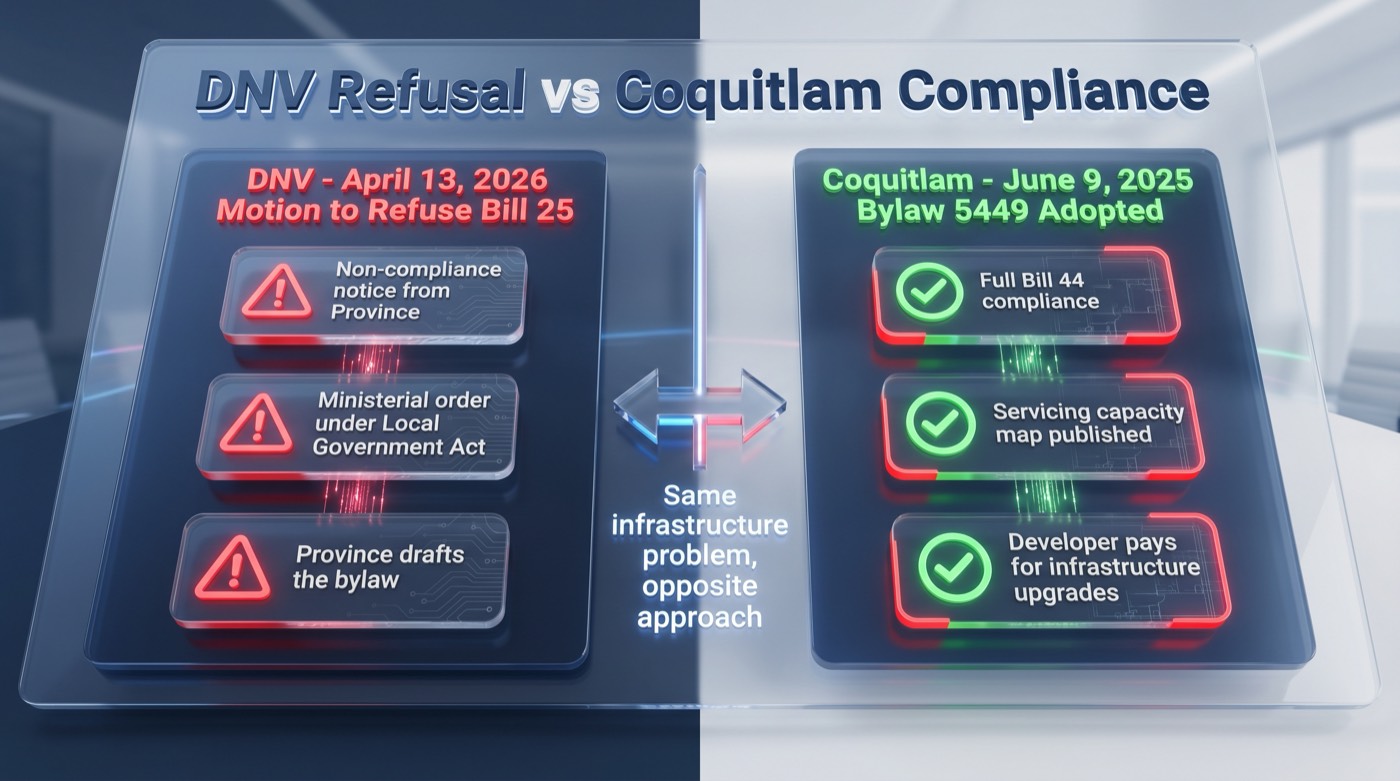
Bill 25 gave Housing Minister Christine Boyle the authority to impose zoning directly by ministerial order under the Local Government Act. Refusal doesn’t stop SSMUH. It just transfers drafting authority from the municipality to Victoria. DNV will get SSMUH zoning by Q3 2026 either way — the only question is who holds the pen.
Coquitlam held the pen. By passing a compliant bylaw with a servicing tie-in, they got three things DNV didn’t:
- No provincial override risk. Coquitlam decides how its own bylaw reads. The Minister has no trigger to intervene.
- Infrastructure costs on the developer, not the ratepayer. A refusal does nothing for a municipality’s capital plan. A compliance-plus-cost-shift bylaw moves capacity upgrades onto the private projects that benefit from them.
- Market-based rationing. Instead of council voting on which lots can be built on, the proforma does it. Lots with good servicing proceed. Lots that need $200K–$400K in frontage and main upgrades sit on the shelf. The Province can’t argue with that outcome — it’s the bylaw working as written.
Coquitlam vs. DNV: same problem, opposite play
| Dimension | Coquitlam | District of North Vancouver |
|---|---|---|
| Compliance action | Bylaw 5449 adopted June 9, 2025 | April 13, 2026 motion to not implement |
| Legal status | Fully compliant with Bill 44 / Bill 25 | Non-compliant; expected ministerial order Q3 2026 |
| Who drafts the bylaw | Coquitlam | The Province (if DNV holds the line) |
| Infrastructure upgrade cost | Developer pays, per application | TBD — Province-imposed bylaw unlikely to shift costs to developers |
| Under-serviced lots | Permitted but often uneconomic | Outcome unknown until ministerial order |
| Political cost | Minimal; bylaw is technical | High; public motion, statements from mayor and councillors |
| Who decides which lots build | The market | The Minister |
One of these jurisdictions is now telling its residents what they can build. The other is telling them what it will cost.
What this means if you own a Coquitlam lot
If you’re sitting on an R-1 or R-2 lot in Coquitlam today, your zoning is already multiplex-capable. That’s the easy part. The harder question is whether the math works on your specific frontage.
The lots that work cleanly:
- Anywhere on a recently-replaced water main (check with the City’s engineering department before you go far on a concept)
- Good AFF on the Available Fire Flow map — Burke Mountain, most of Westwood Plateau, newer parts of Burquitlam outside the TOA
- Shorter street frontages reduce your frontage works exposure
- Corner lots sometimes trigger double frontage and get more expensive, not less
The lots where you need to run the servicing check before you run the proforma:
- Older Maillardville, parts of Central Coquitlam south of Austin, and the older Eagle Ridge pockets where water mains haven’t been touched in 40+ years
- Lots requiring a new hydrant
- Lots on a sewer line flagged as at-capacity in the City’s sanitary master plan
If you’re underwriting a Coquitlam lot today, servicing has to be a top-three line item in the proforma, alongside hard construction costs and financing. The zoning gives you the right. The AFF map decides the price.
What Coquitlam got right that other cities should copy
This isn’t a partisan take. Coquitlam’s council isn’t particularly pro-density — they just read Bill 25 correctly and realized refusal was the worst option on the board. By complying with the letter of the legislation and using servicing as the real density regulator, they kept control of their own infrastructure plan without picking a fight they were going to lose.
Other BC municipalities still stuck on SSMUH — West Vancouver, DNV, parts of the Fraser Valley — should be looking at this model. Comply. Map your servicing. Publish the map. Require the upgrades. Let the developer economics do the work that a refusal motion can’t.
The lots that should get built on will get built on. The ones that shouldn’t, won’t. Council keeps its authority. The Province keeps its legislation intact. Nobody’s running to the media about ministerial override.
That’s what good bylaw drafting looks like.
Check your Coquitlam lot before anyone else does
If you own a single-family lot in Coquitlam and you’re trying to figure out whether yours sits in the “builds cleanly” bucket or the “kill it on servicing” bucket, you can screen it in two minutes. Run a PlexRank check on your address for unit potential, then book a quick engineering pre-consult with the City to confirm where you sit on the AFF map. Those two data points tell you more about your lot’s real value than any zoning bylaw will.
Happy to help if you want a second set of eyes on the numbers.
— Gary Paul Multiplex Realtor, Coquitlam | multiliving.ca