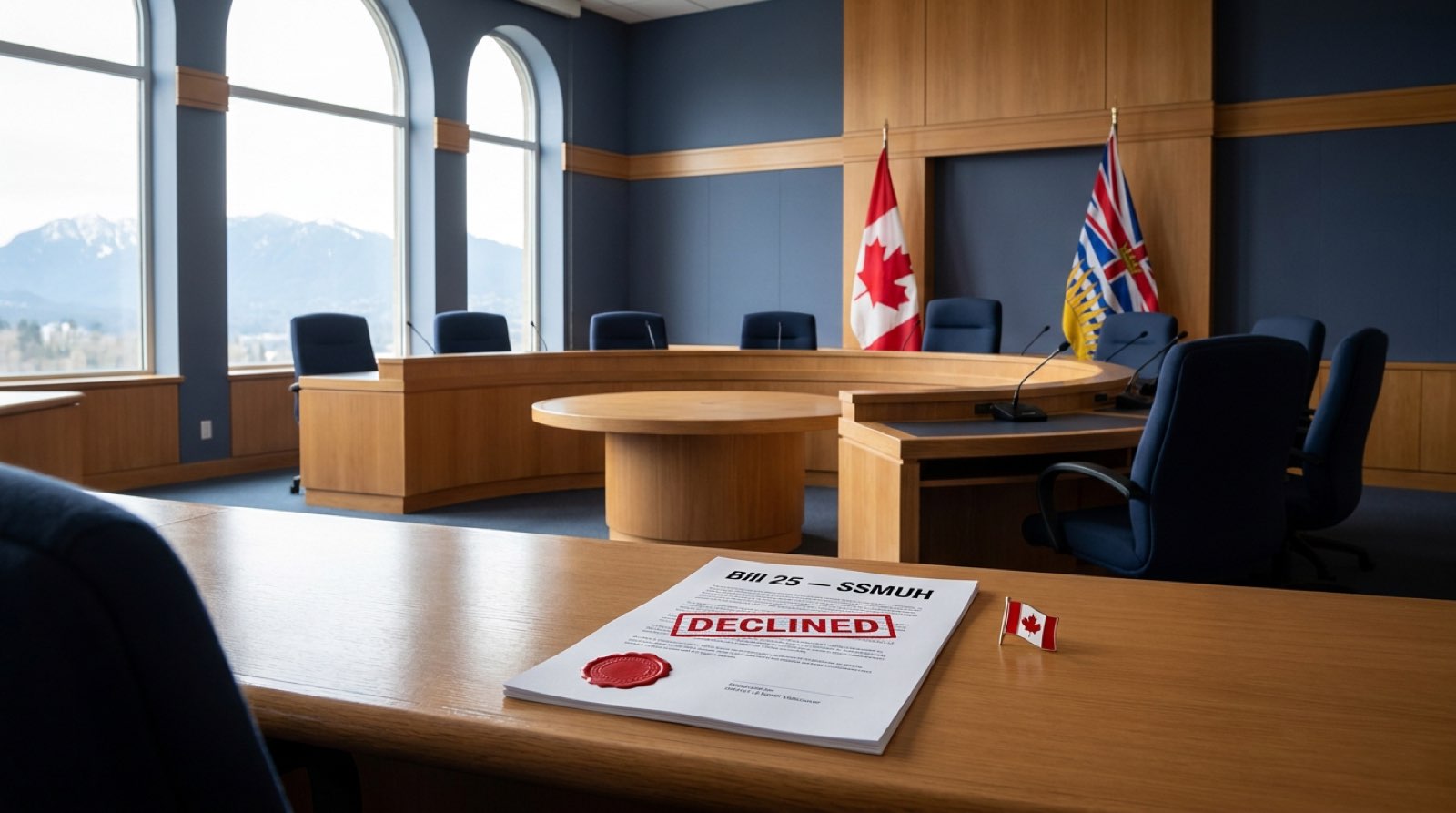
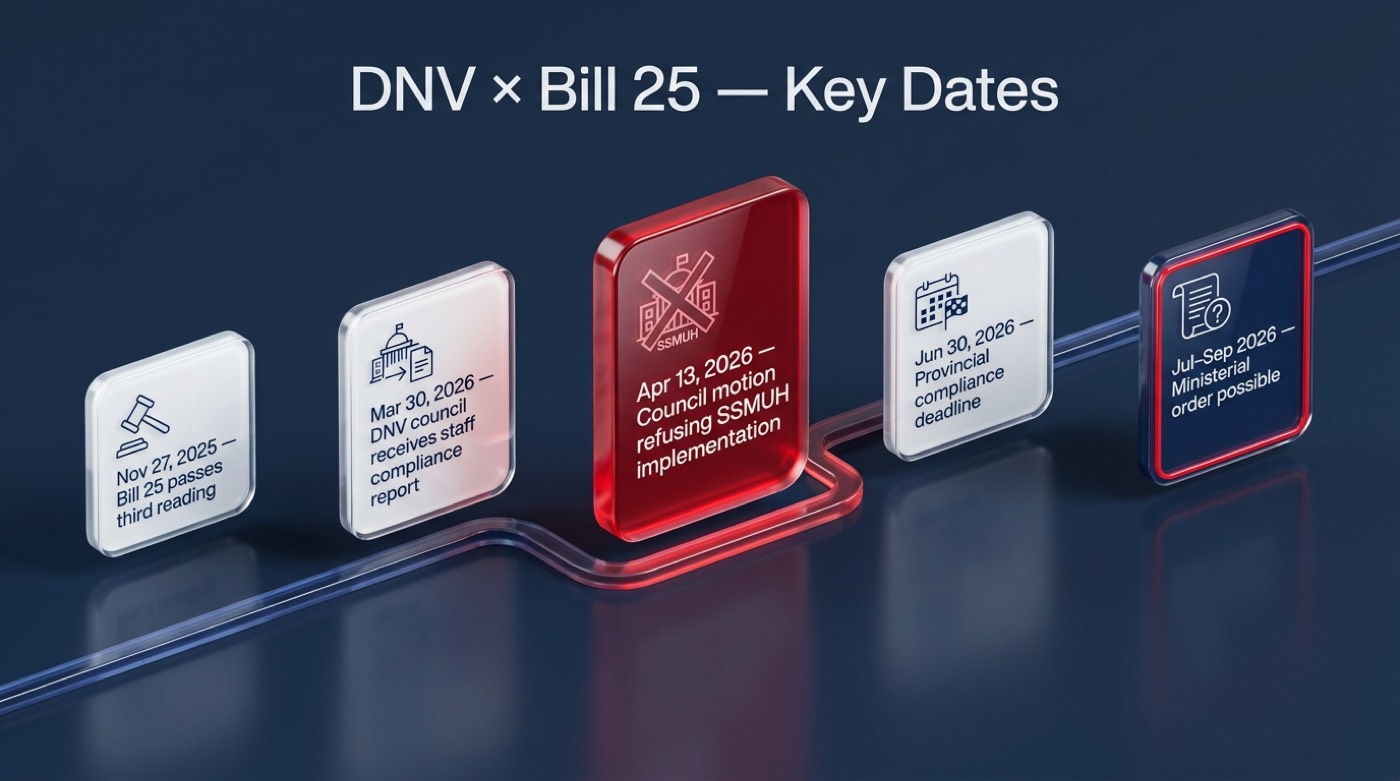
On April 13, 2026, District of North Vancouver Council passed a motion “to not support the implementation of SSMUH in the District as implied in Bill 25.” That one sentence, published on dnv.org three days later, makes DNV the first Metro Vancouver municipality to openly defy the provincial small-scale multi-unit housing mandate — 78 days before the June 30, 2026 compliance deadline.
It won’t hold. Here’s what actually happens next, and what it means if you own a lot on the North Shore or you’re underwriting one.
TL;DR
- April 13, 2026: DNV Council passed a motion to not support SSMUH implementation as implied in Bill 25. Published on DNV’s website April 16, 2026.
- The deadline is June 30, 2026. If DNV doesn’t update its zoning bylaw, Housing Minister Christine Boyle can invoke the Local Government Act and impose zoning directly by ministerial order.
- DNV’s objections are technical, not just political: old water and sewer in Blueridge, fire/slope/creek hazards across roughly 8,600 lots, and a March 16, 2026 staff report finding six-unit multiplex economics “not viable” under the District’s proposed affordability overlay.
- The District mapped its own lots: ~2,900 serviceable for multiplex today, ~8,500 challenging (infrastructure upgrades needed), ~8,600 excluded for natural hazards.
- What this means for owners and builders: expect zoning to exist by Q3 2026 — either passed by Council under provincial pressure or imposed by the Minister. Do not pause lot-screening or DP prep. The land economics don’t change.
What DNV actually said on April 13
The wording on DNV’s own provincial housing legislation page is blunt:
“At a meeting held April 13, 2026, Council passed a motion to not support the implementation of SSMUH in the District as implied in Bill 25.”
No caveat. No extension request. No conditional compliance pathway. Just a refusal.
That’s a step further than the March 30 meeting, where Council received the staff compliance report “for information” but declined to direct staff to draft the amendments. In two weeks, the District moved from procedural stall to formal rejection.
Mayor Mike Little has called Bill 25 “a big problem” and “an intentional effort to create chaos in planning and housing development.” Councillor Lisa Muri called the Province’s approach “dictatorial.” Councillor Jim Hanson, in a separate op-ed, argued that adding 20,000 units within 16 years will “inevitably strain District taxpayers” without matching provincial infrastructure funding.
None of that changes what Bill 25 legally requires.
Why municipalities can’t actually opt out
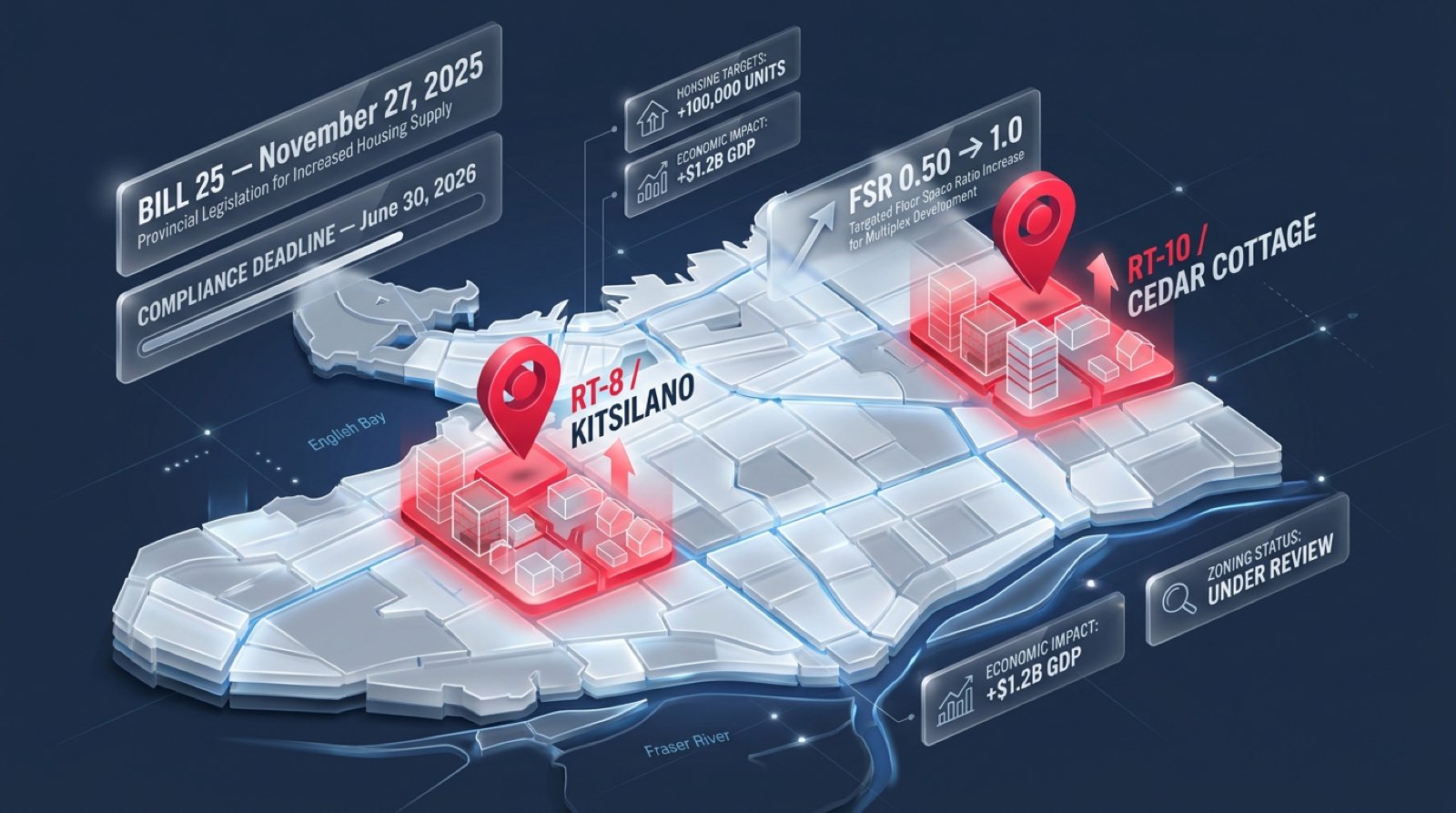
Bill 25 (Housing and Municipal Affairs Statutes Amendment Act, 2025) passed third reading on November 27, 2025. It amended the Local Government Act and the Vancouver Charter to do two things Bill 44 didn’t quite nail down:
- Close compliance loopholes. Cities can’t use excessive parking, setbacks, or FSR caps to make SSMUH technically legal but economically dead.
- Give the Minister direct override authority. If a municipality doesn’t update its bylaw by the deadline, the Housing Minister can impose zoning by ministerial order under the Local Government Act.
That second point is what makes DNV’s motion symbolic rather than consequential. The District’s bylaw authority exists at the pleasure of the Province. If DNV refuses, the Province writes the bylaw. Council can then vote against it, yell about it, or issue a press release — but the zoning is in force regardless.
Why the Province holds the cards
Every Councillor in the chamber on April 13, 2026 knows how this ends — because Bill 25 was specifically written to make refusal ineffective.
The statute grants the Housing Minister three escalating tools, already in force since November 27, 2025:
- Non-compliance notice. A formal finding that a municipality has failed to update its bylaw. Triggers a fixed response window.
- Ministerial order. Under the Local Government Act, the Minister can directly impose the SSMUH zoning provisions on non-compliant municipalities. The municipal bylaw is replaced, not supplemented.
- Infrastructure funding leverage. Provincial grants for water, sewer, and road upgrades flow preferentially to compliant municipalities. DNV’s own infrastructure case for objecting gets weaker if the refusal costs them funding eligibility.
DNV’s motion is a negotiating position and a political signal to residents. It is not a zoning outcome. The bylaw that governs a DNV lot on July 1, 2026 exists — the only question is who drafted it.
What DNV is actually worried about
Dismissing the refusal as NIMBYism misses the specifics. DNV’s objections are unusually technical for a political motion.
Infrastructure deficit. The District’s own servicing analysis split its single-family lots into three buckets. Roughly 2,900 are “green” — multiplex-serviceable today. Around 8,500 are “blue” — challenging, meaning water, sewer, or road upgrades are needed before a six-unit build works. And roughly 8,600 are “orange” — excluded because of natural hazards: creek protection, slope stability, wildfire interface.
Blueridge is the clearest example. Community association submissions flagged that old water and sewer mains can’t support six-unit loads per lot without capacity upgrades. The District can still prohibit SSMUH under Bill 25 for documented servicing-capacity reasons — but that’s a per-lot engineering exercise, not a blanket refusal.
No provincial funding. The common thread in DNV’s pushback, from Mayor Little to Councillor Hanson’s op-ed, is that the Province is mandating output without paying for the inputs. Roads, hospitals, transit, and school capacity on the North Shore were already strained before 20,000 new units were asked for.
Economics don’t pencil. The March 16 staff report examined a DNV-specific overlay requiring one affordable unit per six-unit multiplex and long-term rental tenure. Staff concluded those constraints made projects “not viable.” That’s not a surprise — it’s a staff report written to defend the political position Council had already taken.
None of these arguments is weak. All of them are conversations DNV needs to have with Victoria. None of them are grounds to opt out of Bill 25.
What DNV could actually do (legally)
There is a defensible path that isn’t refusal:
- Apply for an extension. Bill 25 allows the Province to grant deadline extensions. DNV hasn’t formally requested one.
- Use the hazard exemption aggressively. The ~8,600 “orange” lots can be legitimately excluded on natural hazard grounds, with documentation. That alone removes roughly 43% of single-family lots from the mandate.
- Tier servicing requirements. Document per-lot servicing capacity. Where infrastructure can’t support six units, require three or four instead — which Bill 25 allows.
- Ask for infrastructure cost-sharing. The Housing Infrastructure Fund and provincial grant programs exist specifically for this. Use them as a condition of passing a bylaw, not a reason to refuse.
The April 13 motion forecloses all of that. It’s a worse negotiating position than the March 30 stall.
What happens next (short timeline)
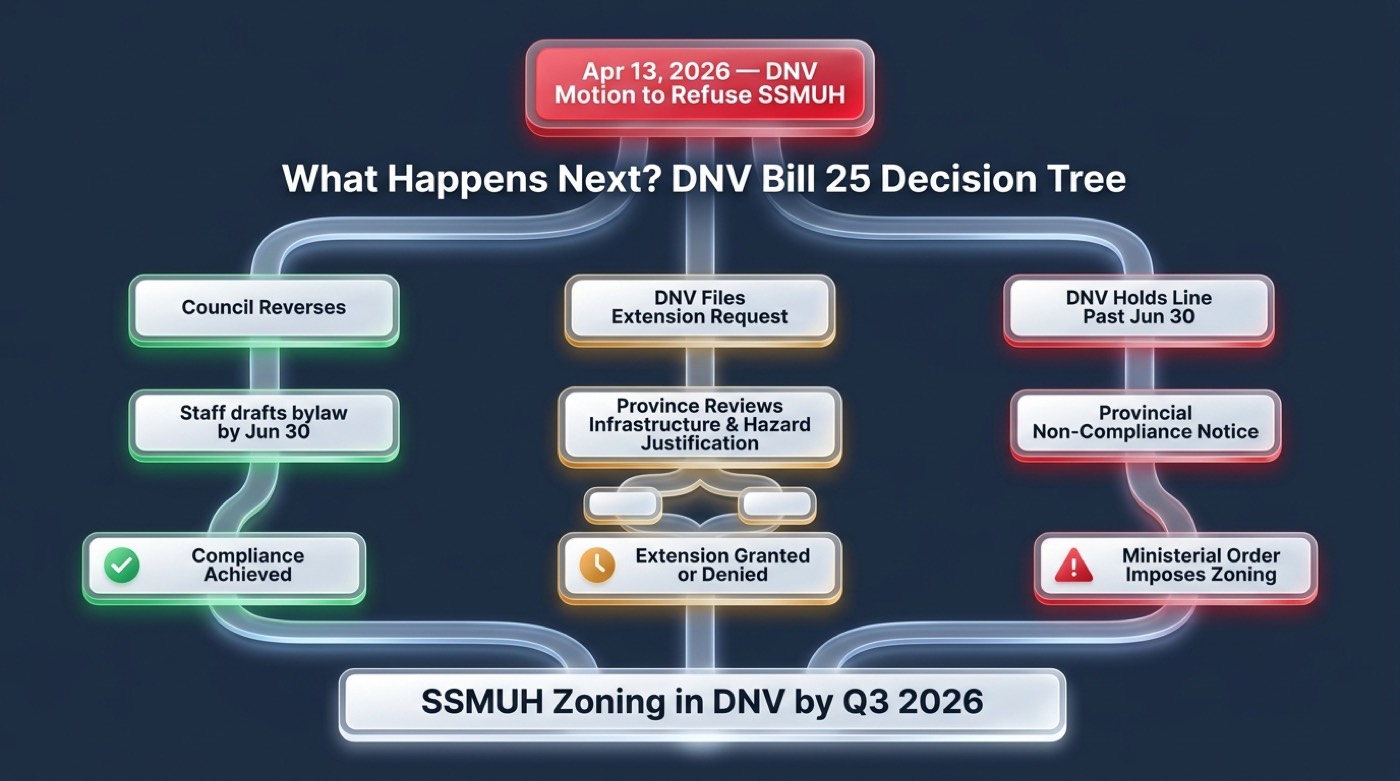
Before June 30, 2026 — expect one of three things:
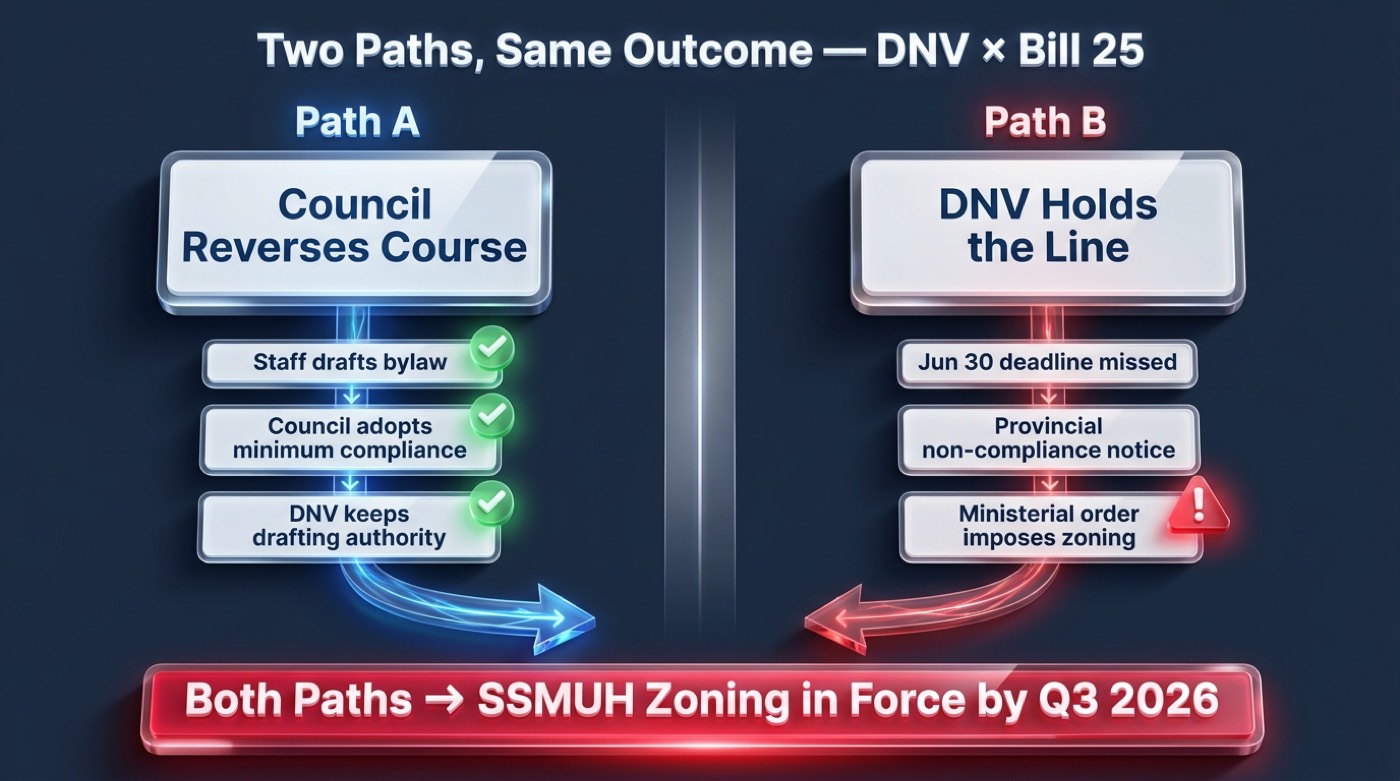
- DNV Council reverses course and passes a minimum-compliance bylaw. Most likely outcome, and the cleanest for the District because it keeps drafting authority in-house.
- DNV files for a formal extension with specific infrastructure and hazard justifications. Possible, but staff haven’t been directed to prepare that filing as of April 13.
- DNV holds the line. The June 30 deadline passes. Minister Boyle issues a non-compliance notice in July. By late summer, either Council adopts a bylaw under ministerial pressure or the Minister imposes one directly by order.
In every scenario, there is SSMUH zoning in force on DNV lots by Q3 2026.
What this means if you own or are buying a DNV lot
Don’t wait for the political theatre to end before doing the work. The legal reality is locked in. The only variable is whether Council writes the bylaw or Victoria does.
If you own a DNV single-family lot:
- Run a PlexRank screen now. Whatever bylaw passes — local or imposed — six-unit zoning is coming to any transit-proximate lot in the “green” bucket.
- Check servicing. The 8,500 “challenging” lots aren’t off the table, but you’ll need a civil review as part of your pre-DP work. Factor water and sewer upgrade costs into your underwriting.
- If you’re on an “orange” hazard lot, the math doesn’t change. SSMUH likely won’t apply. Coach house, laneway, and existing SFH remain your plays.
If you’re a builder or investor sourcing lots in DNV:
- Don’t pause acquisition underwriting. A ministerial order or a forced-compliance bylaw both produce real zoning. The land thesis isn’t contingent on DNV Council’s mood.
- Price in a 60-to-90-day zoning-certainty risk window through end of Q3 2026. After that, the rules will be clear.
- Watch the May and June 2026 DNV Council meetings. Any reversal, extension request, or escalation from the Province will surface there first.
If you’re in pre-development already: stay on schedule. A DP submitted under current rules is a DP. The bylaw that governs your project will exist by the time you’re in zoning review — the only question is who drafted it.
A note on the other North Vancouver
The City of North Vancouver and the District of North Vancouver are different municipalities with different councils. The City has been working toward Bill 25 compliance throughout 2026 — with bylaw amendments introduced and a public engagement process running through Q2. City of North Vancouver owners and developers are on a standard compliance track. Nothing in the DNV April 13 motion applies to them.
See our City of North Vancouver Multiplex Development Guide for that side of the Second Narrows.
Check your DNV lot
If you own property in the District of North Vancouver and want to know what’s actually buildable — regardless of which Council or Minister ends up writing the bylaw — run a PlexRank screen on your address. Two minutes. Real numbers on servicing, hazard status, and unit potential.
The political fight is noise. The land economics are signal.
— The VanPlex Research Team PlexRank™ | Profit with Multiplex