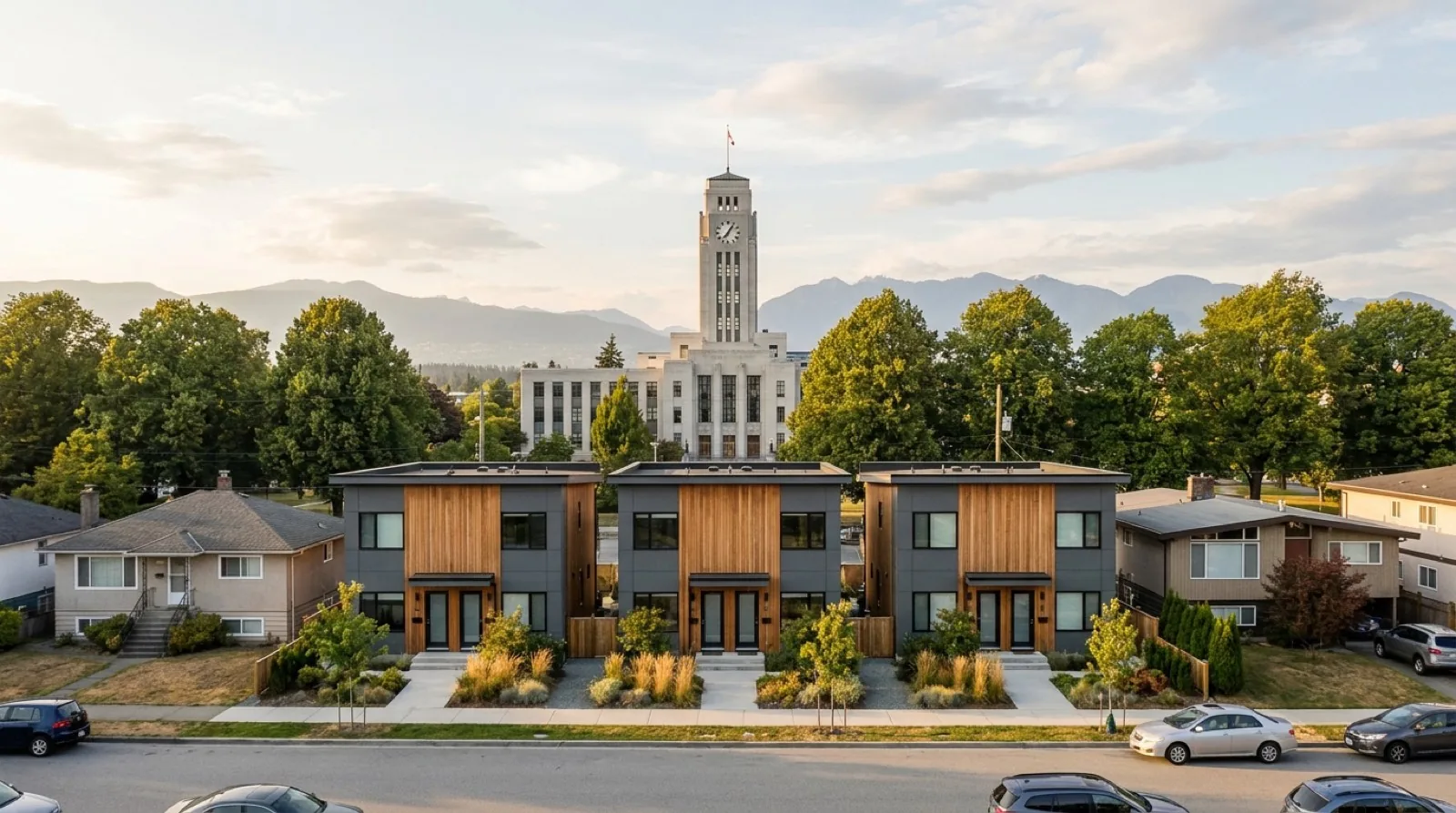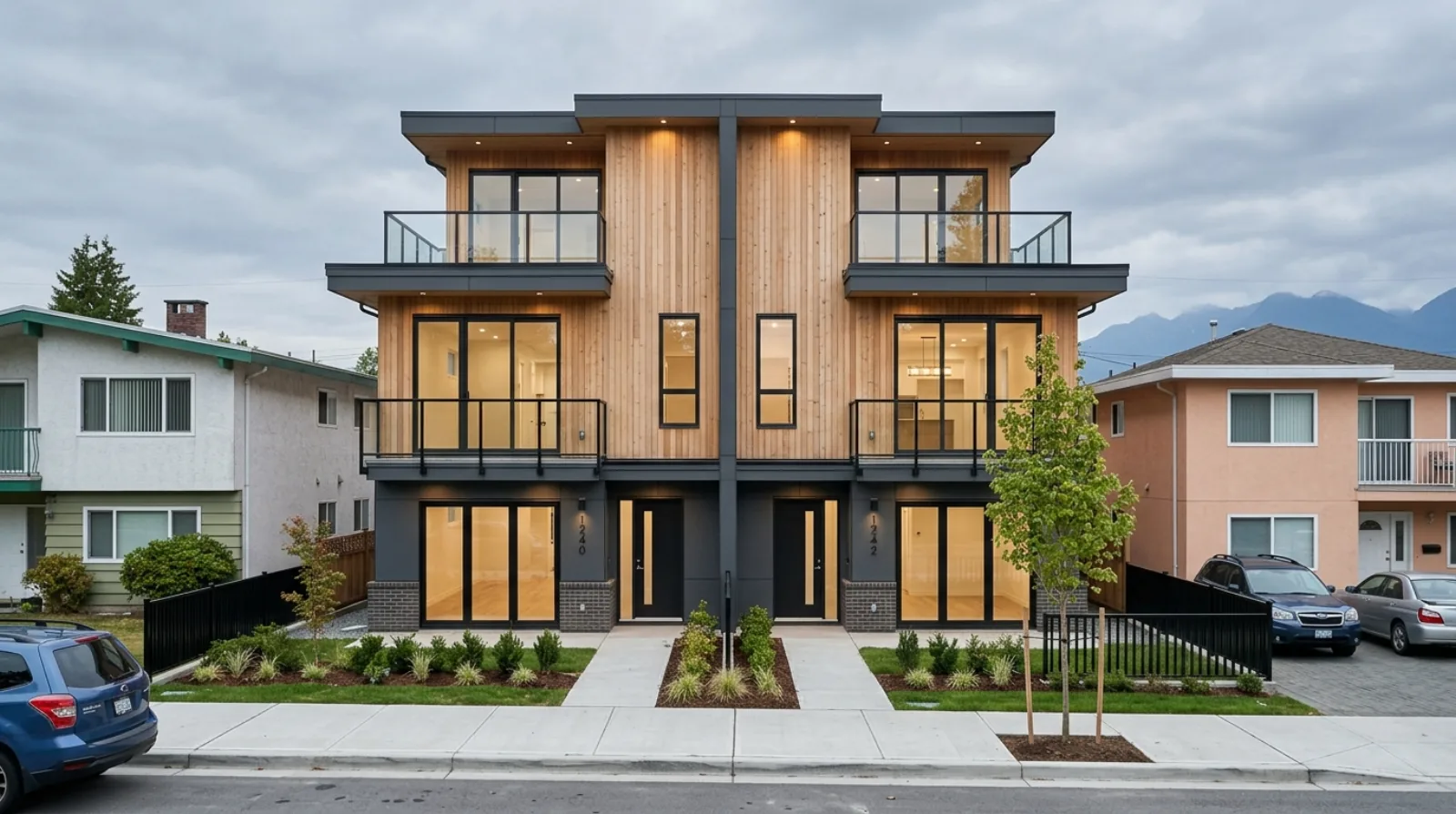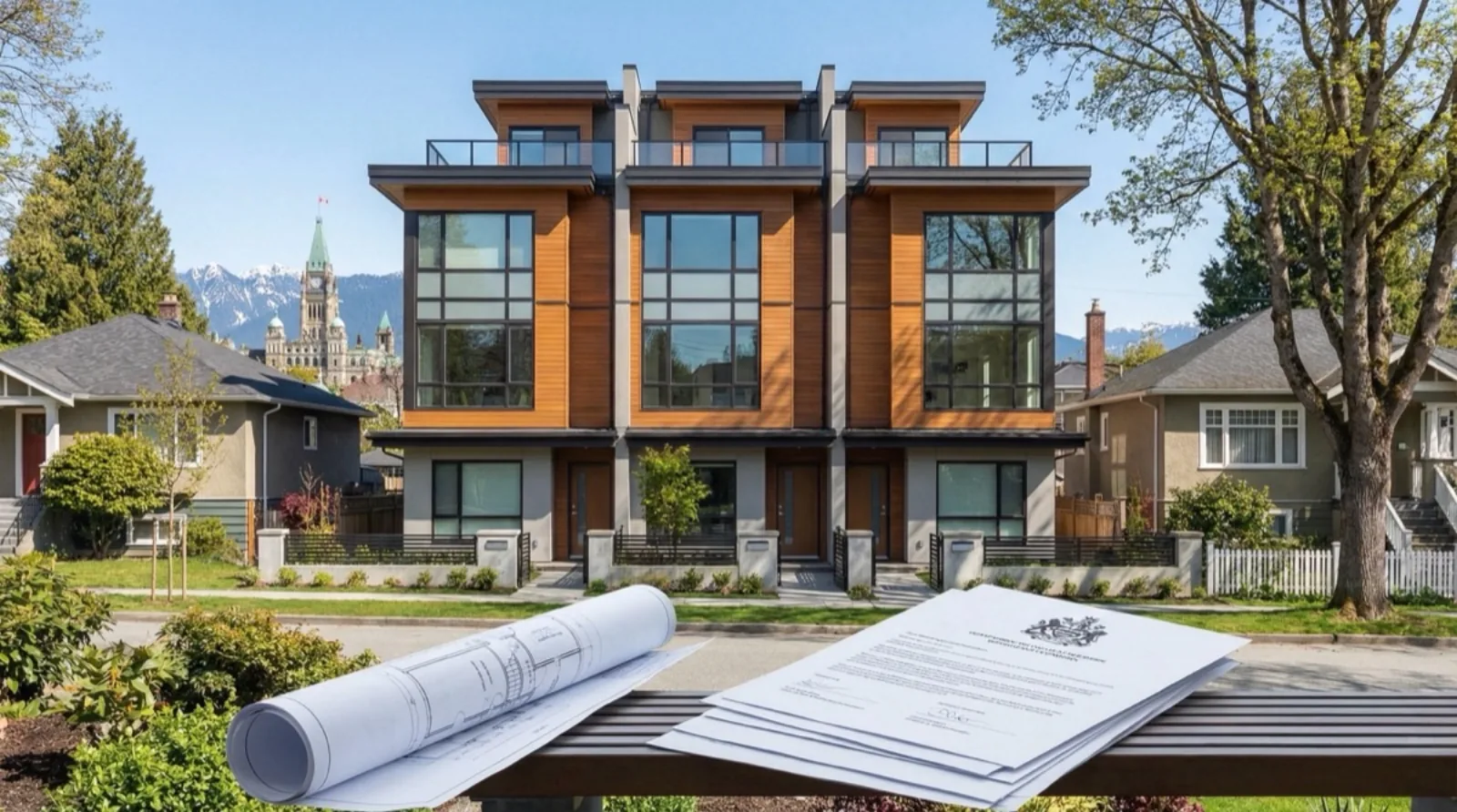

BC’s new small-scale multi-unit housing rules now let homeowners in Metro Vancouver and Kelowna build 3 to 6 homes on a standard single-family lot — as of right, without a rezoning application. The Province’s 96-page policy manual tells every municipality exactly how to implement it, and the rules on parking, height, and unit counts are stricter than most cities wanted.
If you own a single-family home in BC, this document determines what you can build — and what your city is required to allow. I read the entire Provincial Policy Manual and Site Standards for Small-Scale Multi-Unit Housing (January 2026 edition) so you don’t have to. Here’s what actually matters.
What the Policy Manual Actually Does
First, some clarity: this manual doesn’t change Bills 44 or 25. Those are laws passed by the Legislature. What the manual does is tell municipalities how to implement those laws.
Think of it this way:
| Document | What It Does |
|---|---|
| Bill 44 (2023) | The law saying you can build 3-6 units on your lot |
| Bill 25 (2025) | Clarifications closing loopholes some cities were using |
| Policy Manual | The Province’s instructions to cities on setbacks, heights, parking, etc. |
The manual matters because municipalities must consider it when writing their zoning bylaws. If a city’s rules make multiplex development effectively impossible, the Province can step in with a ministerial order.
The Big Clarification: What’s a “Restricted Zone”?
This is where Bill 25 and the updated manual make a real difference.
Some municipalities tried to avoid Bill 44 by getting creative with their zoning definitions. The Province shut that down. Here’s the new rule, straight from the manual:
“A zone that has ANY parcel of land that is restricted to duplexes and/or a single detached home is considered a Restricted Zone and must meet the minimum unit density requirements on ALL lots.”
What this means for you: If your neighborhood has any single-family homes, the entire zone is now subject to SSMUH rules. Cities can’t carve out exceptions by mixing in a few townhouses or commercial lots.
The definition also expanded to include zones where you can already have a house with a secondary suite AND a laneway home. Previously, some cities argued these weren’t “restricted” because they already allowed three units. Now those zones are explicitly included.
The Numbers: What You Can Actually Build
This hasn’t changed from Bill 44, but the manual confirms it applies more broadly than some cities wanted to admit:
| Your Situation | Minimum Units | Applies To |
|---|---|---|
| Small lot (≤280 m² / 3,014 sq ft) | 3 units | Urban areas, pop >5,000 |
| Standard lot (>280 m²) | 4 units | Urban areas, pop >5,000 |
| Near frequent transit (>280 m²) | 6 units | Within 400m of frequent bus |
| Rural/small town | 1 suite or ADU | Province-wide |
What counts as “frequent transit”? A bus that comes every 15 minutes on average from 7am-7pm weekdays and 10am-6pm weekends.
In Metro Vancouver, that’s most major routes. In Kelowna, it’s primarily Highway 97 and the UBCO corridor—but as BC Transit improves service, more areas become eligible for 6-unit development.
Site Standards: The Province’s Recommendations
This is where the manual gets practical. The Province provides four “packages” of recommended site standards. Here’s what matters for most homeowners:
Building Height
The Province recommends allowing at least 11 metres (about 36 feet) to accommodate three storeys.
This is critical. If your city limits height to 7-8 metres, you’re stuck with two storeys, which makes fourplexes much harder to build economically.
The manual explicitly warns that overly restrictive height limits will:
- Reduce the number of units that can actually be built
- Increase costs per unit (making housing less affordable)
- Force more lot coverage (less yard space)
- Reduce tree retention and green space
Parking Requirements
This one’s huge.
Near frequent transit (6-unit zones): Municipalities cannot require any parking at all. Zero. This is law, not a recommendation.
For 3-4 unit zones: The Province recommends either no parking requirements or a maximum (not minimum) of 0.5-1 space per unit.
The manual states bluntly:
“Of all bylaw regulations, on-site vehicular parking requirements often have the greatest influence on the viability of SSMUH housing forms.”
Why does this matter? A typical 33-foot lot can’t fit four units and four parking spaces with the required setbacks. Eliminating parking requirements is what makes multiplexes actually buildable.
Setbacks and Lot Coverage
The Province recommends reducing setbacks from typical single-family standards. For 6-unit buildings near transit, they even suggest zero lot line setbacks to enable rowhouse-style development.
Recommended lot coverage:
- Secondary suites: 30%
- 3-4 unit buildings: 45-50%
- 6-unit buildings: 60%
This is significantly higher than many current single-family zones allow.
What This Means in Metro Vancouver
Most of Metro Vancouver is covered by the urban containment boundary set by Metro Vancouver’s Regional Growth Strategy. Combined with populations well over 5,000, this means virtually every single-family lot in these municipalities must now allow at least 4 units (or 6 near frequent transit):
- Vancouver, Burnaby, Richmond, Surrey, Coquitlam
- North Vancouver (City and District), West Vancouver
- New Westminster, Port Moody, Port Coquitlam
- Delta, Langley (City and Township), Maple Ridge, Pitt Meadows
The Vancouver Charter: The City of Vancouver operates under its own charter, but the SSMUH legislation applies equally. Vancouver has been relatively proactive, but the Bill 25 clarifications ensure consistent implementation.
What This Means in Kelowna
Kelowna presents an interesting case. With a population over 140,000 and an urban containment boundary, most of the city is subject to the 4-unit minimum.
The 6-unit zones depend on transit frequency. Currently, routes meeting the “frequent” threshold (15-minute service) are limited—primarily along Highway 97 and to UBCO. But as BC Transit improves service, more areas will become eligible for 6-unit development.
The manual notes that local governments should update their zoning “in alignment with the legislated five-year pro-active planning requirements” as transit service improves. Translation: as buses run more frequently, more lots become eligible for 6 units.
Key for Kelowna homeowners: The city’s Transit-Oriented Areas (TOAs) around future transit stations will have even higher density allowances than SSMUH—that’s a separate program. If you’re in an existing single-family neighborhood, SSMUH rules apply.
What the Manual Doesn’t Change
A few things to keep in mind:
1. Exemptions still apply Properties over 1 acre (4,050 m²), without municipal water/sewer, or with provincial heritage designations remain exempt from the 3-6 unit requirements.
2. Building permits are still required SSMUH eliminates rezoning, but you still need to meet the BC Building Code and get permits.
3. Development permits may still apply However, the Province discourages municipalities from using development permit areas to effectively block SSMUH.
4. Strata titles work differently If you want to sell units individually, strata subdivision rules apply. The manual doesn’t change that.
5. Covenants on title If your property has a registered covenant limiting development (common in some older subdivisions), that covenant still applies. The Province can’t override private agreements.
The Compliance Timeline
Here’s what matters for timing:
| Deadline | Requirement |
|---|---|
| June 30, 2024 | Original Bill 44 deadline (most municipalities have complied) |
| June 30, 2026 | Deadline for Bill 25 compliance (expanded Restricted Zone definition) |
| June 30, 2027 | Deadline to update Official Community Plans for consistency |
If your municipality hasn’t updated its bylaws, the Province can override them with a ministerial order. The manual makes clear this is not an idle threat.
The Bottom Line for Homeowners
The Policy Manual confirms what the legislation promised: if you own a single-family home in an urban area of BC, you have the right to build multiple units on your property.
The Province is putting pressure on municipalities to make this actually work—not just technically legal but economically viable. That means reasonable heights, minimal parking requirements, and flexible setbacks.
For homeowners considering a multiplex conversion, this is good news. The regulatory environment is becoming more favorable, and the Province is actively working to prevent municipal obstruction.
The question is no longer whether you can build—it’s how to do it right.
Related Reading
- BC Multiplex Index: permit supply across every Bill 44 city — city-by-city data on how many multiplexes have been permitted since SSMUH took effect
- BC Bill 44 vs Ontario Bill 23 — what each province’s missing middle legislation delivered, and why BC outpaced Ontario on permits
- BC Bill 44 compliance: every municipality’s status — the full list of all 87 municipalities, which complied and which resisted
Is Your Property Eligible?
VanPlex is an integrated multiplex builder—we design, permit, and construct complete multiplexes. Our PlexRank AI system analyzes your property’s potential in minutes, giving you specific numbers on what’s buildable and what the returns look like.
Get your property analysis at vanplex.ca to see exactly how the SSMUH rules apply to your lot.
Related reading
- Homes near SkyTrain: SSMUH sets higher unit counts inside transit-oriented areas, so the station your lot sits near changes what you can build
- Mortgage helper suites: the rental-income route to more density when a full multiplex is not the right fit
- Home prices by city: what finished homes sell for in each municipality applying the SSMUH rules
David Babakaiff, CEO & Co-Founder, VanPlex
PlexRank™ | Profit with Multiplex