British Columbia and Canada | Missing Middle Housing
Missing Middle Housing: The Practical Hub
This is a working reference for missing middle housing in BC and Canada. It covers the definition, the legislation, the building types, the economics, and the city-by-city reality. Every external claim links to a primary source from gov.bc.ca, CMHC, Statistics Canada, or a municipal portal.
What This Hub Assumes
- ✓Missing middle is a typological category — not a synonym for any one piece of legislation.
- ✓Bill 44 is the most consequential BC legislation, but parking reform, single-stair reform, and municipal bylaws also matter.
- ✓Affordability is a system effect, not a unit-by-unit promise. New small multiplex units rent at the top of the market.
- ✓What gets built depends on the lot. Most parcels do not pencil at the maximum allowed unit count.
Who Is This For?
Homeowner
You own a single-family lot and want to know what missing middle actually means for your zoning.
Start with the definition →Builder
You build small multiplexes and need a reference for how policy, code, and economics interact.
Read the feasibility page →Policy reader
You want the empirical case — does upzoning actually produce housing or just rhetoric?
See the evidence →The Core Tension
Why the term exists
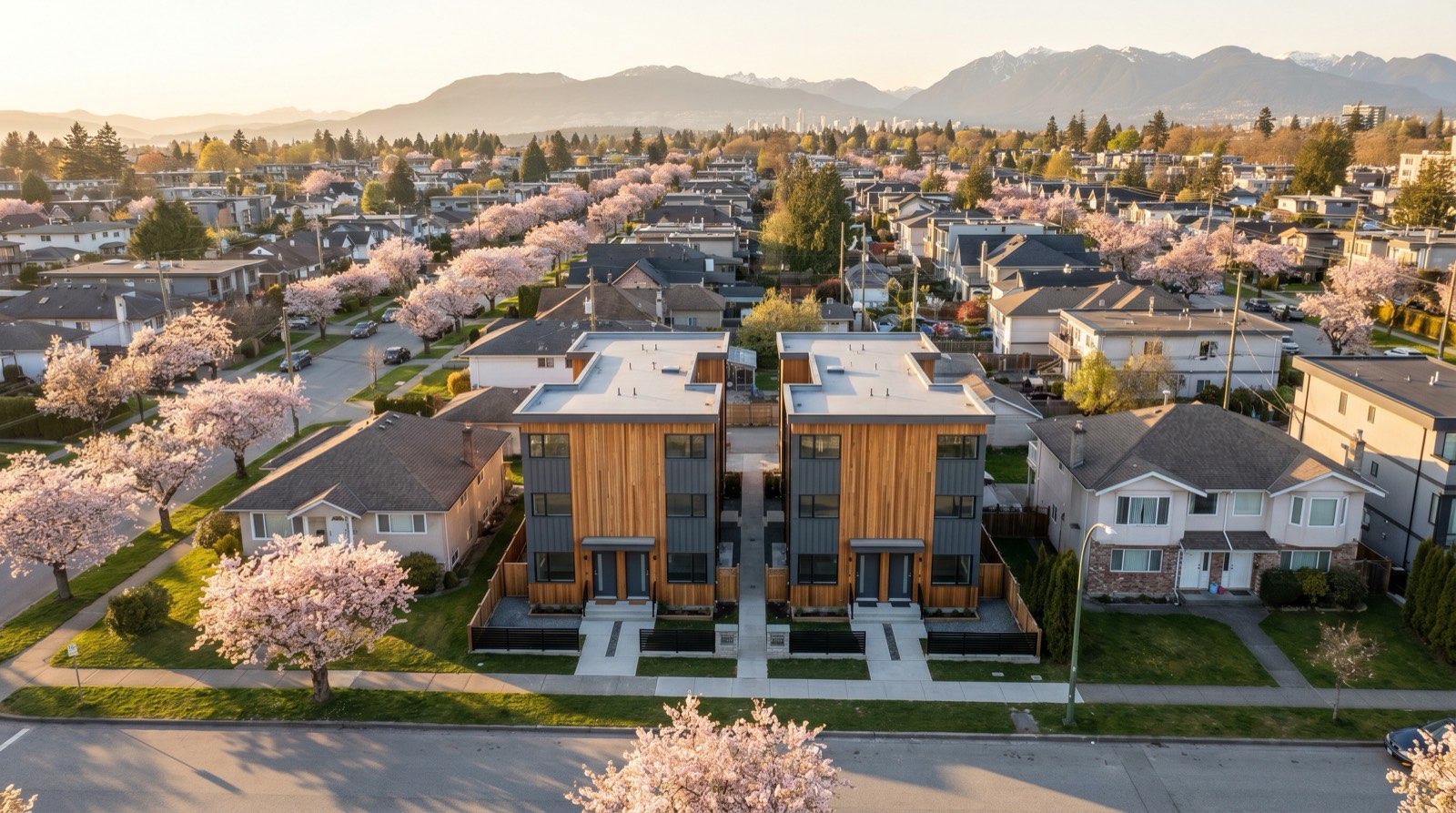
Daniel Parolek of Opticos Design coined "missing middle" in 2010 to name the housing types — duplexes, fourplexes, courtyard apartments — that North American zoning had quietly outlawed since the 1950s.
Why BC mandated it
Bill 44 came into force across BC in 2023. It told municipalities to allow at least three to six units on most former single-family lots. That changed zoning across hundreds of thousands of parcels.
What this hub does
It separates policy text from market reality. The legislation is one thing. What gets built, where, and at what cost is another. Both matter.
How To Read The Guide
Read the policy
Bill 44, the SSMUH provincial policy manual, the parking-reform sections, and the single-stair Building Code path. Then read your own city's implementing bylaw.
Understand the type
A duplex is not a fourplex. A fourplex is not a sixplex. A courtyard cluster is not a townhouse row. Each typology has different geometry, code path, and economics.
Test the lot
Frontage, lot area, slope, soil, servicing, trees, easements. Most parcels do not actually pencil at the maximum unit count, even where the bylaw allows it.
What Makes The Topic Hard
Policy clarity
4/5Bill 44 itself is short and clear. Implementing bylaws vary widely.
Production-to-permit gap
4/5Permitting volume is rising fast. Completed buildings still lag two to three years behind.
Affordability impact
2/5New small multiplex units rent or sell at the top of the local market. Affordability comes from supply at scale.
Regional variation
5/5Vancouver, Burnaby, Surrey, and the District of North Vancouver are running four very different SSMUH playbooks.
Three Ways To Use This Hub
Reader Goal
Read first
You are new to the topic. Start with the definition, the Bill 44 page, and the building-type primers before touching economics.
Reader Goal
Test a lot
You own or are buying a parcel. Read feasibility, financing, cost drivers, and your specific city page side by side.
Reader Goal
Engage the debate
You are following the policy fight. The displacement, design quality, and "does it work" pages summarize the arguments with citations.
Best For
- ✓ BC homeowners who want a citable answer about what Bill 44 changed for their lot.
- ✓ Builders and architects who need a typology + policy reference in one place.
- ✓ Policy readers who want the academic and empirical case with sources, not slogans.
Usually Fails When
- ✕ You want a single dollar figure for how much a multiplex costs — cost depends on site, scope, and code path.
- ✕ You expect upzoning to produce affordable units overnight — the affordability mechanism is supply at scale over years.
- ✕ You assume every R1 lot can support six units — feasibility depends on frontage, slope, soil, and servicing.
What To Verify Before Spending Money
- → Your specific city's implementing bylaw, not just the provincial policy manual.
- → Your lot's frontage, lot area, and slope before assuming any unit count.
- → Whether your city has updated parking minima and how that changes your design.
Explore The Hub
Frequently Asked Questions
What is missing middle housing?
Is missing middle the same as Bill 44 SSMUH?
Where in BC does missing middle apply?
Does missing middle housing make housing more affordable?
Who is this hub for?
Explore Related Guides
Build-to-Rent
Built-to-Rent Multiplex Hub
For owners specifically considering rental tenure on a missing middle lot, including CMHC MLI Select pathways.
Gentle Density
Gentle Density Guide
Sister concept used by some Canadian cities. Includes laneway, infill, and small-scale density that overlaps with missing middle.
Multigenerational
Multigenerational Living Hub
For families using missing middle units to live across generations on the same lot under shared title.
Official Sources Referenced
Screen Your Lot for Missing Middle
Enter any BC address to see what Bill 44 SSMUH unit count, lot coverage, and FSR your parcel actually qualifies for.