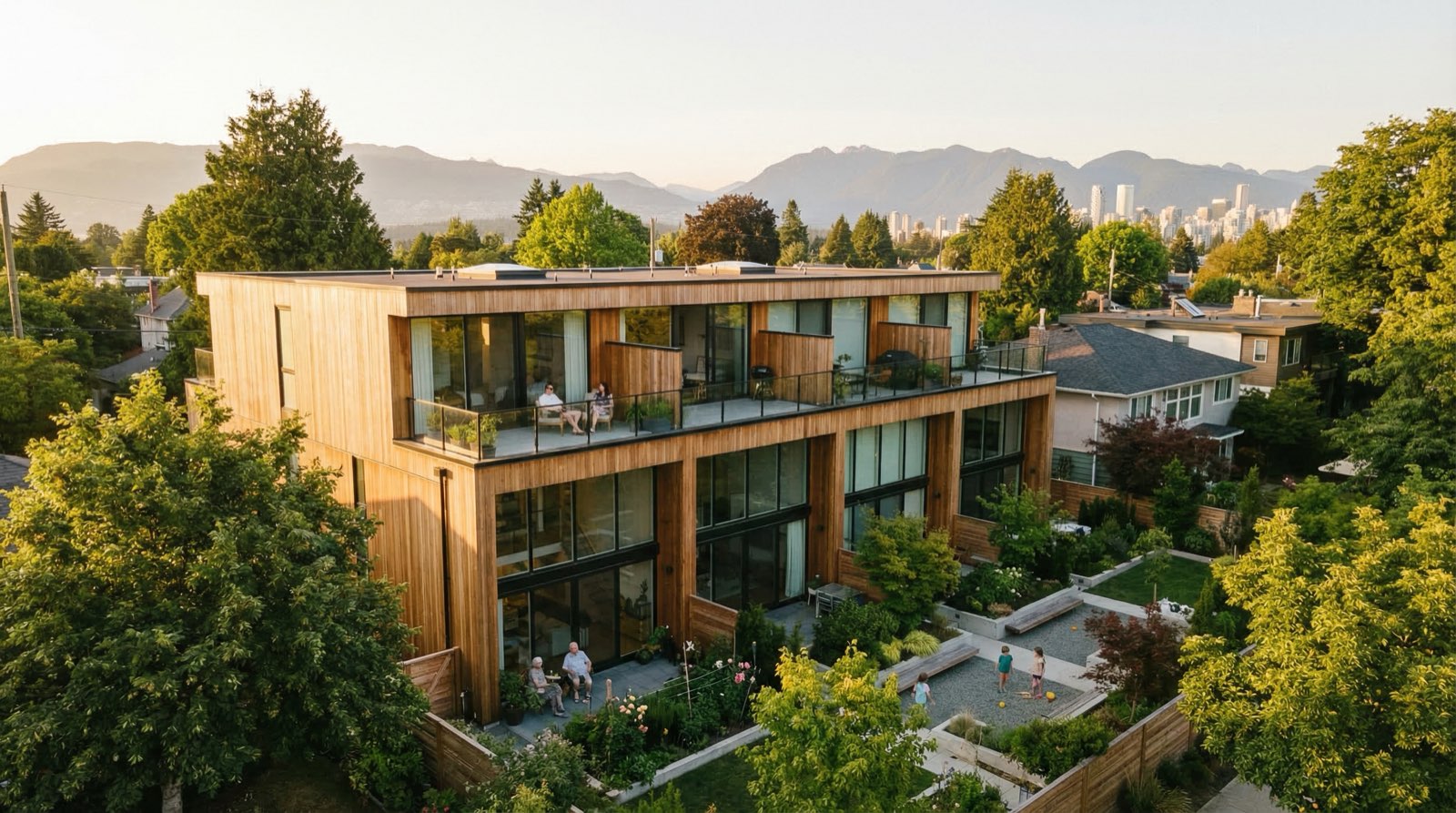
British Columbia | Multigenerational Housing
Multigenerational Living in BC: The Complete Multiplex Guide
441,750 Canadian households already live multigenerationally. Bill 44 makes it possible to build purpose-designed multiplex homes where every generation has privacy, equity, and proximity. This is the definitive guide.
441,750
Multigenerational households in Canada
Stats Canada 2021 Census
3.7%
BC multigenerational rate
Stats Canada, highest province
9.6%
Surrey multigenerational rate
Stats Canada Census 2021
+21.2%
Growth since 2001
Stats Canada longitudinal

Why Multiplex for Multigenerational Living?
Traditional multigenerational arrangements force families into compromises: a basement suite with limited light, a laneway house that only fits one generation, or overcrowded shared spaces. A multiplex eliminates those trade-offs.
Privacy + Proximity
Each generation gets a self-contained unit with its own entrance, kitchen, bathroom, and living space. But you share the same address, the same yard, and the same property title. Grandparents are next door, not across town. Adult children have independence without paying $2,800/month rent.
Financial Advantage
A single-family home worth $1.8M can become a multiplex valued at $5.0-5.6M. That equity funds construction, replaces the need for rental housing, and creates intergenerational wealth. Blended family income strengthens mortgage qualification. One property serves the financial needs of an entire family.
Aging in Place
Purpose-designed accessible units allow seniors to age safely at home with family nearby. Main-floor bedrooms, walk-in showers, wide doorways, and zero-step entries mean no move to assisted living. Families save $4,000-8,000/month compared to care facility costs while maintaining dignity and connection.
Next-Generation Affordability
With the median Vancouver home at $2.0M+, adult children face a 15-20 year savings timeline for a down payment. A multigenerational multiplex provides immediate homeownership within the family property, building equity from day one instead of paying rent that builds someone else's wealth.
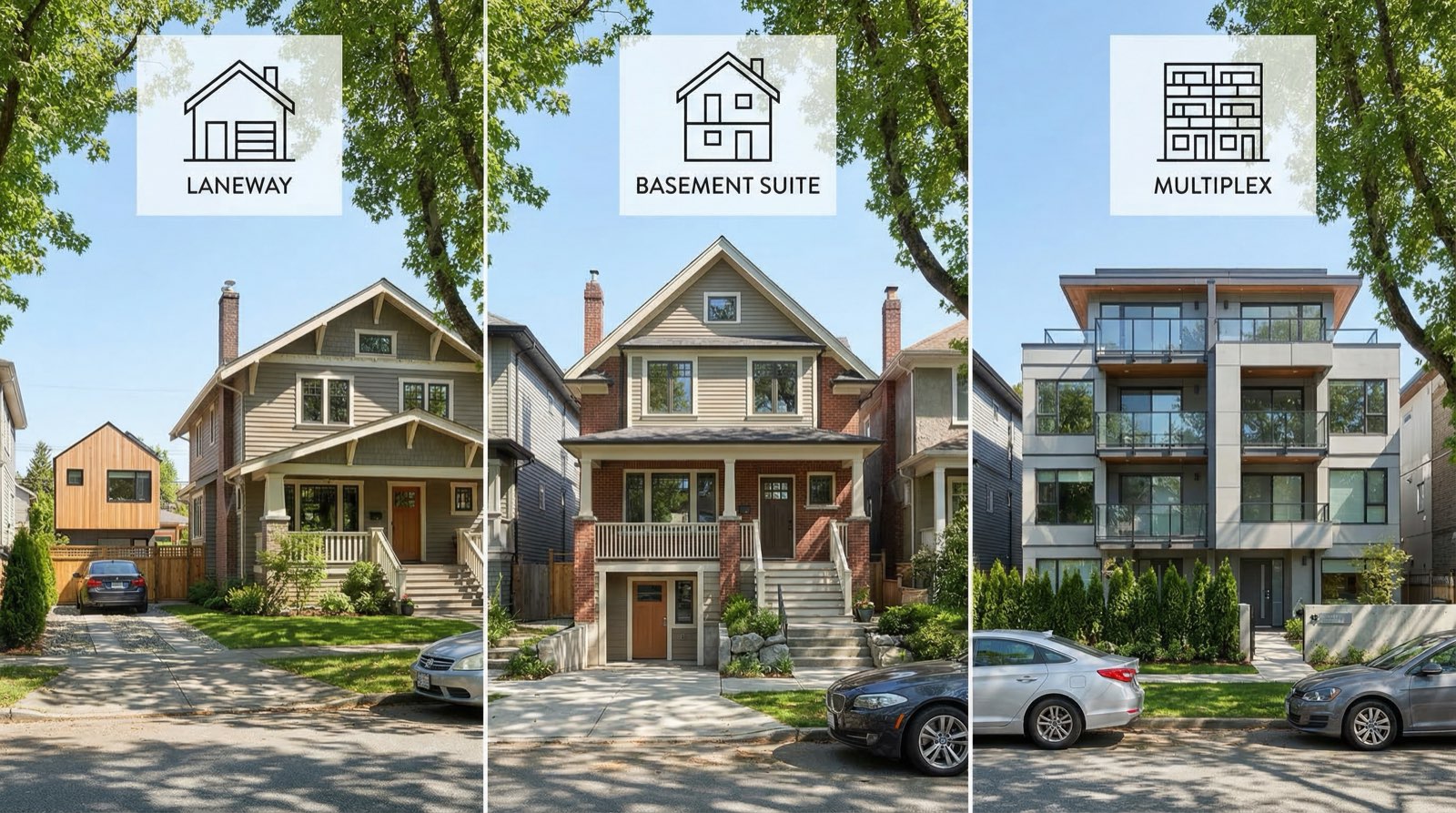
Laneway vs Suite vs Multiplex for Multigenerational Living
Side-by-side comparison of BC housing forms for families considering multigenerational arrangements.
| Feature | Laneway House | Basement Suite | Multiplex |
|---|---|---|---|
| Units available | 1 secondary | 1 basement | 3-6 primary |
| Typical unit size | 750-1,000 sq ft | 500-800 sq ft | 800-1,400 sq ft |
| Separate entrance | Yes | Usually side/rear | Yes, each unit |
| Full kitchen per unit | Yes | Yes | Yes, each unit |
| Accessibility options | Limited (often 2-storey) | Below grade, stairs | Main-floor units possible |
| Generations supported | 2 | 2 | 2-4 |
| Stratifiable (separate title) | No | No | Yes, in many cities |
| Estimated build cost | $550-900K | $100-200K | $1.8-3.2M (full project) |
| Value creation potential | Moderate | Low | High ($1.5-2.5M equity) |
| Privacy level | High (detached) | Low (shared structure) | High (separate units) |
The Numbers: Multigenerational Housing in Canada
Statistics Canada Census 2021 data reveals multigenerational living is accelerating across the country, with British Columbia leading the trend.
National Trends
| Metric | Value |
|---|---|
| Total multi-gen households | 441,750 |
| National rate | 2.9% |
| Growth since 2001 | +21.2% |
| Adults 25-34 with parents | 35% |
| Seniors 65+ in multi-gen | 413,000 |
| Avg household size (multi-gen) | 4.8 persons |
BC & Metro Vancouver
| Region | Multi-Gen Rate |
|---|---|
| British Columbia (overall) | 3.7% |
| Surrey | 9.6% |
| Abbotsford | 7.8% |
| Richmond | 5.2% |
| Delta | 4.5% |
| Burnaby | 4.1% |
| Vancouver | 3.2% |
Municipal Multigenerational Multiplex Support
Which Metro Vancouver cities support multigenerational multiplex development under Bill 44 SSMUH bylaws.
| City | Multi-Gen Rate | Max Units | Lot Widths | Status | Notes | Details |
|---|---|---|---|---|---|---|
| Vancouver | 3.2% | 6 | 33' - 50'+ | Full SSMUH | R1-1 zoning, stratification allowed | View |
| Burnaby | 4.1% | 6 | 40' - 66'+ | Full SSMUH | No FSR max, transit bonus density | View |
| Surrey | 9.6% | 4-6 | 50' - 70'+ | Full SSMUH | Highest multi-gen rate in Metro | View |
| Coquitlam | 3.4% | 4-6 | 50' - 60'+ | Full SSMUH | Evergreen Line transit zones | View |
| Richmond | 5.2% | 4-6 | 40' - 60'+ | Active | Canada Line proximity, strong demand | View |
| North Vancouver | 2.8% | 4-6 | 40' - 50'+ | Full SSMUH | City + District adopted | View |
| Delta | 4.5% | 4 | 50' - 66'+ | Active | Larger lots, suburban density | View |
| Langley | 3.8% | 4-6 | 50' - 66'+ | Active | Township + City aligning | View |
See the full city-by-city comparison at multigenerational by city.
How It Works: From Feasibility to Move-In
Feasibility Assessment
We analyze your lot dimensions, zoning, servicing capacity, and family needs to determine unit count, layout options, and financial viability. This includes a preliminary pro forma showing construction costs, timeline, and projected value creation.
Family Planning Workshop
We work with your family to define each generation's space requirements, accessibility needs, shared vs. private areas, and budget parameters. This ensures the design brief reflects how your family actually lives.
Design & Permitting
Our architect team produces drawings that meet municipal requirements while optimizing for multigenerational living: separate entrances, accessible units, sound insulation, and shared outdoor space. We manage the full permitting submission.
Financing & Pre-Construction
We arrange construction financing using blended family income where applicable, coordinate CMHC programs, and prepare for the MHRTC tax credit. Pre-construction includes trades scheduling, materials procurement, and site preparation.
Construction & Move-In
VanPlex manages construction delivery with SSMUH-experienced trades. We coordinate phased occupancy if needed, so one generation can move in while finishing touches complete on other units. Final inspections, occupancy permits, and keys.
Tax Benefits for Multigenerational Builds
The federal Multigenerational Home Renovation Tax Credit (MHRTC) provides a 15% refundable credit on up to $50,000 of eligible renovation expenses, yielding up to $7,500. The credit applies when creating a secondary dwelling unit for a qualifying relative who is 65+ or has a disability.
Beyond the MHRTC, multigenerational multiplex owners benefit from principal residence exemption on their occupied unit, potential capital gains deferral strategies, and income splitting through family-member tenancies.
Read the full financial guideMHRTC Quick Facts
- Eligible expenses: Up to $50,000
- Credit rate: 15% refundable
- Max credit: $7,500 per qualifying renovation
- Qualifying relative: Senior 65+ or adult with disability
- Requirements: Must create a self-contained secondary unit with private entrance, kitchen, and bathroom
- Claim period: Year renovation is completed
Design Principles for Multigenerational Multiplex
A well-designed multigenerational multiplex balances independence with connection. These principles guide every VanPlex family build.
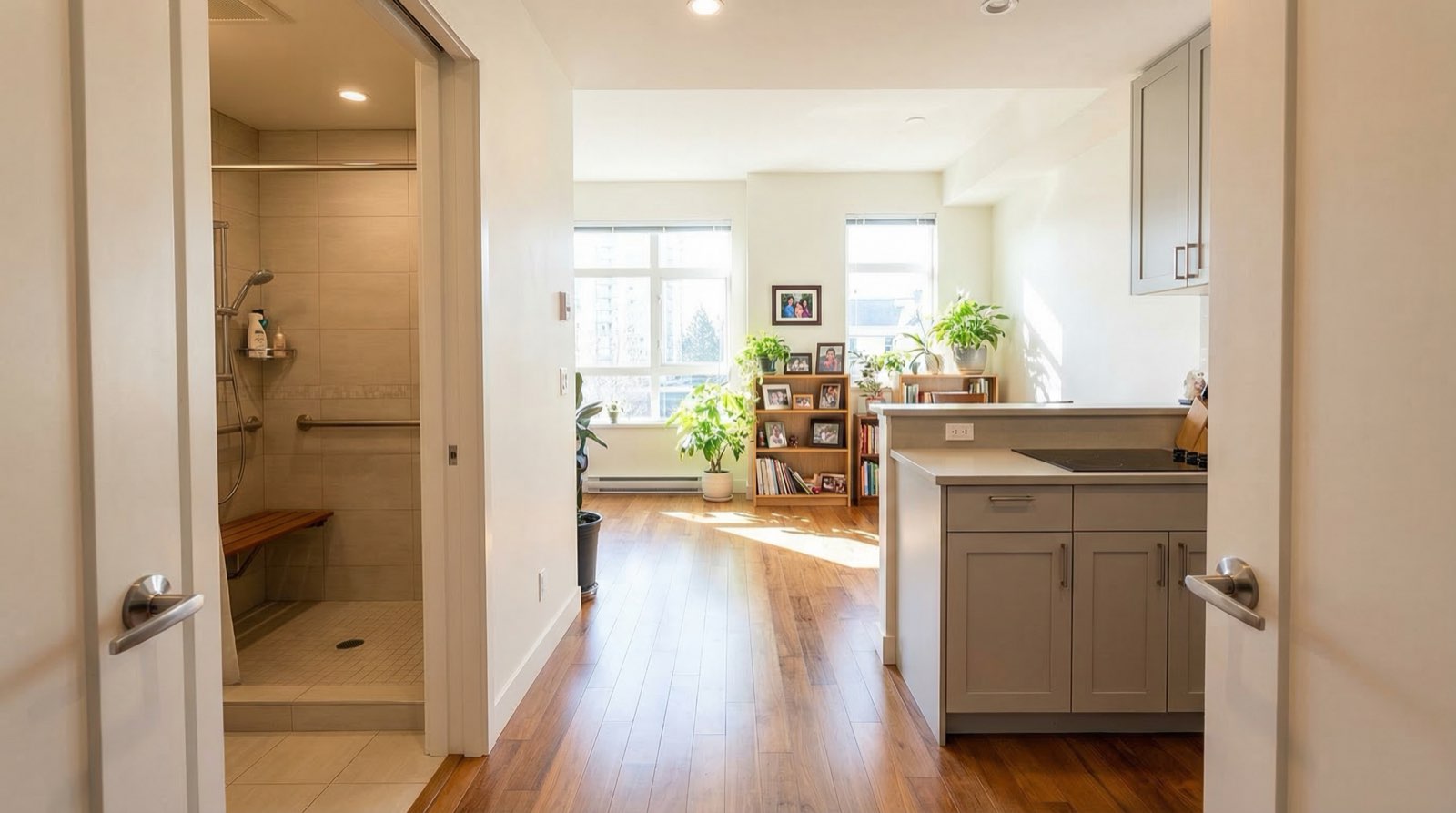
Accessible Units
At least one unit designed for aging in place: main-floor bedroom and bathroom, 36"+ doorways, zero-step entry, reinforced walls for grab bars, lever handles throughout, and roll-in shower capability.
Separate Entrances
Each unit requires its own dedicated entrance. Best practice positions entrances on different sides of the building or uses a shared lobby with private vestibules to maintain independence and reduce noise transfer.
Shared Outdoor Space
A central courtyard, shared garden, or connected deck area creates natural gathering points for family meals, celebrations, and daily interaction without encroaching on private unit space.
Sound Insulation
STC 55+ ratings between units, resilient channel mounting, acoustic insulation in party walls, and strategic unit placement (bedrooms away from shared walls) ensure privacy and comfortable living.
Flexible Floor Plans
Units designed with demountable walls or convertible rooms allow families to adapt spaces as needs change: a nursery today becomes a home office in five years, then a caregiver suite in fifteen.
Cultural Sensitivity
Many multigenerational families have specific cultural needs: larger gathering kitchens, dedicated prayer or meditation rooms, shoe-removal entries, or multi-purpose family rooms. These are integrated from day one.
Explore detailed design strategies in our multigenerational design guide.
Explore Multigenerational Guides
Financial Guide
Fund Your Family Compound
MHRTC deep dive, mortgage options, proforma walkthrough, care facility cost comparison, and tax strategy for multigenerational builds.
Design Guide
Design for Every Generation
Accessible design principles, unit configurations, cultural considerations, energy efficiency, and separate entrance strategies.
City Guide
Find Your City's Potential
City-by-city comparison of multigenerational rates, zoning capacity, lot sizes, build costs, and transit access across Metro Vancouver.
Multigenerational Insights from the VanPlex Blog
Deep dives into multigenerational strategy, family success stories, and market analysis from the VanPlex research team.
3 Benefits of Multi-Generational Housing Through Multiplex Development
Multigenerational Multiplex: Real Family Success Stories
The Multiplex Advantage: Smartest Move for Canadian Homeowners
Family Office Strategy: Generational Wealth Through Multiplex
Unlock Retirement Wealth with Bill 44
Richmond Multiplex Zoning: 2026 Status & Opportunities
The World Is on Fire. Why Are People Still Building?
Partner-in-Place Multiplex Strategy
Zoning Reform as Retirement Security
Vancouver Multiplex Market: A New Phase in 2026
Why 98% Should Wait and 2% Should Build Now
Three Doors: The Multiplex Homeowner Decision Framework
Check Your Property's Multigenerational Potential
Enter your address to see how many units your lot supports, the estimated build cost, and the projected value creation for your family.
Frequently Asked Questions
What is multigenerational housing?
How common is multigenerational living in Canada?
Can I build a multigenerational multiplex under Bill 44?
What tax credits are available for multigenerational renovations?
How does a multiplex compare to a laneway house for multigenerational living?
What is the typical cost of a multigenerational multiplex in Metro Vancouver?
Which BC cities have the highest multigenerational housing rates?
Can each unit in a multigenerational multiplex be separately owned?
What accessibility features should a multigenerational multiplex include?
How long does it take to build a multigenerational multiplex?
Ready to Build for Your Family?
VanPlex has guided dozens of multigenerational multiplex projects from feasibility to keys. Start with a free lot analysis to see what your property can deliver for every generation.
Analyze your property now