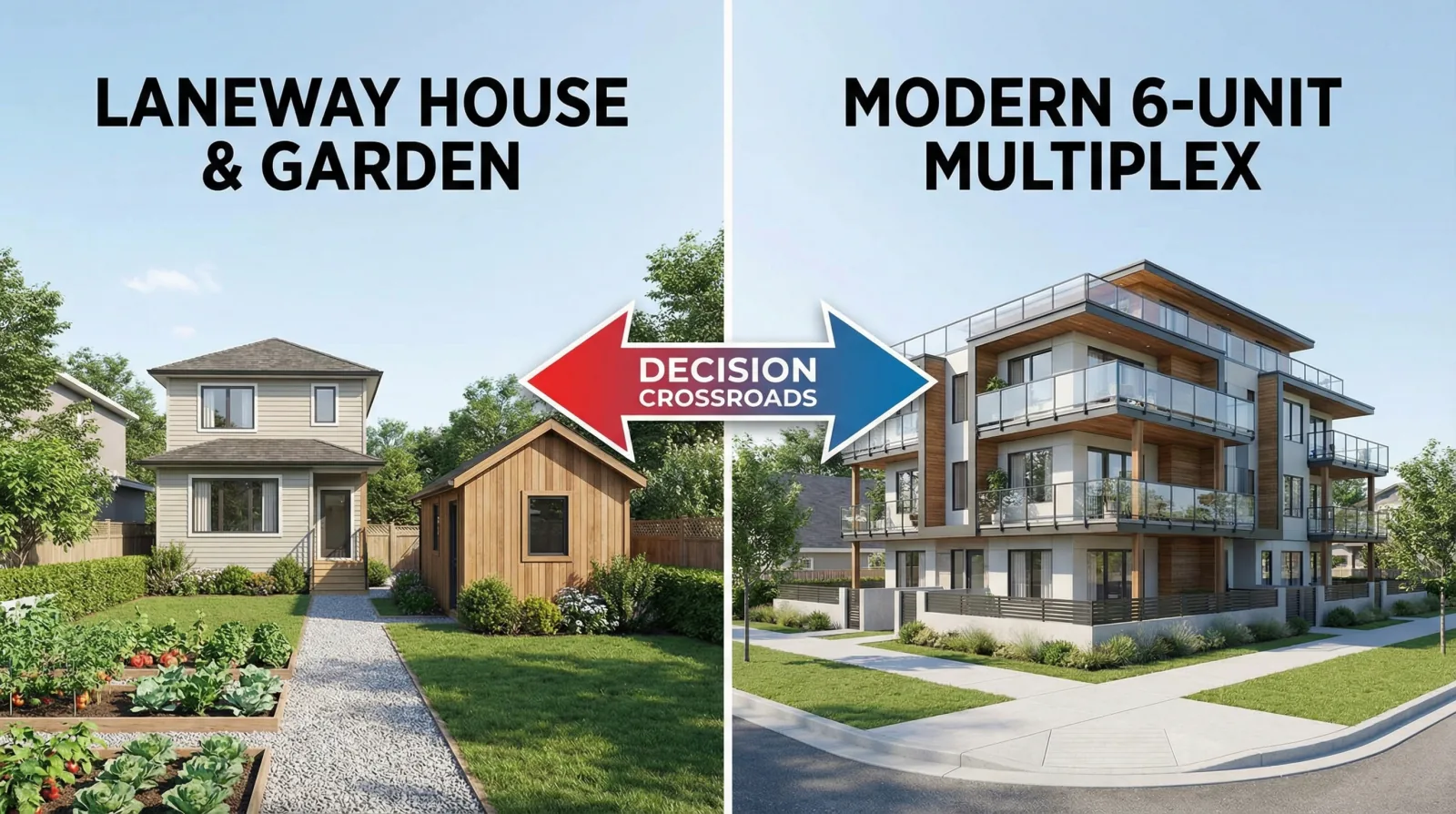

Most homeowners exploring multiplex zoning tend to focus on one of two paths:
- Convert their property independently to add units and unlock value
- Sell the property outright and redeploy capital elsewhere
The homeowners overview covers both of those paths in plain terms before you go further.
But for a small subset of properties — typically those with exceptionally strong multiplex economics — there is a third, less discussed option.
We refer to it as the Partner-in-Place path.
What does “Partner-in-Place” mean?
In simple terms, instead of selling your home outright or undertaking a self-funded conversion, your property becomes part of a larger, professionally executed multiplex project, alongside investors.
- Your land remains the foundation of the project
- Outside capital funds construction and execution
- You participate proportionally in the project’s outcome
- You do not take on construction risk or management responsibility
You’re not becoming a developer.
You’re not funding a build.
And you’re not stepping away from the value your land creates.
A critical (and often overlooked) tax reality
Many homeowners don’t realize this until late in the process:
Converting a single-family home into a multiplex independently often triggers a “change of use,” which can result in unfavourable capital-gains treatment.
Once a property is developed and sold as multiple units, it is commonly reclassified in a way that removes the protections homeowners expect under principal-residence rules. This can lead to significant taxable gains, even when the homeowner never intended to operate as a developer.
By contrast, when structured correctly, a Partner-in-Place approach can preserve a homeowner’s principal residence tax privileges, because the program does not inherently trigger the same change-of-use definition. As a result, value can be unlocked and participation maintained without automatically crystallizing capital gains at the same point in time.
This is not about aggressive tax planning or loopholes.
It’s about choosing a structure that aligns with how the tax code defines use, ownership, and disposition.
Professional tax and legal advice is always required — structure matters.
Who is this actually for?
This option is not common, and it’s not appropriate for most properties.
It tends to make sense only when:
- The site supports very high multiplex returns (often over 90% ROE scenarios)
- The homeowner is open to partnership rather than a clean sale
- The objective is long-term value participation, not speed alone
- Tax efficiency and structural alignment are meaningful considerations
For sites where you want to model the return before having this conversation, the advanced proforma tool gives you a starting point. Our services team can then assess whether a partner-in-place structure fits what the numbers show.
In other words, this is an advanced option for homeowners who think in terms of equity, structure, and alignment, not just price.
Why consider it at all?
Some homeowners face a very real tension:
“I don’t want to manage a complex build — but I also don’t want to give away the upside or lose a large portion of it to taxes.”
The Partner-in-Place path exists to resolve that tension.
It allows:
- Capital to do what capital does best
- Operators to manage execution professionally
- Homeowners to remain aligned, invested, and structurally protected
When it fits, it can be one of the most capital-efficient and tax-aware ways to unlock multiplex value.
A note on expectations
This is not a default path, and it’s never pushed.
It only appears when the site economics, capital structure, and tax profile all line up cleanly.
Most homeowners will still choose to sell or convert independently — and that’s often the right decision.
But for a small number of exceptional properties, partnership can be the most elegant and strategically sound option available.
If you’re curious whether your property might qualify for this type of structure, the first step is simply understanding your site’s multiplex potential.
Clarity always comes before decisions.
Visit VanPlex.ca to:
- Run an instant eligibility check for your Vancouver or Burnaby property
- Calculate your multiplex ROI using PlexRank™ analysis
- Explore whether partnership structures align with your goals
—
David Babakaiff
Co-Founder, VanPlex.ca
PlexRank™ | Profit with Multiplex