British Columbia | Green & Net-Zero Multiplex
Net-Zero & Green Multiplex in BC: The Practical Resource Hub
Building green is no longer optional for BC multiplex developers. Step Code is mandatory, financing rewards energy performance, and the gap between code-minimum and net-zero is narrower than most people think.
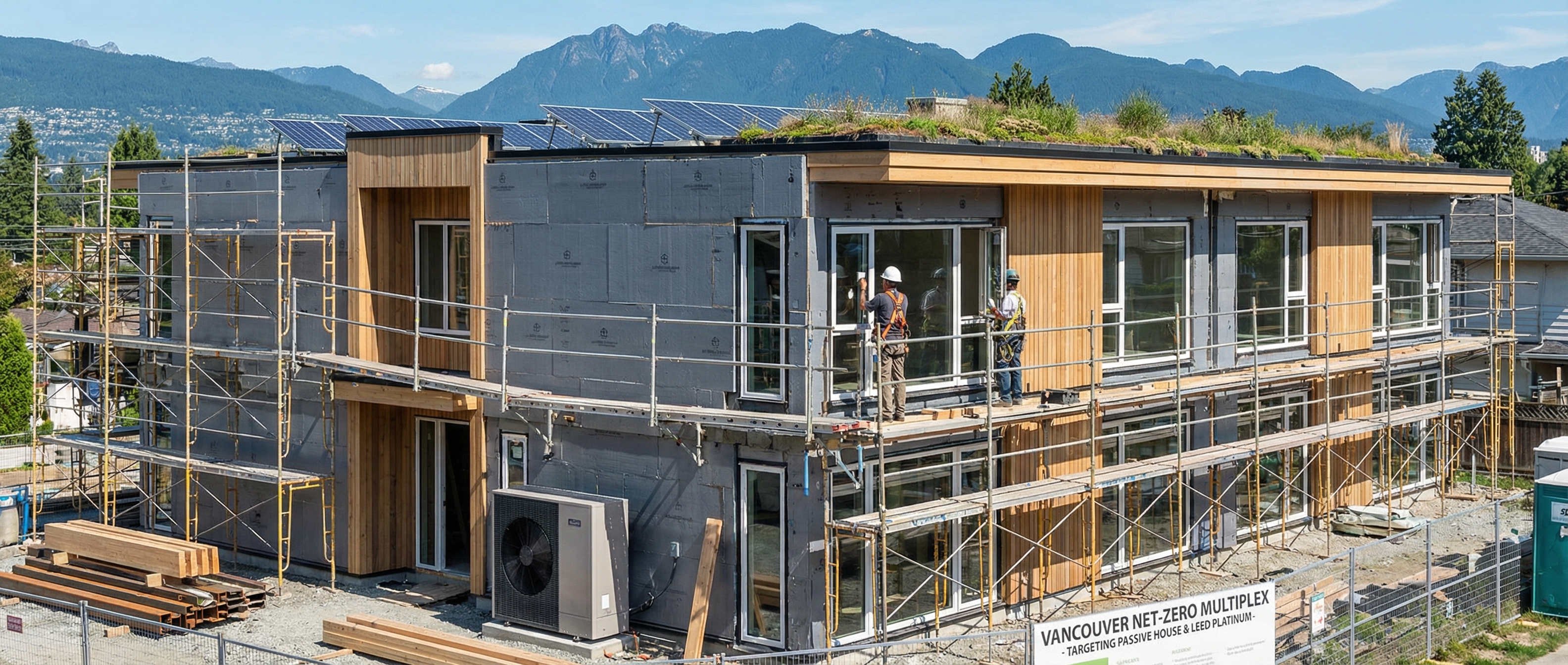
- ✓Step Code is mandatory — every new multiplex in BC must meet energy performance targets. The question is how far beyond minimum to go.
- ✓Green financing rewards performance — CMHC discounts, BC Hydro rebates, and municipal incentives can recover 30-60% of the green premium.
- ✓Vancouver's FSR exclusion is the biggest lever — net-zero buildings get up to 19% bonus floor area at no density cost.
- ✓The cost premium is shrinking — Step 3 adds 5-10%, not the 20-30% that many builders still assume.
Why code is tightening
- • BC committed to net-zero new construction by 2032
- • Step Code ratchets up every 2-3 years
- • Building today at code minimum means building to tomorrow's substandard
Why builders resist
- • Upfront cost premium feels real; long-term savings feel abstract
- • Green modeling adds design cost and timeline
- • Not all trades are comfortable with high-performance assemblies
What this hub does
- • Breaks down Step Code levels with real cost premiums
- • Shows which incentives actually move the needle
- • City-by-city rules so you know your baseline
Three Questions That Shape Every Green Multiplex Decision
What Step Code level does your city require?
Baseline varies by municipality. Vancouver is at Step 3. Some cities are still at Step 2. Know your floor before you plan your ceiling.
Does going beyond minimum pencil?
Step 4 typically adds 10-18% to build cost but unlocks CMHC premium discounts and BC Hydro rebates that can recover 30-60% of the premium.
Can green incentives change the deal?
Vancouver's 19% net-zero FSR exclusion alone can be worth $200K+ on a typical lot. Stack that with CMHC and utility rebates and the math changes substantially.
Reading the Signals
Code complexity
4/5Step Code adds energy modeling, blower door tests, and design coordination
Cost premium predictability
3/5Premium is well-documented for Steps 2-4; Step 5 varies more
Financing upside
4/5CMHC discounts + BC Hydro rebates can recover 30-60% of premium
Long-term operating savings
5/5Heat pump + envelope = 40-70% lower energy bills over building lifetime
Three Outcomes
Build to Code Minimum
- • Lowest upfront cost
- • No additional design complexity
- • Risk: code tightens and your building becomes substandard faster
Target Step 4 for Financing Edge
- • CMHC premium discount saves thousands over loan life
- • BC Hydro rebates offset 30-60% of green premium
- • Sweet spot for most multiplex developers
Go Net-Zero for Maximum Incentives
- • Vancouver 19% FSR exclusion unlocks free floor area
- • Lowest operating costs attract premium tenants
- • Future-proof against all foreseeable code changes
Best For
- ✓ Developers targeting CMHC MLI Select financing (5+ units)
- ✓ Vancouver projects where the net-zero FSR exclusion adds significant floor area
- ✓ Purpose-built rental where lower operating costs attract tenants
Usually Fails When
- ✕ The project is small (1-2 units) and there is no financing advantage beyond code minimum
- ✕ The municipality offers no local green incentives beyond provincial baseline
- ✕ The additional design timeline threatens a time-sensitive closing or market window
What To Verify Before Spending Money
- → Your municipality's current and planned Step Code requirements
- → Whether CMHC green premium discounts apply to your project size and tenure type
- → An energy modeler's estimate of the cost premium for each Step Code level on your specific design
Explore The Hub
STANDARDS & DESIGN
ECONOMICS
BY CITY
Frequently Asked Questions
Is green building mandatory for multiplex in BC?
How much more does a green multiplex cost?
What is the Vancouver net-zero FSR exclusion?
Do green buildings get better rents?
Can I retrofit an existing multiplex to green standards?
Explore Related Guides
Build-to-Rent
Rental Tenure Multiplex
CMHC MLI Select green incentives are strongest for purpose-built rental. See how rental tenure amplifies the green financing stack.
Laneway & ADU
Laneway Houses & ADUs
Step Code applies to laneway houses too. Smaller projects have different cost-benefit math for green upgrades.
Heritage Multiplex
Heritage Lots & HRAs
Heritage buildings face unique energy challenges. Combining HRA density bonuses with green incentives can create powerful stacking opportunities.
Official Sources Referenced
Check Your Lot's Green Multiplex Potential
Enter any BC address to see unit count, energy requirements, and whether green incentives change the economics on your site.