
Standards & Design | Step Code
BC Energy Step Code for Multiplex: Levels 1-5 Explained
The Step Code is not a single standard — it is a ladder. Each step requires measurably better energy performance, tighter envelopes, and more sophisticated mechanical systems. Understanding the ladder helps you decide how high to climb.
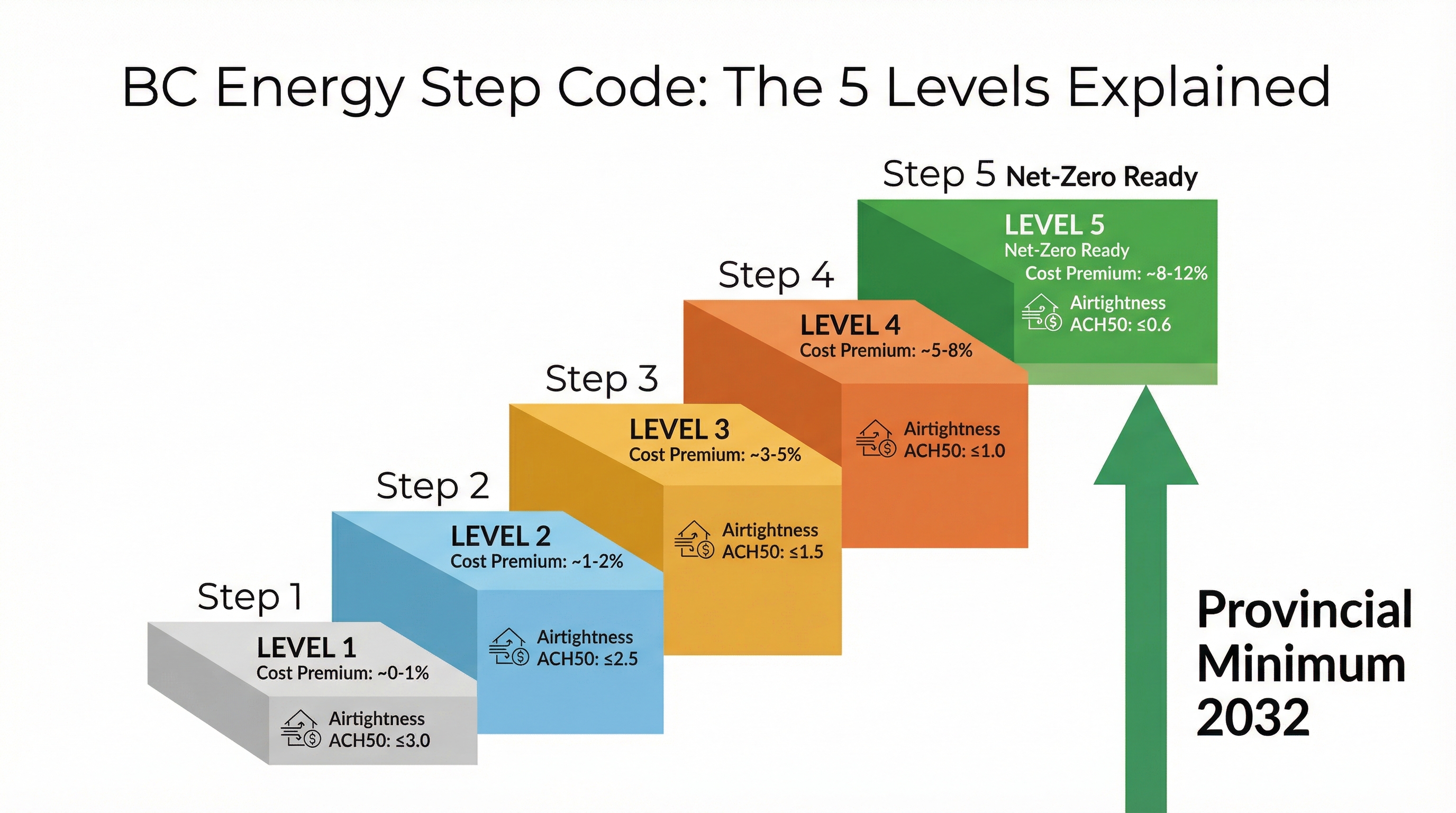
The Five Steps
Better than base code, but still largely conventional construction with improved air barrier detailing.
Energy Target
~10-15% better than base code
Airtightness
3.0 ACH50 or better
Typical Status
Standard practice for most builders since 2023
Meaningful envelope improvement, better windows, improved insulation continuity. The current BC minimum for most Part 9 buildings.
Energy Target
~20-30% better than base code
Airtightness
2.5 ACH50 or better
Typical Status
Provincial minimum since late 2024. Most municipalities already here or higher.
Significant design attention to thermal bridging, window performance, and mechanical ventilation with heat recovery.
Energy Target
~40-50% better than base code
Airtightness
1.5 ACH50 or better
Typical Status
Vancouver and several municipalities require this or will by 2027.
Approaching Passive House performance. Triple-pane windows, continuous exterior insulation, HRV/ERV standard.
Energy Target
~60-70% better than base code
Airtightness
1.0 ACH50 or better
Typical Status
Leading-edge builders and projects seeking CMHC green premium discounts.
Building envelope is net-zero capable. With on-site renewables (solar PV), the building can achieve net-zero energy.
Energy Target
Net-zero energy ready
Airtightness
0.6 ACH50 or better (Passive House territory)
Typical Status
Demonstration projects and Passive House certified buildings. BC target for all new construction by 2032.
What Changes at Each Step
Insulation
- Steps 1-2: Standard cavity insulation, some thermal bridge detailing
- Step 3: Continuous exterior insulation becomes practical necessity
- Steps 4-5: High-R assemblies (R-30+ walls), triple-pane windows, attention to every thermal bridge
Windows
- Steps 1-2: Standard double-pane, low-E
- Step 3: High-performance double-pane or triple-pane on north-facing
- Steps 4-5: Triple-pane standard, careful window-to-wall ratio management
Airtightness
- Step 1: 3.0 ACH50 — achievable with standard construction and air barrier tape
- Step 3: 1.5 ACH50 — requires detailed air barrier strategy and mid-construction blower door test
- Step 5: 0.6 ACH50 — Passive House territory. Every penetration must be sealed and tested
Mechanical
- Steps 1-2: Heat pump recommended but gas still permitted in some jurisdictions
- Step 3: Heat pump effectively required. HRV/ERV strongly recommended
- Steps 4-5: High-efficiency heat pump + dedicated HRV/ERV per unit. All-electric standard
Where the Province Is Heading
Step 2-3 minimum — most Metro Vancouver municipalities. Vancouver at Step 3.
Step 3 provincial minimum — all BC municipalities required to be at Step 3 or higher.
Step 4 target — leading municipalities move to Step 4. Provincial floor rises.
Step 5 / Net-zero ready — all new construction in BC to be net-zero energy ready.
Envelope Specifications by Step Level
The building envelope is where Step Code compliance is won or lost. Here is what each component looks like at each level — and what the cost delta means for your budget.
Walls (effective R-value)
+$3-$8/sq ft wall area from Step 2 to Step 5Step 2
R-22 nominal (2x6 + batt)
Step 3
R-24 effective (2x6 + 1" exterior foam)
Step 4
R-30 effective (2x6 + 2" exterior mineral wool)
Step 5
R-40+ effective (double stud or 3"+ exterior CI)
Roof / ceiling
+$1.50-$4/sq ft ceiling area from Step 2 to Step 5Step 2
R-40 attic blown cellulose
Step 3
R-50 attic blown cellulose
Step 4
R-60 attic + improved air sealing
Step 5
R-70+ with uninterrupted thermal envelope
Slab / foundation
+$2-$5/sq ft slab area from Step 2 to Step 5Step 2
R-10 underslab XPS (2")
Step 3
R-14 underslab XPS (2.5") + edge insulation
Step 4
R-20 underslab EPS/XPS (4") + thermal break at footing
Step 5
R-24+ underslab + continuous sub-slab + frost wall insulation
Windows
+$80-$200/sq ft window area from Step 2 to Step 5. Windows are typically the single largest envelope cost delta.Step 2
Double-pane, low-E, argon (U-1.6)
Step 3
Double-pane high-performance (U-1.4) or triple-pane (U-1.2)
Step 4
Triple-pane, low-E2, argon/krypton (U-0.9 to U-1.0)
Step 5
Triple-pane, Passive House certified (U-0.8 or better)
Air barrier system
+$1-$3/sq ft envelope area from Step 2 to Step 5. Labour-intensive but materials are inexpensive.Step 2
Poly vapour barrier + acoustic sealant (2.5 ACH50)
Step 3
Taped sheathing or liquid-applied WRB + blower-door verified (1.5 ACH50)
Step 4
Continuous exterior air barrier membrane + all penetrations sealed (1.0 ACH50)
Step 5
Passive House-grade airtightness: taped sheathing + service cavity (0.6 ACH50)
How the Premium Scales with Building Size
The percentage premium stays roughly the same across building sizes, but the per-unit cost drops as you add more doors. Larger multiplexes spread fixed envelope costs more efficiently.
Step 3 Premium
+$54,000 to $108,000 (5-10%)
Step 4 Premium
+$108,000 to $194,000 (10-18%)
Step 5 Premium
+$162,000 to $270,000 (15-25%)
Smallest form factor has the highest per-unit premium because fixed envelope costs are spread across fewer doors.
Step 3 Premium
+$81,000 to $162,000 (5-10%)
Step 4 Premium
+$162,000 to $292,000 (10-18%)
Step 5 Premium
+$243,000 to $405,000 (15-25%)
The sweet spot for green multiplex. Enough units to spread costs, small enough for Part 9 simplicity.
Step 3 Premium
+$96,000 to $192,000 (5-10%)
Step 4 Premium
+$192,000 to $346,000 (10-18%)
Step 5 Premium
+$288,000 to $480,000 (15-25%)
Only available on the secured rental path. CMHC MLI Select green discount can offset 40-60% of the Step 4 premium over the mortgage term.
- ✓Step 3 is the current practical floor — if your city has not adopted it yet, it will within 1-2 years.
- ✓Step 4 is where the financing incentives start — CMHC and BC Hydro rewards kick in meaningfully at Step 4.
- ✓Airtightness is the make-or-break metric — a building can have great insulation but fail Step Code if the air barrier leaks.
- ✓Engage an energy advisor at the design stage — not after drawings are done.
Best For
- ✓ All new multiplex construction in BC (Step Code is mandatory)
- ✓ Developers seeking CMHC green financing advantages at Step 4+
- ✓ Long-hold rental projects where operating savings compound over decades
Usually Fails When
- ✕ The project timeline cannot accommodate energy modeling (add 2-4 weeks to design phase)
- ✕ The builder has no experience with airtightness detailing (highest risk factor for Step Code compliance)
- ✕ Cost estimates are based on old data — premiums have dropped 30-50% since 2020
What To Verify Before Spending Money
- → Your municipality's current Step Code level and when the next ratchet is planned
- → Your energy advisor's estimate of incremental cost per step for your specific design and form factor
- → The builder's track record with blower door test results on recent projects
Frequently Asked Questions
What is BC Energy Step Code?
Which Step Code level does my city require?
What is the difference between Step Code and Zero Carbon Step Code?
Do I need an energy modeler?
What happens if I fail the blower door test?
Official Sources Referenced
Check Your Lot's Green Multiplex Potential
Enter any BC address to see unit count, energy requirements, and whether green incentives change the economics on your site.