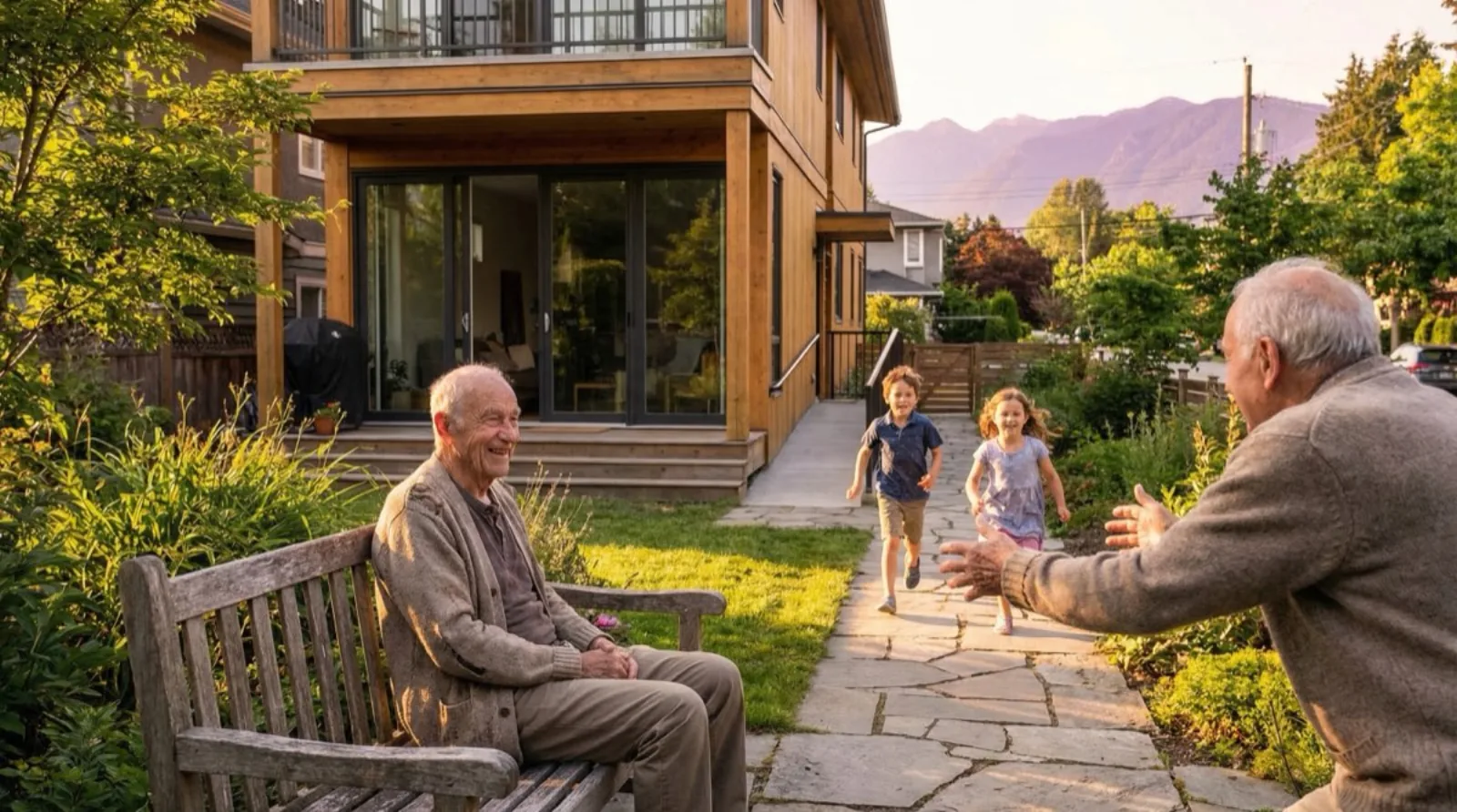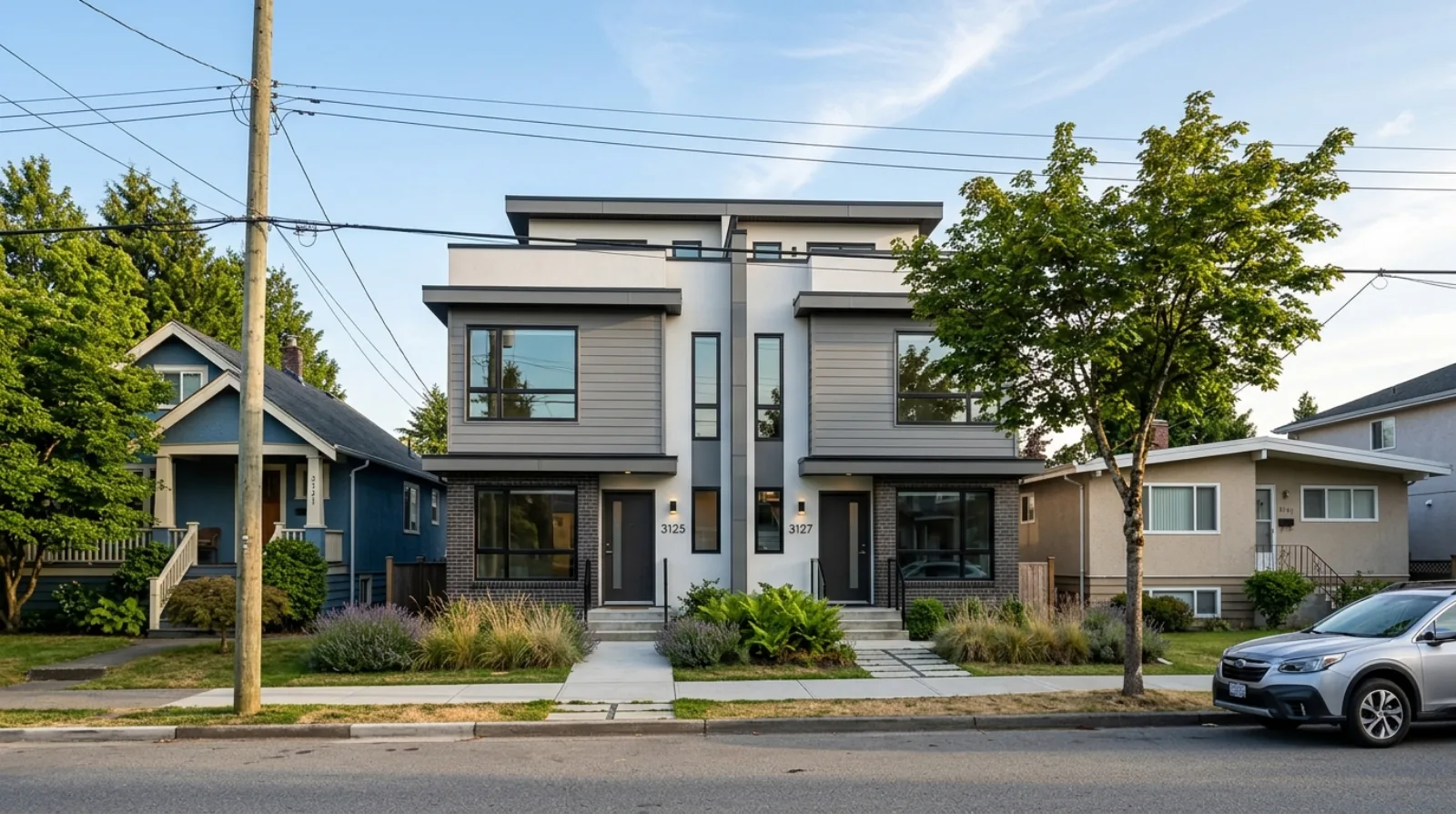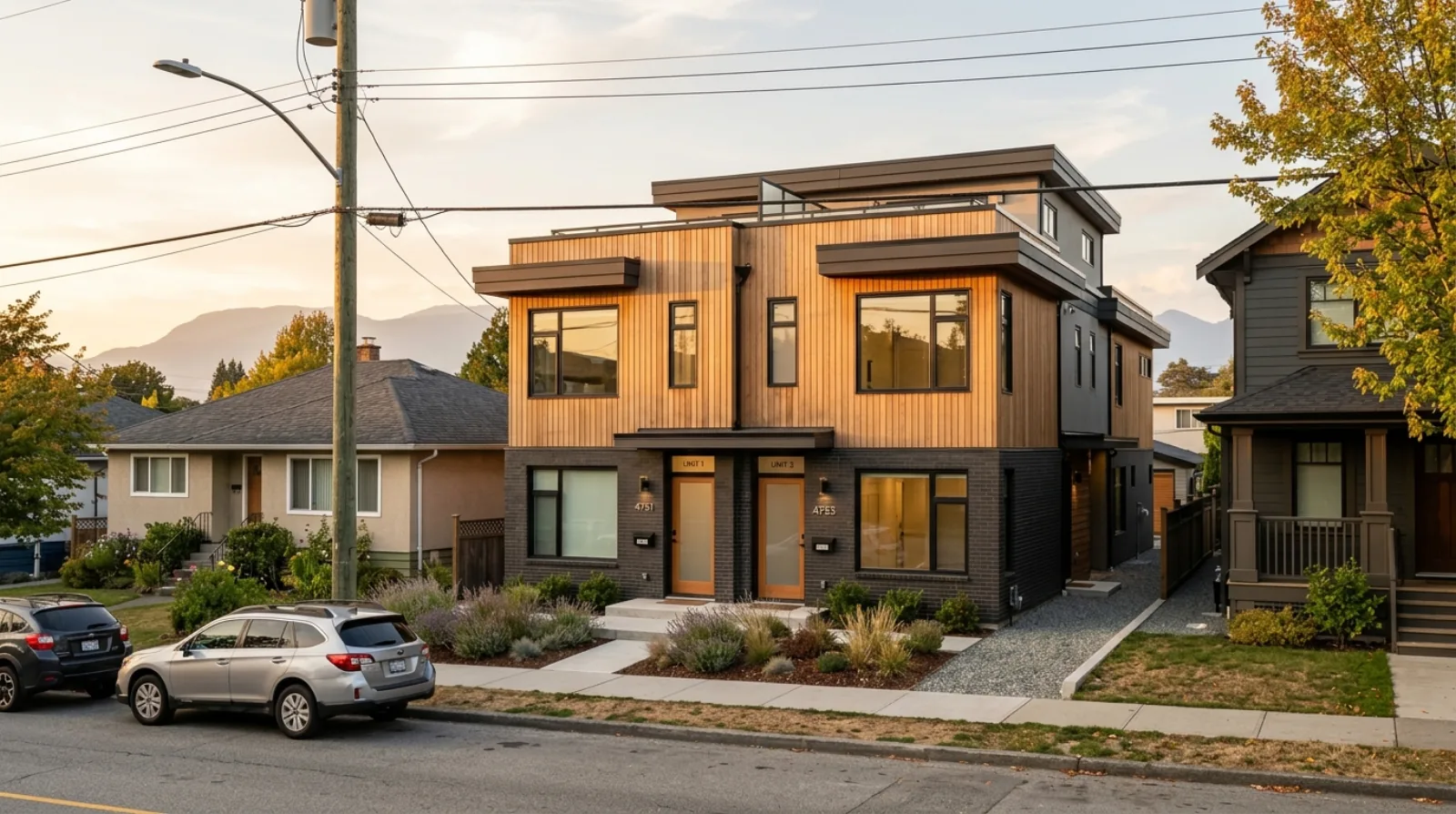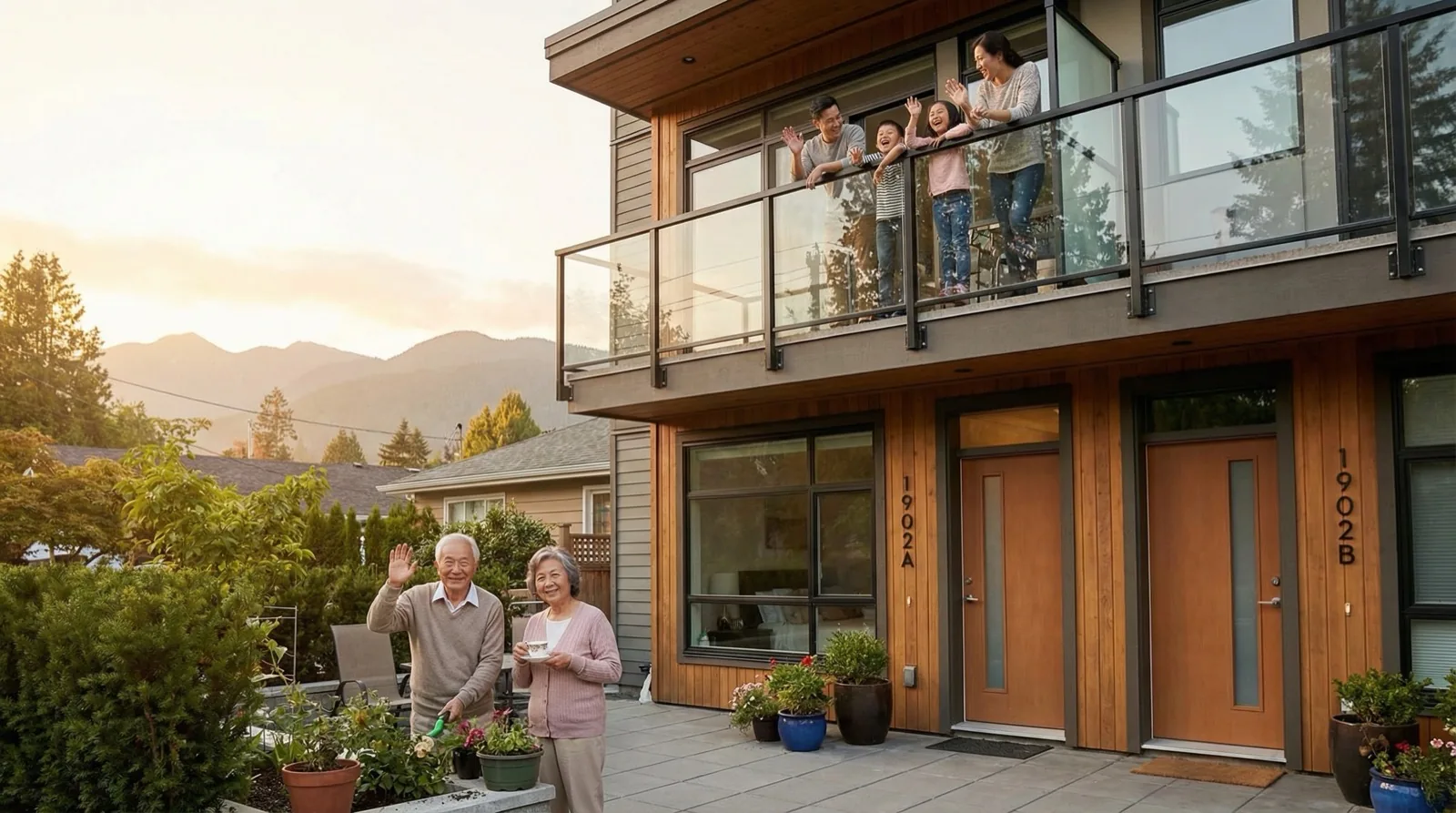

The fastest-growing segment of multiplex development isn’t investors—it’s families. Across Vancouver and Burnaby, multigenerational households are using Bill 44 to solve housing challenges that seemed impossible just three years ago. If you’re exploring this option for your family, our multigenerational living guide covers how to design and structure these projects. Here are their stories.
The Multigenerational Moment
Canada is experiencing a fundamental shift in how families live. Vancouver’s R1-1 zoning makes the city one of the best places in Canada to act on this shift — most standard lots can now accommodate four to six units without a rezoning application.
| Trend | Data Point | Source |
|---|---|---|
| Multigenerational growth | +45% since 2001 | CMHC |
| Adults 25-34 living with parents | 35% nationally | Stats Canada |
| Seniors preferring family care | 78% vs institutional | CIHI |
| Vancouver affordability gap | $550K affordable vs $1.5M avg | VanPlex analysis |
These trends converge in one solution: multiplex development that keeps families together while creating individual spaces.
Story #1: The Retirement Solution (Kitsilano)
The Situation: Margaret and Robert, both 72, owned their Kitsilano home for 38 years. Their daughter Sarah, 42, and her two children were renting a two-bedroom apartment for $3,200/month in Burnaby—1.5 hours from grandparents by transit.
The Challenge:
- Grandparents aging in oversized home
- Daughter priced out of neighborhood
- Grandchildren missing relationship with grandparents
- No viable traditional solution
The Multiplex Solution: Converted the property into a fourplex:
- Unit 1: Margaret and Robert (1,200 sf, main floor)
- Unit 2: Sarah and kids (1,400 sf, upper floor)
- Units 3-4: Sold to offset costs ($2.4M combined)
The Outcome:
| Before | After |
|---|---|
| One aging home, $3.2M value | Two family homes + $2.4M cash |
| Grandkids 1.5 hours away | Grandkids upstairs |
| $3,200/month rent leaving family | $0 housing cost for daughter |
| Isolated seniors | Daily family connection |
Margaret’s Reflection: “We went from rattling around in a house that was too big to living exactly the way we always wanted—with family close but everyone having their own space. And Sarah doesn’t have to choose between career and kids anymore.”
Story #2: The Sandwich Generation (East Vancouver)
The Situation: Michael and Jennifer, both 48, faced a common dilemma: Michael’s mother needed increasing support, while their two adult children couldn’t afford to move out. Four generations, stuck.
The Numbers Before:
- Parents’ home value: $2.1M
- Children’s combined rent: $4,800/month
- Michael’s mother’s care facility: $6,500/month (projected)
- Family stress: immeasurable
The Multiplex Solution: Built a sixplex on their East Vancouver lot:
- Unit 1: Michael and Jennifer (1,500 sf)
- Unit 2: Michael’s mother (900 sf, accessible design)
- Unit 3: Son David, 26 (750 sf)
- Unit 4: Daughter Emma, 24 (750 sf)
- Units 5-6: Sold to finance project
The Financial Transformation:
| Cost/Benefit | Amount |
|---|---|
| Development cost | $4.2M |
| Sale of 2 units | $2.6M |
| Net family investment | $1.6M |
| Eliminated rent (children) | $57,600/year |
| Avoided care facility | $78,000/year |
| Annual family savings | $135,600 |
Jennifer’s Reflection: “Everyone said we were crazy to take on a project this big. But the alternative—watching my mother-in-law go into a facility while our kids couldn’t afford to start their lives—that was the crazy option.”
Story #3: The Investment Partnership (Burnaby)
The Situation: The Chen family—three adult siblings—inherited their parents’ Burnaby home. Traditional options: sell and split proceeds ($2.8M ÷ 3 = $933K each), or one sibling buys out others (impossible given prices).
The Creative Solution: The siblings developed the property together:
- Pooled inherited equity as land contribution
- Each retained one unit in the completed sixplex
- Three units sold to fund construction
The Structure:
| Component | Arrangement |
|---|---|
| Land contribution | Equal (inherited) |
| Construction cost | $3.2M (financed) |
| Units retained | 3 (one per sibling) |
| Units sold | 3 at $1.3M each = $3.9M |
| Net profit distributed | $700K total ($233K each) |
The Outcome: Each sibling now owns a brand-new $1.3M home free and clear, plus received $233K cash. Total value per sibling: $1.53M—64% more than selling would have provided.
David Chen’s Reflection: “Our parents worked their whole lives for that house. Turning it into homes for all three of their children—that honors their sacrifice in a way that cashing out never could.”
Story #4: The Boomerang Solution (South Vancouver)
The Situation: The Patels’ son Raj, 31, returned from Toronto after a job change. At 31, living in his childhood bedroom felt like failure. But Vancouver rents made independence impossible on his starting salary.
The Partial Development: Rather than full multiplex, the Patels added a laneway house with the intention to later develop the full property:
- Raj moved into laneway (750 sf, completely private)
- Pays parents $1,500/month (below market, building savings)
- Main house unchanged for now
- Full multiplex planned for parents’ retirement
The Intermediate Benefits:
| Benefit | Value |
|---|---|
| Raj’s savings vs market rent | $1,500/month |
| Rental income to parents | $1,500/month |
| Property value increase | $600K |
| Family relationship | Preserved through privacy |
Raj’s Reflection: “Two years ago I was embarrassed to be ‘moving back home.’ Now I’m building wealth while my friends pay $3,000/month to landlords. And I see my parents every day but I have my own space. This is actually better than being on my own.”
Common Patterns Across Success Stories
Design Elements That Work:
| Feature | Why It Matters |
|---|---|
| Separate entrances | Psychological independence |
| Sound insulation | Privacy and peace |
| Shared outdoor space | Family connection point |
| Flexible rooms | Adapts as needs change |
| Accessibility features | Future-proofing for aging |
Financial Structures That Work:
| Approach | Best For |
|---|---|
| Retain units, sell remainder | Families prioritizing housing over cash |
| Equal ownership shares | Siblings developing together |
| Intergenerational loans | Parents helping children buy retained units |
| Phased development | Families not ready for full project |
The Tax Advantage
When family members occupy units as principal residences, significant tax benefits apply:
Principal Residence Exemption:
- Capital gains on your unit: tax-free
- Each family member can claim their own unit
- Proper structuring essential (consult tax advisor)
Example (4-Unit Family Multiplex):
- Total property appreciation: $1.2M
- If sold as investment: $300K capital gains tax
- If family-occupied principal residences: $0 tax
Is Multigenerational Multiplex Right for Your Family?
If you own your home and want to understand the process before talking to anyone, the homeowners overview is a good starting point.
Strong Candidates:
- Families with housing affordability challenges
- Aging parents needing proximity but not shared living
- Adult children unable to enter housing market
- Multi-sibling inheritances
- Cultural preference for family proximity
Consider Carefully If:
- Family relationships are strained
- No clear agreement on unit allocation
- One generation isn’t committed to project
- Geographic needs may change soon
- Privacy requirements are extreme
Your Family’s Next Step
The families in these stories share one trait: they stopped accepting that housing challenges were unsolvable. Bill 44 created options that didn’t exist before. The question is whether your family will use them.
Visit vanplex.ca to see if your family property could become multiple homes for multiple generations—and what the numbers look like for your specific situation.
VanPlex Team
PlexRank™ | Profit with Multiplex