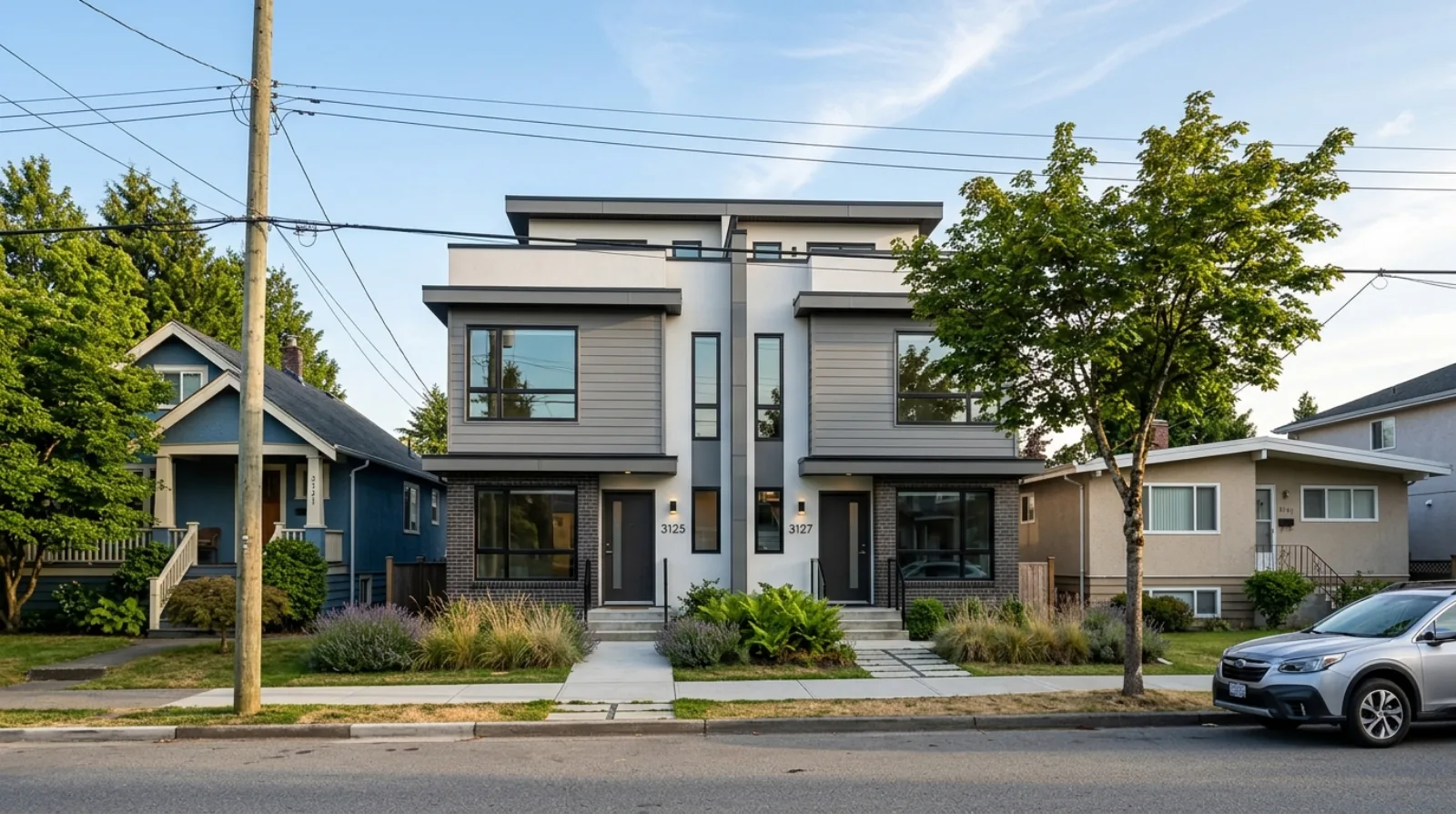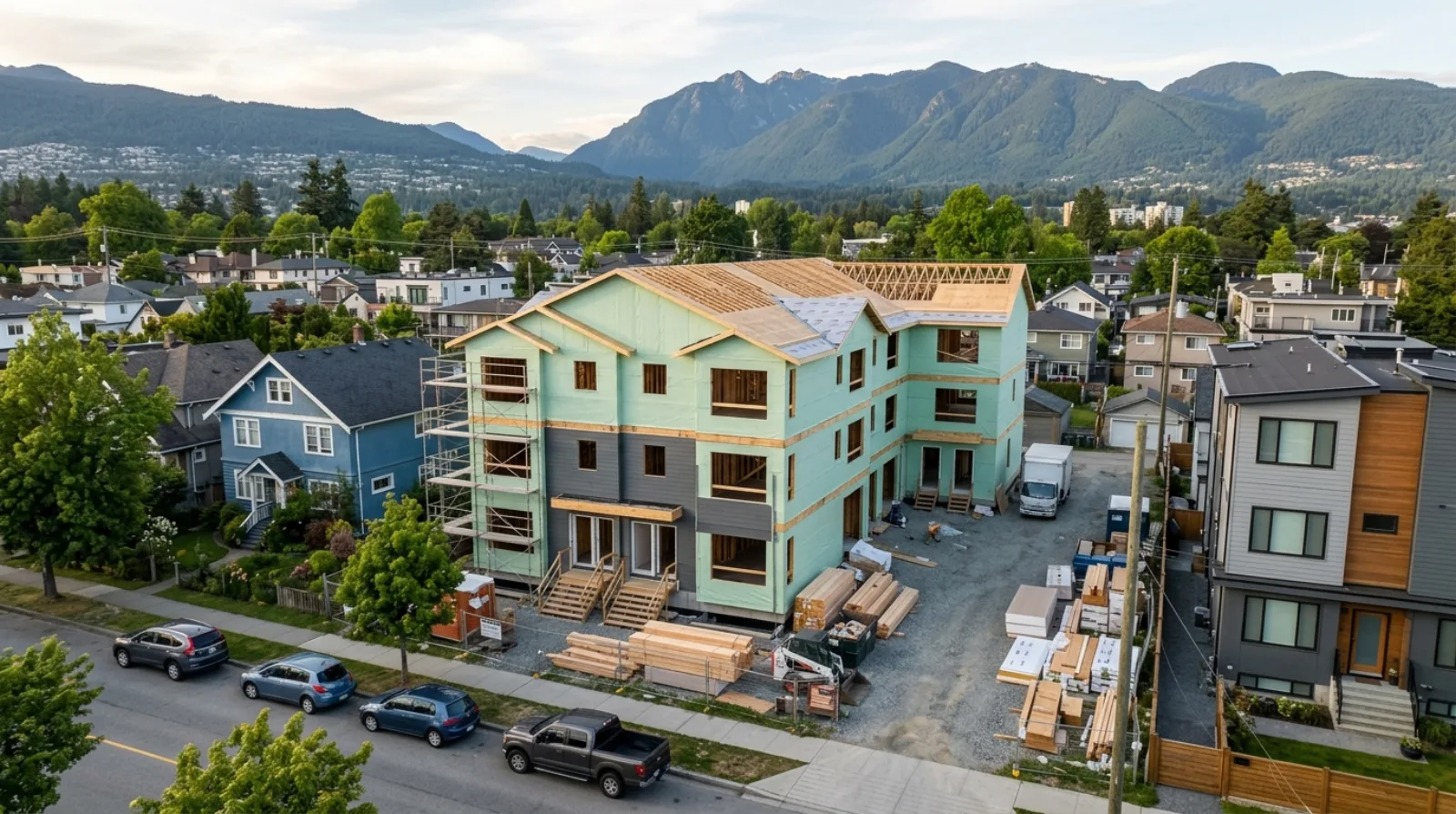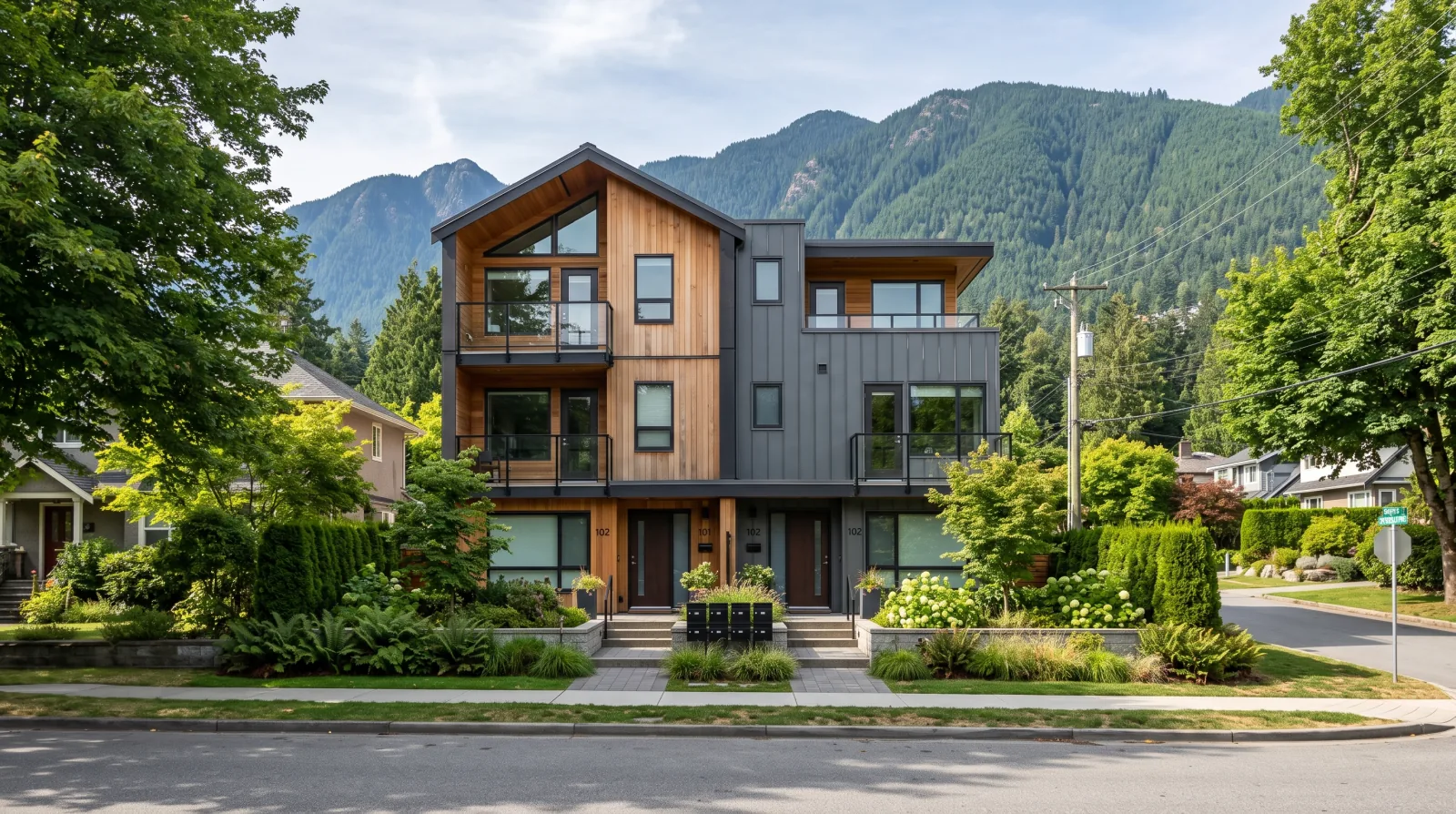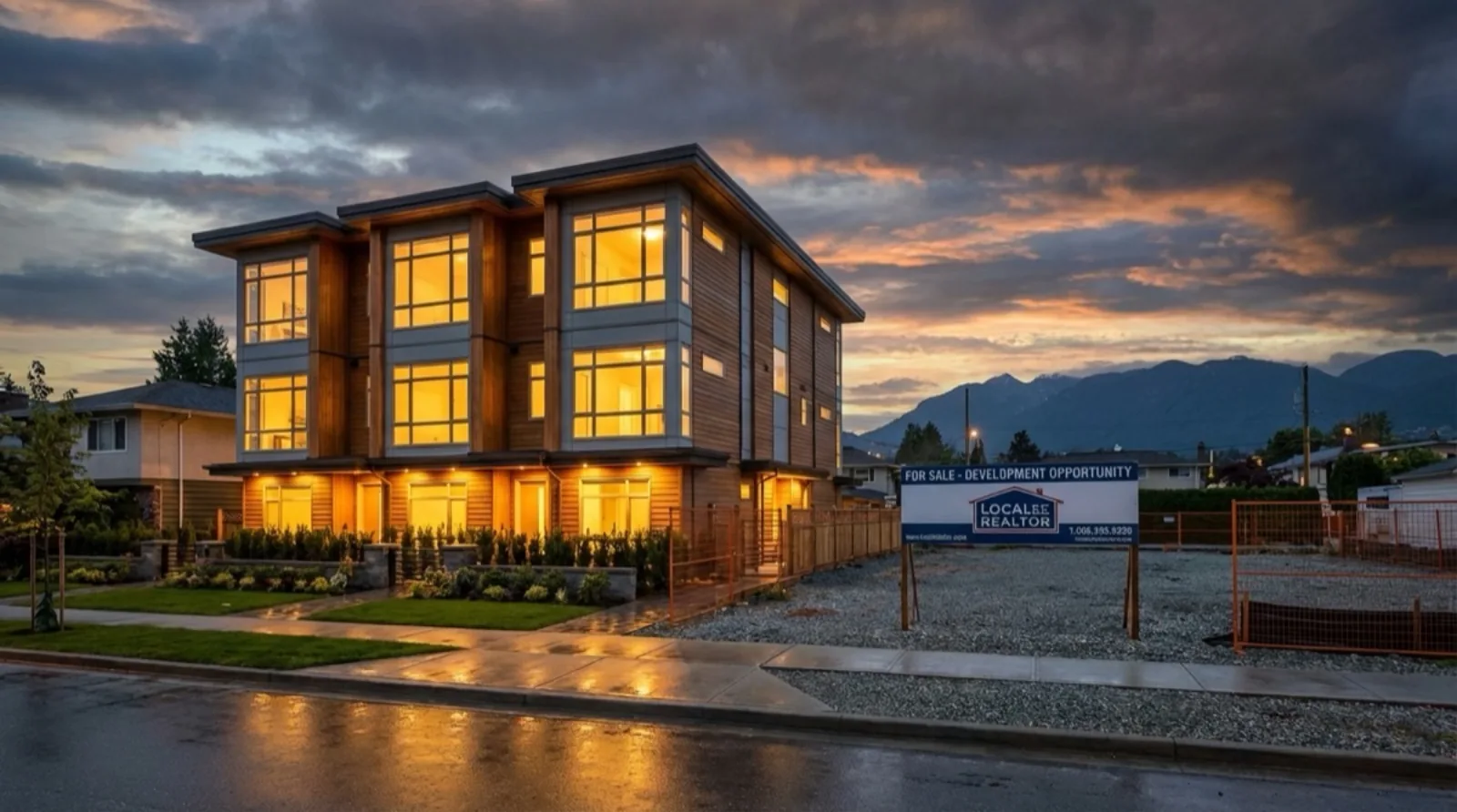

Vancouver’s housing market just entered a new phase. For the first time in years, “Fear of Missing Out” has been replaced by “Fear of Overpaying.” Your neighbor’s house sat on the market for 90 days. The instinct is to freeze. But here’s what the data shows: while 98% of homeowners should wait, PlexRank screening finds a top 2% of lots projecting 60-100% ROI in current proforma modeling, and that window won’t stay open. Those are the highest-scoring lots in the dataset, not a typical outcome.
TL;DR (Key Takeaways)
- Vancouver prices sliding for first time since 2019; permits hit 45-year low (population-adjusted)
- Supply cliff forming: new multifamily starts down 47% from 2023 peak
- 2027-2028 shortage projected as projects started 2022-2024 complete but nothing replaces them
- 98% of lots don’t pencil—only top 2% qualify for development now
- PlexRank™ threshold: 100%+ ROE required to absorb market softness
- Multi-generational need doesn’t wait for market bottoms
- Build-to-2028 strategy positions you ahead of the recovery wave
The Biological Response vs. The Strategic Response
Watch the market long enough and you see the pattern. Prices slide, and homeowners do what humans do: they freeze. Financial loss aversion kicks in. The perceived safety of four existing walls feels better than the uncertainty of action.
But for the strategic owner, this price slide isn’t a signal to stop—it’s a signal to filter harder.
The Point of No Return—the day you demolish your existing home to build your future—is terrifying when you’re guessing. It’s a calculated move when you understand what’s actually happening to Vancouver’s housing supply.
The Supply Destruction of 2026
Everyone’s watching prices. Almost nobody’s watching supply—and that’s where the opportunity lives.
The numbers:
| Metric | 2024 | 2026 (Current) | Change |
|---|---|---|---|
| Vancouver building permits (per capita) | 7.2 per 1,000 | 4.1 per 1,000 | -43% |
| Large-scale multifamily starts (units) | 12,400 | 6,600 | -47% |
| Active multiplex applications | 382 | 472 | +24% |
| Multiplex permits under construction | ~45 | ~65 | +44% |
The large developers froze. Multifamily projects that penciled at 5% rates don’t work at 7%. The cranes you see finishing towers in 2026? Those broke ground in 2022-2023. What’s replacing them? Almost nothing.
The implication: While everyone else is frozen, a massive supply shortage is forming for 2027-2028. The “missing middle” gap—the one multiplex development was designed to fill—is about to become a chasm.
Why Would Anyone Build When Prices Are Sliding?
Fair question. The answer depends on your goal.
Scenario 1: The Multi-Generational Anchor
Your adult children are priced out of the city. Your parents need ground-level living to age in place. The “market bottom” is irrelevant to the family that needs a home today.
Waiting two years for a 5% price drop doesn’t help if:
- Your 32-year-old is paying $2,800/month for a one-bedroom
- Your 78-year-old mother can’t navigate stairs safely
- Three generations are scattered across the Lower Mainland
Building a high-efficiency 4 or 6-plex lets you solve your family’s housing crisis using your own land as the engine. The math isn’t about market timing—it’s about occupancy certainty and generational consolidation.
Scenario 2: Building Into the 2028 Recovery
This is the contrarian play. While everyone freezes, you build. By breaking ground now, you’re building into a massive supply shortage.
| Timeline | Market Position |
|---|---|
| Q1 2026 | Break ground during softness |
| Q4 2026 | Complete during continued uncertainty |
| 2027 | Hold or list as supply shortage becomes obvious |
| 2028 | Positioned ahead of recovery demand wave |
When the market recovers—and it always does—you won’t be competing with a thousand other new builds. You’ll be one of the few “missing middle” options available.
The construction advantage: Better to build in the quiet than fight for trades and materials when the 2028 wave hits and everything takes twice as long.
The 15% ROE Trap
This is where most homeowners get it wrong. They see “Bill 44 eligible” and assume profitable. Eligibility is easy. Profitability requires analysis.
VanPlex has analyzed over 86,000 R1-1 lots in Vancouver and Burnaby. Here’s the uncomfortable distribution:
| ROE Range | % of Lots | Development Recommendation |
|---|---|---|
| Under 15% | 50% | Do not build—margin too thin |
| 15-40% | 30% | Risky in sliding market |
| 40-60% | 12% | Proceed with caution |
| 60-100% | 6% | Strong candidates |
| 100%+ | 2% | Optimal for 2026 development |
In a falling market, that 15% margin evaporates. You need lots that can absorb continued softness, sell in front of price reductions, and still exit profitably.
The PlexRank™ standard: We only work with the top 2% of lots—those with the geometry, location, and financial structure to survive market turbulence and deliver meaningful returns.
What Separates the 2% from the 98%
The profitable lots share specific characteristics:
Geometry:
- Frontage: 49.5ft minimum (ideally 50ft+)
- Lot area: 5,000+ sqft
- Rectangular or regular shape
- No unusual easements or encroachments
Location:
- Within 400m of frequent transit (for 6-unit eligibility)
- Established neighborhoods with proven resale values
- Infrastructure capacity (no BC Hydro transformer surprises)
Financial structure:
- Land cost below 40% of total project value
- Construction costs at or below $450/sqft achievable
- Projected exit values supported by recent comparables
The Infrastructure Certainty Test
Here’s what kills projects in 2026: off-site costs that nobody budgeted for.
BC Hydro PMT requirements emerged as the quiet project killer of 2025. Many multiplexes now require pad-mounted transformers costing $40,000-$80,000 and consuming valuable site area.
The VanPlex approach: We verify off-site utility costs before the house comes down. Not after. If the infrastructure math doesn’t work, we tell you not to build.
Other hidden costs that ambush unprepared developers:
- Storm water management systems: $15,000-$30,000
- Sewer capacity charges: $10,000-$25,000
- Street tree contributions: $5,000-$15,000
- Water service upgrades: $8,000-$20,000
The Safe Landing Checklist
Do not cross the Point of No Return unless your lot hits these marks:
1. High PlexRank™ Score Does your lot geometry and market location qualify as a 2% winner? Run the analysis before spending on design.
2. Infrastructure Certainty Have you verified BC Hydro requirements? Sewer capacity? Water service? These are knowable before you commit.
3. Exit Strategy Clarity Are you building for:
- Multi-generational family use (hold)
- 2027/2028 strata sale (sell)
- Long-term rental portfolio (hold)
Each strategy has different financial requirements and risk tolerances.
4. Capital Position Do you have 25-35% equity contribution capacity? Cash reserves for contingencies? Access to construction financing?
5. Timeline Alignment Can you commit to 18-24 months from permit to completion? Does that timeline align with your life plans?
The VanPlex Development Model
We carry the complexity of development so you don’t live in decision fog.
Integrated Developer & Builder We’re the single point of accountability. Our construction arm builds the Part 9, 3-storey multiplexes we design. One contract. One responsible party.
AI-Driven Stress Testing We run real simulations on your project. What happens if prices drop another 5%? Another 10%? If the math doesn’t protect your net worth against continued slides, we recommend you don’t build.
The Complexity Buffer We manage the consultants, the BC Hydro transformer surprises, the opaque city fees, the trade scheduling, the inspection sequencing. You get the keys—we handle the chaos.
The 2026 Strategic Calculus
Most homeowners should wait. The market hasn’t found its bottom, and the average lot doesn’t have enough margin to absorb further declines.
But if your lot qualifies in the top 2%—and if your goal is either multi-generational housing or building into the 2028 supply shortage—the strategic case is stronger than the emotional case.
The Point of No Return is only dangerous if you’re guessing.
Visit VanPlex.ca to check your property’s PlexRank™ score. We’ll tell you honestly whether you’re in the 2% that should build now—or the 98% that should wait.
David Babakaiff, Co-Founder of VanPlex
PlexRank™ | Profit with Multiplex