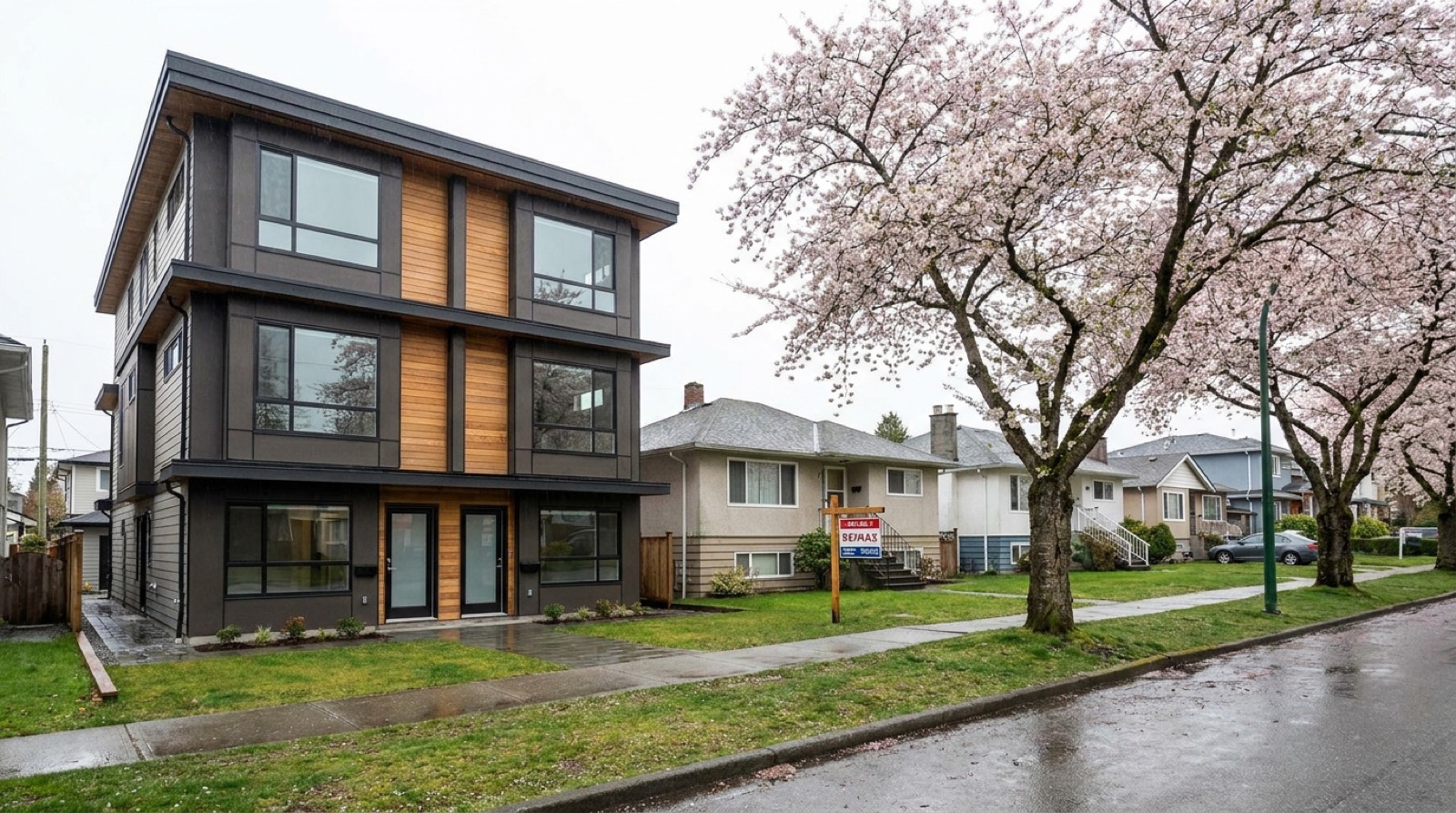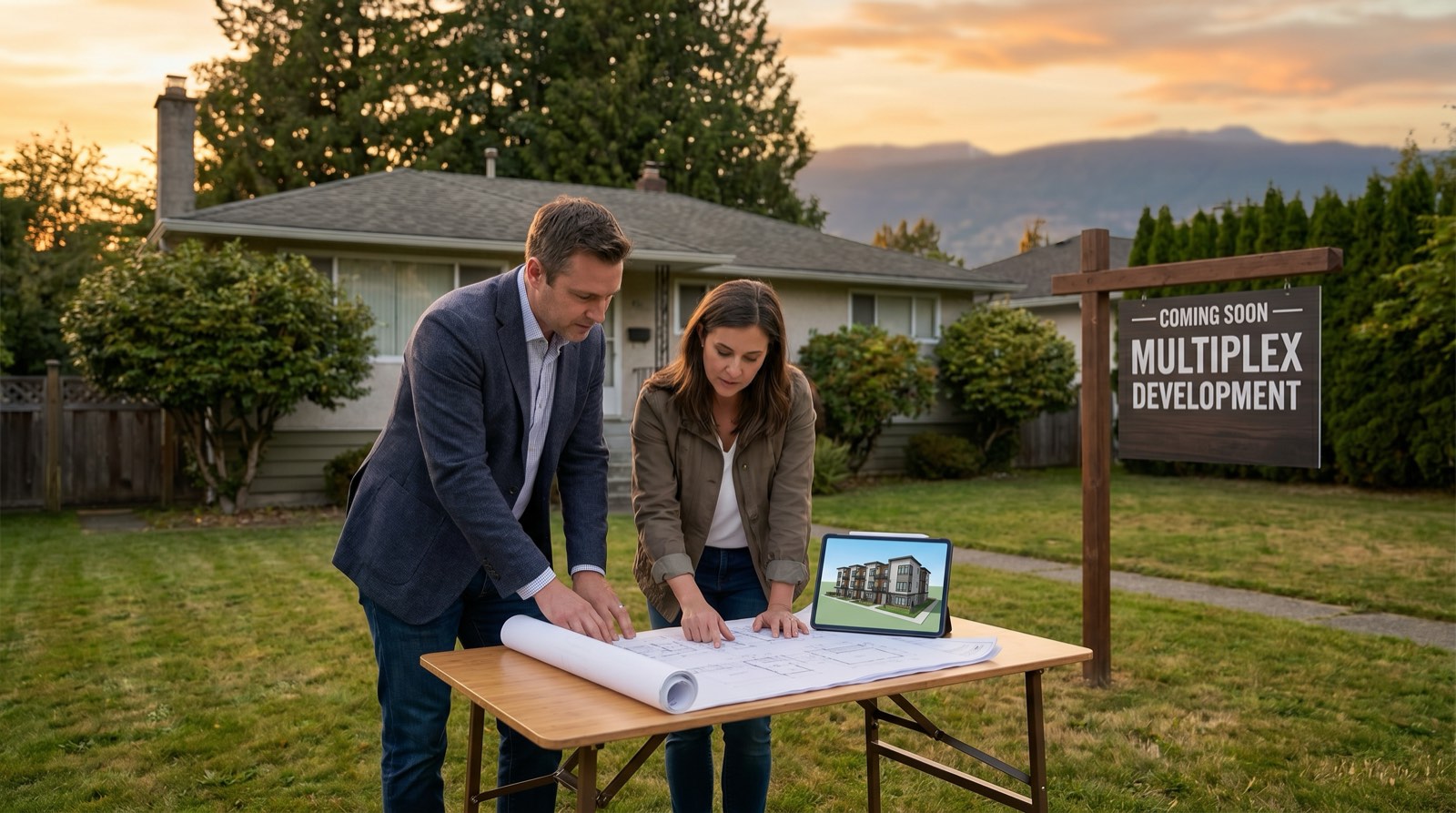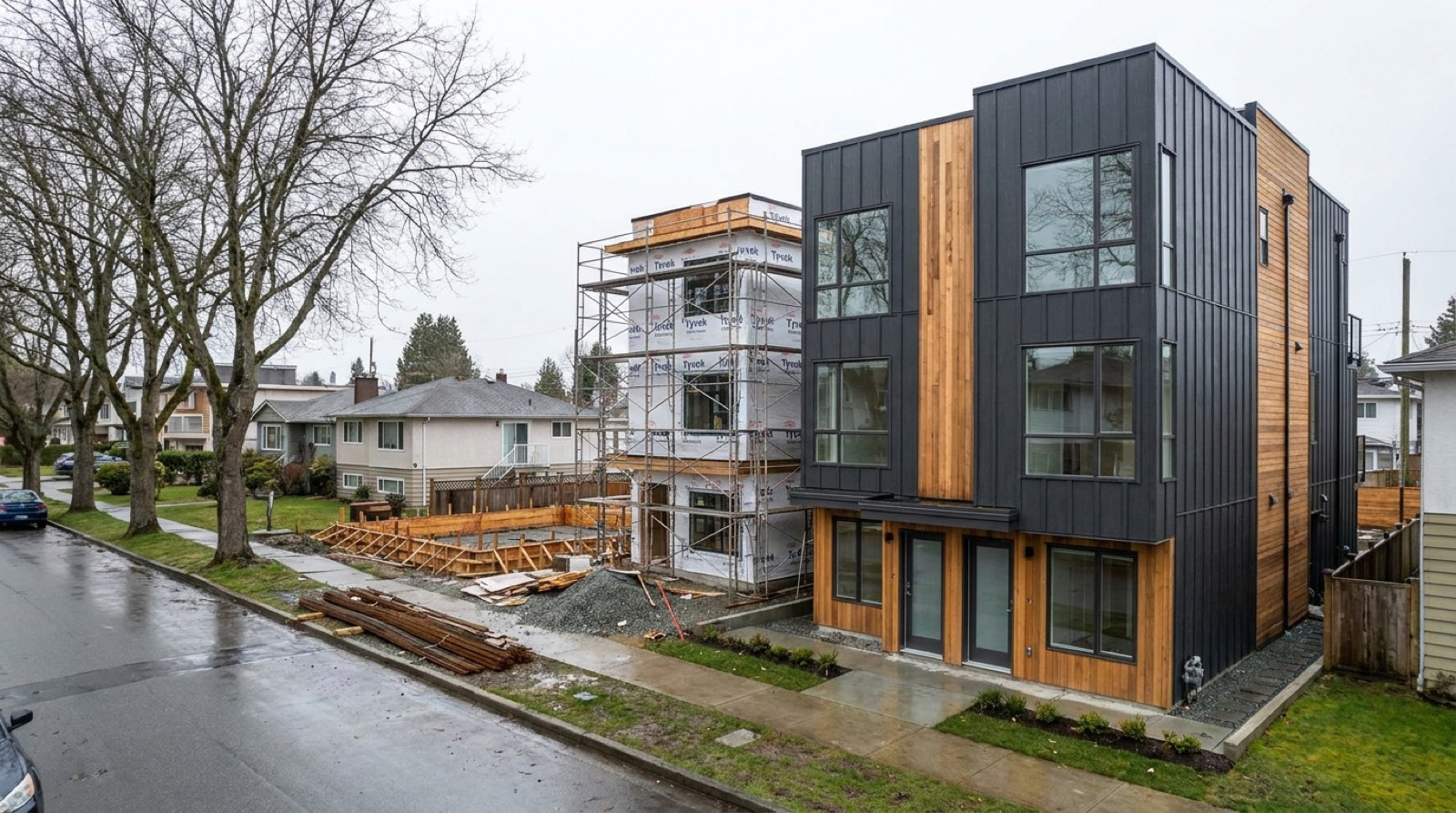
If you own a single-family home in Vancouver or Burnaby, you’ve likely noticed the conversations shifting. Neighbours mention fourplexes. Articles talk about zoning changes. People ask whether you’re planning to develop. What’s often missing is a clear structure for thinking about the decision. There are three legitimate options—each fits a different situation. Understanding which door is right for you could mean the difference between leaving $500K on the table or making a decision you regret for decades.
TL;DR (Key Takeaways)
- You have three options: Stay, Convert (two sub-options), or Sell
- Staying is valid when mortgage exists, you love your home, or stability matters more than maximizing value
- Owner-led development requires 18-30 months, significant capital, and hands-on project management
- Co-development partnerships let you retain equity (typically 40-60%) while professionals handle execution
- Selling captures tax-free gains on principal residence but requires understanding true market value
- The zoning change created options, not obligations—clarity comes from choosing the door that fits your circumstances
The Conversation You’re Having (Or Avoiding)
Bill 44 changed the rules for over 60,000 single-family lots across Metro Vancouver. Properties that could only hold one home can now legally accommodate four to six units. That’s not theoretical—it’s happening. In 2025 alone, Vancouver issued over 480 multiplex permits.
But here’s what the headlines miss: having an option doesn’t mean you should exercise it.
The homeowners who navigate this transition successfully aren’t the ones who chase the highest theoretical return. They’re the ones who honestly assess their situation, understand their constraints, and choose the path that fits.
There are three doors. Let’s walk through each one.
Door #1: Stay
Staying is a valid and often sensible choice.
This surprises some homeowners who assume “doing nothing” is passive or uninformed. It’s not. Staying is a deliberate decision to prioritize stability and continuity over potential upside.
When Staying Makes Sense
You have a meaningful mortgage balance. Development requires capital—significant capital. If you’re still paying down your mortgage, the math rarely works. Most development financing requires substantial equity, and carrying two debt loads (mortgage plus construction loan) creates unnecessary risk.
You love your home and location. This sounds obvious, but it matters. A home isn’t just an asset. If your kids’ schools are dialed in, your commute works, and your neighbours have become friends, that has value that doesn’t show up on a proforma.
You don’t want a multi-year project. Multiplex development takes 18-30 months from design to completion. That’s 18-30 months of decisions, contractors, permits, and stress. Some people thrive on that. Many don’t.
Stability matters more than maximizing theoretical value. There’s nothing wrong with choosing peace of mind over optimization. The homeowners who try to squeeze every dollar from every opportunity often end up exhausted and dissatisfied.
The Hidden Cost of Staying Undecided
Here’s the trap: staying works best when it’s chosen and then left alone.
The homeowners who struggle are the ones who stay but keep revisiting the question. They read every article, attend every webinar, and constantly recalculate what they “could have” made. That mental overhead extracts a real toll.
If staying is your door, commit to it. Check back in three years if circumstances change. But stop torturing yourself with alternatives you’ve already decided against.
Door #2: Convert (Two Structures)
Conversion is the option most commonly discussed, but it exists in two distinct forms that produce very different outcomes.
Door 2A: Owner-Led Development
In this structure, you become the developer.
That sentence sounds exciting until you understand what it actually means.
What Owner-Led Development Involves:
| Responsibility | What It Actually Means |
|---|---|
| Design Management | Hiring architects, reviewing plans, making decisions on unit mix, finishes, and layout |
| Permitting | Navigating city processes, responding to comments, managing timelines |
| Financing | Securing construction loans (typically 65-75% LTC), managing draws, handling cost overruns |
| Construction | Selecting and managing contractors, resolving disputes, making thousands of micro-decisions |
| Sales/Leasing | Marketing completed units, negotiating with buyers, managing closing processes |
The timeline is typically 18-30 months. During that time, you’re making decisions almost daily. Not big strategic decisions—small operational ones. Which tile for the bathrooms? How do we handle the change order for the electrical? The surveyor found an issue with the lot line—now what?
When Owner-Led Development Works:
You’re mortgage-free or close to it. Development financing requires equity, and lenders want to see that you can absorb delays without financial stress.
You have liquidity beyond the property itself. Projects go over budget. Markets shift. Having $200-400K in reserves isn’t optional—it’s the difference between finishing a project and losing it.
You’re comfortable with construction and market risk. Not theoretically comfortable—actually comfortable. If the thought of a six-month delay and $150K cost overrun makes you physically anxious, this isn’t your path.
You can devote sustained attention over 24+ months. This isn’t a side project. It requires consistent engagement, availability for calls and site visits, and mental bandwidth for problem-solving.
The Capital Gains Reality:
Owner-led development triggers capital gains tax on the profit. Unlike selling your principal residence (which is tax-free), developing and selling units creates a taxable event. On a project with $800K in profit, that could mean $200K+ in taxes.
Some sophisticated owners use CRA Section 45(2) elections or corporate structures to manage this. But that adds complexity and requires professional tax advice.
Door 2B: Co-Development Partnership
There’s a middle path that many homeowners don’t know exists.
In a co-development structure, an experienced developer handles execution while you retain an equity position based on your contribution.
How It Works:
You contribute the property (and optionally additional capital). The developer contributes expertise, project management, financing relationships, and execution capacity.
The developer handles:
- Design and architecture
- Permitting and approvals
- Construction financing and management
- Sales or leasing
- Day-to-day operational decisions
You retain:
- A pro-rata equity position (typically 40-60% depending on contribution)
- Participation in the upside
- Quarterly updates without daily involvement
The Trade-Off Is Explicit:
The developer is compensated through profit splits. Expertise, execution, and risk management aren’t free. If a project generates $1.2M in profit, you might receive $500-700K rather than the full amount.
But here’s the question: would you have generated that $1.2M on your own? Or would you have hit obstacles at the permitting stage, underestimated construction costs, or made design decisions that reduced end values?
The math isn’t “your share vs. the whole.” It’s “your share vs. what you would have actually achieved alone.”
When Co-Development Makes Sense:
You want exposure to development outcomes without operational control. You believe in the opportunity but don’t want (or can’t manage) a multi-year project.
You lack the specialized knowledge but have the asset. Real estate development is a profession. The learning curve is steep, and the mistakes are expensive. A good development partner has made those mistakes on previous projects.
You value certainty of completion. Developer partnerships have higher completion rates than owner-led projects. When someone’s business depends on delivering results, they tend to deliver.
Due Diligence Matters:
Not all development partners are equal. Before entering any partnership, understand:
- Track record: How many projects have they completed?
- Financial structure: How is profit calculated and distributed?
- Decision rights: Who controls what?
- Exit provisions: What happens if the partnership doesn’t work?
- References: What do previous partners say?
The best partnerships have clear documentation, aligned incentives, and transparent communication. If anything feels opaque or pressured, walk away.
Door #3: Sell
Selling requires careful framing because the market has fundamentally changed.
Blanket Rezoning ≠ Automatic Value Increase
Here’s a misconception that costs homeowners money: “My property is now zoned for four units, so it must be worth more.”
Not necessarily.
When all properties are rezoned simultaneously (as happened with Bill 44), supply conditions adjust. Price effects depend on feasibility, not just permission.
In practice:
- Some properties attract strong developer demand
- Many properties don’t pencil for development
- Zoning alone doesn’t guarantee a premium
The premium goes to properties where the development economics actually work—the right lot size, frontage, location, and market conditions. VanPlex has analyzed 86,000+ properties across Metro Vancouver, and approximately 12% meet the criteria for economically viable multiplex development.
When Selling Makes Sense
Your property is economically viable for development. This means lot size over 5,000 sqft (ideally 6,000+ for six units), adequate frontage (50’+ preferred), and location where end buyers exist.
You want to capture tax-free gains. Selling your principal residence remains tax-free in Canada. If you’ve owned your home for decades and accumulated significant appreciation, selling locks in those gains without triggering capital gains tax.
You value liquidity and certainty over potential upside. Development involves risk. Markets shift, costs increase, and timelines extend. Selling exchanges complexity and uncertainty for cash in hand.
You have a clear next step planned. Selling without a plan often leads to regret. The homeowners who sell successfully know what comes next—whether that’s downsizing, relocating, or redeploying capital into other investments.
Maximizing Sale Value
If you’re going to sell, understand who your buyers are:
Traditional Buyers: Looking for a home to live in. They evaluate the kitchen, bathrooms, curb appeal. They compare to recent sales of similar homes.
Developer Buyers: Looking for land value plus development rights. They evaluate lot dimensions, zoning capacity, end values, and construction economics. They often pay premiums for the right properties—sometimes 10-20% above “market value.”
The smart approach is to understand your property’s development potential before listing. If it qualifies as a strong development site, market it accordingly. If it doesn’t, price based on residential comparables.
Selling to a developer isn’t always the right choice, but leaving $200K on the table because you didn’t know to ask is always the wrong one.
The Decision Framework
The decision isn’t about identifying a universally “best” option.
It’s about alignment:
| Factor | Stay | Convert (Owner-Led) | Convert (Co-Develop) | Sell |
|---|---|---|---|---|
| Mortgage Status | Any | Minimal/None | Minimal/None | Any |
| Available Capital | None needed | $200-400K+ reserves | Varies by structure | None needed |
| Time Commitment | None | High (24+ months) | Low (quarterly updates) | Transaction only |
| Risk Tolerance | Low | High | Medium | Low |
| Involvement Level | None | Very High | Low | Transaction only |
| Tax Treatment | N/A | Capital Gains | Capital Gains (pro-rata) | Tax-Free (principal residence) |
| Potential Return | Market appreciation | Highest (if executed well) | Shared upside | Market value (possibly premium) |
Questions to Ask Yourself
-
What’s my actual financial situation? Not the optimistic version—the honest one. How much equity? How much liquidity? How much debt?
-
How do I honestly handle stress and uncertainty? Not theoretically—based on past experience. When projects have gone sideways before, how did I respond?
-
What does my next five years look like? Job changes? Health considerations? Family transitions? Development timelines don’t flex for life circumstances.
-
What would I regret more—trying and struggling, or not trying at all? There’s no right answer. But knowing your answer clarifies the decision.
Making the Choice
The zoning change created options, not obligations.
You don’t have to do anything. Staying in your home, in the neighbourhood you know, surrounded by relationships you’ve built—that’s a legitimate choice with real value.
But if you’re going to act, act with clarity. Understand which door fits your situation. Get the right information. Make the decision once, and then move forward without second-guessing.
The homeowners who struggle aren’t the ones who chose wrong. They’re the ones who never chose at all—who stayed perpetually in research mode, attending webinars, reading articles, and never committing to a path.
Three doors. Pick one. Walk through it.
Your Next Step
If you’re still unclear which door fits your situation, start with the data.
VanPlex has analyzed 86,000+ properties across Metro Vancouver for multiplex feasibility. In under 2 minutes, you can see whether your property qualifies for development, what the projected returns look like, and which path might make sense for your specific situation.
That clarity—knowing what’s actually possible—makes the decision easier.
Check Your Property’s Multiplex Potential →
VanPlex Team PlexRank™ | Profit with Multiplex