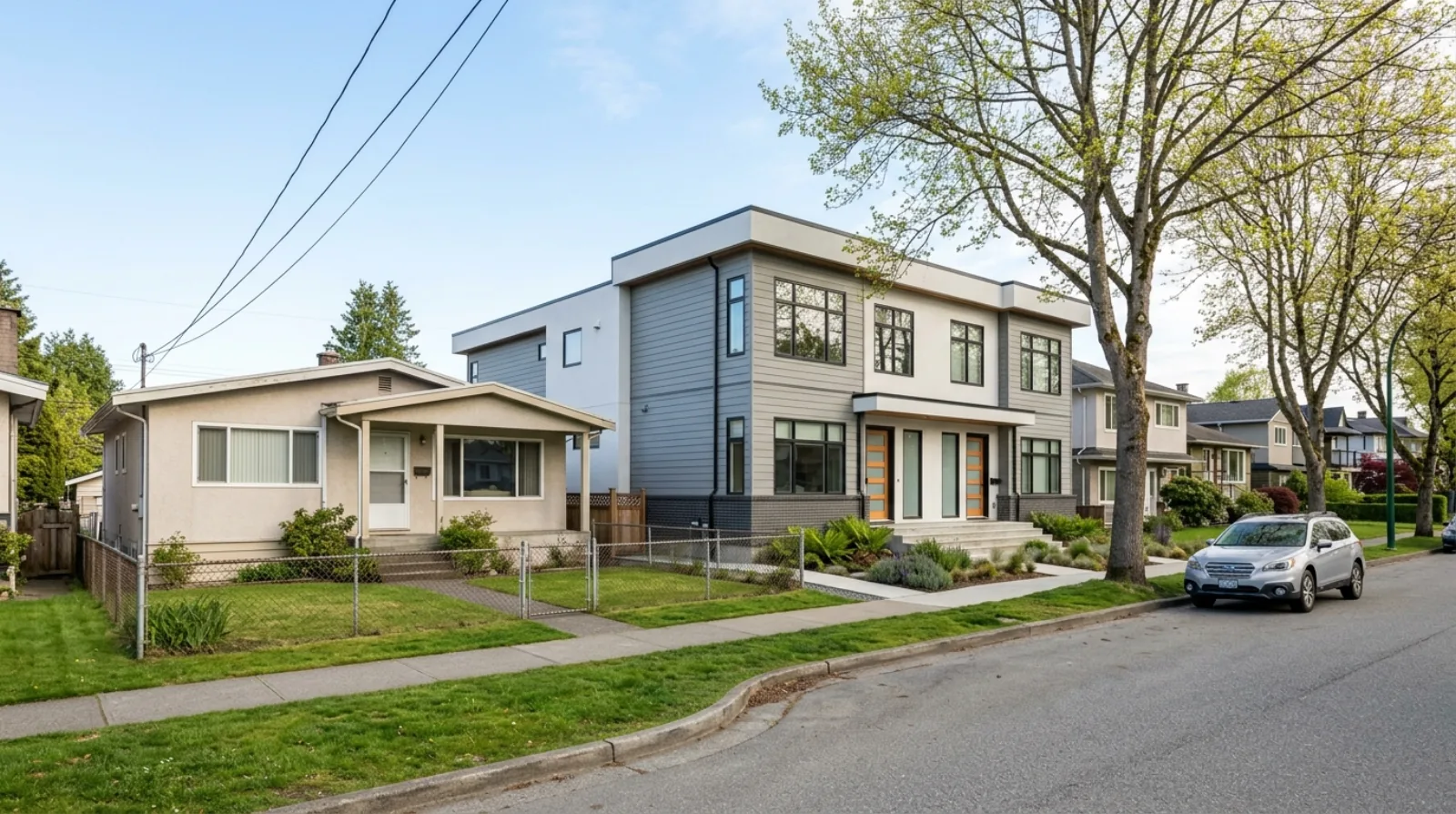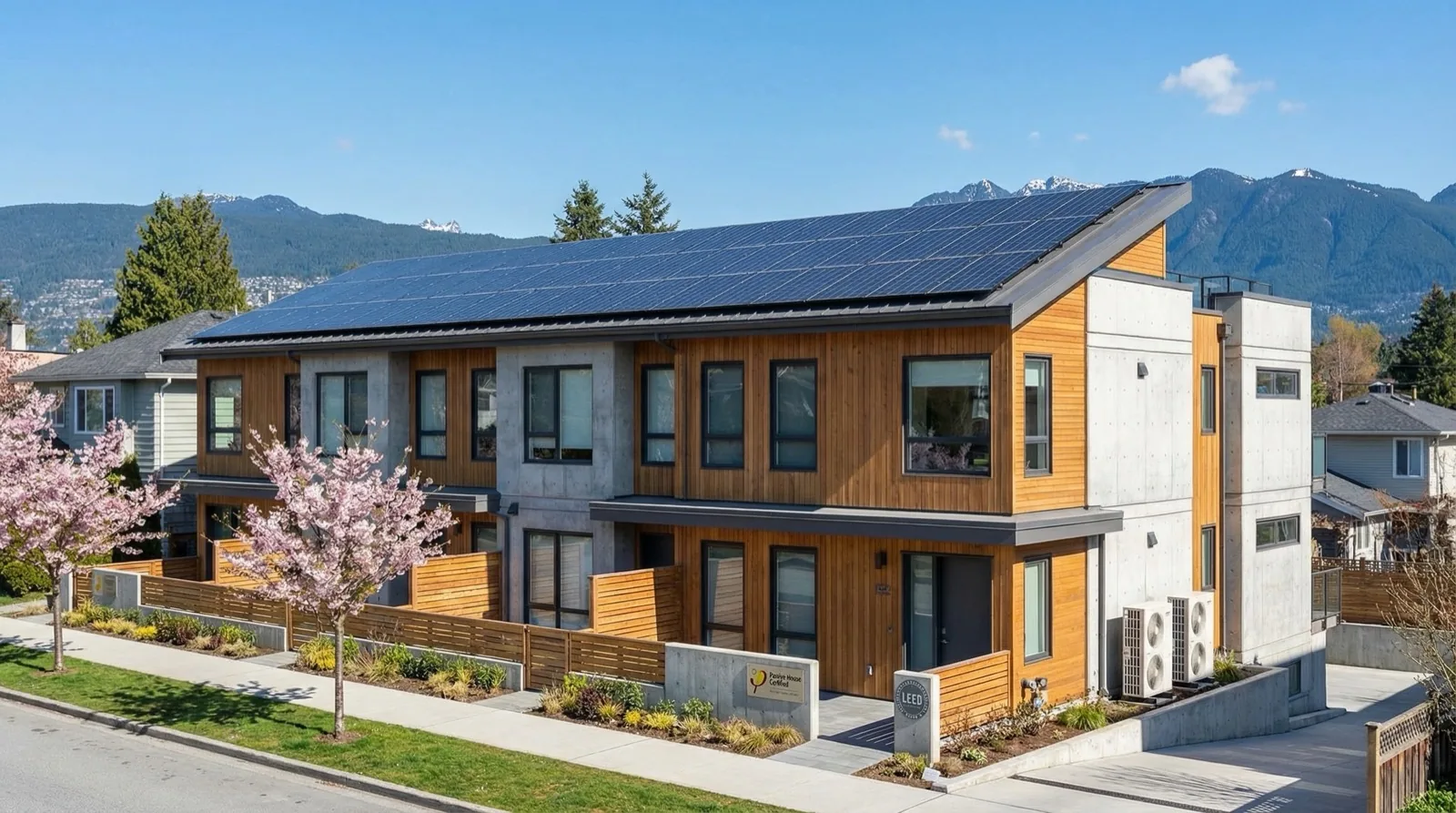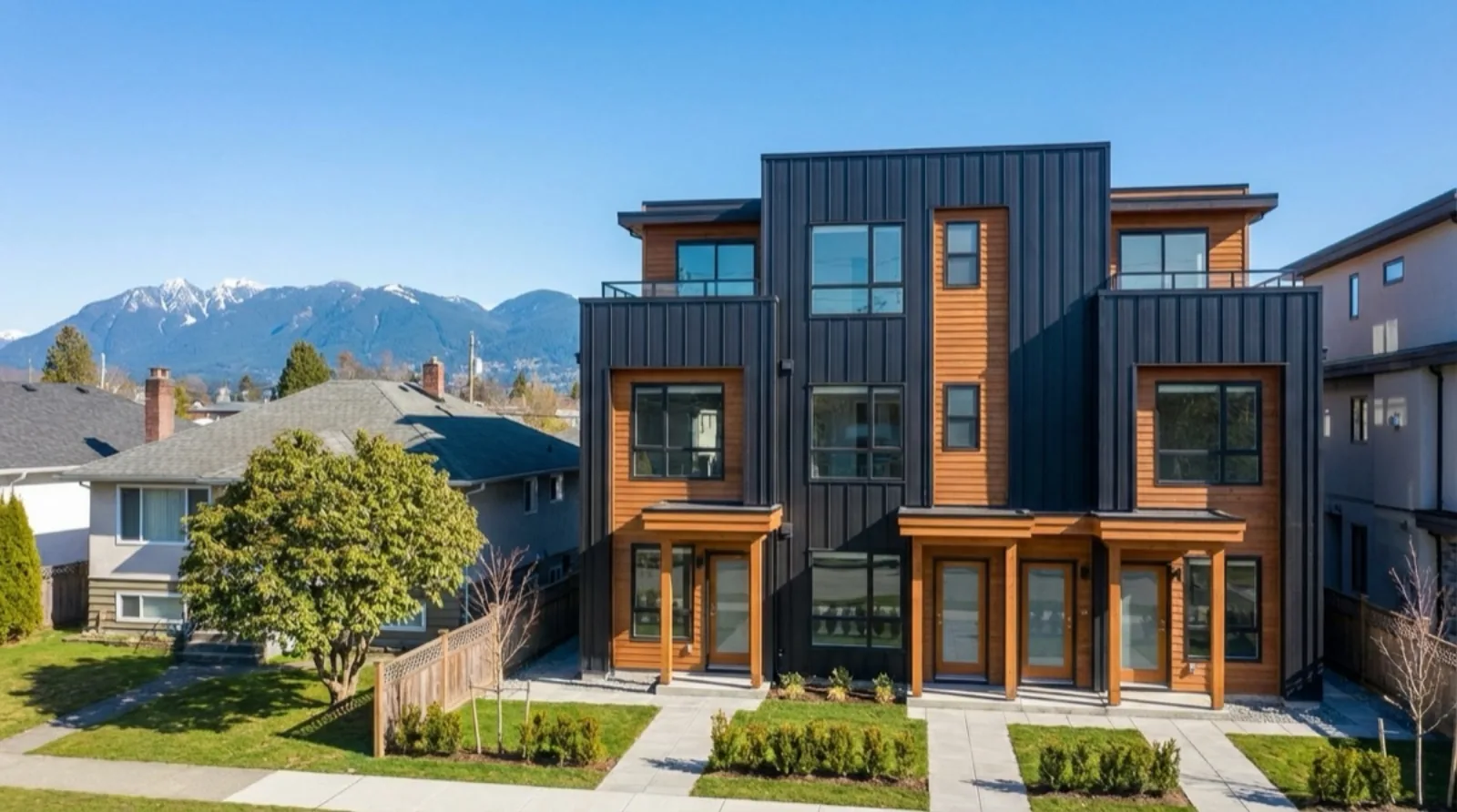

If you own a single-family home in Vancouver, you’re sitting on one of the most valuable development opportunities in Canadian real estate—and most homeowners have no idea. Bill 44 gives you the legal right to build up to 6 units on your property without rezoning. That’s not a future possibility. It’s law right now.
I’ve analyzed 86,000+ Metro Vancouver properties through our PlexRank system, and here’s what the data shows: homeowners who convert to multiplex are creating $800K to $3M in new equity within 18-24 months. But the window is narrowing. Early movers capture the best margins before the market adjusts.
What Bill 44 Actually Changed
Before Bill 44, building anything beyond a single-family home with a suite required rezoning. That process took 12-24 months, cost $50,000+, and city council could reject it for essentially any reason. Your neighbor didn’t like the look? Rejected. Councilor thought there was “too much density”? Rejected.
Bill 44 flipped that on its head. Here’s what you now have as a right, not a privilege:
| Lot Type | Units Allowed | Approval Process |
|---|---|---|
| Small lots (≤280 m²) | 3 units | Building permit only |
| Standard lots (>280 m²) | 4 units | Building permit only |
| Near frequent transit (>280 m²) | 6 units | Building permit only |
The critical difference: If your building plans meet code, the city must issue your permit. No public hearing. No council vote. No discretionary refusal.
The Financial Math That Makes This Work
Let me show you why Vancouver homeowners are paying attention to Bill 44 with real numbers from our 2025-2026 market analysis.
Typical Vancouver Scenario:
- Current property value: $2.4M
- Lot: 33’ x 122’ (4,026 sq ft) in Kensington-Cedar Cottage
- Current structure: 1960s bungalow, 1,800 sq ft with illegal suite
After Multiplex Development:
- New building: 4-unit multiplex, 4,200 sq ft total
- Development cost: $1.6-1.9M (including demolition, soft costs)
- Finished multiplex value: $4.8-5.6M (based on January 2026 comparables)
- New equity created: $800K-$1.5M
| Metric | Before | After | Change |
|---|---|---|---|
| Property Value | $2.4M | $5.2M | +$2.8M |
| Annual Rental Income | $24K (illegal suite) | $96-120K | +$72-96K |
| Total Equity Position | $2.4M | $5.2M | +$2.8M |
| Development Cost | — | $1.7M | — |
| Net Equity Gain | — | $1.1M | — |
That’s a 65% return on invested capital in under two years. Where else can you get that in a relatively low-risk real estate play?
Why 2026 Is the Optimal Window
The multiplex opportunity won’t last forever at current margins. Here’s what the data tells us about timing:
1. Construction costs are stabilizing
After the 2021-2023 inflation spike, Vancouver construction costs have plateaued at $400-500/sq ft for multiplex builds. That’s high by historical standards, but it’s predictable—and predictability lets you underwrite accurately.
2. Multiplex sale prices are rising faster than construction costs
Vancouver multiplex sale prices increased 12% in 2025 (CMHC Q4 data). Construction costs rose 3%. That spread is your profit margin, and it’s widening.
3. Permit volumes are still low
Vancouver issued 847 multiplex permits in 2025, up from 234 in 2024. But that’s still just 1.5% of eligible lots. The supply constraint creates pricing power for new units.
4. First-mover advantage is real
Early multiplex developments in each neighborhood establish comparable sales. If your area has few comps, you benefit from scarcity pricing. As more projects complete, pricing normalizes.
Who Should Consider Bill 44 Development?
Not every property—or every homeowner—is right for multiplex development. See our homeowner’s guide for a full walkthrough of whether your situation fits. Based on our analysis of 450+ completed projects, here are the characteristics that predict success:
Ideal Candidates:
- Lot size: 5,000+ sq ft (though 4,000+ can work)
- Lane access: Rear lane dramatically simplifies construction and parking
- Zoning: R1-1 or RT-1 (most Vancouver single-family zones)
- Equity position: At least 50% equity in current property
- Timeline: 18-24 months to completion doesn’t create hardship
- Financial goal: Seeking long-term wealth building, not quick flip
Properties That Don’t Work:
- Lots under 3,500 sq ft: Math rarely pencils
- Properties with significant slope: Excavation costs erode margins
- Heritage-designated homes: Bill 44 exemptions apply
- Lots without lane access in tight areas: Parking becomes impossible
- Properties near high-voltage transmission lines: BC Hydro setbacks reduce buildable area
How to Evaluate Your Property’s Bill 44 Potential
Here’s the process we use to assess any Vancouver single-family property:
Step 1: Confirm zoning
Look up your property on Vancouver’s VanMap. You want R1-1, R1-1A, RT-1, RT-2, or similar single-family/duplex zones. If you’re in RS-1 (older designation), check if it’s been updated.
Step 2: Measure your lot
Standard Vancouver lot is 33’ x 122’ (4,026 sq ft). You need at least 280 m² (3,014 sq ft) for 4 units. For 6 units, you need 280+ m² AND be within 400m of frequent transit (15-minute service).
Step 3: Check transit proximity
Use TransLink’s trip planner to check bus frequency. If there’s a bus stop within 400m that has 15-minute service from 7am-7pm weekdays, your lot likely qualifies for 6 units under the transit-oriented threshold. Transit service levels change, so confirm current frequency data and your lot’s exact zoning designation with the City of Vancouver’s Planning Department before finalizing a design.
Step 4: Assess constraints
Walk your property and note:
- Power lines (BC Hydro requires setbacks from high-voltage)
- Trees over 20cm diameter (replacement requirements)
- Slope (anything over 10% adds cost)
- Neighboring buildings (shadows can affect design)
Step 5: Run the numbers
A proper feasibility study should include:
- Land value (what builders would pay for your lot)
- Hard construction costs ($400-500/sq ft as of Q1 2026)
- Soft costs (typically 15-18% of total project)
- Projected sale or rental values
- Financing costs (construction loans run 7-10% currently)
The Three Development Paths
Vancouver homeowners pursuing Bill 44 development typically choose one of three approaches:
Option A: Sell to a Builder
You sell your property at land value to a developer who handles everything. This is the simplest option but captures the least value.
- Typical outcome: Property sells for 10-25% premium over assessed value
- Your effort: Minimal (just the sale process)
- Risk: Very low
- Equity captured: 15-25% of total upside
Option B: Partner with a Developer
You contribute your land; a development partner handles design, permitting, construction, and financing. You split the proceeds.
- Typical outcome: 35-50% of development profit goes to landowner
- Your effort: Moderate (decision-making, approvals)
- Risk: Low to moderate (you retain land ownership)
- Equity captured: 40-60% of total upside
Option C: Self-Develop
You manage the entire process—hire architects, contractors, arrange financing. Maximum control and profit, but also maximum complexity.
- Typical outcome: Keep 100% of development profit
- Your effort: Substantial (essentially a full-time project)
- Risk: Highest (you bear cost overruns, delays)
- Equity captured: 80-100% of total upside
Most homeowners we work with choose Option B. The partnership model captures 2-3x more value than selling outright while avoiding the complexity and risk of self-development.
What to Expect: Timeline and Process
Here’s what a typical Bill 44 multiplex development looks like from start to finish:
Months 1-2: Feasibility and Design
- Property analysis and site survey
- Preliminary design concepts
- Financial modeling and pro forma
- Partner selection (if using partnership model)
Months 3-5: Permit Application
- Detailed architectural drawings
- Engineering (structural, mechanical, electrical)
- Building permit submission
- Revisions and approval
Months 6-8: Pre-Construction
- Financing finalization
- Contractor selection and contracts
- Material ordering
- Demolition of existing structure
Months 9-18: Construction
- Foundation and framing (3-4 months)
- Mechanical/electrical rough-in (2 months)
- Finishing and fixtures (3-4 months)
- Inspections and occupancy permit
Months 19-24: Completion
- Final punch list items
- Strata registration (if selling units)
- Sale or lease-up
- Project close-out
Common Questions About Bill 44
Can I live in one unit and rent the others?
Absolutely. This is one of the most popular approaches. You build a fourplex, keep the ground-floor unit for yourself, and rent three units for $2,500-3,500/month each. That’s $7,500-$10,500/month in rental income while living mortgage-free.
What if my property is still mortgaged?
You can still develop. Construction financing replaces your existing mortgage during the build. Many homeowners use their existing equity (typically 50-70% of current value) as their contribution to the project.
Do I need to move out during construction?
Yes. Multiplex development requires demolition of the existing structure. Plan for 12-18 months of alternative housing. Some homeowners rent nearby; others use this as an excuse for extended travel.
What about property taxes during development?
Your property taxes continue based on current assessed value until the new building is assessed. The significant increase comes after completion, but rental income typically exceeds the tax increase by 5-8x.
Can I sell individual units?
Yes, through strata titling. This requires additional legal work and strata registration but often maximizes sale value. A 4-unit multiplex typically sells for 15-20% more as individual strata units versus a single rental property.
The Risk Reality
Every investment carries risk. Here’s an honest assessment of Bill 44 development risks:
Moderate Risks (manageable with proper planning):
- Construction cost overruns (budget 10-15% contingency)
- Timeline delays (permits, weather, contractor availability)
- Interest rate changes during construction
Lower Risks (less likely but monitor):
- Market downturn during development window
- Changes to Bill 44 or related regulations
- Difficulty finding qualified contractors
Mitigants:
- Work with experienced multiplex builders
- Use fixed-price construction contracts where possible
- Maintain adequate contingency reserves
- Don’t over-leverage (keep loan-to-cost under 75%)
Next Steps: Evaluating Your Property
If you’ve read this far, you’re probably wondering whether Bill 44 makes sense for your specific situation. Here’s how to find out.
VanPlex analyzes properties using our PlexRank system, which scores feasibility based on 47 variables including lot size, zoning, transit proximity, construction constraints, and current market conditions. The analysis takes about 2 minutes and gives you:
- Unit count eligibility (3, 4, or 6 units)
- Estimated development cost
- Projected completed value
- ROI range
- Key constraints and opportunities
Get your free property analysis at vanplex.ca to see exactly how Bill 44 applies to your property—and whether multiplex development makes financial sense for your situation.
David Babakaiff, CEO & Co-Founder, VanPlex
PlexRank™ | Profit with Multiplex