
BC released free standardized multiplex designs that comply with current building codes, work on standard lots, and could save you $30,000-$50,000 in design costs. They’re publicly available right now, and almost nobody knows they exist. Here’s what’s available, how to use them, and why experienced builders are adapting them instead of starting from scratch. Our own design guidelines layer site-specific optimization on top of these standardized starting points.
TL;DR (Key Takeaways)
- Free designs available from BC Housing for duplex, triplex, fourplex, and townhouse configurations
- Code-compliant out of the box (BC Building Code 2024)
- Customizable for varying lot sizes and site conditions
- $30,000-$50,000 savings on architectural design fees
- Faster permit approval when using recognized design templates
- Experienced builders adapting these designs, not starting from scratch
- Available now at BC Housing website
- Works with Bill 44 density allowances
The “Vancouver Special 2.0” Opportunity
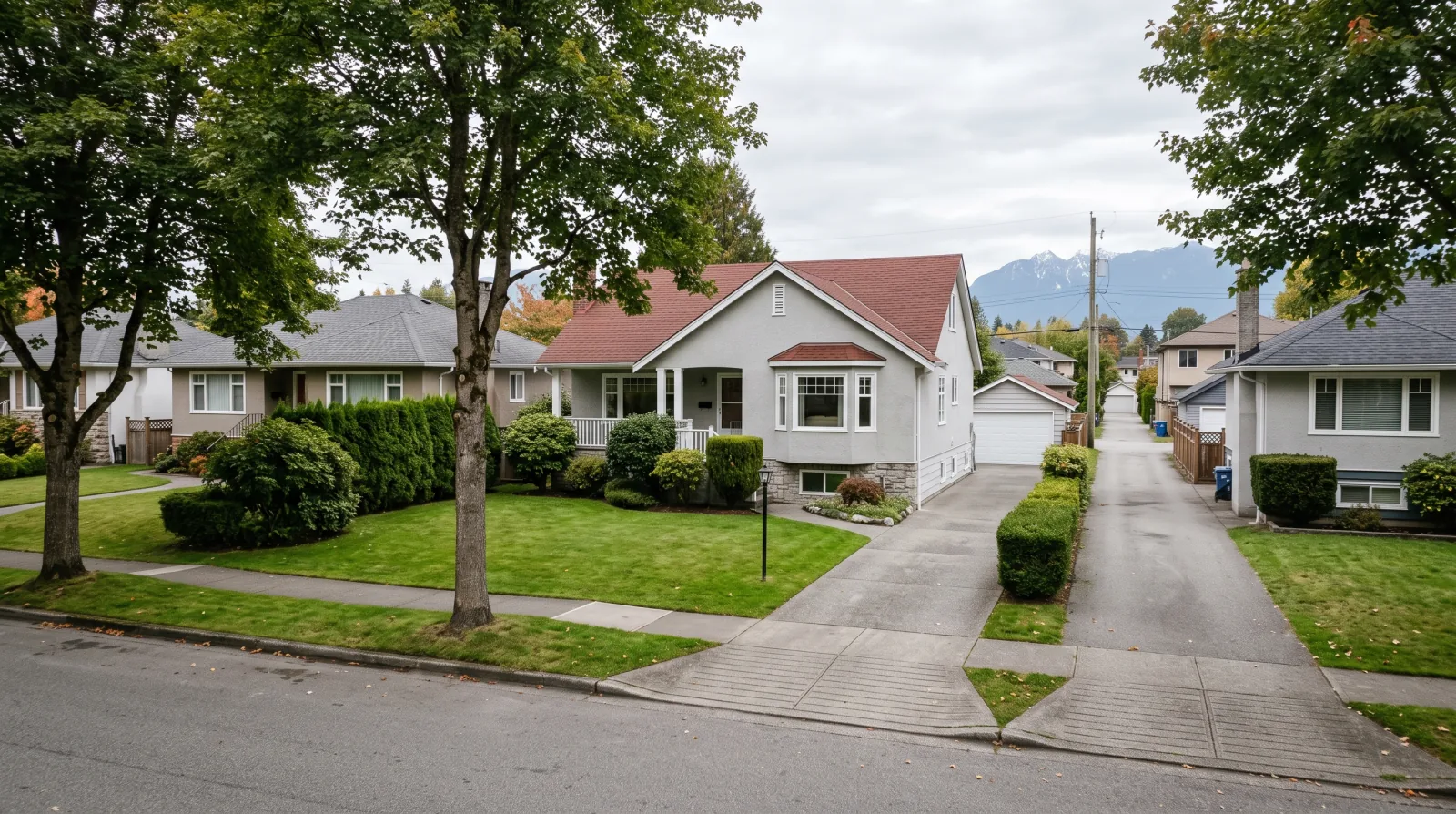
In the 1960s-80s, Vancouver’s “Vancouver Special” became iconic—a standardized design that builders repeated across thousands of lots. It was efficient, affordable, and perfectly suited to the lots of its era.
BC’s standardized multiplex designs represent the same opportunity for the multiplex era. The province commissioned professional architects to create designs that:
- Comply with current BC Building Code
- Fit standard Vancouver and BC lot configurations
- Include construction-ready drawings
- Eliminate months of custom design work
Yet adoption remains low. Most homeowners and many builders don’t know these resources exist.
What’s Actually Available
BC Housing’s standardized design library includes:
Duplex Designs
- Side-by-side configurations
- Stacked configurations
- 2-bedroom and 3-bedroom unit options
- Fits lots as narrow as 33 feet
Triplex Designs
- Three-unit configurations
- Mix of 2BR and 3BR units
- Optimized for 40-50 foot lots
Fourplex Designs
- Two buildings with two units each
- Single building with four units
- Multiple configurations for different lot shapes
- Designed for 45-55 foot lots
Townhouse/Rowhouse Designs
- 3-4 unit configurations
- Street-facing entries
- Designed for 50+ foot lots
Each design package includes:
- Floor plans
- Elevations
- Basic structural specifications
- Energy code compliance documentation
- Site plan templates
The $30,000-$50,000 Calculation
Custom architectural design for a multiplex typically costs:
| Design Phase | Custom Cost | Using Standardized |
|---|---|---|
| Schematic design | $15,000-$25,000 | $0 (included) |
| Design development | $10,000-$20,000 | $5,000-$10,000 |
| Construction documents | $15,000-$25,000 | $10,000-$15,000 |
| Permit coordination | $5,000-$10,000 | $3,000-$5,000 |
| Total | $45,000-$80,000 | $18,000-$30,000 |
The savings come from eliminating schematic design (the most time-intensive phase) and reducing design development to site-specific adaptations rather than starting from zero.
Why Experienced Builders Use Them
Counter-intuitively, it’s experienced builders—not first-timers—who most commonly use standardized designs. Here’s why:
Time compression. An experienced builder knows that custom design adds 3-6 months to project timeline. Standardized designs cut that to 4-8 weeks of adaptation.
Reduced revision cycles. Standardized designs are pre-vetted for code compliance. They typically pass permit review in 1-2 cycles rather than 3-4.
Cost predictability. Builders who’ve constructed the same basic design multiple times can estimate costs within 5% accuracy. Custom designs introduce 10-20% estimation uncertainty.
Trade familiarity. Framers, electricians, and plumbers who’ve worked on similar configurations before are faster and make fewer errors.
Focus on value-adds. With basic design solved, builders focus resources on finishes, site optimization, and marketing—activities that actually differentiate their product.
How Adaptation Works
Nobody builds standardized designs exactly as published. Here’s the typical adaptation process:
Site analysis (Week 1):
- Survey and geotechnical assessment
- Utility location and capacity verification
- Tree protection requirements
- Setback confirmation
Design selection (Week 2):
- Match standardized design to lot characteristics
- Identify required modifications
- Preliminary cost estimate
Adaptation (Weeks 3-6):
- Adjust dimensions for actual lot
- Modify parking and access configuration
- Update finishes to target market
- Prepare permit drawings
Permit submission (Week 7+):
- Submit with adaptation documentation
- Reference standardized design for code compliance
- Respond to review comments
Total timeline: 8-12 weeks from project start to permit submission, versus 16-24 weeks for full custom design.
Design-for-Approval Strategy
The standardized designs incorporate a crucial advantage: they’re designed to pass permit review, not just to look good on paper.
Code compliance built in:
- Fire separation already specified
- Egress routes clearly documented
- Energy code calculations included
- Accessibility provisions addressed
Common review triggers avoided:
- Window-to-floor-area ratios verified
- Smoke alarm placement optimized
- Structural spans within typical limits
- Mechanical room sizing adequate
Documentation format familiar:
- Drawing conventions match what permit reviewers expect
- Specification format aligned with standard practice
- Reference documents cited appropriately
When permit reviewers see a standardized design, they know the code compliance has been pre-verified. This creates psychological momentum toward approval.
Where to Access the Designs
BC Housing maintains the standardized design library at:
Primary source: BC Housing website, Housing Design Resources section
What you’ll find:
- PDF design packages
- CAD files for architect modification
- Energy modeling documentation
- Construction specification templates
Cost: Free for all users
License: Designs can be used commercially without royalty or attribution
Updates: BC Housing updates designs when building codes change
The Customization Spectrum
Different projects require different levels of customization:
| Customization Level | Typical Use Case | Additional Cost |
|---|---|---|
| Minimal | Lot matches design exactly | $5,000-$10,000 |
| Moderate | Standard lot, minor adjustments | $10,000-$20,000 |
| Significant | Unusual lot shape or slope | $20,000-$35,000 |
| Major | Heritage, complex site | $30,000-$50,000 |
Even “major” customization starting from standardized designs costs less than full custom—and delivers faster.
What the Designs Don’t Include
Standardized designs solve the architecture problem but leave several elements for the builder:
Site-specific engineering:
- Structural engineering for actual soil conditions
- Rainwater management design
- Utility connection design
Interior selections:
- Finishes, fixtures, appliances
- Flooring, countertops, cabinetry
- Lighting and electrical fixtures
Landscape design:
- Outdoor living spaces
- Planting plans
- Fencing and screening
Marketing materials:
- Renderings for pre-sales
- Floor plan marketing versions
- Finish packages for buyers
Budget $25,000-$50,000 for these elements regardless of whether base design is standardized or custom.
Comparison: Standardized vs. Custom vs. Prefab
Three approaches to multiplex design exist in the 2026 market:
| Factor | Standardized | Custom | Prefab |
|---|---|---|---|
| Design cost | $20-30K | $50-80K | Included in package |
| Design timeline | 8-12 weeks | 16-24 weeks | 2-4 weeks |
| Permit risk | Low | Moderate | Low |
| Differentiation | Moderate | High | Low |
| Builder familiarity | High | Varies | Low |
| Total cost impact | -5% to -8% | Baseline | -10% to -20% |
Standardized designs occupy the middle ground: meaningful cost savings without the constraints of full prefab systems.
Case Study: Kensington-Cedar Cottage
A Vancouver builder completed a fourplex in Kensington-Cedar Cottage using adapted standardized designs. Results:
Design phase: 10 weeks (vs. estimated 20 weeks for custom) Design cost: $24,000 (vs. estimated $55,000 for custom) Permit review cycles: 1 (vs. typical 2-3) Permit timeline: 7 months (vs. typical 10-12 months)
Total time savings: 5-6 months Total cost savings: ~$35,000 direct design costs + ~$100,000 carrying costs
The builder invested the savings in upgraded finishes, achieving higher per-unit sale prices than comparable custom-designed projects.
Common Objections (And Responses)
“Standardized designs look generic.” Exterior finishes—cladding, windows, landscaping—create 90% of visual differentiation. The floor plan is invisible from the street. Buyers care about unit functionality, not design originality.
“My lot is unique.” Most Vancouver lots fit within standard parameters. True outliers (extreme slope, irregular shape, heritage adjacency) still benefit from standardized starting points versus blank-page design.
“Custom design adds value.” In the commercial multiplex market, buyers value price-per-square-foot, unit count, and location. They don’t pay premiums for “designed by famous architect.” Custom design costs rarely translate to higher sale prices.
“My architect recommends custom.” Architects earn higher fees for custom work. This creates misaligned incentives. Ask your architect: “What would it cost to adapt a standardized design versus full custom?” Compare answers.
Integration with Bill 44 Requirements
BC’s standardized designs were created specifically for the Bill 44 density allowances:
Unit counts align:
- Duplex designs for 2-unit allowance
- Triplex/fourplex designs for 4-unit allowance
- Townhouse designs for 6-unit allowance
Lot size assumptions match:
- Designs sized for typical R1-1 lot dimensions
- Setback assumptions align with Vancouver and Burnaby bylaws
- Height limits respected in all configurations
Parking accommodates:
- Reduced parking configurations for transit-adjacent sites
- Surface parking options for standard lots
- Garage configurations available
Using standardized designs reinforces Bill 44 compliance rather than creating conflicts. If you’re in Vancouver, the standardized designs also align with Vancouver’s R1-1 setback and height parameters, which simplifies permit review further.
Getting Started with Standardized Designs
If you’re considering multiplex development, here’s how to leverage standardized designs:
Step 1: Download relevant designs. Review the BC Housing library for configurations matching your lot size and target unit count.
Step 2: Share with your architect. Even architects unfamiliar with standardized designs will recognize the time savings.
Step 3: Commission site analysis. Survey, geotech, and utility verification proceed regardless of design approach.
Step 4: Request adaptation quote. Compare architect quotes for standardized adaptation versus custom design. Expect 40-60% difference.
Step 5: Confirm permit pathway. Verify with municipal planning that your standardized design approach will be accepted.
VanPlex Design Analysis
VanPlex’s PlexRank™ analysis includes design pathway recommendations. If you’d like to work with our team directly, our development services cover the full design-to-permit process. For each property, we evaluate:
- Which standardized design configurations fit the lot
- Required adaptations and estimated costs
- Permit timeline projections
- Total development cost comparison (standardized vs. custom)
Visit VanPlex.ca to see which standardized designs match your property and project the cost savings potential.
VanPlex Team
PlexRank™ | Profit with Multiplex