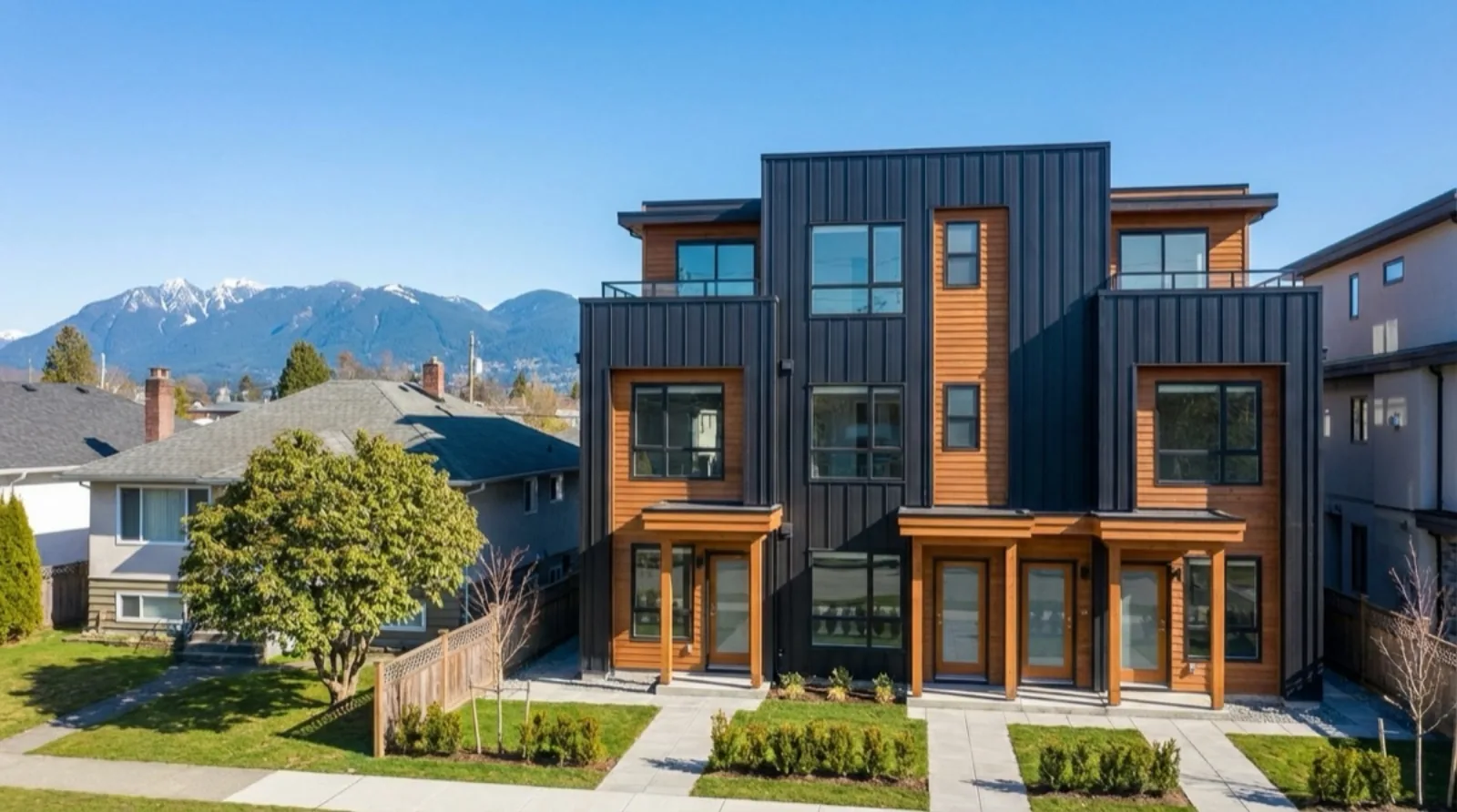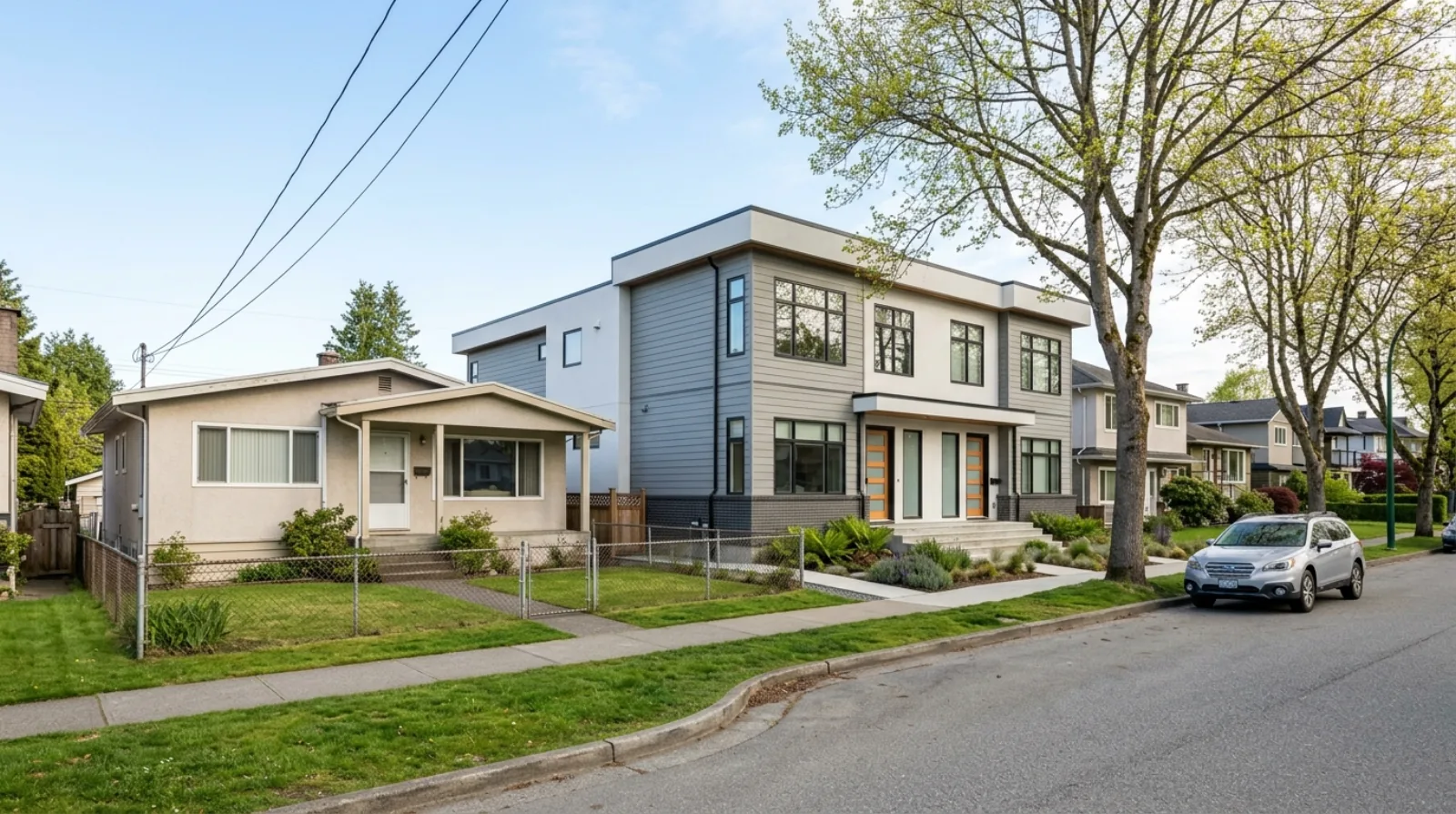

If you own a single-family home in Vancouver or Burnaby and are exploring multiplex development, you face a fundamental decision:
Partner with a developer or self-fund the conversion independently.
Our homeowners guide covers the full picture of what to expect before you engage anyone.
Most homeowners assume the choice is binary. But the reality is more nuanced—and the stakes are higher than most realize.
This guide breaks down the two partnership structures available when working with a professional developer, the financial and operational risks of each path, and the critical question you must answer before making any commitment.
The two paths: partnering vs. going solo
When redeveloping a single-family property into a multiplex, there are three possible approaches:
- Sell outright to a developer and walk away with capital
- Partner with a developer and retain equity participation (limited or general partnership)
- Self-fund the entire project and act as your own developer
Most homeowners reflexively consider option 1 or 3. Few understand option 2 exists—or how it works.
The partnership path allows you to sell your land to a developer while securing a unit (or units) in the completed multiplex. You participate in the upside without shouldering the full burden of execution.
But partnership comes in two forms, and the distinction matters significantly.
Limited partnership: capital participation without construction exposure
In a limited partnership structure, you sell your property to the developer and contractually reserve one or more units in the finished building.
Key characteristics:
- The developer assumes financing, permitting, and construction risk
- You retain decision-making rights over specific elements (finishes, layouts, major expenditures)
- Your financial exposure is limited to your initial equity contribution
- You are not liable for cost overruns, delays, or on-site hazards
This structure is appropriate when:
- You want to remain in the neighbourhood and occupy a unit in the completed multiplex
- You do not have construction or development experience
- You prefer predictable risk exposure over maximum control
- Your primary objective is long-term housing security, not developer-level profit
Example scenario: You own a $2.4M property in East Vancouver eligible for a fourplex. A developer offers to purchase the land for $2.8M and contractually reserves two units for you in the completed building (valued at $1.4M each upon completion). You participate in value creation without managing the build. Our services page explains how VanPlex structures these arrangements.
General partnership: maximum control, maximum liability
In a general partnership, you and the developer share full operational and financial responsibility for the project.
Key characteristics:
- You must qualify for construction financing alongside the developer
- You are jointly liable for all project costs, including overruns
- You assume risk for on-site hazards (contaminated soil, oil tanks, structural issues)
- You have complete decision-making authority over design, materials, and strategy
This structure is appropriate when:
- You have significant construction or real estate development experience
- You want developer-level control over every aspect of the project
- You can qualify for and service construction financing (typically $1.6M–$2.1M for a standard Vancouver fourplex)
- You are prepared to manage delays, contractor issues, and unforeseen costs
Critical consideration: As one Vancouver-based developer notes, “not everybody wants a bathtub in their living room.” If you plan to sell units to end users after completion, highly customized layouts may limit marketability. Control comes with responsibility.
The self-funded path: when does it make sense?
Some homeowners bypass developers entirely and act as their own general contractor.
This approach makes sense only when:
- You have construction management experience or access to a trusted builder
- You have cash reserves or financing capacity beyond the land value (typically $1.6M–$2.1M for Vancouver fourplexes)
- You understand permitting, zoning, and municipal approval processes
- You can manage subcontractors, scheduling, and quality control
Risks of self-funding:
- Change-of-use tax implications (potential loss of principal residence exemption)
- Construction delays extending beyond 18–24 months
- Cost overruns (10–15% contingency is standard, but overruns can exceed this)
- On-site hazards discovered during excavation
- Difficulty securing construction financing without a proven track record
For most homeowners, self-funding introduces more risk than it eliminates. Unless you have direct experience managing construction projects, the partnership path offers better risk-adjusted returns.
The question you must answer first: what is your property actually worth?
Before engaging any developer or evaluating partnership structures, you need an accurate understanding of your property’s as-is value and its redevelopment potential. Investors who have already run the numbers on a site often find our investment resources helpful for comparing partnership structures side by side.
Many homeowners make a critical error: they assume a fourplex-eligible lot is worth four times what a single-family lot would be. That is not how valuation works.
Land value depends on:
- Comparable sales of similar multiplex-eligible properties
- The projected end value of the completed multiplex (based on unit sales or rental income)
- Development costs (construction, permits, soft costs, financing)
- Developer margin requirements (typically 15–25% of total project cost)
A developer offering $2.8M for your land is not being generous or exploitative—they are pricing in construction risk, financing costs, and the capital required to execute.
Example: A $2.4M single-family home on a fourplex-eligible lot may have a redevelopment value of $2.8M–$3.2M, depending on the neighbourhood and site characteristics. If the completed fourplex is valued at $5.6M and construction costs $2.0M, the residual land value after developer margin is approximately $2.8M–$3.0M.
Understanding this upfront prevents unrealistic expectations and allows for informed negotiation.
Financing a multiplex partnership: who qualifies, and for how much?
Financing structure depends on the partnership model.
Limited partnership:
- The developer secures construction financing
- You contribute your land equity (or cash equivalent)
- If you are purchasing additional units beyond your reserved allocation, you may need to qualify for a mortgage on those units
General partnership:
- You and the developer co-sign construction financing
- Lenders will assess your creditworthiness, income, and debt-service capacity
- Construction loans for Vancouver fourplexes typically range from $1.6M–$2.1M
- Interest rates on construction financing are higher than residential mortgages (prime + 1–2%)
Vancity and other lenders now offer multiplex-specific financing products. Work with a mortgage broker early to understand your borrowing capacity before committing to a partnership structure.
Timeline: how long from contract signing to occupancy?
A realistic timeline for a multiplex partnership in Vancouver or Burnaby:
Months 1–3: Architectural design, site planning, initial zoning review Months 4–8: Permit applications and municipal approvals Months 9–10: Final permits issued, construction financing secured Months 11–22: Construction phase Months 23–24: Final inspections, strata registration, occupancy
Total timeline: 18–24 months from contract signing to move-in.
Key variable: Municipal approval timelines vary significantly. Vancouver’s online portal provides estimates, but delays are common. Some projects receive permits in 4 months; others take 10+.
You typically remain in your existing home until permits are issued (around month 9–10), then relocate to temporary housing during construction.
What happens after completion? Understanding strata management
Once your multiplex is complete, it functions as a strata. Even if you own multiple units or share the building with family members, professional strata management is strongly recommended.
Strata responsibilities include:
- Building insurance
- Maintenance of common areas (roof, siding, gardens, shared driveways)
- Contingency fund contributions for major repairs
- Dispute resolution between unit owners
Monthly strata fees for small multiplexes typically range from $150–$300 per unit, depending on the building’s complexity and shared amenities.
If you are building a multi-generational multiplex with extended family, treat the strata fee as a collective commitment to avoid future conflicts over maintenance and repair costs.
The decision framework: which path is right for you?
Choose limited partnership if:
- You want to remain in your neighbourhood and occupy a unit in the completed building
- You lack construction or development experience
- You prefer predictable outcomes over maximum control
- Your goal is long-term housing security for yourself or family members
Choose general partnership if:
- You have significant real estate development or construction management experience
- You want full control over design, materials, and execution
- You can qualify for construction financing and manage financial risk
- You are comfortable with the possibility of cost overruns and delays
Choose self-funding if:
- You have direct construction management experience
- You have cash reserves or financing capacity beyond your land value
- You are prepared to navigate permitting, zoning, and contractor management independently
- You understand and accept the tax implications of independent conversion
Choose to sell outright if:
- You do not want to live in the completed multiplex
- You prefer liquidity over long-term equity participation
- You want to redeploy capital elsewhere
The first step: understanding your property’s potential
Before contacting developers or evaluating partnership structures, the first step is clarity.
What can your property support under current zoning? What is the realistic end value of a completed multiplex on your site? What is your land worth in today’s market?
Answering these questions allows you to evaluate developer offers, assess partnership terms, and determine whether the economics justify participation.
Visit VanPlex.ca to:
- Run an instant eligibility check for your Vancouver or Burnaby property
- Calculate your site’s multiplex potential using PlexRank™ analysis
- Understand land valuation before engaging developers
- Explore whether limited partnership, general partnership, or outright sale aligns with your goals
Clarity always comes before decisions.
—
David Babakaiff
Co-Founder, VanPlex.ca
PlexRank™ | Profit with Multiplex