DNV Council just voted to ask the Province for a four-and-a-half-year delay on rezoning 319 single-family properties along Marine Drive. The proposed deadline shift: from June 30, 2026 to December 31, 2030. The reason? TransLink’s planned Bus Rapid Transit line running through the corridor. If the Province approves, these 319 lots sit in regulatory limbo while the rest of the District moves forward with multiplex zoning.
TL;DR (Key Takeaways)
- 319 single-family properties in DNV’s Marine Drive BRT corridor face a potential rezoning delay
- Deadline shift requested: June 30, 2026 to December 31, 2030 (4.5 years)
- Boundaries: Hope Road (north), Pemberton Ave (east), Sowden Street (south), McGuire Ave (west)
- Reason: TransLink’s Metrotown-North Shore BRT at only 10% conceptual design
- OCP amendments proposed: higher-density mixed-use and apartment designations replacing SSMUH
- Staff vision: transit-oriented development with apartments and mixed-use, not just fourplexes
- 4,000+ other DNV properties still on track for multiplex zoning by June 2026
What’s actually happening
On March 2, 2026, DNV Council reviewed a staff report requesting authorization to apply to the Province for a time extension under Bill 25. The request covers a specific pocket of 319 properties along the Marine Drive corridor—bounded by Hope Road to the north, Pemberton Avenue to the east, Sowden Street to the south, and McGuire Avenue to the west.
The properties currently sit in single-family zoning. Under normal Bill 25 compliance, they’d need to be rezoned for small-scale multi-unit housing (SSMUH) by June 30, 2026. Staff wants to skip that step entirely and jump straight to higher-density designations once the BRT project advances.
Here’s the staff logic: the Metrotown-North Shore BRT corridor runs directly through this area. The project is at 10% conceptual design, with funding approved to reach 30%. Staff argues that rezoning these 319 properties for fourplexes and sixplexes now would lock in lower-density zoning that conflicts with the future transit investment.
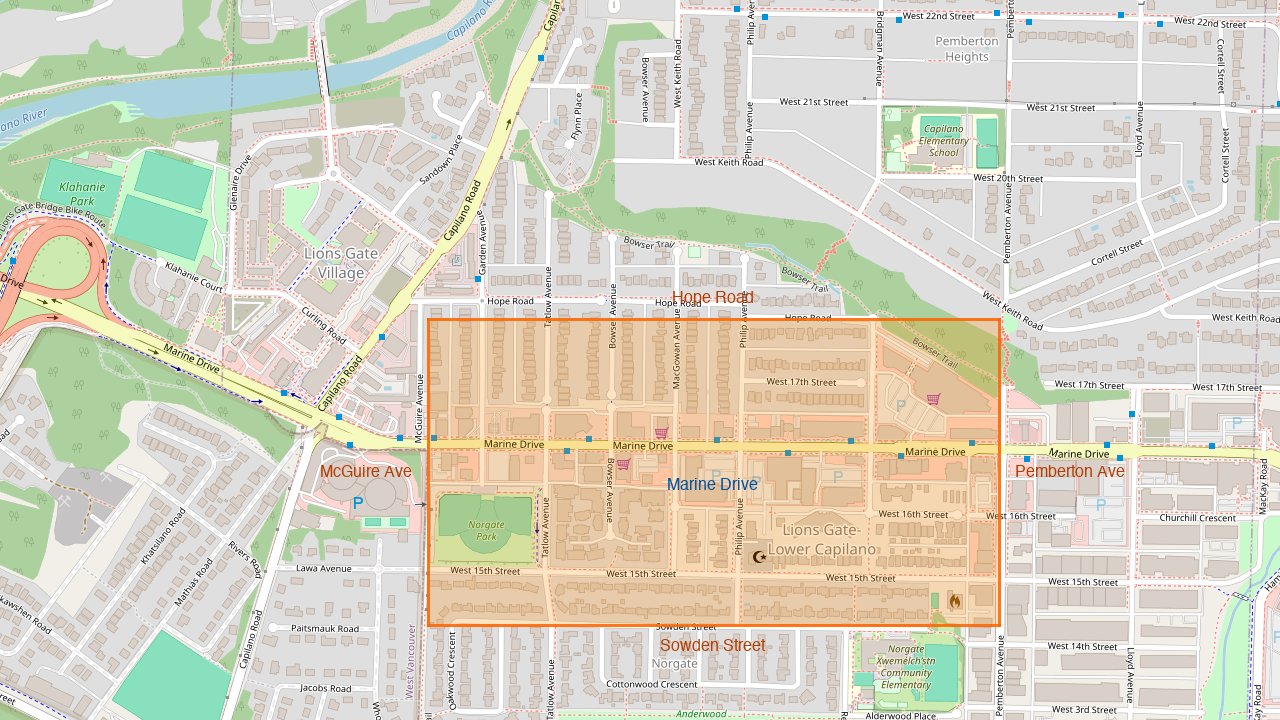
The BRT corridor: why staff says density should wait
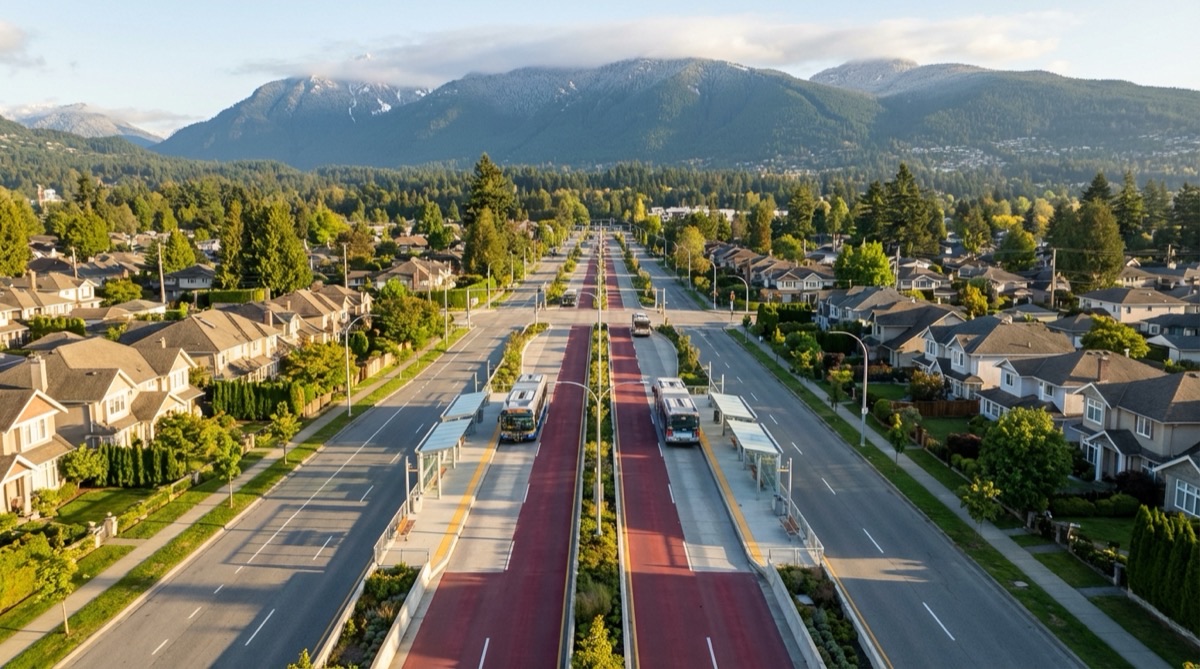
TransLink’s Metrotown-North Shore Bus Rapid Transit project is one of the largest transit upgrades planned for the North Shore. The corridor follows Marine Drive through DNV, and the 319 affected properties sit squarely in its path.
Staff raised three concerns about proceeding with SSMUH rezoning now:
Transit-oriented development gets constrained. If you rezone 319 lots for fourplexes today, you’ve set the density ceiling. When BRT arrives and the corridor needs apartments, mixed-use, and commercial space, you’re working against zoning you just adopted. Staff wants to skip the intermediate step.
Road network planning gets complicated. BRT requires dedicated lanes, stop infrastructure, and intersection redesigns. Rezoning properties before the road layout is finalized could create conflicts between new multiplex developments and future road widening or transit infrastructure.
Construction timing creates friction. If multiplex construction starts on these 319 lots while BRT construction is also underway, you get overlapping disruption—traffic management nightmares, utility conflicts, and coordination headaches.
What staff wants to build instead
The staff report includes proposed OCP amendments that would redesignate all 319 properties. The vision is explicitly higher-density than what SSMUH would allow:
| Area | Current Zoning | Proposed Designation | What That Means |
|---|---|---|---|
| North of Marine Drive | Single-family | Mixed-use commercial-residential | Ground-floor retail, apartments above |
| Surrounding Marine Drive | Single-family | Medium-density apartments | 4-6 storey apartment buildings |
| West 15th to Sowden Street | Single-family | Townhouses / low-rise apartments | 3-4 storey forms, higher density than SSMUH |
This is a scaled-back version of OCP Update Option A, which received broad community support during 2025 engagement sessions. Council signaled support at a February 9, 2026 workshop.
The math here is straightforward: SSMUH allows 4-6 units per lot. The proposed designations could allow 20-50+ units on the same land once consolidated. Staff is betting that the BRT investment justifies skipping gentle density and going straight to urban density.
The Bill 25 extension mechanism
In November 2025, the Province amended the Local Government Act through Bill 25, requiring municipalities to rezone most single-family properties within the Urban Containment Boundary for SSMUH by June 30, 2026. But Bill 25 also includes a provision allowing municipalities to apply for time extensions under certain conditions.
DNV’s application would argue that the BRT project constitutes a valid reason for delay. The Province hasn’t publicly signaled how it will evaluate these requests, so approval isn’t guaranteed. If the Province rejects the extension, DNV would need to rezone the 319 properties under standard SSMUH rules by the original deadline.
What this means for DNV property owners
If you own one of the 319 properties: Your lot won’t be rezoned for SSMUH by June 2026 if the extension is approved. That means no fourplex or sixplex development rights in the near term. But the long-term vision is actually higher density—apartments, mixed-use, and townhouses once BRT design advances. Your land value trajectory depends on whether the BRT project stays on track and whether the OCP amendments are ultimately adopted.
If you own one of the other 4,000+ DNV properties: Nothing changes. The District is still on track to comply with Bill 25 by June 30, 2026 for the rest of the municipality. The comprehensive OCP and zoning bylaw rewrite continues, with a draft expected mid-April 2026.
If you’re a developer or investor: The 319 properties are effectively frozen for SSMUH purposes, but they become interesting longer-term plays if the BRT-oriented OCP amendments go through. Medium-density apartments and mixed-use along a rapid transit corridor could be worth significantly more than SSMUH-eligible lots. The catch: you’re looking at a 2030+ timeline, and the BRT project itself carries execution risk.
The bigger picture on North Shore transit
The Metrotown-North Shore BRT has been discussed for years, but it’s still early stage. At 10% conceptual design, most details—station locations, lane configurations, stop spacing—remain uncertain. Funding to reach 30% design has been approved, which gets the project through preliminary engineering.
For context, 30% design typically means you’ve settled the alignment and station locations but haven’t started detailed engineering or construction procurement. Going from 30% design to operational service usually takes 5-8 years for a project of this scale.
So if the extension is approved and DNV delays rezoning until December 31, 2030, there’s a real question about whether the BRT project will be far enough along by then to inform the final zoning decisions. Staff is betting it will be. That bet may or may not pay off.
What happens next
If Council approved the request (which they were considering March 2), staff submits the extension application to the Province. The Province reviews and either approves or rejects the time extension. Meanwhile, staff begins work on the OCP bylaw amendments to redesignate the 319 properties.
Without Council approval, neither step moves forward, and the 319 properties would need to be rezoned under standard SSMUH rules by June 30, 2026.
The rest of DNV’s Bill 25 compliance work continues on schedule. The comprehensive zoning bylaw rewrite with updated SSMUH provisions is expected to produce a draft OCP by mid-April 2026, ahead of the June 30 deadline.
Check your DNV property’s current eligibility and development potential at VanPlex.ca. Whether your lot falls in the BRT delay zone or the broader SSMUH area, knowing your numbers is the first step.
David Babakaiff, CEO & Co-Founder of VanPlex PlexRank(TM) | Profit with Multiplex