
The BC Speculation and Vacancy Tax scares people who shouldn’t be scared and misses the people it should catch.
If you’re building a multiplex and renting out the units, you’re almost certainly exempt. Full stop. The tax targets vacant and underused properties — not purpose-built rental housing. But the name alone sends landlords into panic mode every March when declarations are due, and promoters use that panic to sell consulting services you don’t need.
Here’s what actually matters for multiplex owners.
The Rates
BC’s Speculation and Vacancy Tax (SVT) is assessed annually on residential property in designated taxable regions. The rates differ based on who you are:
2025 Tax Year:
| Owner Category | Rate |
|---|---|
| BC resident (Canadian citizen/PR) | 0.5% |
| Other Canadian citizen/PR (not BC resident) | 0.5% |
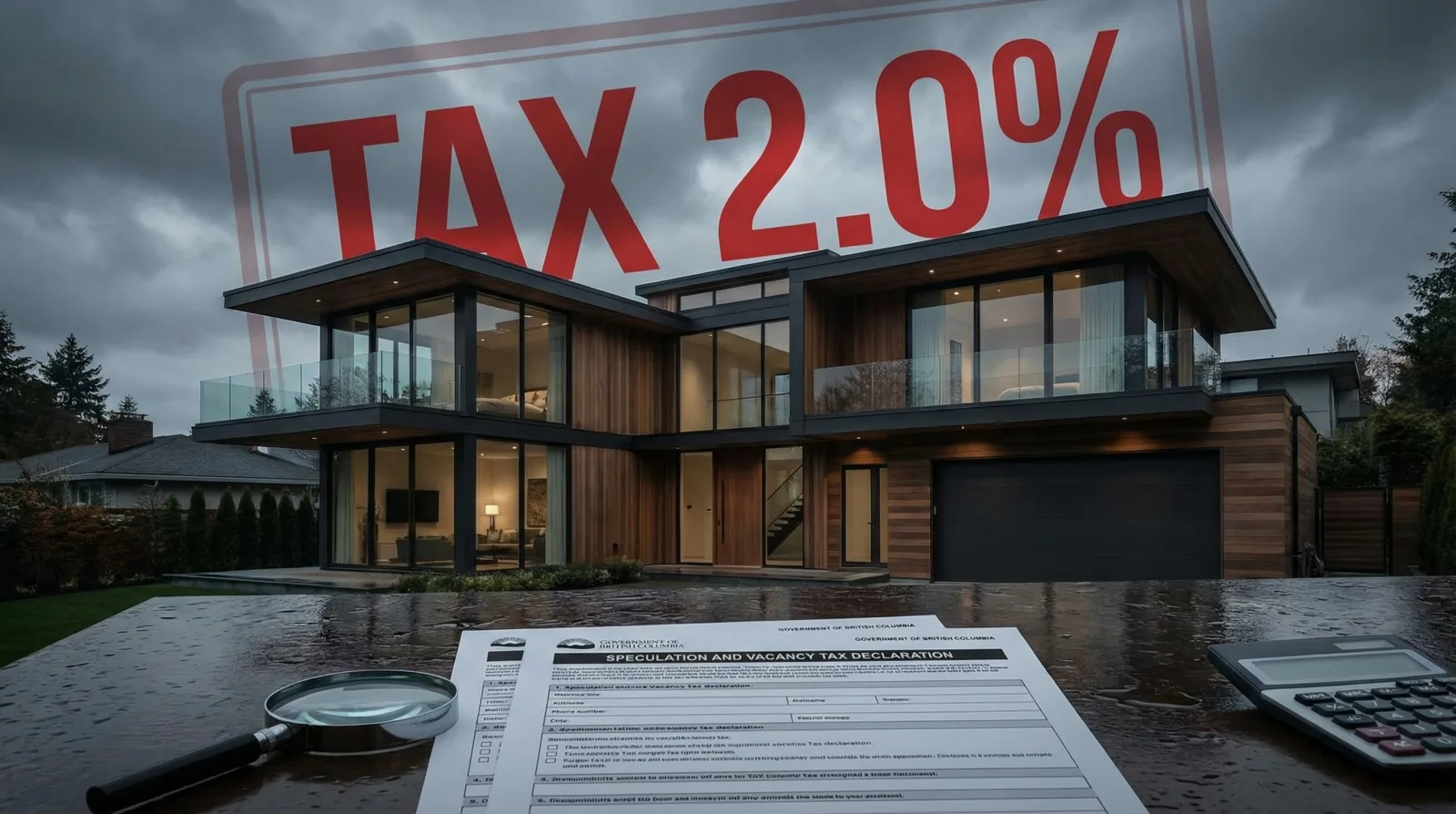
| Foreign owner | 2.0% |
| Satellite family / untaxed worldwide earner | 2.0% |
2026 Tax Year (announced):
| Owner Category | Rate |
|---|---|
| BC resident | 1.0% |
| Other Canadian citizen/PR | 1.0% |
| Foreign owner | 3.0% |
| Satellite family | 3.0% |
On a $2M property, the BC resident rate goes from $10,000 to $20,000 annually. The foreign owner rate goes from $40,000 to $60,000. These are significant numbers — if you owe them.
Most BTR operators won’t.
The Rental Exemption
This is the part that matters. If your residential property is rented to arm’s-length tenants for at least six months of the calendar year, you qualify for the tenanted property exemption.
Six months. That’s the threshold. Not twelve. Not nine. Six.
For a purpose-built rental multiplex with 6-8 units, you’re renting continuously. Your tenants have 12-month leases. You clear this threshold on January 1. The SVT is irrelevant to your operating economics.
The exemption applies per-property. Each residential property is assessed independently. If you own the entire multiplex building (not stratified — which it won’t be under secured rental tenure), the building is one property. Rented for six months. Exempt.
What Counts as “Rented”
The province defines qualifying occupancy broadly. A tenant with a lease agreement occupying the property counts. The tenant doesn’t need to be arm’s-length in all cases — certain family members occupying the property can also qualify, though the rules are stricter.
For BTR: your tenants are arm’s-length. They have signed leases. They pay market rent. You meet every criterion without trying.
The Declaration Requirement
Even if you’re 100% exempt, you must file an annual declaration by March 31. Every year. Every owner on title.
Miss the deadline and the province assumes you owe the tax. You’ll receive an assessment at the full rate. You can appeal, but the process takes months and creates unnecessary stress.
Put it in your calendar. March 31. File the declaration. Check the “tenanted property” exemption box. Done.
Satellite Family Rules
This is where the SVT gets complicated — and where it catches people off guard.
A “satellite family” (the province’s term, not mine) is defined as: an individual or spousal unit where more than 50% of total worldwide income for the year is not reported on a Canadian tax return.
Translation: if you and your spouse collectively earn $500,000 worldwide, and less than $250,000 of that is reported on Canadian returns, you’re classified as a satellite family. The SVT rate jumps to 2% (rising to 3% in 2026).
Why this matters for multiplex owners:
Scenario 1: You’re a BC resident. Your spouse works locally. All income is Canadian-source. You’re at the 0.5% rate (1% in 2026) — and exempt anyway because you’re renting units.
Scenario 2: You’re a Canadian PR. Your spouse earns income overseas that isn’t reported in Canada. If that foreign income exceeds your combined Canadian income, you’re classified as a satellite family. Rate: 2% (3% in 2026). You’re still exempt if renting — but if you have vacancy issues or are in the construction phase before tenants move in, the satellite family classification bites hard.
Scenario 3: You’re a foreign owner using a Canadian corporation. The SVT applies to the individual beneficial owner, not the corporation. You can’t avoid satellite family classification through corporate structuring.
The Principal Residence Angle
Satellite family members cannot claim the principal residence exemption for SVT purposes. If you live in one unit of your multiplex and rent the others, you’d normally claim principal residence on your unit and tenanted property on the rest.
Satellite family classification blocks the principal residence claim. Your unit is still exempt through the tenanted property route (if you can structure it correctly), but the path is narrower.
If your worldwide income picture is complex, get tax advice specific to your situation before building.
When the Tax Still Applies
The SVT isn’t a non-issue for everyone in the BTR space. Three scenarios where it bites:
1. Construction period vacancy. You’ve demolished the existing house. You’re 14 months into construction. No tenants. The lot is assessed as residential. You may owe SVT for the year(s) where no rental occupancy exists.
There is a “property under development” exemption, but it has conditions: you must have obtained permits and be actively constructing. A vacant lot with no building permit doesn’t qualify. Timing your demolition and permit sequencing matters.
2. Extended lease-up. Your 8-unit building is complete but only 3 units are rented after 6 months. The property-level exemption looks at whether the property is rented, not whether every unit is occupied. If some units are rented and you’re actively marketing the others, you likely qualify. But if the building sits entirely empty for 6+ months — a scenario in a market where Vancouver’s purpose-built rental vacancy hit 3.7% in 2025 — you could face assessment.
3. Land banking. You bought the lot. You haven’t applied for permits. You’re waiting for the market to improve. The SVT applies at full rate every year you hold a vacant residential property without renting it.
Why This Tax Matters Less Than Promoters Suggest
Real estate seminars love to weaponize the SVT. “Build rental to avoid the speculation tax!” they say. As if the tax is so punitive that it alone justifies a $5M construction project.
The math doesn’t support that framing. At the BC resident rate of 0.5% on a $2M property, the annual SVT is $10,000. Even at the 2026 rate of 1%, it’s $20,000. That’s a nuisance, not a project driver.
You don’t build an 8-unit multiplex to avoid $20,000/year in SVT. You build it because the rental income, CMHC financing, and long-term asset appreciation justify the capital investment. The SVT exemption is a side benefit — nice to have, not the business case.
If someone is telling you the SVT is the primary reason to go BTR, they’re selling you fear, not analysis.
The Designated Regions
The SVT applies only in specific areas. The full list of taxable regions:
- Metro Vancouver: All municipalities including Vancouver, Burnaby, Surrey, Richmond, Coquitlam, North Vancouver, West Vancouver, Delta, Langley, Maple Ridge, New Westminster, Port Moody, Port Coquitlam, Pitt Meadows, White Rock, Lions Bay, Bowen Island, Anmore, Belcarra
- Capital Regional District: Victoria, Saanich, Oak Bay, Esquimalt, Langford, Colwood, View Royal, Sidney, North Saanich, Central Saanich, Highlands, Metchosin, Sooke
- Kelowna and West Kelowna
- Nanaimo and Lantzville
- Other: Abbotsford, Chilliwack, Mission
If your multiplex is in Prince George, Kamloops, or Terrace — no SVT. But those markets also don’t have the rental demand to justify BTR at scale.
The Bottom Line for Multiplex Owners
If you’re operating a purpose-built rental multiplex in a designated region:
- You’re exempt through the tenanted property exemption.
- File your declaration by March 31 every year. Non-negotiable.
- Watch your satellite family status if your household has significant foreign income.
- Plan your construction timeline to minimize the gap between demolition and tenant occupancy.
- Don’t let anyone sell you a BTR project on SVT avoidance alone. The numbers don’t justify it.
The speculation tax is designed to penalize vacant and underused properties. A fully tenanted multiplex is the opposite of what this tax targets. Understand the rules, file your paperwork, and move on to the decisions that actually determine whether your project succeeds: land basis, construction costs, rent levels, and financing terms.
For the full tax and incentive picture for BTR multiplex in BC, see the VanPlex tax and incentives analysis.
David Babakaiff is the Co-Founder and CEO of VanPlex, a Vancouver-based company specializing in multiplex development and Missing Middle housing. VanPlex uses its AI-powered PlexRank system to identify and underwrite multiplex conversion opportunities under BC’s Bill 44 zoning reforms.