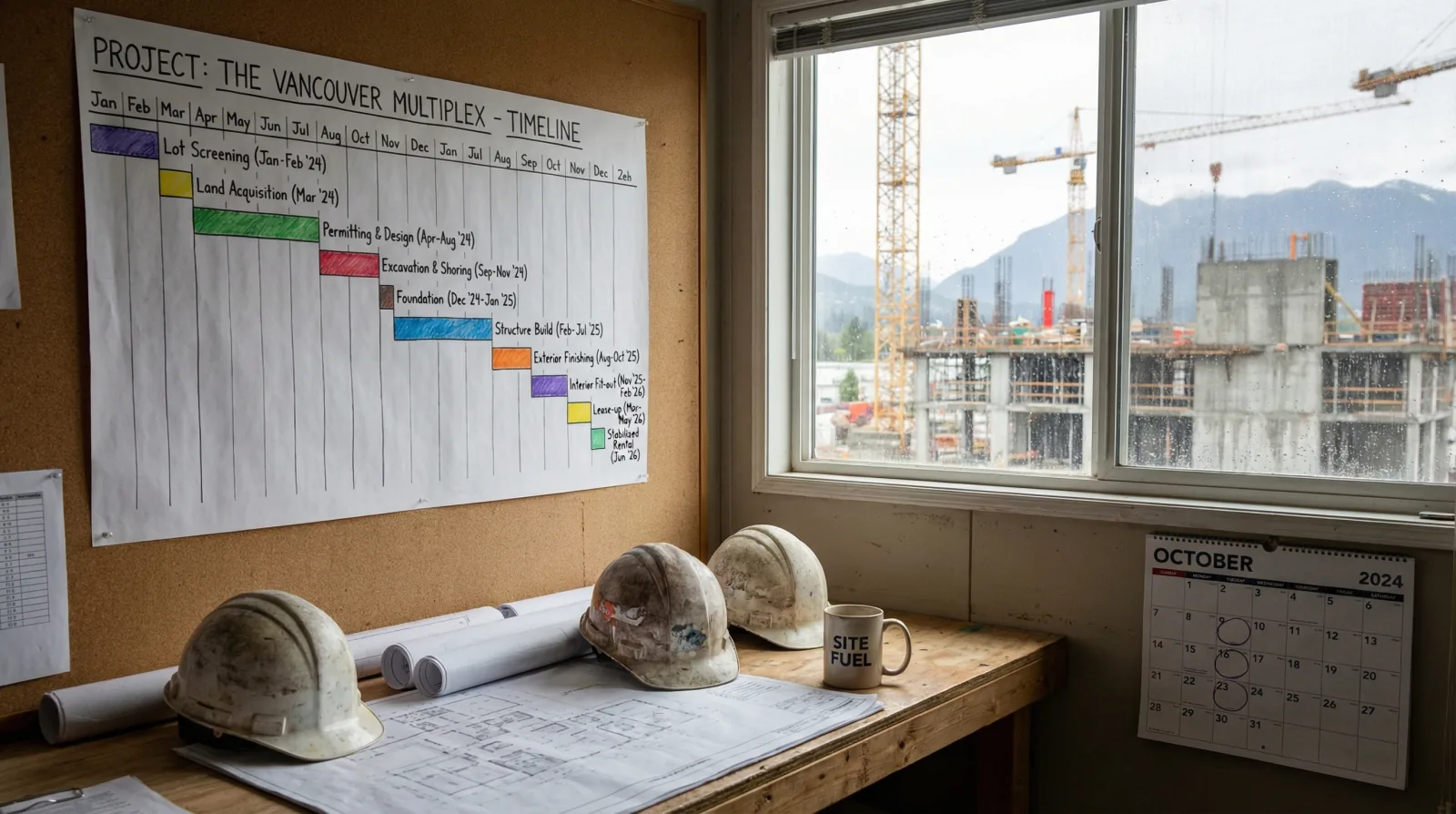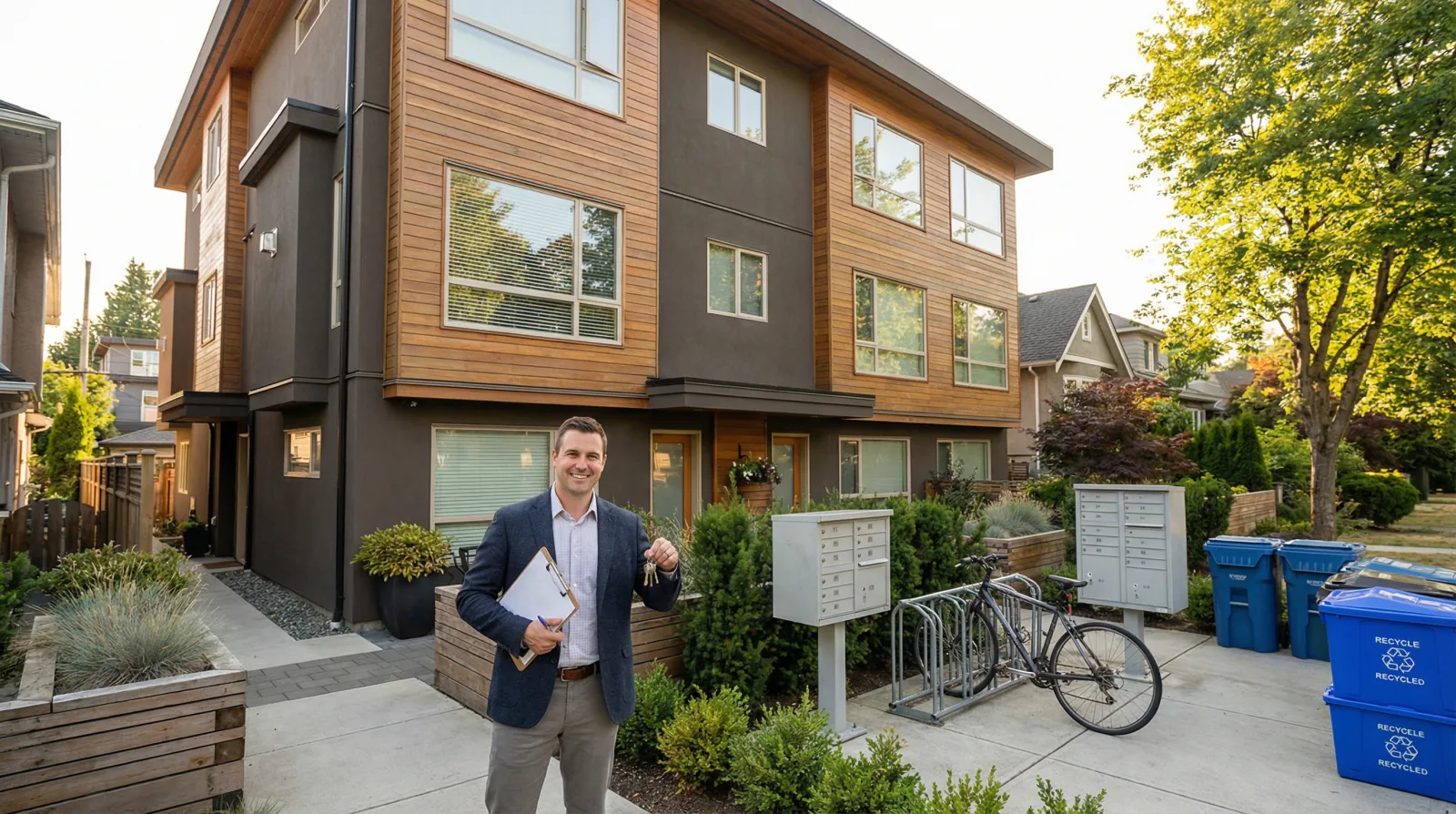

You just built an 8-unit multiplex. Construction took 14 months. Permits took 7. You survived cost overruns, rain delays, and a plumber who ghosted mid-rough-in. Now the building is leased and generating rent.
Who manages it?
This is where most first-time BTR owners get stuck. They’ve spent 20 months thinking about construction. They’ve spent zero time thinking about operations. And operations is where the building either makes money or slowly bleeds it.
TL;DR (Key Takeaways)
- Self-managing saves 6-10% of gross rent but costs 10-15 hours per week on a 5-8 unit building
- Professional management runs 8-12% of gross rent in Metro Vancouver — worth it above 8-10 units or if you have a day job
- BC Residential Tenancy Act governs everything: 2.3% max rent increase for 2026, minimum 3-month notice for tenancy end, RTB disputes average 8-12 weeks
- Budget $2,000-$3,500 per unit per year for maintenance on a new building, rising to $4,000-$6,000 after year 5
- Turnover costs $3,000-$6,000 per unit between vacancy loss, cleaning, repairs, and re-leasing
- The real question isn’t cost — it’s whether you’ll actually do the work consistently
The Self-Management Reality
Managing a 6-8 unit building yourself saves 8-12% of gross rent. On a building generating $22,000-$25,000/month in gross income, that’s $21,000-$30,000 per year staying in your pocket instead of going to a property manager.
The trade-off is your time. Here’s what a typical month looks like:
Rent collection and accounting: 2-3 hours/month. You need a system — Buildium, Rentec Direct, or even a spreadsheet — to track payments, issue receipts, and generate reports for your accountant. Most tenants pay electronically. The ones who don’t will consume disproportionate time.
Maintenance coordination: 4-8 hours/month. A new building generates fewer maintenance calls than an old one. But “fewer” is not “zero.” Expect 2-4 maintenance requests per month across 8 units. Leaky faucets, stuck windows, broken blinds, clogged drains. You need a reliable plumber, electrician, and general handyperson on speed dial. Response time matters — BC’s Residential Tenancy Act requires landlords to maintain the property in a state of repair that complies with health, safety, and housing standards.
Tenant communication: 2-3 hours/month. Questions about parking, complaints about noise, requests for package storage, notification of upcoming vacations. Most of this is texting. Some of it requires judgment calls.
Administrative: 2-3 hours/month. Insurance renewals, tax filings, strata-adjacent tasks (even though it’s not strata, you still need fire inspections, elevator maintenance if applicable, common area cleaning), and bookkeeping.
Total: 10-15 hours per month for a smooth-running building. Double that during tenant turnover or a major repair.
If you value your time at $50/hour, self-management costs $6,000-$9,000/year in opportunity cost. The savings over professional management shrink to $12,000-$21,000 net. Still meaningful. But not as dramatic as the 8-12% headline suggests.
When to Hire a Professional
Hire a property manager if any three of these apply:
- You have a full-time job and can’t respond to maintenance emergencies during business hours
- You own 8+ units across one or more buildings — the complexity increases non-linearly
- You live far from the building — same-day maintenance response requires proximity
- You don’t want to learn the BC Residential Tenancy Act — and violations can cost you thousands
- Tenant disputes make you anxious — the RTB process is adversarial and time-consuming
What professional management costs in Metro Vancouver (2026):
| Service | Typical Fee |
|---|---|
| Monthly management fee | 8-12% of collected rent |
| Tenant placement (new lease) | 50-100% of first month’s rent |
| Lease renewal | $150-$300 per renewal |
| Maintenance markup | 0-15% on contractor invoices |
| Move-out inspection/turnover | $200-$500 per unit |
On our 8-unit building at $25,000/month gross rent, a property manager at 10% costs $30,000/year. Add one tenant placement ($3,200) and two lease renewals ($500), and annual management expense is roughly $33,700.
The management fee is tax-deductible against rental income. So the after-tax cost is lower — roughly $22,000-$25,000 depending on your marginal rate.
How to choose a manager: Ask for their current portfolio. Do they manage other small multiplexes, or are they primarily condo property managers? The skill sets are different. A condo manager handles strata councils and common property disputes. A multiplex manager handles tenant relations, vacancy marketing, and maintenance coordination for a single owner. You want someone who has managed 5-20 unit buildings — not someone whose smallest client is a 200-unit tower.
Get references from other multiplex owners. Check their Google reviews. Ask about their maintenance response time (should be under 4 hours for emergencies, 24-48 hours for routine). Ask how they handle the RTB dispute process.
BC Residential Tenancy Act: What You Must Know
Whether you self-manage or hire, you’re bound by the RTA. Key rules for 2026:
Rent increases: Maximum 2.3% per year. You must give 3 months’ notice using the approved RTB form (RTB-7). You can only increase rent once every 12 months. Additional rent increases for capital expenditures require RTB approval — and the process takes 6-12 months.
Ending tenancies: You can end a tenancy for landlord’s use of property (2 months’ notice, 1 month’s rent compensation), demolition/renovation (4 months’ notice, 1 month’s rent compensation), or cause (1 month’s notice for unpaid rent, immediate for illegal activity). You cannot end a tenancy because you want a higher-paying tenant.
Security deposits: Maximum half a month’s rent. Must be returned within 15 days of tenancy end, with deductions only for damage beyond normal wear and tear. You must complete a condition inspection report at move-in and move-out. If you skip the move-in inspection, you lose the right to claim against the deposit.
RTB disputes: Average resolution time is 8-12 weeks. Hearings are conducted by phone or video. Decisions are binding. If a tenant files a complaint about maintenance, you need documentation showing you responded promptly. Keep records of every maintenance request and response.
Pet deposits: Maximum half a month’s rent, separate from security deposit. Many Vancouver tenants have pets. Restricting pets limits your tenant pool significantly.
What to Budget for Operations
Year 1-3 (new building):
| Category | Per Unit/Year | 8-Unit Total |
|---|---|---|
| Routine maintenance | $1,500-$2,500 | $12,000-$20,000 |
| Common area cleaning | $200-$400 | $1,600-$3,200 |
| Landscaping | $150-$300 | $1,200-$2,400 |
| Insurance | $1,200-$1,800 | $9,600-$14,400 |
| Property taxes | $3,000-$4,000 | $24,000-$32,000 |
| Capital reserve (3%) | $750-$1,000 | $6,000-$8,000 |
Year 5+ (post-warranty): Maintenance costs roughly double. The builder’s warranty (2 years on most items in BC, 5 years on building envelope, 10 years on structural) expires progressively. Budget $4,000-$6,000 per unit annually for maintenance after year 5. Appliance replacements start around year 7-10. HVAC systems need servicing by year 5.
Capital expenditure reserve: Set aside 3-5% of gross rent annually in a dedicated account. This funds roof repairs, boiler replacement, parking lot resurfacing, and other major items. On a $300,000/year gross rent building, that’s $9,000-$15,000/year into reserves. You’ll be glad it’s there when the hot water tank fails at 3 AM on a Sunday.
Turnover: The Hidden Profit Killer
Average tenancy duration in Vancouver: 2.5-3.5 years. In an 8-unit building, expect 2-3 turnovers per year once the building stabilizes.
Cost per turnover:
| Item | Cost |
|---|---|
| Vacancy loss (average 3-4 weeks) | $2,400-$3,600 |
| Cleaning and touch-up paint | $400-$800 |
| Minor repairs (holes, scuffs, wear) | $200-$600 |
| Re-leasing (advertising, screening) | $300-$500 |
| Total per turnover | $3,300-$5,500 |
Three turnovers per year: $10,000-$16,500 in direct costs. That’s 3-5% of gross rent gone. This is why tenant retention matters more than squeezing an extra $50/month at renewal. A tenant who stays 5 years saves you $6,000-$11,000 in avoided turnover costs compared to one who stays 2 years.
Retention strategies that work: Respond to maintenance requests within 24 hours. Keep common areas clean. Don’t raise rent to the maximum every year — going 1.5% instead of 2.3% costs you $400/year per unit but dramatically reduces the chance of a tenant deciding to leave. Fix cosmetic issues proactively. A $200 faucet replacement before it becomes a complaint is worth more than $200 in goodwill.
Insurance: Don’t Underinsure
Your building needs several policies:
Commercial property insurance: Covers the building structure, common areas, and building systems. Replacement cost coverage, not actual cash value. For a new 8-unit wood-frame multiplex: $9,000-$14,000/year.
Commercial general liability: Covers slip-and-fall claims, property damage to third parties. Minimum $2M coverage. Often bundled with property insurance. Add $2,000-$3,000/year.
Loss of rental income coverage: If a fire or flood makes units uninhabitable, this covers lost rent during repairs. Critical for a BTR building where rental income services your mortgage. Typically included in commercial property insurance but verify the limit — it should cover 12 months of gross rent.
Require tenant insurance. Make it a lease condition. Tenant insurance ($20-$30/month per tenant) covers their personal property and their liability for damage they cause. Without it, a tenant who causes a kitchen fire has no coverage for their possessions, and you’re handling a displaced-tenant situation with no insurance backing on their end.
Umbrella policy: If your building is worth $4M+ and you carry a large mortgage, consider a $2M-$5M umbrella policy ($800-$1,500/year). One serious liability claim can exceed your base CGL limit.
The Decision Framework
Self-manage if:
- You live within 20 minutes of the building
- You have 10+ hours/week available
- You’re willing to learn BC tenancy law
- Your building is under 8 units
- You want maximum cash flow in years 1-5
Hire a manager if:
- You have a full-time career
- You own multiple buildings
- You live far from the property
- Tenant relations stress you out
- Your time is worth more than the management fee
Hybrid approach: Some owners self-manage day-to-day operations but hire a property manager for tenant placement only (50-100% of first month’s rent per placement). This captures 80% of the cost savings while outsourcing the most time-intensive, highest-stakes task — finding good tenants who pay on time and stay for years.
Whatever you choose, build the management cost into your underwriting from day one. A building that only pencils if you self-manage is a building that depends on your personal labor to stay solvent. That’s a job, not an investment. The best BTR projects pencil with professional management included — and self-management becomes a bonus, not a requirement.
For a deeper look at how property management fits into the full BTR operating model, see the VanPlex property management guide.