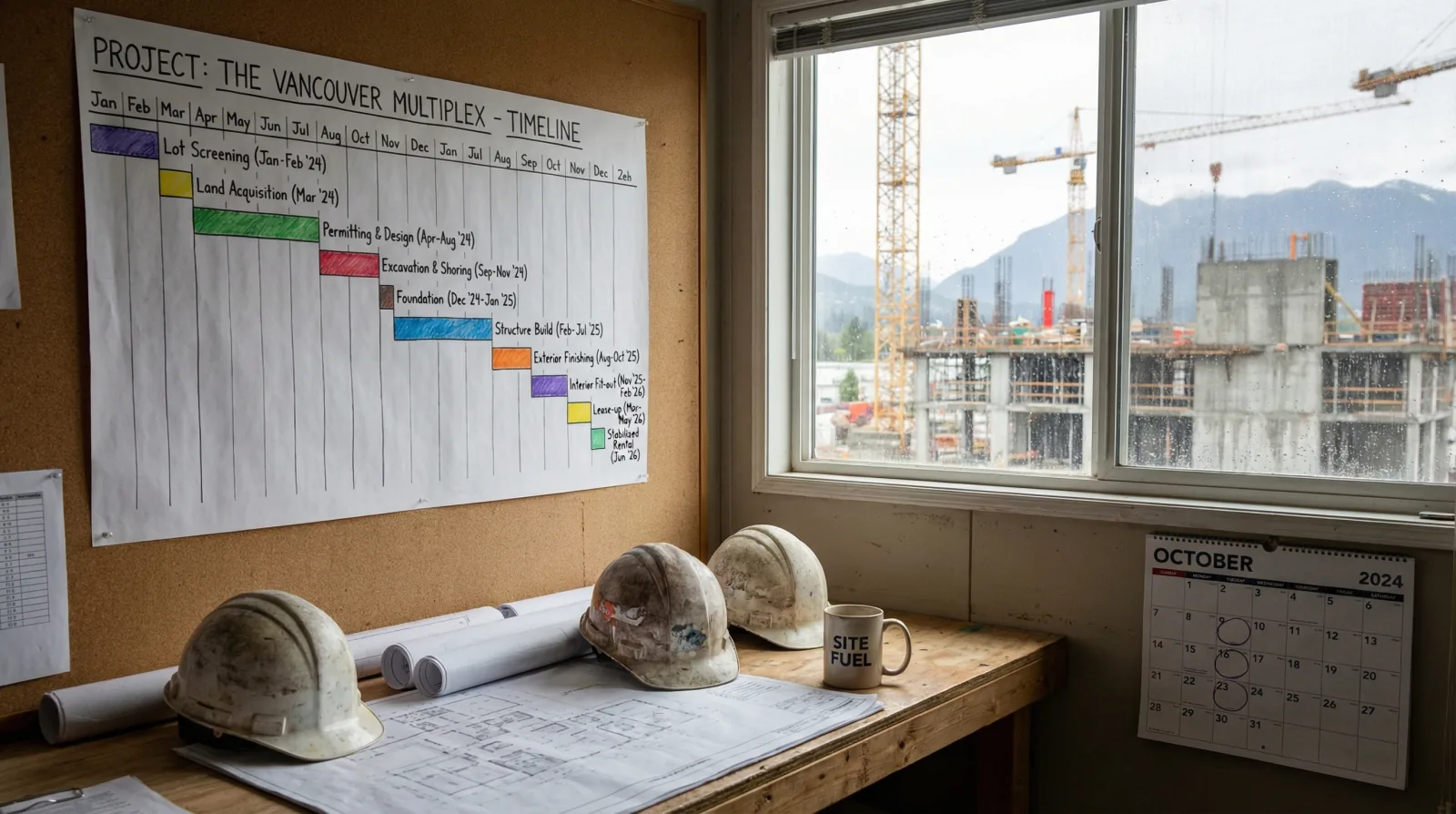

Building a rental multiplex takes 18-24 months from your first lot search to collecting stabilized rent. That number surprises people. They hear “construction takes 12 months” and assume the whole project fits in a calendar year. It doesn’t. Permits alone can burn 4-9 months. Lease-up adds another 3-6. And that’s if nothing goes wrong.
Here’s the full timeline, phase by phase, with real durations and real costs for Vancouver-area BTR multiplexes in 2026.
Phase 1: Lot Screening (Month 0-1)
Duration: 2-4 weeks active searching.
You’re filtering for five things simultaneously: lot area (557 m2+ for 6-8 units in Vancouver R1-1), frontage (15.1m+ for full density), zoning compatibility, land basis under $300 per buildable square foot, and neighbourhood rent levels that support CMHC DSCR minimums.
Most owners skip this phase because they already own the lot. Good. That eliminates your biggest variable — land cost — and drops your total project timeline by a month.
If you’re acquiring, budget 2-4 weeks for screening plus 30-60 days for closing. Subject removal on a tear-down lot in Vancouver typically runs 10-14 days. You’ll want a Phase 1 environmental assessment ($3,000-$5,000) and a geotechnical report ($4,000-$7,000) during subjects.
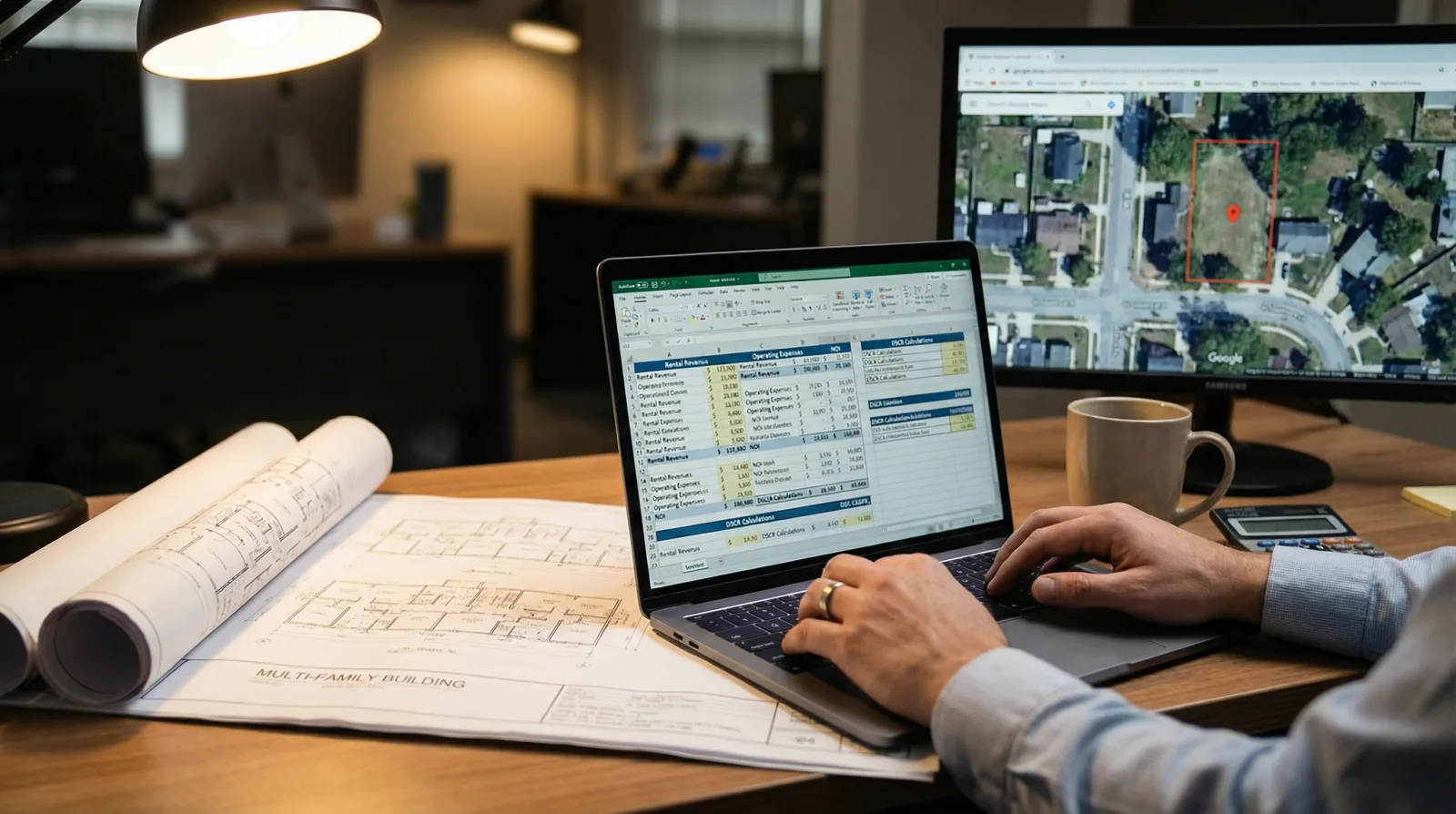
What goes wrong: You fall in love with a lot that fails the proforma. The neighbourhood is great, the lot looks perfect, but rents don’t support the land price. Kill it and move on. Running the numbers through a proforma calculator before making an offer saves you $30,000 in architectural fees on a lot that never works.
Cost this phase: $7,000-$12,000 in due diligence (environmental, geotech) if acquiring. $0 if you own the lot.
Phase 2: Feasibility and Design (Month 1-3)
Duration: 6-10 weeks.
You hire an architect ($25,000-$45,000 for full permit drawings on a 6-8 unit multiplex). The first 2-3 weeks produce a test fit — a quick layout showing unit count, unit sizes, parking, and building envelope on your specific lot. This is your last off-ramp before committing serious money.
The test fit feeds your proforma. You now know: 6 units or 8? What FSR are you actually hitting? What’s the average unit size? Can you fit the parking required under the district schedule?
Weeks 4-10 produce full architectural drawings, structural engineering, and building envelope design. Your architect coordinates with a structural engineer ($8,000-$15,000), building envelope consultant ($5,000-$8,000), and energy advisor ($3,000-$5,000 for BC Energy Step Code compliance).
Vancouver’s R1-1 secured rental path requires Step Code Level 3 minimum. Most architects designing multiplexes in 2026 are defaulting to Step Code 4 because it earns CMHC MLI Select points that reduce your insurance premium.
What goes wrong: Design iteration loops. Your first layout shows 7 units but the parking doesn’t work. Your second layout solves parking but drops to 6 units. Each iteration takes 1-2 weeks. Three redesign rounds can push this phase to 14 weeks. Nail the test fit before full drawings begin.
Cost this phase: $40,000-$70,000 in design and engineering.
Phase 3: Permit Application (Month 3-5)
Duration: 2-4 weeks to prepare and submit.
Your architect prepares the Development and Building Permit application. Since Vancouver merged the DP and BP into a single combined application pathway in early 2025, you submit one package. This cut 2-3 months off the old two-stage process.
The application package includes: architectural drawings, structural plans, site survey, geotech report, arborist report ($2,000-$4,000 if trees are present), landscape plan, energy modelling, and the Section 219 covenant for secured rental tenure.
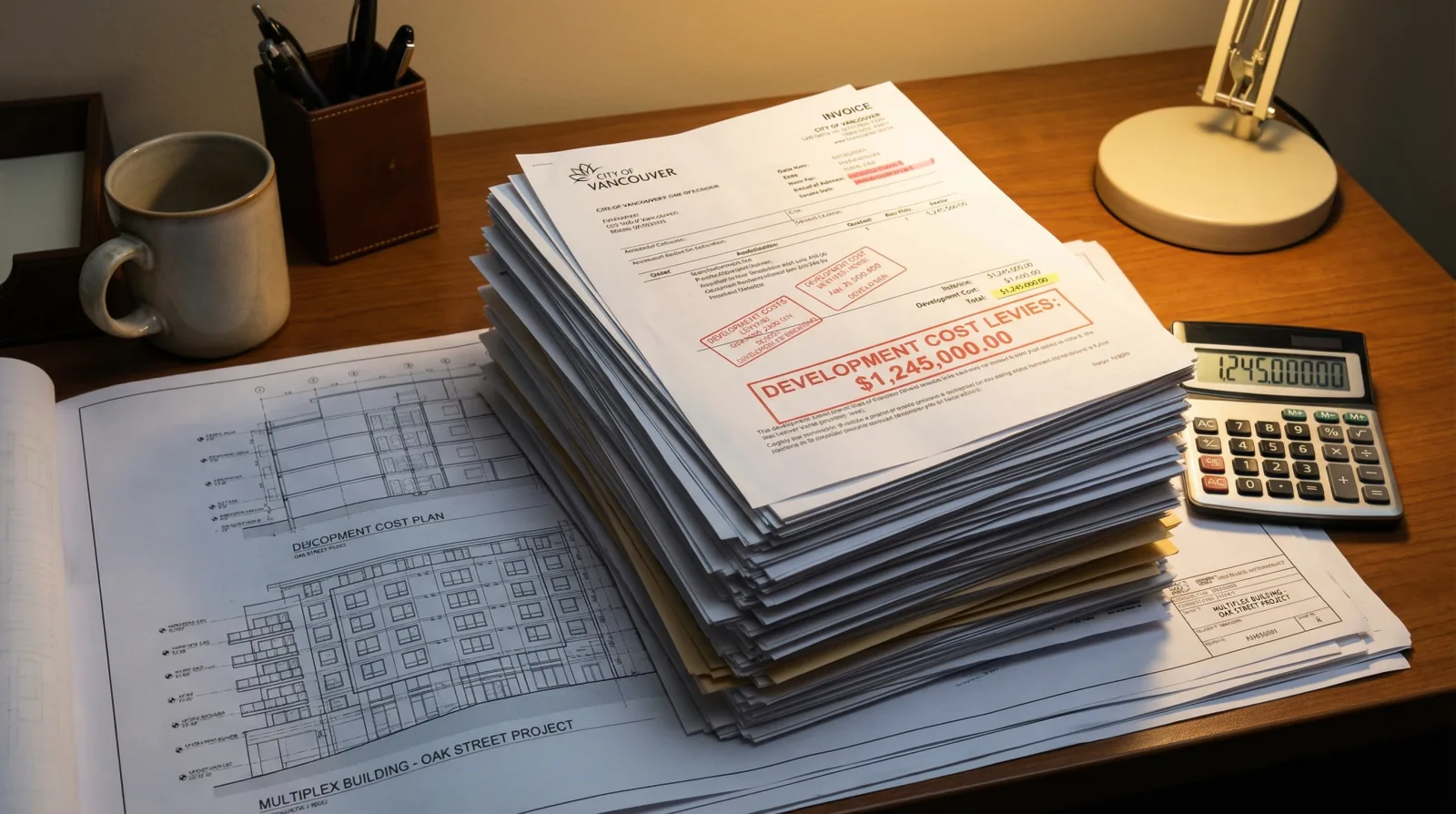
That covenant is permanent. It registers on title. Once recorded, all units must remain rental in perpetuity. This is the mechanism that earns you the density bonus (1.00 FSR vs 0.70), the DCL discount, and the density bonus contribution exemption. Vancouver’s fee stack saves $180,000-$228,000 on an 8-unit project — but only with this covenant.
What goes wrong: Incomplete applications get sent back. Missing geotech, outdated survey, wrong form version. Each rejection adds 2-4 weeks. Have your architect do a pre-application meeting with the city ($250) to catch issues before formal submission.
Cost this phase: $5,000-$10,000 in application fees and remaining consultants.
Phase 4: Permit Review and Approval (Month 5-9)
Duration: 8-20 weeks. This is the phase you cannot control.
Vancouver’s combined DP/BP review averaged 6.2 months in Q4 2025, down from 8.4 months in Q1 2025. The city’s streamlined multiplex pathway cut processing times roughly in half for straightforward applications. Pre-approved designs from BC’s housing catalogue (if you use one) can shave another 4-6 weeks.
During review, the city may issue Requests for Information (RFIs). Each RFI requires your architect to respond, and each response re-enters the review queue. Two RFI rounds add 4-8 weeks easily.
Other municipalities are slower. Burnaby averages 8-10 months. Surrey: 6-8 months. Smaller cities with less staff capacity can run 10-14 months. Check your city’s current processing times before building your financial model.
What goes wrong: Neighbour opposition can trigger additional review, though multiplexes on R1-1 lots are permitted outright (no rezoning needed). Design panel review adds 4-6 weeks if triggered. The most common delay is simply queue depth — too many applications, not enough planners.
Carrying cost: You’re paying property taxes, insurance, and possibly mortgage interest on land that’s producing zero revenue. Budget $8,000-$15,000/month depending on your land cost and existing mortgage.
Phase 5: Construction (Month 9-18)
Duration: 10-14 months for wood-frame 6-8 unit multiplex.
The breakdown:
| Sub-phase | Duration | What Happens |
|---|---|---|
| Site prep and demolition | 2-3 weeks | Existing structure removed, site graded |
| Foundation and below-grade | 4-6 weeks | Excavation, formwork, concrete pour, waterproofing |
| Framing | 8-12 weeks | Wood-frame structure erected, roof sheathing |
| Mechanical/electrical rough-in | 4-6 weeks | Plumbing, HVAC, electrical (overlaps with framing) |
| Building envelope | 4-6 weeks | Windows, cladding, air barrier, insulation |
| Interior finishing | 8-12 weeks | Drywall, flooring, cabinets, fixtures, paint |
| Final inspections and occupancy | 2-4 weeks | Municipal inspections, deficiency corrections, occupancy permit |
Hard costs in Metro Vancouver as of Q1 2026: $400-$450 per square foot for wood-frame multiplex construction. On a 6,000 sq ft building, that’s $2.4M-$2.7M. Tariff-driven material increases added roughly $9,000 per unit since early 2025 — about $54,000-$72,000 on a 6-8 unit project.
Your general contractor draws funds from your construction loan on a progress-draw schedule. Typical draw structure: 5 draws over the construction period, each tied to completion milestones (foundation complete, framing complete, lock-up, drywall complete, substantial completion).
What goes wrong: Weather delays during framing (Vancouver’s rainy season runs October through March — budget 2-4 weeks of rain delays if framing spans winter). Trade shortages in electrical and plumbing. Material lead times on windows (8-12 weeks in current market) and mechanical equipment. An experienced GC builds these buffers into the schedule. An inexperienced one doesn’t.
Cost this phase: $2.4M-$3.2M hard costs depending on unit count and finishes. Construction loan interest at 6.5-7.5%: $13,000-$18,000/month on average balance.
Phase 6: Lease-Up (Month 18-21)
Duration: 2-4 months for a well-located, well-priced building.
You can start marketing 60-90 days before occupancy. List on Craigslist, Facebook Marketplace, Rentals.ca, and Zumper. Professional photography matters — budget $500-$1,000. If you have a model suite, show it.
Lease-up speed depends on three things: location, price, and unit mix. A building with 4 two-bedrooms and 4 one-bedrooms in a transit-accessible neighbourhood at market rents will lease faster than 8 studios in a car-dependent location priced 10% above market.
Average absorption for new-build multiplex rentals in Vancouver: 1.5-2.5 units per month. An 8-unit building reaches full occupancy in 3-5 months at typical velocity. If you price 3-5% below comparable new builds, you can compress this to 6-8 weeks.
What goes wrong: Overpricing. You built a premium product and want premium rent. But the market sets the price, not your cost basis. If comparable 2-bedrooms are renting at $3,200 and you list at $3,500 because your proforma needs it, you’ll sit vacant. Vacancy at this stage costs you $3,000-$4,000 per unit per month in lost rent plus ongoing debt service. Price to fill, then raise rents at renewal.
Lease-up risk is one of the most underestimated BTR hazards.
Cost this phase: Marketing ($2,000-$5,000), tenant screening ($200-$400 per applicant via professional service), legal review of lease templates ($1,500-$3,000).
Phase 7: Stabilization (Month 21-24)
Duration: 3-6 months after initial lease-up.
Stabilization means: all units leased, all tenants paying, no major turnover, and operating expenses tracking to budget. CMHC considers a property stabilized when it has maintained 90%+ occupancy for 3-6 consecutive months.
This is when your CMHC construction loan converts to a permanent take-out mortgage. The take-out terms are what make BTR work long-term: up to 50-year amortization, fixed rates, and government-backed insurance. Your monthly debt service drops significantly compared to the construction-phase floating rate.
During stabilization, you’re also discovering your actual operating costs. The proforma assumed 30-35% operating expense ratio. Reality might be 32% or 38%. Adjust your model.
Budget for first-year surprises: $5,000-$15,000 in unexpected maintenance, warranty claims you need to chase with the GC, and tenant-caused issues. This is normal. Build a 3-month operating reserve ($30,000-$50,000) before the first tenant moves in.
Milestone: When your actual NOI matches or exceeds your underwritten NOI for 3 consecutive months, you’re stabilized. Your building is now a performing asset generating predictable cash flow.
The Full Cost Stack
| Phase | Duration | Cost Range |
|---|---|---|
| Lot screening/acquisition | 0-2 months | $0-$12,000 (due diligence) |
| Feasibility and design | 2-3 months | $40,000-$70,000 |
| Permit application | 1-2 months | $5,000-$10,000 |
| Permit review | 2-5 months | $0 (carrying costs only) |
| Construction | 10-14 months | $2.4M-$3.2M |
| Lease-up | 2-4 months | $5,000-$10,000 |
| Stabilization | 3-6 months | $5,000-$15,000 (reserves) |
| Total | 18-24 months | $2.5M-$3.3M + land |
What Compresses the Timeline
Three things can shave 2-4 months off the total:
Pre-approved designs. BC’s housing catalogue offers pre-designed multiplex plans that skip portions of the design review. Savings: 4-8 weeks in permitting.
Already owning the lot. Eliminates acquisition and due diligence. Savings: 1-2 months.
Experienced general contractor. A GC who has completed 3+ multiplexes knows the inspection schedule, has trade relationships, and builds weather buffers into the timeline. Savings: 1-2 months of construction delays avoided.
What Extends the Timeline
Contaminated soil (former gas station, dry cleaner, or industrial use). Environmental remediation adds 2-6 months and $50,000-$200,000 in cost. Get the Phase 1 environmental assessment during your due diligence period, not after you’ve committed.
Design changes during permitting. Each change restarts the review clock. Finalize your design before submitting.
Financing delays. CMHC insured construction loans take 8-12 weeks to arrange. Start the application during the design phase, not after permit approval. Your mortgage broker should be working in parallel with your architect.
The 18-24 month timeline is achievable. But it requires parallel-tracking design, financing, and permitting — not running them in sequence. Every month of delay costs you $8,000-$18,000 in carrying costs and zero revenue. Move with urgency. Start by screening your lot to confirm the project is worth pursuing at all.