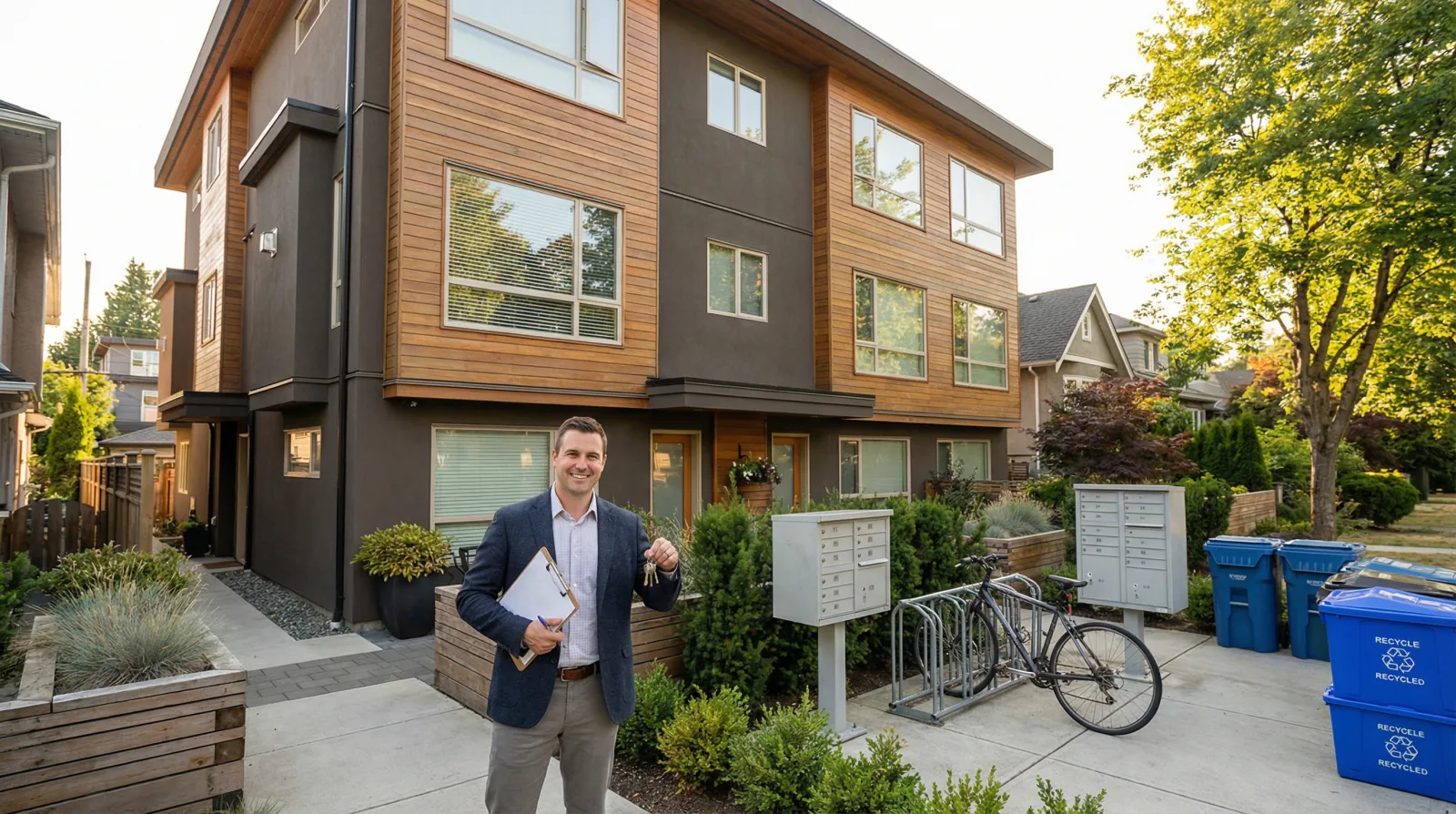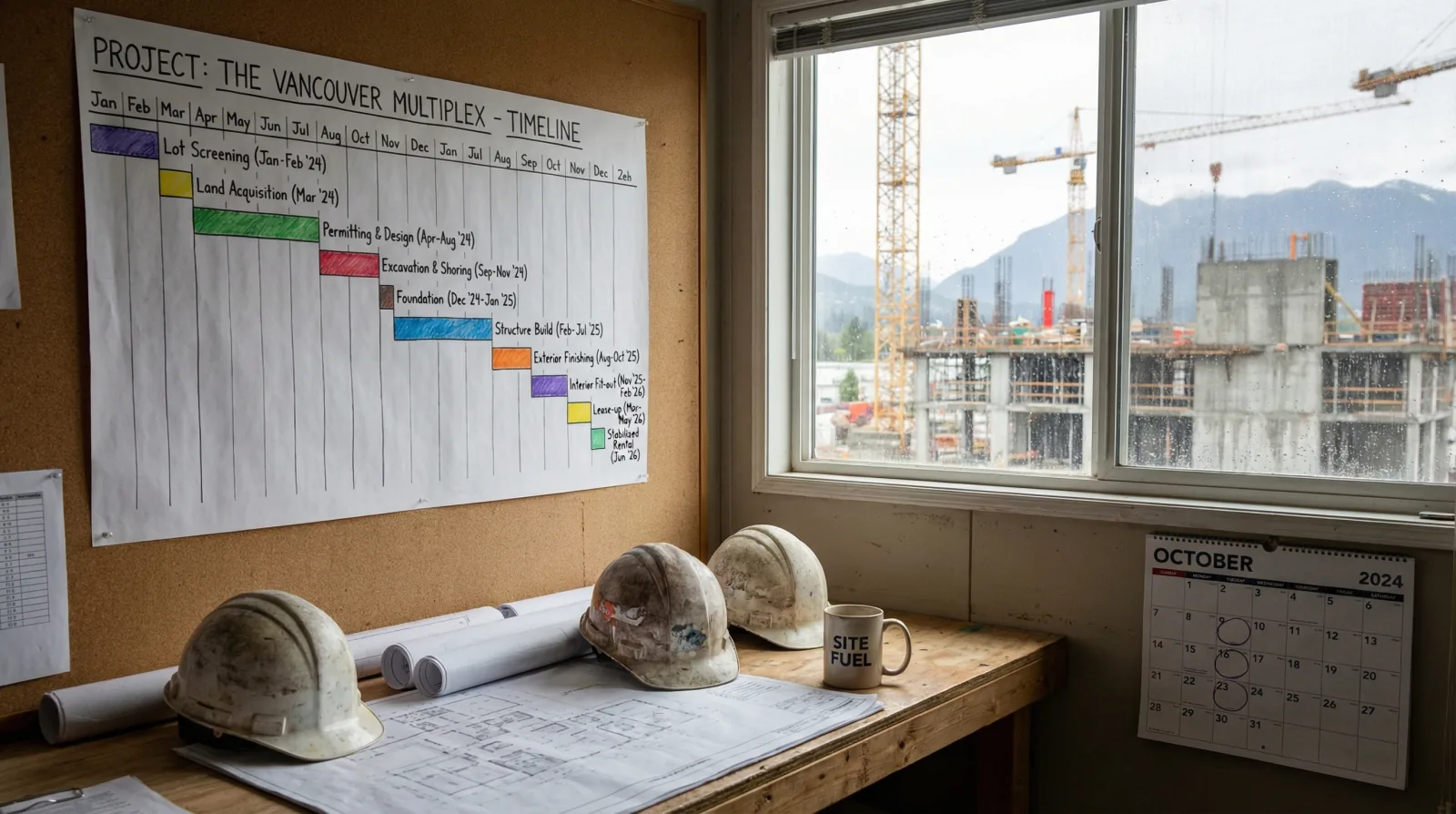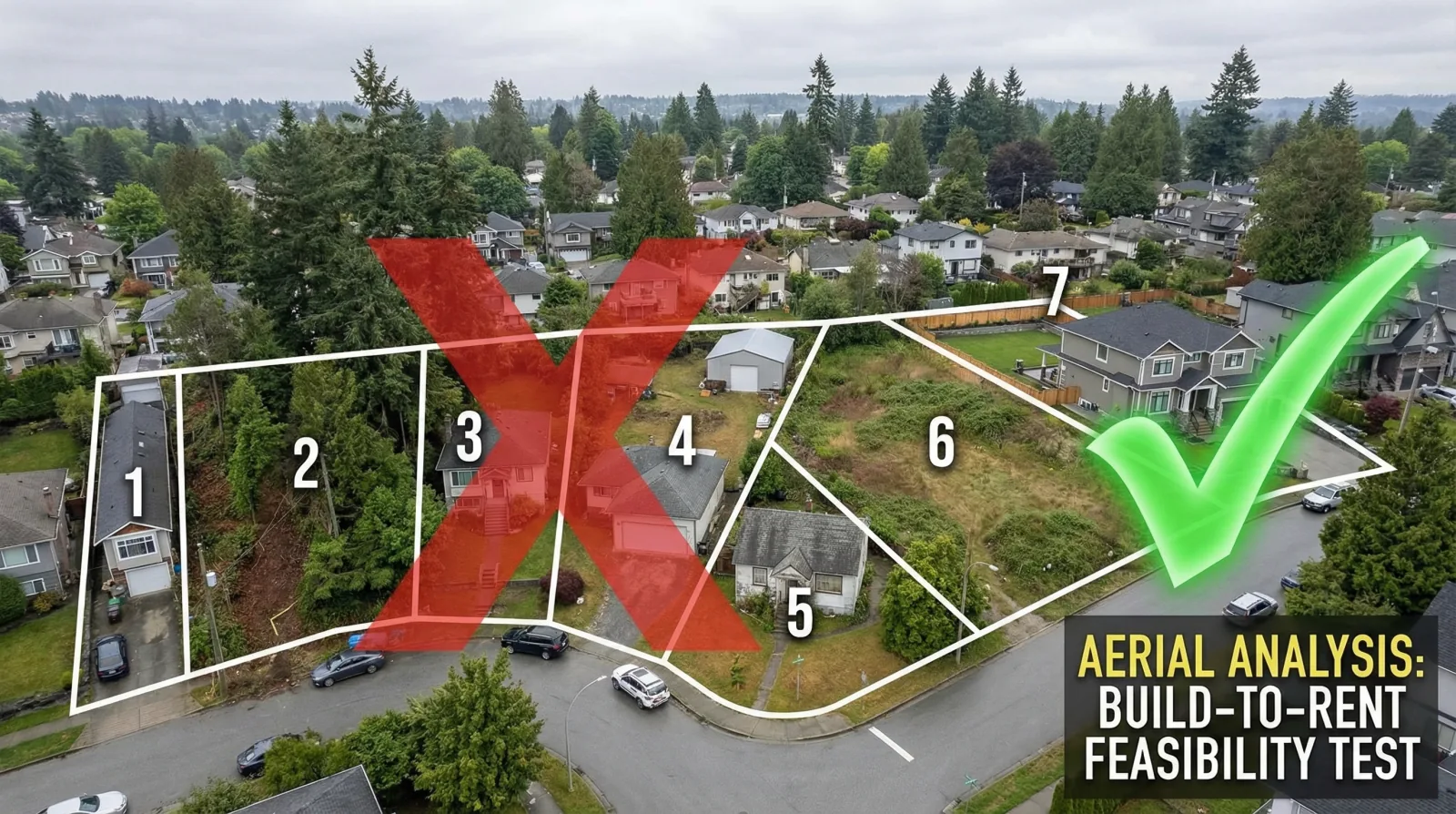

Underwriting a build-to-rent multiplex is not complicated. It’s eight steps. Each one is arithmetic. The hard part is using honest inputs instead of optimistic ones.
Most failed BTR projects don’t fail because the math was wrong. They fail because someone plugged in 95% occupancy during year one, ignored the tariff surcharge on materials, or assumed rents would grow 5% annually because “Vancouver.” The spreadsheet said yes. Reality said no.
Here’s how to underwrite a 6-8 unit rental multiplex in Metro Vancouver using real Q1 2026 numbers. Every step includes the actual calculation so you can follow along with your own lot.
Step 1: Land Cost Per Buildable Square Foot
This is your first filter. It determines whether the project is even worth analyzing further.
Formula: Land Basis = Purchase Price / Total Buildable Area
Example lot: 6,200 sq ft (576 m2) in East Vancouver. Purchase price: $1.75M. Under R1-1 secured rental zoning, FSR is 1.00. Buildable area: 6,200 sq ft.
Land Basis = $1,750,000 / 6,200 = $282 per buildable sq ft
Threshold: Under $250 is strong. $250-$300 is workable. Above $300 is a warning. Above $350, stop here.
If you already own the lot, your land basis is your remaining mortgage balance divided by buildable area. A homeowner with $400,000 remaining on a 6,200 sq ft lot has a land basis of $65/sq ft. That’s an enormous structural advantage over someone acquiring at market price.
Step 2: Unit Count and Mix
Your lot dimensions determine your maximum unit count under the applicable district schedule. For Vancouver R1-1:
- 557 m2+ lot with 15.1m+ frontage: up to 8 units (secured rental)
- 464-556 m2 lot with 13.4m+ frontage: up to 5 units
- Below these thresholds: 3-4 units (no CMHC eligibility)
Our example: 576 m2, 50-foot frontage (15.24m). Qualifies for 8 units.
Unit mix for an 8-unit building on a 6,200 sq ft lot:
| Unit Type | Count | Avg Size | Total Sq Ft |
|---|---|---|---|
| 1-bedroom | 4 | 550 sq ft | 2,200 |
| 2-bedroom | 3 | 800 sq ft | 2,400 |
| 3-bedroom | 1 | 1,000 sq ft | 1,000 |
| Total | 8 | 700 sq ft avg | 5,600 |
Common area (hallways, mechanical, stairs): 600 sq ft. Total building: 6,200 sq ft at 1.00 FSR.
The mix matters. More 2-bedrooms and 3-bedrooms mean higher rents per unit but fewer units. More 1-bedrooms mean more units but lower per-unit revenue. The sweet spot for DSCR optimization in Vancouver is 40-50% one-bedrooms, 35-40% two-bedrooms, and 10-15% three-bedrooms.
Step 3: Rental Income Projection
Use actual comparable rents, not asking rents. Check Rentals.ca, CMHC rental market reports, and Zumper for your specific neighbourhood.
Metro Vancouver new-build rents, Q1 2026:
| Unit Type | Monthly Rent | Annual |
|---|---|---|
| 1-bedroom (550 sq ft) | $2,400 | $28,800 |
| 2-bedroom (800 sq ft) | $3,200 | $38,400 |
| 3-bedroom (1,000 sq ft) | $3,800 | $45,600 |
Potential Gross Income (PGI): (4 x $28,800) + (3 x $38,400) + (1 x $45,600) = $115,200 + $115,200 + $45,600 = $276,000/year
Now apply vacancy and credit loss. CMHC uses 3% for Vancouver. New builds in strong locations run 1.5-2.5% in practice, but underwrite conservatively.
Effective Gross Income (EGI): $276,000 x 0.97 = $267,720/year
Add ancillary income if applicable: parking ($100-$150/stall/month), storage lockers ($50-$75/month), laundry ($30-$50/unit/month). On an 8-unit building with 4 parking stalls and laundry, this might add $10,000-$15,000 annually. For this exercise, we’ll add $12,000.
Adjusted EGI: $279,720/year
Step 4: Operating Expenses
New-build multiplexes in Vancouver operate at 30-35% of EGI. Older buildings run 35-45%. Do not use the 30% number unless your building is new and you have actual quotes for every line item.
Expense breakdown for a new 8-unit building:
| Category | Annual Cost | % of EGI |
|---|---|---|
| Property taxes | $28,000 | 10.0% |
| Insurance | $12,000 | 4.3% |
| Property management (8%) | $22,400 | 8.0% |
| Maintenance and repairs | $12,000 | 4.3% |
| Utilities (common area) | $8,000 | 2.9% |
| Capital reserve | $6,000 | 2.1% |
| Administrative/legal | $4,000 | 1.4% |
| Total Operating Expenses | $92,400 | 33.0% |
Property management at 8% assumes you hire a professional firm. If you self-manage, you save $22,400/year but spend 10-15 hours per week. That trade-off is worth examining carefully.
Property taxes on a new 8-unit rental building in Vancouver: expect $3,000-$4,000 per unit annually. BC Assessment will reassess after construction completion, and the assessed value will reflect the income-producing building, not just the land.
Insurance for a new wood-frame multiplex: $1,200-$1,800 per unit annually. Rates jumped 15-25% between 2023 and 2025 and have stabilized in 2026. Get quotes from at least three brokers.
Step 5: Net Operating Income
Formula: NOI = Adjusted EGI - Total Operating Expenses
NOI = $279,720 - $92,400 = $187,320/year
This is the number that everything else depends on. NOI determines your building’s value, your debt capacity, and your cash-on-cash return.
A quick sanity check: NOI per unit should be $20,000-$28,000 for a viable BTR multiplex in Vancouver. Ours is $23,415 per unit. That’s in range.
Step 6: Debt Service and CMHC Tier Selection
CMHC MLI Select offers three tiers based on social outcome points:
| Tier | Points Required | Premium Discount | Max Amortization | Max LTV |
|---|---|---|---|---|
| Standard | 50+ points | 10% off premium | 40 years | 85% |
| Silver | 70+ points | 20% off premium | 45 years | 90% |
| Gold | 100+ points | 30% off premium | 50 years | 95% |
Most new-build multiplexes meeting BC Energy Step Code 4 and including affordable units score 70-85 points. Assume Silver tier: 45-year amortization, 90% LTV.
Total project cost:
| Component | Cost |
|---|---|
| Land | $1,750,000 |
| Hard costs (6,200 sq ft x $425/sf) | $2,635,000 |
| Soft costs (design, permits, legal) | $175,000 |
| Financing costs (construction interest) | $195,000 |
| CMHC insurance premium (~3.5% of loan after 20% discount) | $145,000 |
| Total | $4,900,000 |
Mortgage calculation (Silver tier):
- Loan amount: $4,900,000 x 90% = $4,410,000
- Interest rate: 4.25% (CMHC-insured 10-year fixed, Q1 2026)
- Amortization: 45 years
- Annual debt service: $225,400
- Monthly payment: $18,783
Equity required: $490,000 (10% of total project cost).
Step 7: DSCR Check
Formula: DSCR = NOI / Annual Debt Service
DSCR = $187,320 / $225,400 = 0.83x
This project fails. CMHC requires minimum 1.10x. You need NOI of at least $247,940 to clear the threshold with this debt load.
This is exactly why you underwrite before you commit capital. This lot, at this price, with this unit mix, does not pencil for BTR.
Three levers to fix it:
-
Lower land cost. At $1.35M ($218/buildable sq ft), total project cost drops to $4.5M, debt service to $206,000, and DSCR rises to 0.91x. Still short. At $1.1M ($177/sq ft), DSCR hits 1.02x. Getting closer but still below 1.10.
-
Higher rents. You need blended average rent of $3,300/unit/month (vs current $2,875) to hit 1.10x at the original land price. That’s 15% above current market. Unrealistic for day-one underwriting.
-
Already own the lot. If your remaining mortgage is $400,000, total project cost drops to $3.55M, loan is $3,195,000, annual debt service is $163,600, and DSCR = $187,320 / $163,600 = 1.14x. That passes.
This is why existing homeowners are the natural BTR builders. The land basis advantage is structural.
Step 8: Sensitivity Testing
Even if your base case passes, stress it. Two tests are mandatory:
Rent stress test (-10%): Reduce all rents by 10%. New EGI: $251,748. New NOI (at 33% OpEx): $168,670. Does your DSCR still clear 1.10? If not, your project has zero margin for a rent correction.
Cost stress test (+15%): Increase hard costs by 15% (tariff escalation, trade shortages, weather delays). New total project cost rises by ~$395,000. New loan increases proportionally. Does DSCR hold?
Combined worst case (-10% rent, +15% cost): If your project survives both simultaneously, it’s resilient. If it fails either test individually, you’re building on the edge.
For our homeowner scenario (DSCR 1.14x base case):
- At -10% rent: DSCR drops to 1.03x. Fails the 1.10 minimum. Marginal.
- At +15% cost: DSCR drops to 0.99x. Fails.
Even the homeowner scenario is tight on this particular lot. You’d want rents 5-8% higher or construction costs 5-10% lower to have real cushion.
The Underwriting Checklist
Run these eight steps on any lot before spending money on architects:
- Land basis under $300/buildable sq ft? If no, stop.
- Unit count at 5+ (CMHC eligible)? If no, stop.
- Market rents support $2,400+ for 1-beds, $3,100+ for 2-beds? If no, stop.
- Operating expenses modelled at 30-35% EGI? Not 25%.
- NOI per unit above $20,000? If below $18,000, the project is structurally weak.
- CMHC tier identified and premium calculated? Don’t assume Gold tier.
- DSCR at 1.10x or above in base case? Hard stop if below 1.05.
- Project survives -10% rent test? If not, you have no margin.
Steps 1-3 take 30 minutes with public data and a rent search. Steps 4-8 take another hour with a spreadsheet. The VanPlex BTR calculator runs all eight in under a minute.
What Separates Good Underwriting from Bad
Bad underwriting uses asking rents instead of achieved rents. It assumes 2% vacancy when the building hasn’t leased a single unit yet. It uses 28% operating expenses because “it’s new construction.” It ignores CMHC insurance premiums in the cost stack. It models 5% annual rent growth for 10 years.
Good underwriting uses conservative inputs and lets the numbers speak. If the project works at 3% vacancy, 33% OpEx, flat rents for years 1-2, and -10% rent stress — it’s a real project. If it only works with optimistic assumptions stacked on top of each other, it’s a hope trade.
Build the spreadsheet. Be honest with the inputs. The math will tell you what to do.