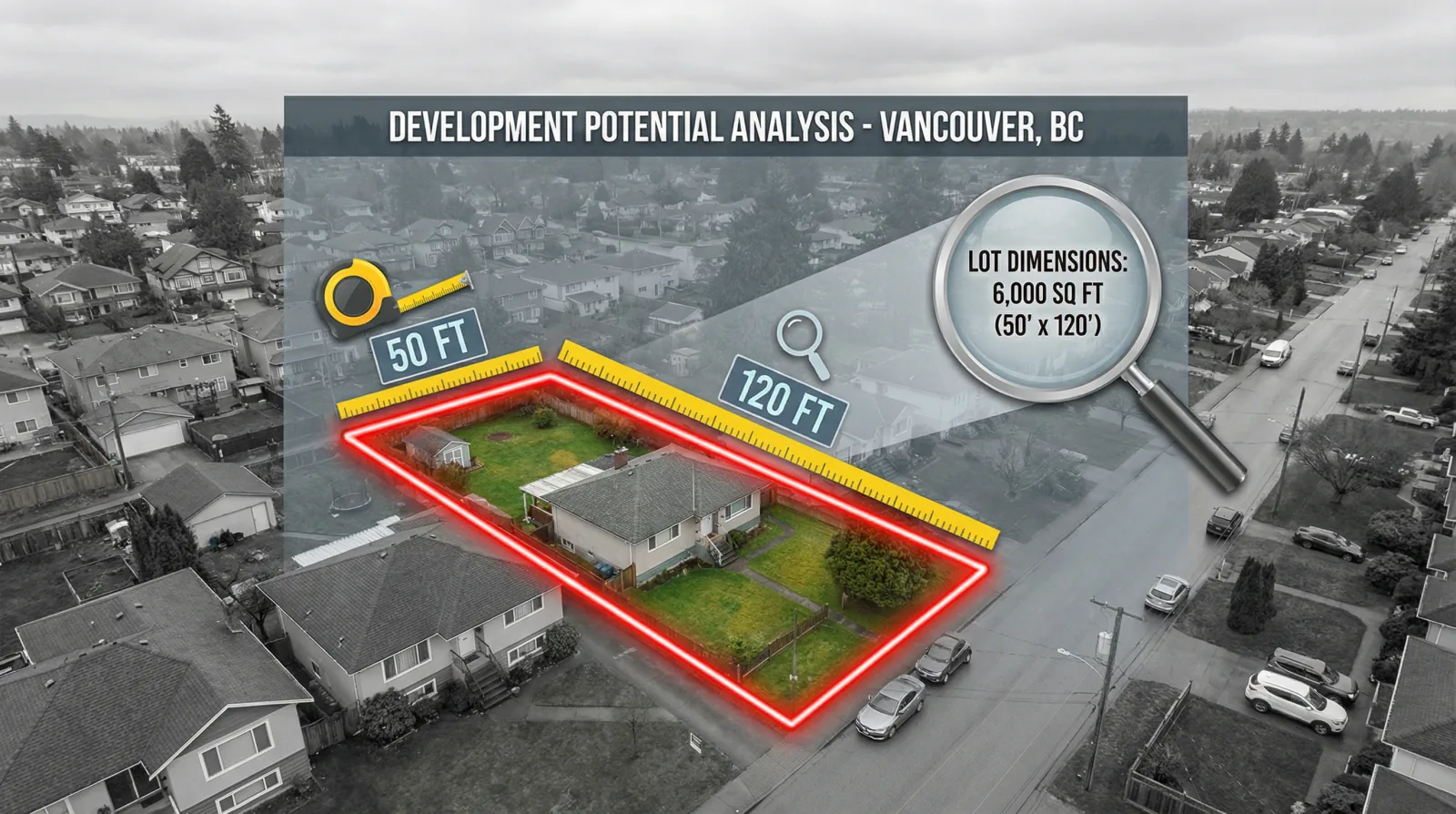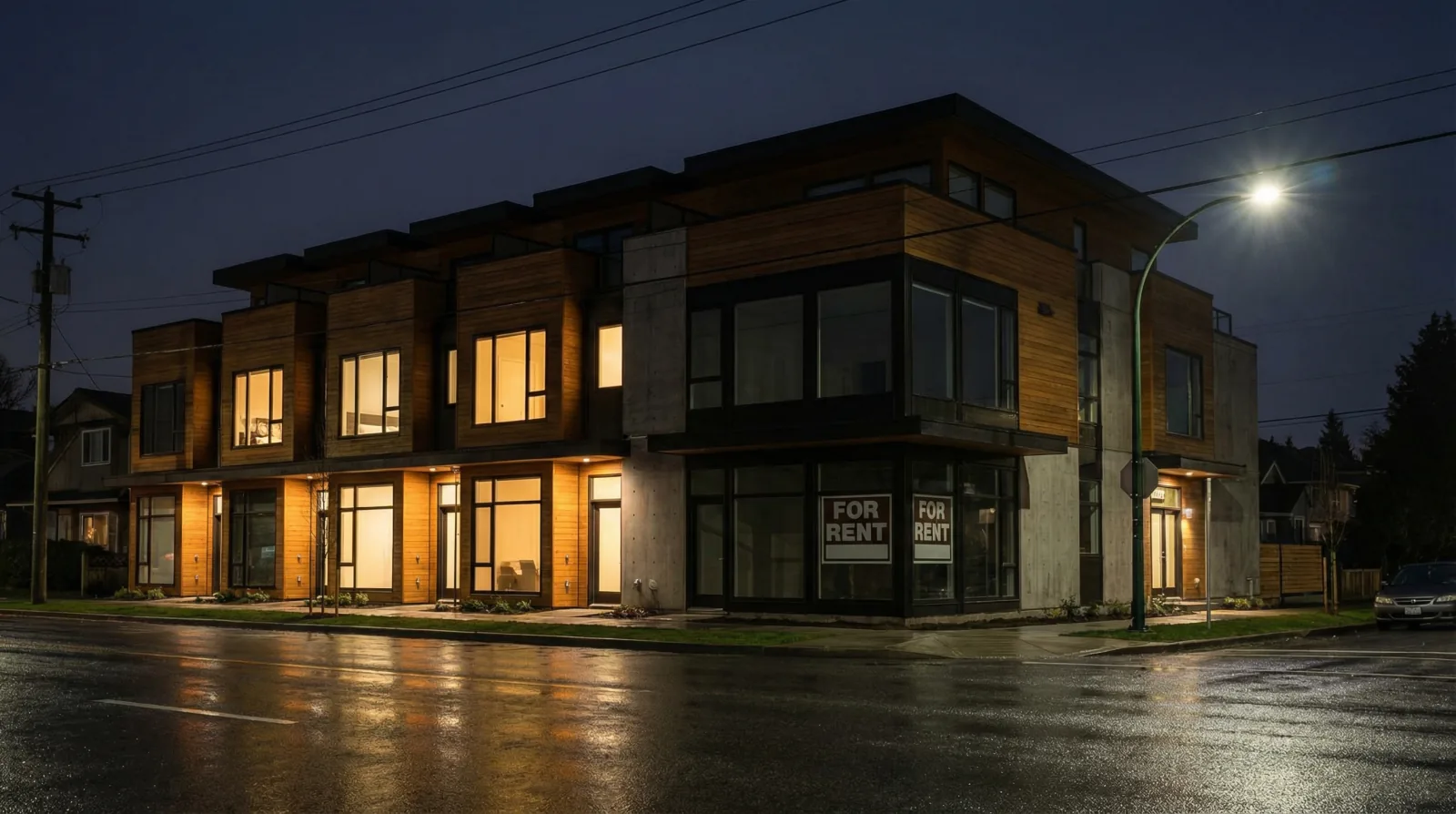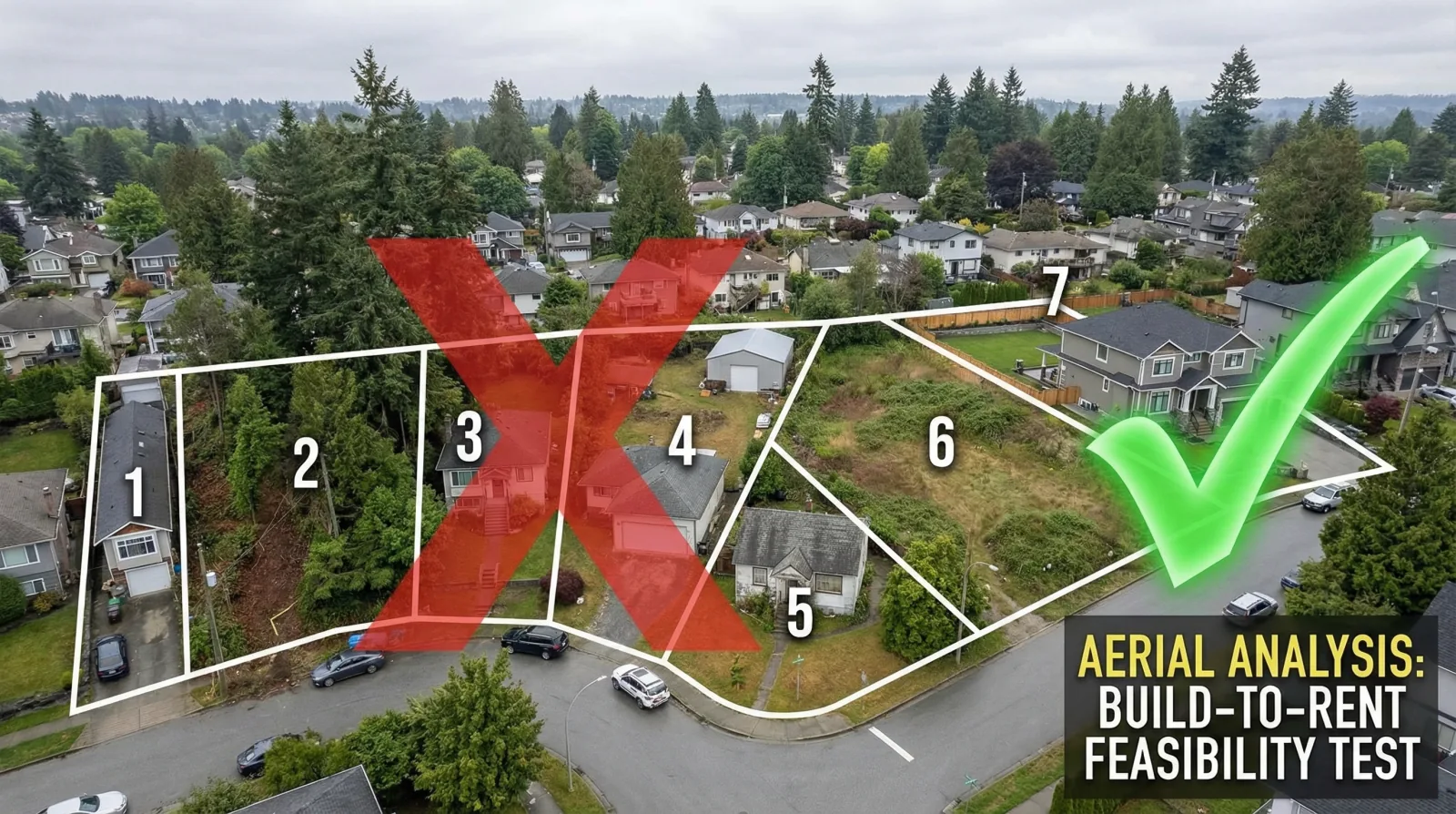

We underwrite a lot of lots. Most of them fail.
Not because the owners are wrong to be interested in build-to-rent multiplex. The economics of holding a CMHC-financed multiplex over 25 years are genuinely compelling — on the right site. The problem is that “right site” is a narrow filter. Most lots that look promising on a map blow up somewhere in the proforma.
Here are seven real examples. Names and exact addresses are removed, but the numbers are from actual underwriting we ran in Q1 2026.
TL;DR (Key Takeaways)
- Most lots fail BTR underwriting — even lots that work perfectly well for strata multiplex development
- Land basis is the #1 killer — lots above $350/buildable sq ft in most East Vancouver neighbourhoods can’t clear CMHC’s 1.10 DSCR
- 4 units is a dead zone — you miss CMHC MLI Select entirely and fall into conventional financing at 20% down
- Rents have softened — Vancouver 2-bedroom averages dropped to $3,279/month in January 2026, down 4.8% year-over-year
- Every assumption matters — a $15/month error on operating costs per unit, compounded across 6-8 units, can flip a DSCR from passing to failing
Lot 1: The $3.2M West Side Lot
A 6,100 sq ft R1-1 lot in Dunbar. 15.2m frontage, rear lane, 557 m2+ — it checked every box for 8-unit secured rental. The owner paid $3.2M in late 2024.
At 1.00 FSR, the building is 6,100 sq ft. Eight units averaging 762 sq ft each. Hard costs at $425/sq ft = $2.59M. Soft costs, permits, GST push total project cost to $6.4M.
Market rents for new-build 1-bed and 2-bed units in Dunbar: $2,200-$3,100/month. Gross annual revenue: roughly $246,000. After 3% vacancy and $72,000 in operating expenses, NOI lands at $166,600.
Annual debt service on a $6.08M CMHC mortgage (95% LTV, 4.2% rate, 45-year amortization): $282,000.
DSCR: 0.59.
You need 1.10. This lot fails by 46%. The land cost alone consumed the model. At zero land basis — if you already owned this lot free and clear — it would work. But at $3.2M acquisition? Not close.
Lot 2: The Narrow Lot in Renfrew
A 33-foot-wide lot. 5,800 sq ft total. The owner assumed 6 units because the lot is over 5,000 sq ft.
But R1-1 requires 15.1m (49.5 feet) frontage for 6+ units. At 33 feet (10.06m), this lot maxes out at 4 units.
Four units means no CMHC MLI Select. Conventional financing: 20% down, 25-year amortization. On a $3.8M total project cost, you need $760,000 in equity instead of $190,000. Monthly debt service jumps because the amortization is 20 years shorter.
The lot works fine for a strata fourplex. It does not work for BTR. The frontage killed it before we even ran the revenue numbers.
Lot 3: The “Almost” Lot in East Van
A 6,200 sq ft R1-1 lot near Commercial Drive. $1.85M purchase price. 15.3m frontage. Qualifies for 8 units secured rental.
Total project cost: $4.91M. Gross annual rent: $237,600 (eight units at an average of $2,475/month). After vacancy and operating: NOI of $158,400.
CMHC mortgage at 95% LTV: $4.66M. Annual debt service at 4.2%, 45-year am: $216,800.
DSCR: 0.73.
Better than the Dunbar lot, but still 34% short. The land was cheaper, but rents near Commercial Drive don’t command the premium that Kitsilano or Mount Pleasant do. And the 3.7% metro vacancy rate — highest since 1988 — means we can’t assume zero vacancy anymore.
This lot only pencils if you drop to 70% LTV conventional financing and accept $1.47M in equity requirements. At that point, you need to ask whether tying up $1.47M for a 3.2% cash-on-cash return in year one makes any sense.
Lot 4: The Fee Surprise in South Vancouver
A 5,900 sq ft lot near Marine Drive. $1.65M. Good frontage, qualifies for 6 units at 0.70 FSR (not enough for the rental density bonus because the lot is 548 m2, just under the 557 m2 threshold for 7-8 units).
Six units. Gross rent: $172,800/year. The owner’s proforma showed $425/sq ft hard costs and $48,000/year in operating expenses.
What they missed: $18,200 in annual property tax (reassessed at improved value, not land value), $14,400 in property management fees (8% of gross, non-negotiable at 6 units because no manager wants to self-manage a building this small for less), and $9,600/year in maintenance reserves.
Actual operating expenses: $72,200. NOI dropped from the owner’s projected $118,000 to $94,000.
DSCR went from a projected 1.14 to 0.91. A passing proforma became a failure because operating costs were underestimated by $24,200 per year.
Lot 5: The Rent Assumption Problem
A well-located lot in Mount Pleasant. 6,300 sq ft, 15.4m frontage, $2.1M. Everything about the lot was right.
The owner plugged in rents of $3,200/month for 2-bedroom units based on listings they’d seen on Craigslist. New-build 2-bedrooms in Mount Pleasant were indeed listing at $3,200-$3,400 in mid-2025.
By January 2026, average 2-bedroom rents in Vancouver had dropped to $3,279 — down 4.8% year-over-year. New-build purpose-built rental buildings were offering one to two months free rent to fill units. The 25,855 purpose-built rental completions registered in BC in 2025 (40% more than the prior year) flooded the market.
We re-ran the proforma at $2,900/month average (blending 1-beds at $2,400 and 2-beds at $3,100, with a concession baked in). The $2,400/month difference across 8 units = $28,800/year in lost revenue. DSCR dropped from 1.12 to 0.98.
A lot that worked in June 2025 stopped working by January 2026. Rent assumptions are the second most fragile input after land cost.
Lot 6: The Exit Strategy Gap
A 6-unit lot in Hastings-Sunrise. The numbers actually worked: DSCR of 1.14, reasonable land basis ($1.7M), solid rents.
The problem was the owner’s 7-year timeline. They wanted to build, hold for 7 years, then sell the building and use proceeds for retirement.
Selling a 6-unit rental building means selling based on cap rate, not unit price. A 14-unit Kitsilano building recently traded at a 3.4% cap rate. For a 6-unit building in Hastings-Sunrise, realistic cap rates are 4.5-5.0%.
At a 4.75% cap rate and $158,000 NOI in year 7, the building is worth $3.33M. Total cost to build was $4.6M. Even with 7 years of mortgage paydown ($280,000) and modest appreciation, the owner’s equity position at sale is roughly breakeven.
BTR works as a 20-25 year hold. It does not work as a 7-year flip. The exit strategy was wrong for the model.
Lot 7: The Municipal Delay Trap
A lot in Burnaby that technically qualified under Bill 44 for 6-unit multiplex. The owner ran the BTR numbers and they cleared — barely. DSCR of 1.11.
Then they discovered Burnaby’s development permit timeline: 12-18 months for a multiplex DP, versus 6-8 months in Vancouver. That’s 6-12 months of additional carrying costs on the land — property tax, mortgage interest, opportunity cost.
At $1.9M land value and 5.5% carrying cost, each additional month costs $8,700. Six months of delay = $52,200 in additional cost that wasn’t in the proforma. The DSCR that barely cleared at 1.11 now fails at 1.05.
Municipal timeline risk is real and varies dramatically by jurisdiction. Vancouver’s streamlined R1-1 process is an exception, not the rule.
The Pattern
Five of these seven lots failed on financial fundamentals: land cost too high, rents too low, fees underestimated, timeline too short, or unit count too low. The other two failed on physical constraints (frontage) and municipal process.
The common thread: every one of these owners started with enthusiasm about BTR’s long-term wealth creation — and they were right about the concept. They were wrong about their specific lot.
What Actually Clears
In our underwriting across Metro Vancouver, the lots that pass BTR screening share specific traits:
- Land basis under $300/buildable sq ft (ideally under $250)
- Minimum 15.1m frontage for the 6-8 unit density bonus
- 557 m2+ lot area to qualify for secured rental bonus
- Location supporting $2,800+/month average rents across the unit mix
- Owner willing to hold 15+ years — this is not a medium-term investment
If your lot doesn’t meet all five, BTR probably isn’t the right path. Strata development, laneway additions, or a straight hold-and-sell may deliver better risk-adjusted returns.
The honest answer is that most BC lots fail the build-to-rent test. Knowing yours fails early saves you $30,000-$50,000 in architectural and engineering fees on a project that was never going to pencil.
David Babakaiff is the Co-Founder and CEO of VanPlex, a Vancouver-based company specializing in multiplex development and Missing Middle housing. VanPlex uses its AI-powered PlexRank system to identify and underwrite multiplex conversion opportunities under BC’s Bill 44 zoning reforms.
Want to check whether your lot passes the BTR test? Visit VanPlex.ca and run a proforma using the advanced calculator. If BTR doesn’t pencil, the investment overview covers the strata and co-development alternatives that often work where rental hold doesn’t.