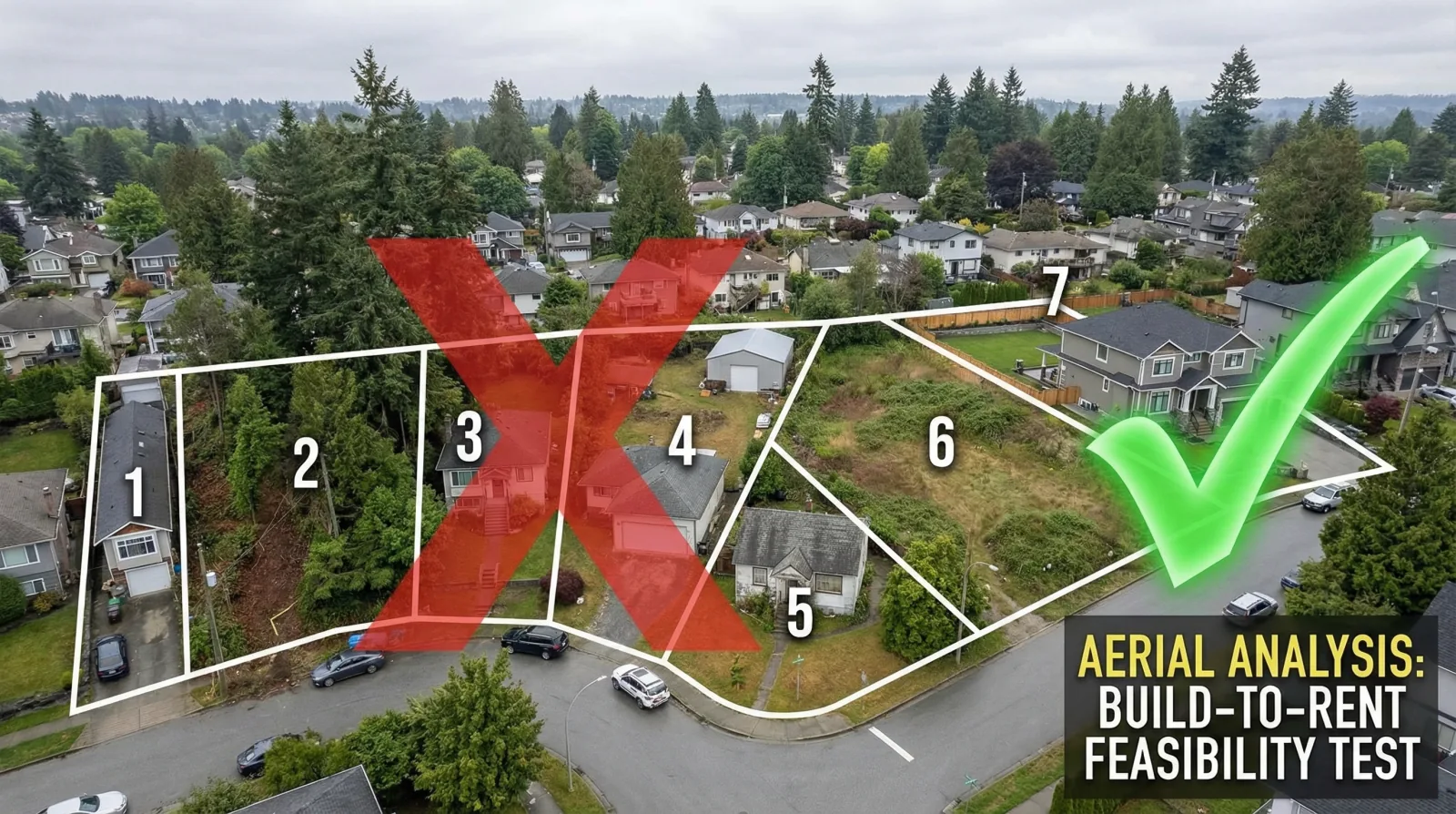

We’ve screened over 56,000 R1-1 lots in Vancouver. Fewer than 12% pass the initial filters for build-to-rent viability. By the time you run the full proforma — including current rents, realistic operating costs, and CMHC DSCR requirements — the number drops further.
Most lots are better suited for strata development, laneway additions, or a simple hold. BTR is structurally advantaged on a narrow subset of properties. This is how you figure out if yours is one of them — before you spend $30,000-$50,000 on architectural drawings.
Filter 1: Lot Area — 557 m2 Minimum
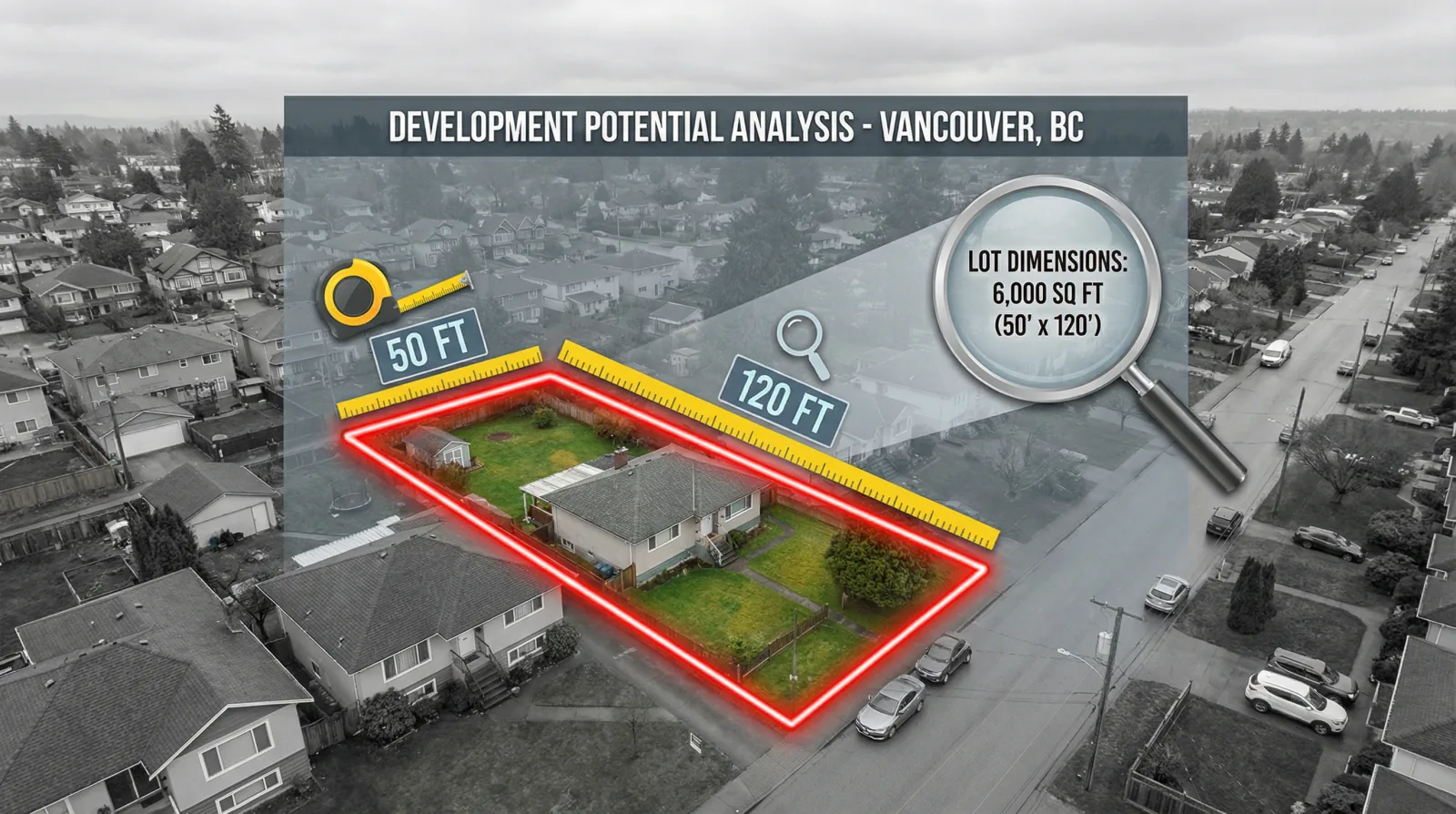
This is binary. Under Vancouver’s R1-1 District Schedule, you need 557 m2 (5,995 sq ft) of lot area to qualify for 6-8 units. If your lot is smaller, your maximum is:
- 306-463 m2 (3,294-4,984 sq ft): 3 units max
- 464-556 m2 (4,995-5,984 sq ft): 5 units max
- 557 m2+ (5,995+ sq ft): 6-8 units
Why this matters for BTR: 5 units is the minimum for CMHC MLI Select eligibility. So you technically need only 464 m2. But 6-8 units gives you significantly better revenue per dollar of construction cost. The marginal cost of adding units 6, 7, and 8 on a 557 m2+ lot is lower than the revenue they generate.
Where to check: BC Assessment property records (free), City of Vancouver property information system, or your title documents. This takes 5 minutes.
Kill signal: Lot under 464 m2 = no BTR path. Lot between 464-556 m2 = possible with 5 units, but the proforma is tight.
Filter 2: Frontage — 15.1m for Full Density
Your lot can be 6,000 sq ft and still fail this filter. R1-1 requires minimum 15.1m (49.5 feet) of frontage for 6+ units. Below that threshold:
- 10.0m (32.8 ft): 3-4 units max
- 13.4m (43.9 ft): 5 units max
- 15.1m (49.5 ft): 6-8 units
Many Vancouver lots are 33 feet wide. That’s 10.06m. Four units maximum, no matter how deep the lot is.
A 33-foot lot can still do a 4-unit strata project profitably. But for BTR, you’re stuck below the CMHC 5-unit threshold, which means conventional financing: 20% down, 25-year amortization instead of CMHC’s 5% down, 45-50 year amortization. The leverage difference kills the BTR model.
Some owners of adjacent 33-foot lots explore lot assembly — combining two lots to get 66 feet (20.1m) of frontage. This works if the economics support it, but the combined land cost often pushes the land basis too high. Two $1.3M lots = $2.6M land cost for a 12,000 sq ft combined lot. At 1.00 FSR, that’s 12,000 sq ft of building at $217/buildable sq ft in land alone — before you spend a dollar on construction.
Where to check: City of Vancouver’s VanMap online tool shows lot frontage dimensions. Your land survey will have exact measurements.
Kill signal: Frontage under 13.4m = maximum 4 units = no CMHC = no BTR. Frontage 13.4-15.0m = 5 units possible but no density bonus.
Filter 3: Unit Count — The 5-Unit Threshold
If you pass Filters 1 and 2, you know your maximum unit count. Now the question is whether that count clears the financing threshold.
- 4 units or fewer: Residential mortgage rules. 20% minimum down payment for non-owner-occupied. 25-year maximum amortization. Personal income underwriting. On a $4M project, you need $800K equity.
- 5+ units: CMHC MLI Select eligible. As low as 5% down. Up to 50-year amortization (45-year at 70 points). Property-income-based underwriting. On a $4M project, you need $200K equity.
That’s a 4x leverage gap. It’s the single most important threshold in Canadian multiplex financing.
For secured rental projects, R1-1 lots with 557 m2+ and 15.1m+ frontage typically qualify for up to 8 units at 1.00 FSR. This is the sweet spot: maximum density, CMHC eligible, density bonus exemption (saving $82,000+ per unit in density bonus contributions that strata projects pay). Confirm your lot’s exact zoning and eligible unit count with the municipality before underwriting a deal on it.
Kill signal: If your lot maxes at 4 units, BTR doesn’t pencil under any realistic scenario. Build strata.
Filter 4: Land Basis — $300/Buildable Sq Ft Ceiling
This is where most surviving lots die.
Land basis = land cost / buildable square footage. It tells you how much of your per-sq-ft project cost is consumed by land before you build anything.
On a 6,000 sq ft R1-1 lot at 1.00 FSR (secured rental), buildable area is 6,000 sq ft.
| Land Price | Land Basis (per buildable sq ft) | BTR Viable? |
|---|---|---|
| $1.5M | $250 | Likely yes |
| $1.8M | $300 | Marginal |
| $2.1M | $350 | Likely no |
| $2.5M | $417 | No |
| $3.0M | $500 | Definitely no |
Why $300 is the ceiling: at $425/sq ft hard costs + $300 land basis + $75-100 soft costs, your total cost per square foot is $800-825. At 750 sq ft average unit size, each unit costs roughly $600,000-$618,000 to deliver. For that unit to service debt at CMHC rates and clear 1.10 DSCR, you need rent of approximately $2,700-$2,900/month.
Average Vancouver new-build 2-bedroom rent as of January 2026: $3,279 (and dropping). Average 1-bedroom: roughly $2,400. Blended across a typical unit mix, you’re at $2,700-$2,800 — right at the margin.
Above $300/buildable sq ft in land basis, the rent required to clear DSCR exceeds what the market reliably supports. Below $250, you have cushion.
Existing homeowners have a massive advantage here. If you already own the lot, your effective land basis is zero (or whatever the remaining mortgage balance is). This is why BTR pencils most reliably for owner-occupied lot conversions.
Where to check: BC Assessment for current assessed value (usually below market). Recent comparable sales on your block. Your purchase price if you’re acquiring.
Kill signal: Land basis above $350/buildable sq ft = BTR almost certainly fails DSCR. Between $300-$350 = marginal, depends on rents. Below $300 = proceed to Filter 5.
Filter 5: The DSCR Calculation
If you’ve passed Filters 1-4, your lot has the physical dimensions, the unit count, and a reasonable land cost. Now you run the actual numbers.
Inputs you need:
- Gross annual rent: Unit count x average monthly rent x 12. Use current market rents, not aspirational ones. Vancouver 2-bedroom new-build rents averaged $3,279/month in January 2026 — down 4.8% year-over-year. Use conservative numbers.
- Vacancy: Budget 5% minimum. Metro Vancouver hit 3.7% vacancy in 2025. New-build buildings are running higher. 5% is not conservative — it’s realistic.
- Operating expenses: Property management (8-10% of gross), property tax (reassessed at improved value — this is the one most people underestimate), insurance ($400-600/unit/year), maintenance reserves ($500-800/unit/year), common area utilities.
- NOI: Gross rent minus vacancy minus operating expenses.
- Annual debt service: Based on your CMHC mortgage amount, interest rate (currently ~4.2% for MLI Select), and amortization period (45 years at 70 points).
The test: NOI / Annual Debt Service >= 1.10
If it’s below 1.10, the deal doesn’t qualify for CMHC. If it’s between 1.10 and 1.15, it qualifies but you have almost no vacancy cushion — one empty unit for one quarter breaks the covenant. If it’s above 1.20, you have meaningful buffer.
Run it yourself:
Here’s a quick sanity check for an 8-unit building:
| Line Item | Monthly | Annual |
|---|---|---|
| Gross rent (8 units x $2,700) | $21,600 | $259,200 |
| Less 5% vacancy | ($1,080) | ($12,960) |
| Effective gross | $20,520 | $246,240 |
| Less operating expenses | ($6,200) | ($74,400) |
| NOI | $14,320 | $171,840 |
| Debt service ($4.5M, 4.2%, 45yr) | $12,800 | $153,600 |
| DSCR | 1.12 |
This passes. But change any one input — lower rents by $200/unit, increase vacancy to 8%, or add $10,000 in annual operating costs — and it fails.
The Decision Tree
- Is your lot 557 m2+ with 15.1m+ frontage? No = stop, build strata or don’t build.
- Can you get 5+ units? No = stop, no CMHC.
- Is your land basis under $300/buildable sq ft? No = stop, DSCR won’t clear.
- Does the DSCR clear 1.10? No = stop or reduce LTV.
- Does the DSCR survive one unit empty for 3 months? No = your margin is too thin for the risk.
If you pass all five, you have a BTR-viable lot. Start spending money on design. Use the advanced proforma calculator to model the full economics before commissioning architectural drawings.
If you fail at step 1 or 2, the answer is definitive. Your lot physically cannot support BTR.
If you fail at step 3, 4, or 5, the answer depends on your equity position. Existing homeowners with no land cost can often clear steps 3-5 easily. Purchasers acquiring lots at current market prices will struggle in most Vancouver neighbourhoods.
Municipal Incentive Check
Before finalizing your decision, check whether your municipality offers additional incentives that improve the math:
- Vancouver R1-1 density bonus exemption: Secured rental projects skip the density bonus contribution — saving $82,000+ per unit that strata projects pay. On an 8-unit building, that’s $656,000+ in avoided fees.
- Property tax exemptions: Some municipalities offer partial property tax relief for purpose-built rental. Check your specific jurisdiction.
- Development cost charge waivers: Certain rental housing projects qualify for reduced or waived DCCs.
- CMHC MLI Select premium discounts: At 70 points, you get a 20% insurance premium discount plus 45-year amortization. At 100 points, 30% discount plus 50 years.
These incentives won’t save a fundamentally unviable lot. But they can push a marginal lot from failing to passing.
What to Do Next
If your lot passes the 5-filter screen, you need three things before committing capital:
- A site-specific proforma — not a back-of-napkin calculation, but a full development pro forma with realistic inputs, stress-tested for vacancy and rent decline scenarios.
- A preliminary design — confirming that the building actually fits on the lot with required setbacks, parking, landscaping, and unit configurations that match your rent assumptions.
- A CMHC pre-qualification conversation — confirming your project qualifies for MLI Select at your target points tier and LTV.
The screening process described here costs nothing except your time. It eliminates roughly 88% of lots before you write a single cheque. That’s the point. BTR works — on the right lot, with the right financing, held for the right timeline. Your job is to figure out whether you’re holding the right lot.
David Babakaiff is the Co-Founder and CEO of VanPlex, a Vancouver-based company specializing in multiplex development and Missing Middle housing. VanPlex uses its AI-powered PlexRank system to identify and underwrite multiplex conversion opportunities under BC’s Bill 44 zoning reforms.
Screen your lot in 60 seconds. Visit VanPlex.ca and enter your address. The investment overview explains how to evaluate the result in the context of your broader goals.