
Vancouver is the only city in BC where choosing rental tenure over strata literally gets you more units on the same lot.
Not a softer setback. Not a streamlined permit. More doors. Eight instead of six. On the exact same piece of dirt.
This is the single most powerful BTR incentive in the province. And most lot owners still don’t know it exists.
The Core Trade: 8 Rental vs. 6 Strata
Here’s what Vancouver’s R1-1 zoning actually says. A standard lot — 557 m2 or larger, 15.1m frontage — can build:
Strata path: Up to 6 units. 0.70 FSR. You can sell each unit individually.
Secured rental path: Up to 8 units. 1.00 FSR. Every unit stays rental. One owner-occupied unit allowed.
The FSR increase from 0.70 to 1.00 means a 6,000 sq ft lot goes from 4,200 buildable sq ft to 6,000 buildable sq ft. That’s 1,800 additional sq ft you can build — roughly two more units at 750-900 sq ft each.
No other BC municipality offers this trade. Surrey doesn’t. Burnaby doesn’t. Kelowna doesn’t. Victoria doesn’t. Vancouver stands alone.
The Proforma Difference: Same Lot, Two Paths
Take a real lot profile: 6,100 sq ft R1-1 in Renfrew-Collingwood. 15.3m frontage. $1.75M land value.
Strata 6-Plex
| Line Item | Amount |
|---|---|
| Buildable area (0.70 FSR) | 4,270 sq ft |
| Hard costs ($425/sq ft) | $1,814,750 |
| Soft costs, permits, GST | $680,000 |
| Land | $1,750,000 |
| Total project cost | $4,244,750 |
| Unit sale price (avg $680K) | $4,080,000 |
| Gross margin | -$164,750 |
At $680K average sale price per unit in East Vancouver (Q1 2026 comps), the strata 6-plex barely breaks even. Factor in marketing, real estate commissions, and GST on new construction, and you’re underwater.
Secured Rental 8-Plex
| Line Item | Amount |
|---|---|
| Buildable area (1.00 FSR) | 6,100 sq ft |
| Hard costs ($425/sq ft) | $2,592,500 |
| Soft costs, permits, GST | $820,000 |
| Land | $1,750,000 |
| Total project cost | $5,162,500 |
| CMHC mortgage (95% LTV) | $4,904,375 |
| Equity required (5%) | $258,125 |
| Annual gross rent (8 units avg $2,500/mo) | $240,000 |
| Vacancy + OpEx | -$78,000 |
| NOI | $162,000 |
| Annual debt service (4.2%, 45-yr am) | $228,400 |
| DSCR | 0.71 |
This lot doesn’t pass BTR at $1.75M land basis either. But notice the structural difference: you only need $258,125 in equity versus the full purchase price on a strata build-and-sell. And if the land basis drops to $1.2M or if you already own the lot — DSCR clears 1.10.
The rental path isn’t automatically profitable. It’s structurally superior on the right lot.
Why 8 Units Matters for CMHC Financing
CMHC’s MLI Select program — the one that gives you 95% LTV, 45-year amortization, and sub-market rates — requires a minimum of 5 units. But more units don’t just qualify you. They buffer you.
At 6 units, one vacancy = 16.7% vacancy rate. Your DSCR drops by roughly 0.15 points. If you were at 1.12, you’re now at 0.97. Covenant breach territory.
At 8 units, one vacancy = 12.5% vacancy rate. DSCR drops by roughly 0.10 points. A building at 1.14 holds at 1.04. Still uncomfortable, but not a breach.
Two extra units don’t just add revenue. They add resilience. In a market where Vancouver’s purpose-built rental vacancy hit 3.7% in 2025 — the highest since 1988 — that buffer matters.
The DCL and Density Bonus Fee Savings
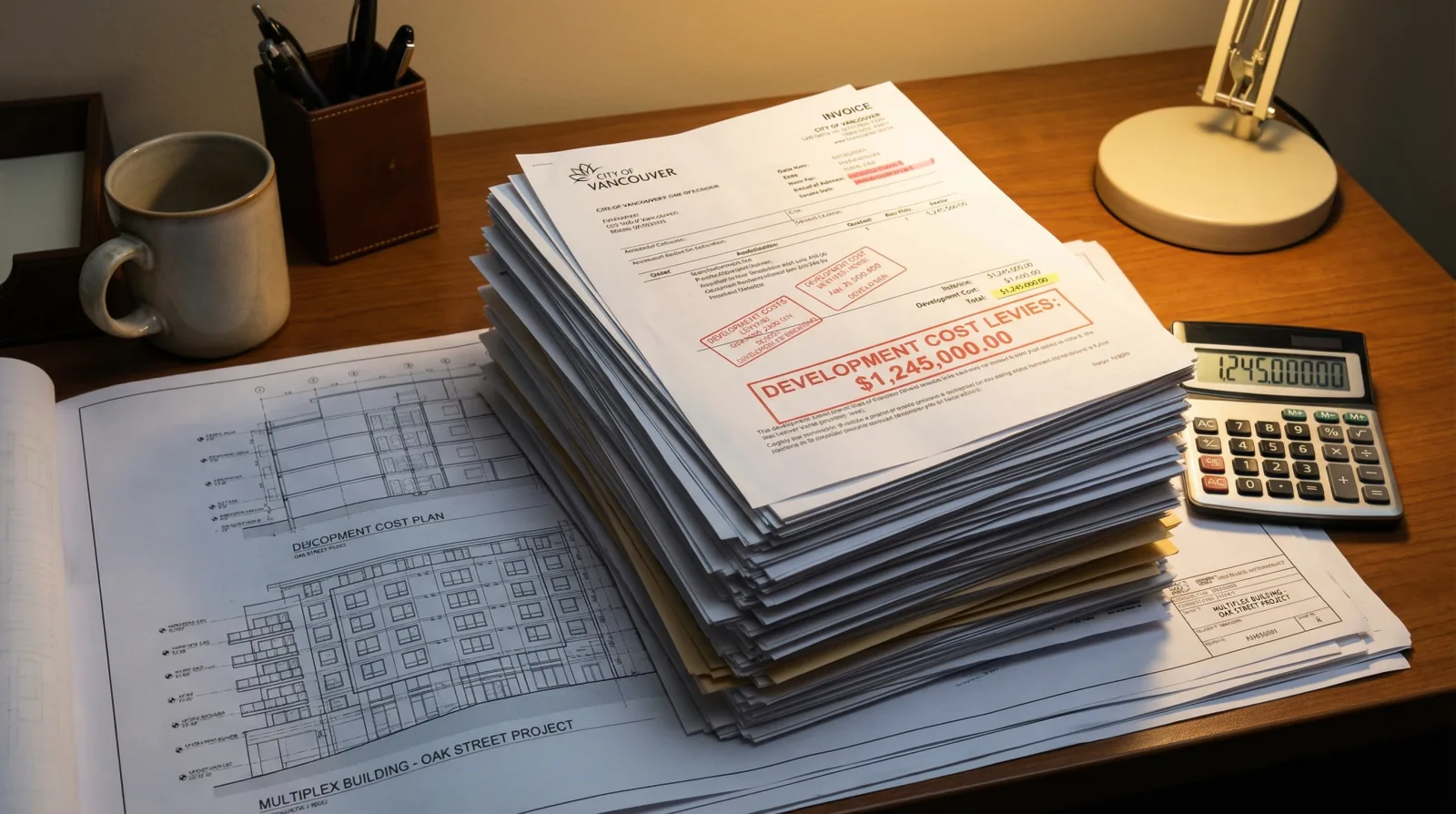
Vancouver currently offers a temporary 20% reduction on Development Cost Levies. For a typical R1-1 multiplex, DCLs run $66,000-$80,000. The 20% reduction saves $13,200-$16,000. This program runs until the city introduces its new “Financing Growth” framework, expected Q2 2026.
But the bigger savings come from the density bonus fee exemption.
When you build 7-8 units on a standard R1-1 lot through the strata path (if it were allowed — it isn’t), Vancouver charges a density bonus contribution of approximately $82,000 per additional unit beyond the base density. For units 7 and 8, that’s $164,000.
Secured rental projects are exempt from this fee. The city waives it entirely because it wants rental housing more than it wants the fee revenue.
Combined savings: roughly $177,000-$180,000 on a single 8-unit project. That’s not nothing. On a $5M total project cost, it’s 3.5% — enough to move a marginal DSCR from failing to passing.
The 557 m2 Threshold
Not every R1-1 lot qualifies for 8 units. The lot must be at least 557 m2 (approximately 5,995 sq ft) with a minimum frontage of 15.1m (49.5 feet).
Lots between 5,000 and 5,995 sq ft — a common size in East Vancouver — max out at 6 units even on the rental path. They still get the FSR bump to 1.00, but the unit count caps at 6. You lose the two-unit buffer that makes the CMHC math more resilient.
This is why lot selection in Vancouver is surgical. A difference of 100 sq ft in lot area can mean two fewer units, $60,000 less annual revenue, and a DSCR that fails instead of passes.
We screened over 56,000 R1-1 lots in Vancouver. Roughly 68% meet the 557 m2 threshold. But once you layer on frontage, lane access, and land basis filters, fewer than 12% pass all five BTR screens.
What the Rental Tenure Lock Actually Means
“Secured rental” means a housing agreement registered on title. The units cannot be stratified or sold individually. Ever. This isn’t a 10-year commitment. It’s permanent.
For some owners, this is the dealbreaker. You can’t sell units to recover capital. Your exit is selling the entire building as a rental asset, valued on cap rate, not per-unit pricing.
For others — particularly existing homeowners building on a lot they already own — it’s the whole point. You’re not trying to flip. You’re building a pension. Eight units at $2,500/month average = $240,000/year gross. After expenses and debt service, that’s a long-term income stream that compounds as rents rise and the mortgage amortizes.
The Rent Reality Check
Vancouver’s average asking rent for a 2-bedroom apartment: $3,170 (Statistics Canada, Q1 2025). CMHC’s purpose-built rental survey shows the average occupied 2-bedroom at $2,363/month — significantly lower because existing tenants are protected by BC’s annual rent increase cap.
For new-build BTR underwriting, you use asking rents, not occupied averages. But you also need to account for the current market reality: purpose-built rental operators are offering one to two months free rent to fill units. The 25,855 rental completions registered in BC in 2025 flooded supply.
We underwrite new 8-unit R1-1 projects at $2,400-$2,800/month blended average depending on neighbourhood. East Vancouver: $2,400-$2,600. Kitsilano/Mount Pleasant: $2,600-$2,800. Dunbar/Kerrisdale: $2,700-$2,900.
These numbers are 10-15% below peak asking rents from mid-2024. That’s deliberate. Underwriting to peak is how projects fail.
Who This Path Actually Works For
The Vancouver R1-1 secured rental bonus works best for three owner profiles:
1. Existing homeowners with zero land basis. You already own the lot. The biggest cost line — land acquisition — is zero. DSCR clears easily on most qualifying lots. Your equity requirement is just 5% of construction costs.
2. Homeowners who purchased pre-2020 at lower basis. If you bought for $1.0-$1.3M, the land basis per buildable sq ft is still under $200. These lots pencil at current rents with reasonable cushion.
3. Investors targeting lots under $1.4M. They exist, but primarily in East Vancouver — Renfrew, Killarney, Victoria-Fraserview, Champlain Heights. At $1.4M land + $3.5M build cost = $4.9M total, and gross rents of $230,000/year, DSCR can clear 1.10 with careful underwriting.
The path does not work for anyone who needs a 7-year exit, anyone buying West Side lots at $2.5M+, or anyone who can’t stomach a permanent rental tenure lock.
Vancouver vs. Every Other BC City
Surrey gives you up to 6 units near frequent transit stops. No rental bonus. Kelowna’s Infill Fast-Track allows 4-6 units on MF1 lots. No rental bonus. Victoria’s Missing Middle zoning allows up to 6 units. No rental bonus. Burnaby’s Bill 44 implementation allows 6 units near transit. No rental bonus.
Only Vancouver says: choose rental, get 33% more units.
This is why Vancouver remains the most interesting BTR market in BC despite having the highest land costs. The zoning incentive is strong enough to overcome the land premium — on the right lot, with the right basis, for the right owner.
The question isn’t whether the policy works. It does. The question is whether your specific lot qualifies and whether your specific cost structure clears the DSCR threshold. That’s a math problem, not a policy problem.
Run the numbers on your lot. Start with the VanPlex proforma tool or explore the Vancouver R1-1 secured rental analysis for the full framework.
David Babakaiff is the Co-Founder and CEO of VanPlex, a Vancouver-based company specializing in multiplex development and Missing Middle housing. VanPlex uses its AI-powered PlexRank system to identify and underwrite multiplex conversion opportunities under BC’s Bill 44 zoning reforms.