
A 6-unit strata multiplex in Vancouver and an 8-unit secured rental multiplex on the identical lot have the same hard construction costs per square foot. Same concrete. Same lumber. Same trades.
The fee stack is where they diverge by $180,000 to $228,000.
That number isn’t theoretical. It’s the compounding effect of Vancouver’s Development Cost Levy waivers, density bonus fee exemptions, and the two additional units that rental tenure unlocks. For a $5M project, it’s 3.6%-4.6% of total cost. For a DSCR calculation, it’s the difference between 1.04 (fails CMHC) and 1.14 (passes with room).
Most developers look at rents and construction costs. The ones who actually build look at the fee stack first.
TL;DR (Key Takeaways)
- Vancouver DCL reduction saves $13,200-$16,000 on a typical multiplex (20% discount, effective Dec 2025)
- Rental Development Relief Program offers full DCL waivers for qualifying below-market projects
- Density bonus fee exemption saves $164,000 — units 7 and 8 at ~$82,000 each, waived for secured rental
- Combined fee stack advantage: $180,000-$228,000 per 8-unit rental project vs. 6-unit strata
- Most BC cities offer zero fee relief for rental — the fee stack advantage is Vancouver-only
- Metro Vancouver regional DCCs increased January 2026 — one government cuts while another collects
- The “Financing Growth” framework (expected Q2 2026) will recalibrate all rates — current discounts are temporary
Development Cost Levies: What You’re Actually Paying
Every new residential unit in Vancouver triggers Development Cost Levies. DCLs fund infrastructure — water, sewer, parks, childcare, transportation. They’re unavoidable. The question is how much.
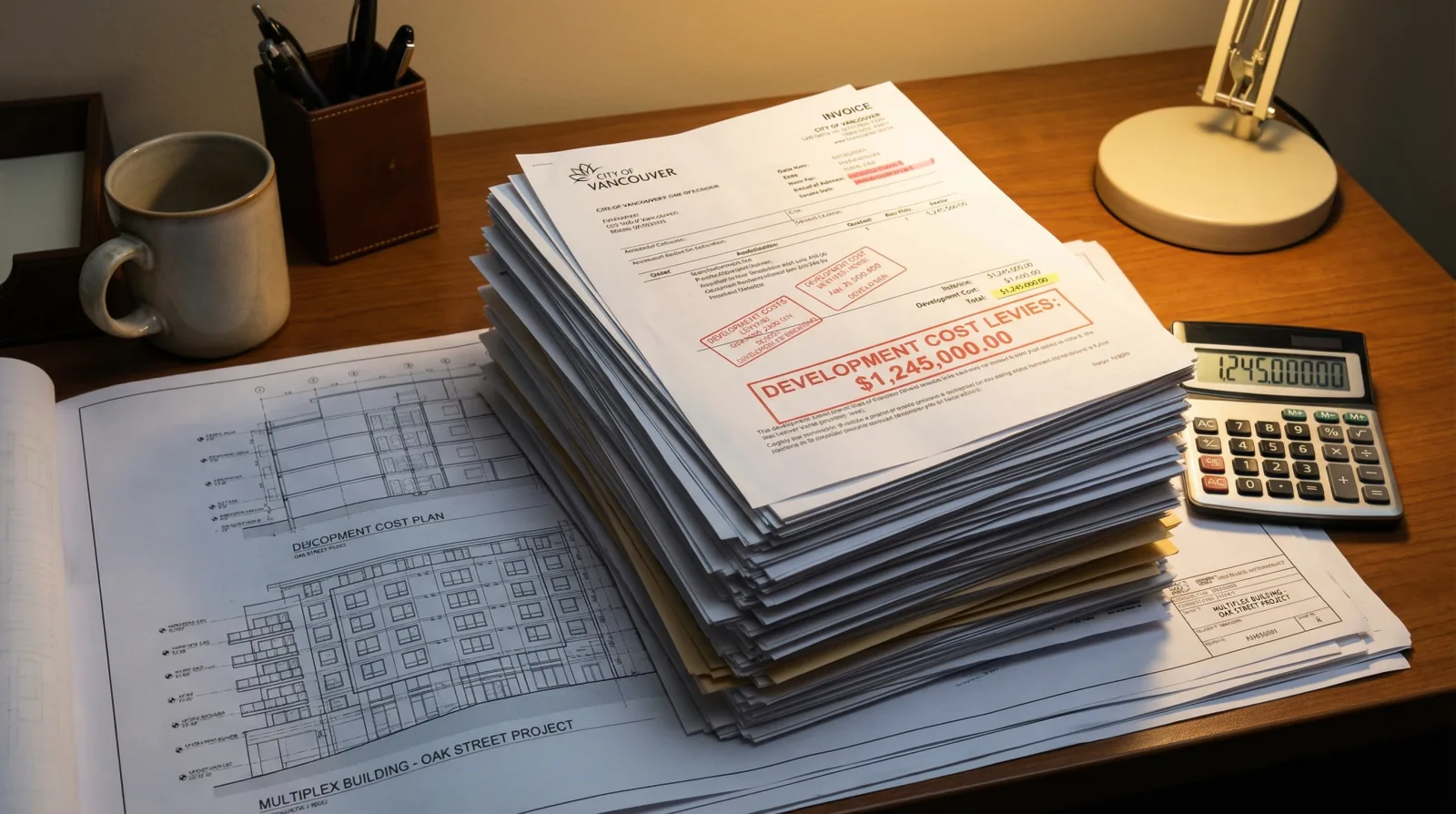
Vancouver charges DCLs based on floor area. For residential development, the combined city-wide DCL and utilities DCL runs approximately $38.42 per square foot. On an 8-unit building at 6,000 sq ft of buildable area, that’s roughly $230,000 in DCLs alone.
Before December 2025, you paid the full rate. Period.
The 20% DCL Discount
On December 10, 2025, Vancouver City Council approved a 20% discount on all development cost levies. Not just rental. All projects. The discount applies to:
- City-wide DCL
- Vancouver Utilities DCL
- Area-Specific DCL
On that same 8-unit building, 20% off $230,000 = $46,000 saved. For a smaller 6-unit project at 4,200 sq ft, the savings are roughly $32,000.
This discount remains in effect until the City rolls out its “Financing Growth” update, expected Q2 2026. It could be extended. It could be replaced with a different structure. Nobody knows yet.
The Rental Development Relief Program
Separate from the blanket 20% cut, Vancouver runs a Rental Development Relief Program (February 1, 2026 through December 15, 2027). This program targets in-stream projects with below-market rental requirements on sites with fewer than 10 existing rental units.
Qualifying projects get a full waiver of the city-wide DCL on the residential portion. Not 20% off. Zero.
The catch: your rents must meet affordability criteria. Below-market rents are set at CMHC’s city-wide average — not a discount below average, but at average. For a purpose-built rental project targeting market rents of $2,600/month, this may or may not align with your proforma.
If it does align, you’ve just saved the entire DCL bill. On an 8-unit project, that’s $180,000-$230,000 depending on buildable area.
DCL Payment Flexibility
Starting January 1, 2026, Vancouver allows DCL payments in two installments for projects with DCLs exceeding $500,000. This doesn’t reduce the total — it shifts cash flow. For builders managing construction draws, splitting a $230,000 DCL bill into two payments provides breathing room.
Small detail. Matters for small builders operating on tight construction financing.
Density Bonus Contributions: The $82,000 Per Unit Reality
This is the fee most people miss until it’s too late.
When you build beyond base density on an R1-1 lot in Vancouver — units 7 and 8 on the rental path — the city can charge a density bonus contribution. The current rate: approximately $82,000 per additional unit beyond base density.
For a strata project (if 7-8 units were even permitted, which they’re not on R1-1), that would be $164,000 for two units.
The Rental Exemption
Secured rental projects are fully exempt from density bonus contributions.
Vancouver’s policy is explicit: the public benefit of securing rental housing replaces the cash contribution. You’re providing affordable housing in perpetuity. The city doesn’t also need $164,000 in cash from you.
Three options exist for density bonus compliance:
- Cash payment — $82,000 per unit beyond base density
- Below-market homeownership unit — deliver one unit at below-market pricing
- Secure all units as rental — fee waived entirely
Option 3 is the only one that costs you zero dollars and gives you maximum units.
The Compounding Math: Strata vs. Rental Fee Stack
Here’s what the fee stack looks like on a real lot profile. Standard R1-1 in East Vancouver, 6,100 sq ft, 15.3m frontage.
Strata 6-Unit Path
| Fee | Amount |
|---|---|
| City-wide DCL (4,270 sq ft × $38.42) | $164,000 |
| 20% DCL discount | -$32,800 |
| Density bonus contribution | $0 (within base density) |
| Total fees | $131,200 |
Secured Rental 8-Unit Path
| Fee | Amount |
|---|---|
| City-wide DCL (6,100 sq ft × $38.42) | $234,400 |
| 20% DCL discount | -$46,900 |
| Density bonus contribution (units 7-8) | $0 (rental exemption) |
| Total fees | $187,500 |
Wait. The rental path has higher total DCL costs because you’re building more square footage. How is this a savings?
Because you also get two more units. The relevant comparison isn’t total fees — it’s fees per unit.
| Metric | Strata 6-Unit | Rental 8-Unit |
|---|---|---|
| Total fees | $131,200 | $187,500 |
| Fee per unit | $21,867 | $23,438 |
| Revenue units | 6 | 8 |
| Density bonus avoided | $0 | $164,000 |
The rental path pays $56,300 more in DCLs but avoids $164,000 in density bonus fees. Net advantage: $107,700. Add the revenue from two additional units — roughly $60,000/year in gross rent — and the rental path is structurally superior.
If You Qualify for the Full Rental DCL Waiver
Under the Rental Development Relief Program, if your rents meet the affordability threshold:
| Fee | Amount |
|---|---|
| City-wide DCL | $0 (full waiver) |
| Density bonus contribution | $0 (rental exemption) |
| Total fees | $0 |
That’s a $131,200 advantage over the strata path’s discounted fees. Or $295,600 compared to pre-discount strata fees plus density bonus at full rates.
This is why the fee stack changes everything.
The Metro Vancouver Complication
Here’s the twist nobody talks about. While the City of Vancouver cuts DCLs, Metro Vancouver — the regional district — increased its Development Cost Charges effective January 1, 2026.
These regional DCCs are separate from city DCLs. They fund regional infrastructure: water treatment, sewage, regional parks. The city discount doesn’t offset the regional increase.
For multiplex builders, the net effect of the city cutting and the region raising is partial cancellation. You save on one line, pay more on another. The net is still positive — the city cut is larger than the regional increase for most projects — but it’s not the clean savings the headlines suggest.
Always model both layers.
City-by-City Comparison: Who Offers What
| City | DCL/DCC Relief | Rental-Specific Relief | Density Bonus Waiver |
|---|---|---|---|
| Vancouver | 20% DCL cut + full waiver program | Yes | Yes — rental exempt |
| Burnaby | None | None | N/A — no density bonus framework |
| Surrey | DCC freeze at 2023 rates through May 2027 | No — freeze applies to all tenure | N/A |
| Kelowna | None | None | N/A |
| Victoria | None | None | N/A |
| Coquitlam | None | None | N/A |
| North Vancouver (City) | None | None | N/A |
| Richmond | None | None | N/A |
Surrey’s DCC freeze helps everyone, not just rental. Effective, but not a rental incentive. Every other city charges the same fees regardless of whether you’re building condos or rental apartments.
Vancouver is the only municipality in BC where choosing rental tenure produces a materially different fee outcome.
What This Means for Your Proforma
If you’re building in Vancouver on a qualifying R1-1 lot:
Model three scenarios. Strata 6-unit at full fees. Rental 8-unit with 20% DCL discount. Rental 8-unit with full DCL waiver (if your rents qualify).
The fee stack alone can move your DSCR by 0.08-0.15 points. On a project where CMHC’s MLI Select requires a minimum 1.10 DSCR, that’s the entire margin between approval and rejection.
The temporary nature of these programs matters. The 20% DCL discount expires when “Financing Growth” launches (Q2 2026). The Rental Development Relief Program runs through December 2027. If you’re 18 months from permit, these numbers could change.
If you’re building outside Vancouver, the fee stack is irrelevant to your tenure decision. No BC city besides Vancouver offers rental-specific fee advantages at the multiplex scale. Your tenure choice should be driven purely by exit strategy and financing — not by hoping for fee savings that don’t exist.
Run the numbers for your specific lot. The VanPlex proforma tool models DCLs and density bonus contributions automatically, or explore the full tax and incentives framework for BTR in BC.
Disclaimer: This post explains Vancouver’s DCL waiver and density bonus fee programs based on publicly available City policy information. It is not financial, legal, or development advice. Fee rates, program terms, and expiry dates change — confirm current figures with the City of Vancouver and a qualified development consultant before including these in any project proforma.
David Babakaiff is the Co-Founder and CEO of VanPlex, a Vancouver-based company specializing in multiplex development and Missing Middle housing. VanPlex uses its AI-powered PlexRank system to identify and underwrite multiplex conversion opportunities under BC’s Bill 44 zoning reforms.