
Operations | Property Management
Property Management for BTR Multiplex
A 6-unit secured rental building is not a stock portfolio. It calls you at 11 PM about a leaking pipe. It requires RTB compliance on every notice. It eats 30-40% of your gross rent before you see a dollar of cash flow. Here is the real operating picture.
Key Operating Facts
- ✓Operating expenses consume 30-40% of gross rental income on a well-managed 6-unit building. That is before debt service.
- ✓Professional property management runs 8-12% of gross rent in Metro Vancouver — $1,200-$1,800/month on a typical 6-unit.
- ✓BC bans personal-use eviction in buildings with 5 or more units. You cannot move yourself or family into any unit. Period.
- ✓One tenant turnover event costs $3,300-$4,400 including vacancy loss, cleaning, repairs, and re-leasing.
Operating Burden at a Glance
Time Commitment
4/5Self-managing a 6-unit building means 10-15 hours per week. Maintenance calls, tenant communication, bookkeeping, inspections, and RTB compliance. This is a part-time job.
Operating Cost Pressure
4/5Insurance, property tax, and maintenance rise 4-6% annually. BC caps your rent increase at 2.3% for 2026. The gap compounds every year.
Regulatory Complexity
3/5The BC Residential Tenancy Act governs everything. Personal-use eviction is banned in buildings with 5+ units. RTB hearings take 4-9 weeks. You cannot shortcut any of it.
Vacancy Impact
4/5One vacant unit in a 6-unit building costs $2,800/month in lost revenue plus $500-$1,500 in turnover expenses. That is 16.7% of your gross income gone.
Capital Reserve Discipline
3/5New construction buys you 5-7 years before major systems need attention. But roofing, HVAC, and plumbing failures do not wait for your cash flow to recover.
The Operating Reality
A 6-unit BTR multiplex grossing $15,000/month sounds like strong income. It is — until you subtract reality. Property management, insurance, property tax, maintenance, utilities, vacancy, and capital reserves take 30-40% off the top. On $180,000 gross annual rent, you keep $108,000-$126,000 as net operating income. Debt service comes out of that.
This is not passive income. Self-managing means fielding maintenance requests, coordinating trades, handling tenant disputes through the BC Residential Tenancy Branch, tracking rent collection, managing insurance renewals, and staying current on a tenancy act that has been amended three times since 2023.
Hiring a property manager eliminates the daily grind but adds 8-12% to your cost structure. On $15,000/month gross, that is $1,200-$1,800/month — roughly the cash flow from one unit. You are paying one unit's rent to have someone else manage the other five.
Gross Rent (6-unit)
$15,000
Per month at $2,500 avg/unit
Operating Expenses
$4,500-$6,000
30-40% of gross, monthly
NOI Before Debt
$9,000-$10,500
What is left to service your mortgage
Self-Manage vs Hire
The decision is not about money alone. It is about how many hours per week you are willing to spend on tenant communication, maintenance coordination, bookkeeping, and regulatory compliance.
Self-Manage
- ▸Saves $9,000-$18,000/year vs professional management
- ▸Requires 10-15 hours/week: tenant calls, maintenance, bookkeeping, RTB paperwork
- ▸You handle RTB disputes directly — hearings, evidence prep, compliance
- ▸Works if you live nearby, own fewer than 8 units, and have flexible scheduling
- ▸Risk: missed maintenance, late compliance, burnout on year 3
Professional Manager
- ▸Costs $1,200-$1,800/month on a 6-unit building grossing $15K/month
- ▸Plus setup fee (one month's rent) and tenant placement (50-100% of first month)
- ▸Handles RTB compliance, maintenance dispatch, rent collection, inspections
- ▸Makes financial sense above 8-10 units where complexity exceeds owner capacity
- ▸Risk: misaligned incentives, slow response, higher tenant placement costs
The break-even math: A 6-unit building grossing $15,000/month loses $750-$1,500/month to a property manager. That manager needs to save you at least that much in avoided vacancy, faster re-leasing, and better maintenance pricing to justify the cost. At 6 units, it is a close call. At 8-10 units, the complexity tips clearly toward professional management.
The Real Operating Budget
Every line below is real money leaving your account. Based on a 6-unit building grossing $15,000/month ($180,000/year) in Metro Vancouver.
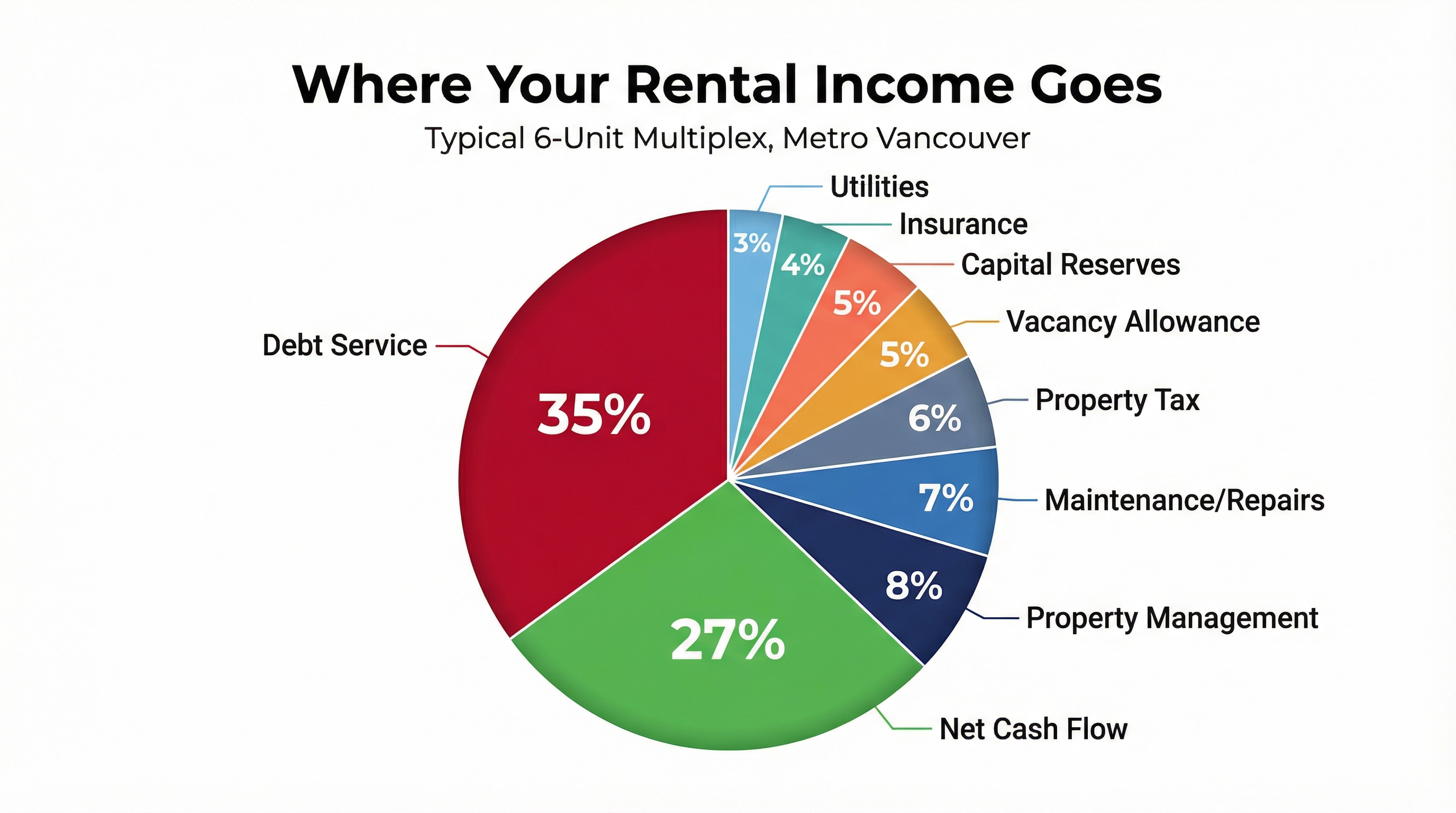
| Category | % of Gross | Monthly (6-unit) | Annual (6-unit) | Notes |
|---|---|---|---|---|
| Property Management | 5-10% | $750-$1,500 | $9,000-$18,000 | 5-8% self-managed admin; 8-12% professional |
| Maintenance & Repairs | 5-8% | $750-$1,200 | $9,000-$14,400 | $500-$800/unit/year for new builds; doubles after year 7 |
| Insurance | 3-5% | $450-$750 | $5,400-$9,000 | Wood-frame multiplex; rising 8-15% annually in BC |
| Property Tax | 8-12% | $1,200-$1,800 | $14,400-$21,600 | Based on assessed value; reassessed annually |
| Utilities (Common Area) | 2-4% | $300-$600 | $3,600-$7,200 | Hallways, exterior lighting, shared laundry, water/sewer |
| Legal & Accounting | 1-2% | $150-$300 | $1,800-$3,600 | RTB filings, lease review, annual tax prep |
| Vacancy Allowance | 3-5% | $450-$750 | $5,400-$9,000 | Budget 3% minimum; 5% if near new supply |
| Capital Reserves | 3-5% | $450-$750 | $5,400-$9,000 | Roof, HVAC, elevator (if applicable), envelope |
| Total Operating Expenses | 30-51% | $4,500-$7,650 | $53,600-$91,800 | Range depends on management model and building age |
Based on a 6-unit wood-frame multiplex in Metro Vancouver. New construction in first 5 years of operation. Professional management at 10% assumed. Your numbers will vary by municipality, building type, and management approach.
Insurance Trend
Wood-frame multiplex insurance in BC has risen 8-15% annually since 2022. A new 6-unit building costs $4,000-$8,000/year to insure. Construction-phase coverage runs an additional $3,000-$8,000. Insurance costs for wood-frame buildings are up to six times higher than concrete — a structural cost penalty that never goes away.
The Cost Squeeze
BC caps your 2026 rent increase at 2.3%. Insurance rises 8-15%. Property tax reassessments run 3-6%. Maintenance costs follow construction inflation at 4-5%. Every year, your expenses grow faster than your revenue. After 10 years, the gap is material — unless your starting yield was strong enough to absorb it.
BC Tenancy Rules That Matter
The BC Residential Tenancy Act governs your relationship with every tenant. These four provisions directly affect your operating costs and management flexibility.
Rent Increase Cap: 2.3% for 2026
BC ties the maximum allowable rent increase to CPI. For 2026, that is 2.3% — down from 3% in 2025. You can increase rent once per 12-month period with three months' written notice. No exceptions for rising operating costs. If your insurance jumps 12% and your property tax rises 5%, you absorb the difference. The only relief valve is the Additional Rent Increase application to the RTB, which requires documented extraordinary costs and takes months to process.
Personal-Use Eviction Ban (5+ Units)
Bill 14 (Royal Assent May 16, 2024) bans personal-use evictions in purpose-built rental buildings with five or more units. Every BTR multiplex that qualifies for CMHC MLI Select hits this threshold. You cannot move yourself, a family member, or a caregiver into any unit. Landlords in buildings under 5 units must now give four months' notice (up from two), occupy for a minimum of 12 months (up from six), and use a government web portal that triggers post-eviction compliance audits.
Security Deposit Limits
Maximum security deposit: half of one month's rent. Maximum pet damage deposit: half of one month's rent. No last month's rent deposit allowed. On a $2,800/month unit, your total protection is $2,800 ($1,400 security + $1,400 pet). That covers roughly 18 days of unpaid rent. If a tenant stops paying and disputes your eviction notice, you are exposed for 4-9 weeks of lost rent with $2,800 in deposit as your only buffer.
RTB Dispute Timelines
Standard participatory hearings are scheduled a minimum of 22 days from filing. Typical resolution takes 4-9 weeks. Expedited hearings for urgent matters (unpaid rent, safety concerns) can be scheduled within 6-12 days. During the entire dispute process, the tenant remains in the unit. A non-paying tenant who files a dispute can stay 2-3 months before you get an order of possession — and that order still requires a bailiff to enforce if the tenant does not leave voluntarily.
Maintenance Reserves
New Construction (Years 1-7)
New builds benefit from warranties and fresh systems. Budget 5-7% of gross rent for maintenance and reserves combined. This covers routine repairs, appliance service, and building the capital reserve fund for future replacements.
Mature Building (Years 8-15)
Maintenance costs roughly double after year 7. Budget 8-10% of gross rent. Major systems — HVAC, roofing, plumbing — begin requiring replacement rather than repair. A roof replacement on a 6-unit building runs $25,000-$40,000.
What Breaks First in a New Multiplex
Tenant Turnover Math
Average tenant stays 18-24 months. Every turnover costs money. In a 6-unit building, you should expect 3-4 turnovers per year at stabilization. That is $10,000-$17,600 in annual turnover costs before you count the management time.
| Cost Item | Amount | Notes |
|---|---|---|
| Lost Rent (1 month vacancy) | $2,800 | Average 2BR unit; 3-4 weeks to re-lease in current market |
| Cleaning & Paint Touch-Up | $300-$600 | Professional clean + minor wall repairs |
| Minor Repairs | $200-$500 | Fixtures, appliance service, flooring patches |
| Listing & Showing Time | $0-$400 | Self-managed = your time; PM charges 50-100% of first month |
| Tenant Screening | $50-$100 | Credit checks, reference verification |
| Total Per Turnover | $3,350-$4,400 | Per unit, per turnover event |
Current Market Context
Metro Vancouver purpose-built rental vacancy hit 3.7% in 2025 — a 30-year high. Turnover rates rose across all unit types. Newer buildings with higher rents saw the most movement as tenants found alternatives. Operators are offering one to two months' free rent to fill units. Your re-leasing timeline is 3-4 weeks, not 1-2 weeks like it was in 2023.
The Retention Advantage
Keeping a tenant for 36 months instead of 18 saves you one full turnover cycle: roughly $3,300-$4,400. The cheapest unit to fill is the one that never goes vacant. Responsive maintenance, reasonable rent increases (even below the 2.3% cap), and professional communication are the highest-ROI investments in a small building. Every retained tenant is money you keep.
Best For
- ✓ Owners who treat the building as a business — with dedicated time, a maintenance budget, and a clear management plan before the first tenant moves in.
- ✓ Projects where the pro forma accounts for 35-40% operating expenses from day one, not the 25% that optimistic spreadsheets assume.
- ✓ Builders who have identified a property manager before construction starts, or who have realistic self-management capacity for 10-15 hours per week.
Usually Fails When
- ✕ The owner assumes "new construction = no maintenance" and budgets 15-20% for operating expenses.
- ✕ The pro forma uses the 2.3% rent increase cap as the revenue growth rate but does not model 4-6% expense growth.
- ✕ Self-management is the plan but the owner lives 45 minutes from the building and has a full-time job.
- ✕ No capital reserve fund is established from day one. The first $15,000 repair wipes out six months of cash flow.
What To Verify Before Spending Money
- → Get three property management quotes for a 6-unit building in your municipality. Compare the full fee schedule — not just the headline percentage.
- → Build a 10-year operating model that escalates expenses at 5% and revenue at 2.3%. Check which year your NOI margin compresses below your debt service comfort zone.
- → Confirm your insurance cost with a broker who specializes in BC wood-frame rental buildings. Do not use a generic estimate.
- → Talk to an owner who self-manages a 6-8 unit building. Ask about hours per week, worst maintenance call, and RTB dispute experience.
Frequently Asked Questions
How much does professional property management cost for a 6-unit multiplex in Vancouver?
Can I evict a tenant for personal use in a purpose-built rental with 5+ units?
What is the maximum security deposit I can collect in BC?
How long does a BC Residential Tenancy Branch hearing take?
What breaks first in a new multiplex building?
Should I self-manage or hire a property manager for a 6-unit building?
Related Reading
Official Sources Referenced
Screen Your Lot for Build-to-Rent
Enter any BC address to compare rental hold potential, unit count, and the for-sale alternative before you spend money on drawings.