
Operations | Construction Guide
Construction Guide for BTR Multiplex
You are building this to hold, not to sell. That changes every finish decision, every wall assembly, and every mechanical system. Strata-spec construction optimizes for a buyer who walks through once. Rental-spec optimizes for tenants who live there for years and a maintenance budget you pay every month.
Key Construction Facts
- ✓Rental-spec finishes save $15-25/sqft over strata-spec with zero impact on achievable rent.
- ✓Two-bedroom units deliver the best rent-to-turnover ratio in Metro Vancouver. Build mostly 2BR.
- ✓Upgrading party walls from STC 50 to STC 55-60 costs $5-10/sqft extra but eliminates the #1 tenant complaint in wood-frame buildings.
- ✓Individual utility sub-metering recovers $7,200-$14,400/year in tenant-paid utilities on a 6-unit building.
Construction Decisions at a Glance
Finish Cost Savings (Rental vs Strata)
4/5Rental-spec finishes save $15-25/sqft over strata-spec. LVP flooring, painted walls, commercial-grade hardware. The savings compound across 6-8 units into $60,000-$120,000 on a typical project.
Sound Separation Investment
4/5BC Building Code requires STC 50 minimum for party walls. Rental buildings should target STC 55-60. The upgrade costs $5-10/sqft on party walls but prevents the #1 tenant complaint in wood-frame buildings.
Metering Complexity
3/5Individual BC Hydro meters are now required for new multi-unit residential. Gas and water sub-metering adds $3,000-$5,000/unit upfront but shifts $800-$1,200/month in utility costs to tenants on a 6-unit building.
Unit Mix Sensitivity
4/5Your unit mix locks in revenue potential for 30+ years. Getting it wrong costs $200-$400/month per unit in lost rent-per-sqft optimization. Two-bedrooms outperform in Metro Vancouver on a rent-per-sqft basis.
Durability vs Aesthetics Trade-off
3/5Spending on durability (plumbing, hardware, underlayment) reduces turnover costs by $500-$1,000/unit over 10 years. Spending on aesthetics (countertops, tile) impresses on day one but adds zero to long-term NOI.
Rental Spec vs Strata Spec
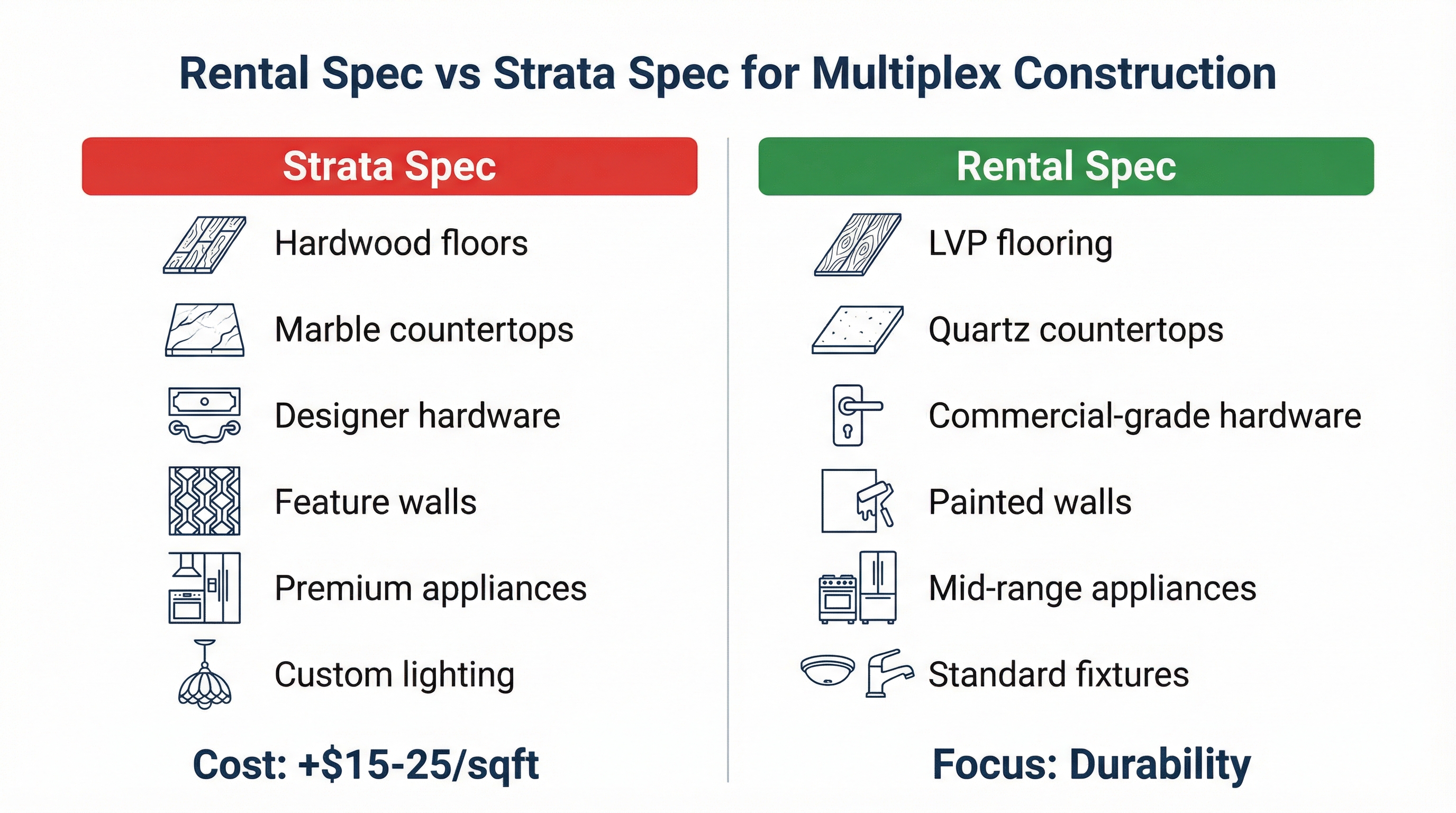
Strata-spec construction is designed to impress a buyer during a 30-minute showing. Engineered hardwood floors, quartz waterfall countertops, designer tile, premium appliance packages. Every dollar spent on finishes is recovered at the point of sale. The buyer pays once and the developer walks away.
Rental-spec is different. You are paying for those finishes and then maintaining them for 30 years. Engineered hardwood scratches under furniture moves and costs $3-5/sqft to refinish. LVP costs $4-7/sqft installed, is waterproof, scratch-resistant, and you replace damaged planks in 20 minutes. Painted drywall touches up between tenants in an afternoon. Feature walls with accent finishes add a full day to turnover prep.
The savings are real: $15-25 per square foot on interior finishes. On a 6-unit building with 5,000 sqft of finished space, that is $75,000-$125,000 you keep in your pocket — or redirect to the things that actually matter: sound separation, plumbing quality, and durable hardware.
| Item | Rental Spec | Strata Spec | Saving | Why It Matters |
|---|---|---|---|---|
| Flooring | LVP ($4-7/sqft installed) | Engineered hardwood ($8-14/sqft) | $4-7/sqft | LVP is waterproof, scratch-resistant, and replaceable by section. Hardwood dents, stains, and requires full refinishing. |
| Walls | Painted drywall (eggshell) | Feature walls, accent paint, wallpaper | $1-3/sqft | Eggshell paint wipes clean and touches up in 20 minutes between tenants. Feature finishes add turnover time and cost. |
| Countertops | Laminate or mid-grade quartz | Premium quartz or stone | $2-4/sqft | Tenants do not pay more rent for countertop upgrades. Functional, stain-resistant surfaces outperform premium stone in rental. |
| Cabinets | Thermofoil with soft-close | Painted shaker or custom | $3-5/sqft | Soft-close hardware is the only upgrade that matters. Tenants notice cabinet function, not cabinet style. |
| Door Hardware | Commercial-grade lever sets | Residential designer hardware | $50-100/door | Commercial lever hardware survives 10,000+ cycles. Residential hardware loosens in 2-3 years. Spend here. |
| Appliances | Mid-range (white or stainless) | Premium stainless package | $1,500-$3,000/unit | Buy appliances you can replace for under $800 each. Premium appliances cost more to repair and do not increase rent. |
Costs reflect Q1 2026 Metro Vancouver pricing. Savings are per-sqft unless noted. Actual savings depend on unit count, layout complexity, and supplier pricing.
Unit Mix for Rental
Your unit mix is a 30-year decision. You cannot change it without gutting the building. Two-bedrooms get the best rent-per-sqft in Metro Vancouver when you factor in turnover costs. Studios have the highest gross rent-per-sqft but the highest turnover. Three-bedrooms have the lowest turnover but the slowest lease-up.
| Unit Type | Size | Rent Range | Rent/sqft | Turnover | Lease-Up |
|---|---|---|---|---|---|
| Studio | 350-450 | $1,600-$1,900 | $4.20-$4.55 | High (12-18 mo avg) | Fast (1-2 weeks) |
| 1-Bedroom | 500-650 | $2,000-$2,300 | $3.50-$4.00 | Medium (18-24 mo) | Fast (1-2 weeks) |
| 2-Bedroom | 750-900 | $2,600-$3,100 | $3.20-$3.60 | Low (24-36 mo) | Moderate (2-3 weeks) |
| 3-Bedroom | 1,000-1,200 | $3,200-$3,800 | $2.80-$3.30 | Very low (36+ mo) | Slow (3-5 weeks) |
Recommended: 6-Unit Building
4x 2BR + 1x 1BR + 1x 3BR. Gross monthly rent: $14,800-$17,500. The four 2-bedrooms anchor your income with low turnover. The 1-bedroom captures singles and couples. The 3-bedroom attracts a family that stays 3+ years. This mix balances revenue, vacancy risk, and tenant stability.
Recommended: 8-Unit Building
5x 2BR + 2x 1BR + 1x 3BR. Gross monthly rent: $19,400-$23,100. Same logic scaled up. The extra 1-bedroom adds diversity without increasing turnover risk significantly. Avoid adding studios unless your market specifically demands them (transit-oriented locations near SkyTrain stations).
The turnover math: A studio turning over every 14 months costs $2,500-$3,500 per event. Over 10 years, that is 8-9 turnovers: $20,000-$31,500 in vacancy and turnover costs per studio. A 2-bedroom turning over every 30 months has 3-4 turnovers in the same period: $10,000-$17,600. The 2-bedroom generates higher total rent and lower turnover costs simultaneously. Build accordingly.
Durability Over Finish
In a rental building, every component faces repeated use cycles across multiple tenants. The question is not "what looks best on move-in day" but "what survives 10 years of real use at the lowest total cost."
Plumbing Fixtures
Cheap faucets and valves leak by year 3. A $180 Moen faucet lasts 10+ years. A $60 builder-grade fails at 3-5. The plumber call to replace it costs $250.
Door Hardware
Commercial lever sets ($80-120/door) survive 10,000 cycles. Builder-grade knobs ($25-40) loosen and break within 2-3 years across multiple tenants.
Flooring Underlayment
Premium acoustic underlayment ($1.50-2.50/sqft vs $0.50 standard) reduces noise complaints between floors by 40-60%. Noise is the #1 complaint in wood-frame rentals.
Soft-Close Cabinets
Soft-close hinges and drawer slides add $15-25/cabinet. They prevent slamming damage, reduce noise complaints, and signal quality to prospective tenants.
Countertops
Mid-grade quartz ($40-55/sqft installed) performs identically to premium ($70-90/sqft) in a rental. No tenant pays more rent for a better countertop edge profile.
Appliances
A $700 mid-range dishwasher performs the same as a $1,200 premium unit. Buy appliances you can replace cheaply. Repair costs on premium brands are 40-60% higher.
Light Fixtures
Simple LED flush-mount fixtures ($30-60) vs designer pendants ($150-300). Tenants do not notice. The expensive fixture gets damaged during moves and costs more to replace.
Bathroom Tile
Large-format porcelain ($5-8/sqft) vs designer mosaic ($15-25/sqft). Fewer grout lines mean easier cleaning and less maintenance. The expensive tile adds nothing to rent.
Spend More On
4 items
Plumbing, hardware, underlayment, soft-close
Save Money On
4 items
Countertops, appliances, lights, tile
10-Year Savings
$30K-$60K
Reduced repairs, fewer replacements, lower turnover
Noise and Privacy
Noise is the single most common complaint in wood-frame multi-family buildings. In a strata, the buyer deals with it after closing. In a rental, you deal with it every month through tenant complaints, turnover, and vacancy. Sound separation is not a code-minimum checkbox — it is a retention investment.
BC Code Minimum (STC)
50
For party walls between dwelling units
ASTC Required
47
Including flanking paths — the real test
Rental Target (STC)
55-60
Eliminates noise complaints in wood-frame
| Wall Assembly | STC Rating | Added Cost | Meets Code? |
|---|---|---|---|
| Single stud, 1 layer drywall each side | STC 33-38 | Baseline | No |
| Single stud, 2 layers drywall, acoustic batt | STC 45-50 | +$2-4/sqft | Borderline |
| Resilient channel, 2 layers drywall, acoustic batt | STC 52-56 | +$5-8/sqft | Yes |
| Double stud wall (1" air gap), acoustic batt, 2 layers drywall | STC 58-63 | +$8-12/sqft | Yes (exceeds) |
| Staggered stud wall, acoustic batt, resilient channel | STC 55-60 | +$6-10/sqft | Yes |
The Resilient Channel Risk
Resilient channel works — until someone drives a screw through it into the stud behind it. One screw short-circuits the decoupling for the entire wall section. In a rental building with maintenance staff who may not understand the assembly, this happens. Double stud walls are foolproof. Resilient channel walls require permanent labeling and strict maintenance protocols.
Floor-Ceiling Assemblies
Walls get attention, but impact noise through floor-ceiling assemblies causes more complaints. Minimum: concrete topping on plywood subfloor with acoustic underlayment. Better: isolated ceiling below using resilient channel or spring clips. The floor above and ceiling below are a system — address both sides or address neither.
Metering and Utilities
Who pays for electricity, gas, and water directly affects your NOI. Individual meters cost more upfront but shift consumption costs to tenants permanently. On a 6-unit building, the difference is $800-$1,200/month in utility costs you either absorb or pass through.
Individual Metering
- ▸BC Hydro requires individual electrical meters for new multi-unit residential — no bulk option
- ▸Gas and water sub-metering is optional but recommended
- ▸Tenants pay their own consumption — you pay common area only
- ▸Tenants use 15-20% less when paying directly (conservation incentive)
- ▸Total upfront for 6 units: $18,000-$30,000 (all utilities)
Bulk / Included in Rent
- ▸Simpler infrastructure — fewer meters, less wiring complexity
- ▸You absorb all gas and water costs (electricity must be individually metered)
- ▸No conservation incentive — tenants have no reason to reduce usage
- ▸Utility costs rise 3-5% annually. Your rent increase is capped at 2.3%
- ▸Over 10 years, the gap between utility inflation and rent cap compounds significantly
The ROI math: Individual gas and water sub-metering for 6 units costs $18,000-$30,000 installed. You recover $9,600-$14,400/year in utility costs shifted to tenants. Payback period: 2-3 years. After that, every dollar of utility inflation hits the tenant's bill, not yours. Given BC's 2.3% rent increase cap and 3-5% annual utility inflation, individual metering is one of the few tools that protects your NOI long-term.
Common Areas
A 6-8 unit multiplex is not a condo tower. You do not need a gym, rooftop deck, or concierge. You need functional common areas that work every day, require minimal maintenance, and meet code requirements. Build for function, not for Instagram.
Bike Storage (Required)
Vancouver and most Metro Vancouver municipalities require covered, secure bike storage for multi-unit residential. The City of Vancouver requires a minimum of 1.25 Class A (secure, enclosed) spaces per unit. For a 6-unit building, that is 8 secure bike spaces minimum. Plan 6-8 sqft per bike. A locked ground-floor room with wall-mount racks is the most cost-effective solution — $3,000-$5,000 total for racks and security hardware.
Garbage and Recycling (3-Stream Required)
Metro Vancouver requires 3-stream waste separation: garbage, recycling, and organics. Budget 100-150 sqft for a dedicated waste room with mechanical ventilation. You need separate containers for each stream, accessible for collection vehicles. Floor drains and washable surfaces are essential — this room will smell regardless of how well tenants sort. Plan for bear-proof enclosures if your building is in a suburban municipality. Monthly waste removal runs $300-$500 for a 6-unit building.
Laundry: In-Suite vs Shared
In-suite laundry adds $1,500-$2,500/unit for washer-dryer hookups and ventilation during construction. It increases achievable rent by $50-$100/month per unit and eliminates shared laundry room maintenance entirely. Shared laundry rooms cost $8,000-$12,000 to build out, require ongoing maintenance ($500-$1,000/year), and are the second-most common source of tenant complaints after noise. For new construction, in-suite is the clear choice. The rent premium alone pays back the hookup cost in 15-25 months.
Mail and Parcel Storage
Canada Post requires a centralized mail delivery point (community mailbox or indoor cluster box). Budget $1,500-$3,000 for a locking cluster mailbox unit with parcel compartments. Parcel theft is a real issue — a secured indoor vestibule with a parcel locker system ($2,000-$4,000) pays for itself in tenant satisfaction. Place it inside the building entrance, not on the street. This is a small cost that removes a daily friction point for every tenant.
What Not to Build
Skip the fitness room, party room, rooftop deck, and dog wash station. In a 6-8 unit building, these amenities serve too few people to justify the construction cost ($15,000-$40,000 each), ongoing maintenance, and liability insurance. Your tenants chose a multiplex over a condo tower. They want quiet, functional space — not amenities they can get at a $40/month gym.
EV Charging Readiness
Run conduit and rough-in electrical capacity for Level 2 EV chargers to every parking stall during construction. Cost: $500-$1,000 per stall for rough-in vs $3,000-$5,000 per stall for retrofit. You do not need to install chargers now. You need the infrastructure so you can install them later without tearing open walls. BC's Zero Emissions Vehicle Act will drive tenant demand.
Best For
- ✓ Builders who treat every finish decision as a 10-year cost calculation, not a move-in day impression.
- ✓ Projects where the unit mix is validated against local rental demand data before architectural drawings begin.
- ✓ Owners who invest in sound separation, durable hardware, and individual metering — the three highest-ROI construction decisions in a BTR building.
Usually Fails When
- ✕ The builder uses strata-spec finishes "because it looks better" without calculating the lifetime maintenance cost difference.
- ✕ The unit mix is all studios or all 3-bedrooms because one type had the highest advertised rent-per-sqft.
- ✕ Sound separation meets code minimum (STC 50) and the owner discovers noise complaints drive 40% of turnover within two years.
- ✕ Utility costs are included in rent and the owner loses $10,000-$14,000/year that could have been tenant-paid.
What To Verify Before Spending Money
- → Get a quantity surveyor to price both rental-spec and strata-spec finish packages for your specific floor plan. Compare the per-unit and per-sqft difference.
- → Review CMHC rental market data for your specific municipality. Confirm which unit types have the lowest vacancy and highest rent growth.
- → Ask your acoustic consultant to specify a party wall assembly targeting STC 55-60, not just code minimum. Get the incremental cost per sqft.
- → Get individual metering quotes from BC Hydro (electrical) and sub-metering companies (gas/water) during the design phase — not after framing.
Frequently Asked Questions
How much cheaper is rental-spec construction compared to strata-spec in Metro Vancouver?
What STC rating do I need for party walls in a BC multiplex?
What is the optimal unit mix for a 6-unit BTR multiplex?
Do I need individual utility meters for each unit in a new BC multiplex?
What BC Energy Step Code level applies to a new multiplex in 2026?
Related Reading
Official Sources Referenced
Screen Your Lot for Build-to-Rent
Enter any BC address to compare rental hold potential, unit count, and the for-sale alternative before you spend money on drawings.