
Policy | Regulatory Landscape
Regulatory Landscape for BTR Multiplex
Three levels of government shape your multiplex project. The province tells cities what to zone. Cities decide how fast to process your permit. Ottawa offers financing if you hit their targets. None of these layers coordinate with each other. You navigate all three.
Key Regulatory Facts
- ✓Bill 44 forces every BC municipality over 5,000 people to allow 3-6 unit multiplex on former single-family lots. No exceptions after June 2026.
- ✓Bill 44 does not require cities to incentivize rental. Rental tenure bonuses are a separate municipal decision. Most cities have none.
- ✓Vancouver's R1-1 zone allows up to 8 rental units with DCL waivers and density bonus exemptions. No other BC city matches this.
- ✓CMHC MLI Select covers 5+ unit rental buildings with premium discounts for affordability and energy efficiency commitments.
Policy Strength by Government Level
Provincial Mandate Strength (Bill 44)
5/5Bill 44 is non-negotiable. Every municipality over 5,000 people must allow multiplex on former single-family lots. The province enforced a June 2024 deadline and passed Bill 25 in November 2025 to close loopholes. This is the strongest provincial housing mandate in Canadian history.
Municipal Rental Incentives
2/5Vancouver stands alone with meaningful rental incentives — 8-unit R1-1 path, DCL waivers, density bonus exemptions. Most BC municipalities have done nothing beyond the Bill 44 minimum. No extra density, no fee relief, no rental tenure bonuses.
Federal Financing Support (CMHC)
4/5MLI Select offers premium discounts for energy efficiency, affordability, and accessibility commitments. The Apartment Construction Loan Program (formerly RCFI) provides low-cost construction financing. Both programs are active and accepting applications through 2026.
Policy Stability / Predictability
3/5Provincial direction is clear and unlikely to reverse. But municipal implementation varies wildly. Some cities enthusiastically comply. Others drag their feet and add restrictive design guidelines that slow approvals. Federal programs shift eligibility criteria without warning.
Coordination Between Government Levels
2/5The province mandates zoning. CMHC offers financing. Municipalities control permits. These three systems do not talk to each other. A project can be zoned for 6 units, qualify for federal insurance, and still wait 14 months for a municipal building permit.
The Two-Layer System
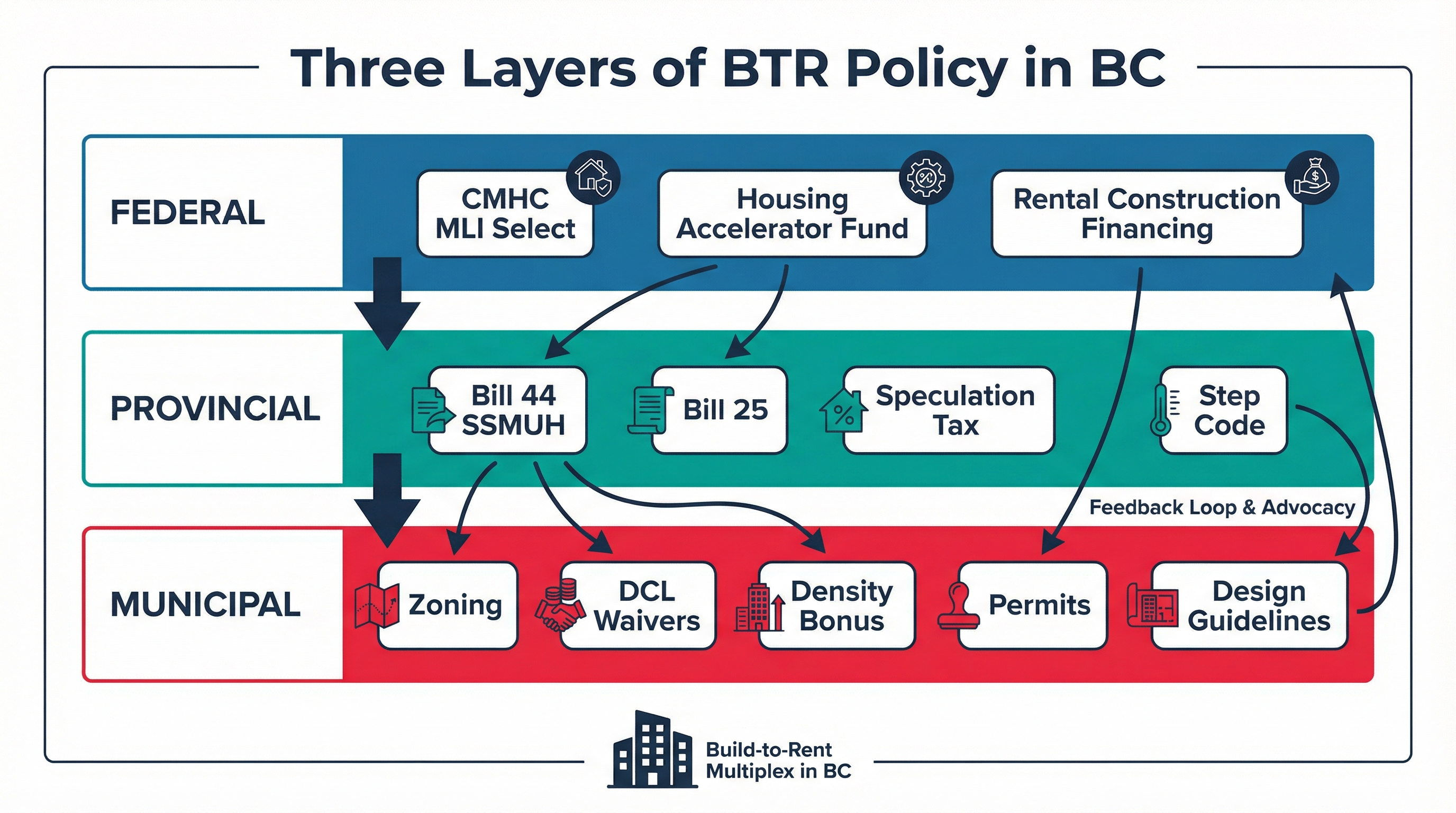
BC operates a two-layer housing system. The province sets the floor. Municipalities build on top of it — or don't.
Bill 44 (2023) is the floor. It tells every municipality over 5,000 people: you must allow multiplex on former single-family and duplex lots. Three to four units on standard lots. Six units on larger lots near frequent transit. The province enforced a June 2024 deadline for bylaw compliance. Bill 25 (November 2025) patched the loopholes. Final compliance deadline: June 30, 2026.
The layer above is municipal. Cities decide design guidelines, parking requirements, servicing standards, permit review timelines, and — critically — whether rental gets any special treatment. A city that zones for 6 units but requires 18 months of design review and $80,000 in off-site servicing has technically complied with Bill 44. It has not made multiplex practical.
The gap between "legally allowed" and "locally supported" is where your deal gets complicated. Zoning approval is step one. Navigating municipal process is the real work.
Province Controls
- ▸Minimum unit density on residential lots (Bill 44)
- ▸Override of single-family-only zoning
- ▸Housing Needs Reports (mandatory since Jan 2025)
- ▸BC Building Code (energy, accessibility, sound)
- ▸Rent increase cap (2.3% for 2026)
Municipality Controls
- ▸Design guidelines (form, massing, materials)
- ▸Parking minimums (varies widely by city)
- ▸Development Cost Levies and Community Amenity Contributions
- ▸Building permit review timelines
- ▸Rental tenure incentives (or lack thereof)
Bill 44 and Rental Tenure
Bill 44 enables multiplex by right. It does not require cities to incentivize rental. This is the most misunderstood distinction in BC housing policy right now.
What Bill 44 Does
Overrides municipal zoning to allow 3-6 units on former single-family and duplex lots. Municipalities over 5,000 people must comply. Lots under 280 sq m get 3 units minimum. Standard lots get 4 units. Larger lots near frequent transit get 6 units. No public hearing required for conforming applications. No rezoning needed. The province removed the municipal veto on housing form.
What Bill 44 Does Not Do
Does not distinguish between rental and strata. Does not require municipalities to offer density bonuses for rental. Does not waive development cost levies for purpose-built rental. Does not fast-track rental permit applications. Does not restrict strata conversion. A developer building 4 strata townhomes and a developer building 4 rental apartments receive identical treatment under Bill 44. The province leveled the zoning playing field but did not tilt it toward rental.
The Rental Tenure Gap
Rental tenure incentives — extra density, fee waivers, expedited permits — are a separate municipal decision. The province has not mandated them. As of March 2026, Vancouver is the only Metro Vancouver municipality with a structured rental incentive program for multiplex-scale buildings. Every other city treats rental and strata identically under their SSMUH bylaws. If you are building rental outside Vancouver, your proforma must stand on economics alone. Do not assume incentives are coming.
Bill 44 Passed
Nov 2023
Royal Assent, immediate effect
Bill 25 Amendment
Nov 2025
Closed implementation loopholes
Final Compliance
Jun 2026
All municipalities must comply
Where Rental Gets Special Treatment
Vancouver. That is the short answer. The City of Vancouver created a rental-specific path within its R1-1 Residential Inclusive Zone that no other BC municipality has matched. Here is what it includes.
Vancouver R1-1 Secured Rental Path
Up to 8 Rental Units
Standard R1-1 allows up to 6 units. Secured rental — where all units are non-stratified and registered as rental tenure — unlocks 7 or 8 units on qualifying lots. One unit may be owner-occupied. This is 2 extra revenue-generating units on the same land, available only to rental.
DCL Waiver (Partial)
Secured rental projects in R1-1 qualify for a partial Development Cost Levy waiver. DCLs in Vancouver run $20,000-$40,000+ per unit depending on area. Even a partial waiver on 8 units saves $40,000-$100,000+ on a typical project. Strata projects pay full DCLs.
Density Bonus Exemption
Secured market rental housing in R1-1 is exempt from density bonus contributions. Strata projects accessing bonus density must pay cash or in-kind contributions. Rental does not. This removes a significant cost from the proforma that strata builders must absorb.
Outside Vancouver, rental incentives are thin. A few municipalities have made moves, but nothing approaches Vancouver's structured program.
| Municipality | Max Units (Standard) | Max Units (Rental) | DCL / Fee Relief | Rental Incentive |
|---|---|---|---|---|
| Vancouver | 6 | 8 | Partial DCL waiver | Strong |
| Burnaby | 6 | 6 | None | None |
| Surrey | 6 | 6 | None | None |
| Richmond | 6 | 6 | None | None |
| Coquitlam | 6 | 6 | None | None |
| New Westminster | 6 | 6 | None | None |
| North Vancouver (District) | 4-6 | 4-6 | None | Requested extension to 2030 |
Data reflects municipal bylaws as of March 2026. "Max Units (Rental)" shows whether the city offers additional density specifically for secured rental tenure. Check your specific municipality's SSMUH bylaws — implementation details vary by lot size and transit proximity.
Where Rental Gets No Edge
Most of BC. Bill 44 enables multiplex but does not favor rental over strata. In the majority of Metro Vancouver municipalities — and across every smaller city in the province — rental and strata receive identical treatment under SSMUH bylaws.
This means your rental proforma in Surrey, Burnaby, Richmond, or Coquitlam must stand on economics alone. No extra units. No fee waivers. No fast-track permits. Same DCLs as strata. Same parking requirements. Same design review timeline.
The case for rental in these cities comes down to three things: long-term hold economics (cash flow over 20+ years beats a one-time strata sale in appreciating markets), CMHC financing advantages (MLI Select offers better terms for rental than any conventional strata construction loan), and demand certainty (Metro Vancouver vacancy sits below 1.5% — your units will rent).
Do not wait for municipal incentives. Over 400 multiplex permit applications were submitted across Metro Vancouver by late 2025. The builders who move first capture the rent premiums. The builders who wait for policy improvements compete with everyone who waited alongside them.
Metro Van Vacancy
<1.5%
Demand supports rental without incentives
Multiplex Applications
400+
Submitted across Metro Vancouver by late 2025
Cities with Rental Incentives
1
Vancouver only, as of March 2026
What's Coming
Policy prediction is unreliable. Here is what has been announced, what has been signaled, and where the uncertainty sits. Plan your project around what exists today.
Confirmed
- ✓June 30, 2026 — Final SSMUH compliance deadline for all affected municipalities. Bill 25 closed the remaining loopholes. Every city over 5,000 people must have conforming bylaws.
- ✓CMHC MLI Select — Risk-based pricing model in effect since July 2025. Premium discounts for affordability, energy efficiency, and accessibility commitments. Active and accepting applications.
- ✓Apartment Construction Loan Program — $15 billion in new loan funding starting 2025-26. BC Builds collaboration agreement signed January 2025. Covers 5+ unit rental construction.
- ✓Energy efficiency updates — CMHC updated MLI Select qualifying criteria in November 2025. Transition period runs until September 30, 2026 for projects qualifying under prior standards.
Signaled but Not Confirmed
- ●The province has signaled continued oversight of municipal SSMUH compliance. Enforcement mechanisms for non-compliant municipalities after June 2026 have not been detailed.
- ●Additional Housing Accelerator Fund rounds are possible but depend on federal budget decisions. BC municipalities that received Round 1 funding (Vancouver, Surrey, Coquitlam, Richmond, Victoria) submitted first annual progress reports in early 2025. Round 2 results expected May 2026.
- ●Some municipalities are developing rental-specific zoning overlays or incentive programs. None outside Vancouver have adopted formal rental tenure incentives for SSMUH-scale buildings.
Uncertain
- ●Whether the province will mandate rental-specific incentives at the municipal level. No indication of this as of March 2026. The province forced zoning changes but has not extended that mandate to rental tenure policy.
- ●Federal program continuity beyond current funding commitments. CMHC programs depend on federal budget cycles and political priorities. Build your proforma to work without federal subsidies.
- ●The District of North Vancouver has asked the province to extend its SSMUH compliance deadline to December 2030 for 319 properties along the Marine Drive corridor, citing planned Bus Rapid Transit. The province has not responded.
The Federal Layer
Ottawa does not zone land or issue building permits. But CMHC controls three programs that directly affect your financing cost, insurance premium, and — in some municipalities — your permit timeline.
CMHC MLI Select
Mortgage loan insurance for multi-unit residential (5+ units). You earn points by committing to affordability (rents below median market), energy efficiency (above code), and accessibility features. More points mean larger premium discounts. Since July 2025, CMHC uses risk-based pricing — lower leverage projects get lower base premiums. Construction loans carry a ~0.60% surcharge.
For a 6-8 unit multiplex, MLI Select is the most accessible federal program. It does not require affordable housing commitments — market rental qualifies. Energy efficiency points are the easiest to earn if your building already targets BC Energy Step Code 3 or higher. Full MLI Select guide →
Apartment Construction Loan Program (formerly RCFI)
Low-cost construction financing for purpose-built rental housing. Typically requires 5+ units. The program received $15 billion in new funding starting 2025-26. In January 2025, BC and CMHC signed the ACLP-BC Builds Collaboration Agreement, streamlining access for BC projects.
This program targets larger rental projects but a 6-8 unit multiplex can qualify. The application process is more involved than MLI Select. You need a detailed proforma, confirmed site control, and typically a development permit in hand. If your project is at the 5-unit minimum, MLI Select alone may be simpler.
Housing Accelerator Fund
Federal money paid to municipalities that commit to speeding up housing approvals. This does not fund your project directly. It funds the city to process your permit faster, reduce fees, or remove barriers. The benefit to you is indirect but real.
BC municipalities that received HAF funding include Vancouver, Surrey, Coquitlam, Richmond, Victoria, West Kelowna, and Maple Ridge ($16.6M for 480 homes in 3 years). If your city received HAF money, ask the planning department what specific process improvements were funded. Some cities used HAF to hire additional permit reviewers — directly reducing your wait time.
The coordination problem: CMHC programs require energy efficiency commitments that reference the National Building Code. Your building must also comply with the BC Building Code and local energy step code requirements. These are not identical standards. Your energy consultant must model compliance across all three simultaneously. Budget $5,000-$10,000 for energy modeling on a 6-8 unit project and start the process before you finalize your construction drawings.
Best For
- ✓ Builders in Vancouver who leverage the R1-1 secured rental path — 8 units, DCL waivers, density bonus exemption — to create a proforma advantage that strata cannot match.
- ✓ Projects in any BC municipality that use CMHC MLI Select to reduce financing costs on 5+ unit rental buildings without depending on municipal incentives.
- ✓ Investors who build their proforma around confirmed policy (Bill 44 zoning, CMHC programs) rather than speculative future incentives.
Usually Fails When
- ✕ The proforma depends on municipal rental incentives that do not exist outside Vancouver.
- ✕ The builder assumes Bill 44 compliance means the city will process permits quickly — zoning approval and permit processing are separate bottlenecks.
- ✕ Federal program eligibility is assumed without confirming current criteria — CMHC updated MLI Select pricing in July 2025 and energy efficiency requirements in November 2025.
- ✕ The project timeline depends on a specific policy change that has been "signaled" but not confirmed.
What To Verify Before Spending Money
- → Confirm your municipality has adopted SSMUH-compliant bylaws. If not, check their compliance timeline against the June 2026 deadline.
- → Contact your municipal planning department directly to confirm permit review timelines, DCL rates, and any rental-specific policies. Do not rely on third-party summaries.
- → Run your CMHC MLI Select eligibility through a licensed mortgage broker who specializes in multi-unit. The July 2025 pricing changes affect your premium calculation.
- → Get your energy consultant to confirm simultaneous compliance with BC Energy Step Code, CMHC MLI Select energy criteria, and any local energy requirements before finalizing construction drawings.
Frequently Asked Questions
Does Bill 44 require municipalities to allow rental multiplex specifically?
Can a municipality block my multiplex project even after Bill 44?
What is the difference between Bill 44 and Bill 25?
Does CMHC MLI Select work for a 6-unit multiplex?
What federal programs apply to small-scale rental construction in BC?
Will the province force municipalities to add rental incentives?
Related Reading
How Bill 44 and Rental Tenure Rules Interact in BC
The interaction between provincial SSMUH mandates and municipal rental tenure requirements, including Bill 25 enforcement.
How to Underwrite a Build-to-Rent Multiplex Step by Step
Eight-step underwriting process with real Q1 2026 Vancouver numbers, from land basis through DSCR sensitivity testing.
Official Sources Referenced
Screen Your Lot for Build-to-Rent
Enter any BC address to compare rental hold potential, unit count, and the for-sale alternative before you spend money on drawings.