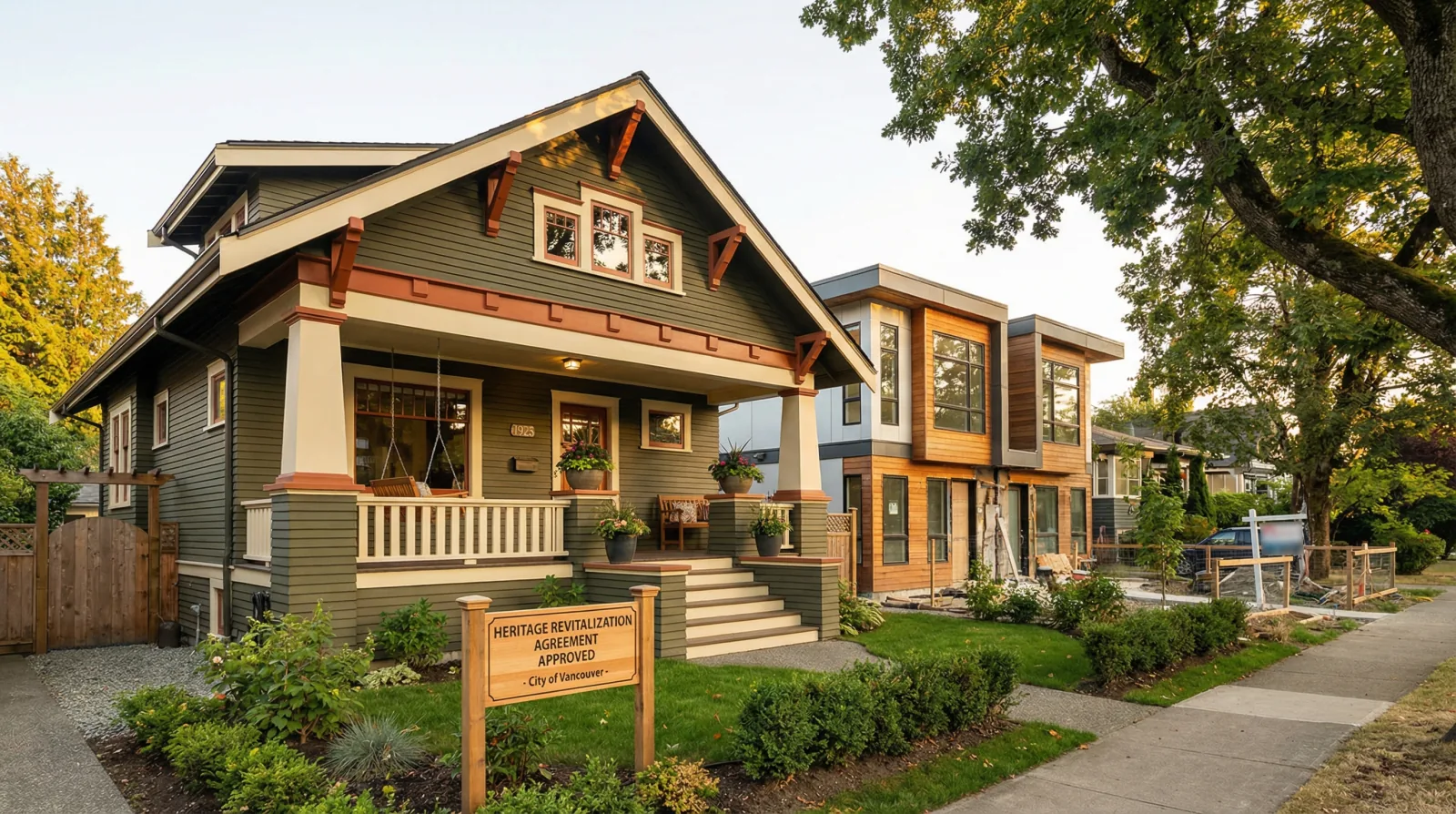

Vancouver has a density tool that most homeowners have never heard of. It is called a Heritage Revitalization Agreement, and it has quietly delivered more than 200 completed projects across the city. No rezoning application. No public hearing. Just a negotiated deal between the homeowner and the city that trades heritage protection for bonus density.
If you own a registered heritage property on a standard residential lot, an HRA may be the single most valuable entitlement available to you.
What Is a Heritage Revitalization Agreement?
An HRA is a legal agreement between a property owner and the City of Vancouver under Section 610 of the Local Government Act. The owner agrees to protect and restore a heritage building. In exchange, the city grants zoning relaxations that would not otherwise be permitted — additional floor space ratio, extra units, reduced setbacks, or a combination of all three.
This is not a grant. It is not a subsidy. It is a negotiated exchange of value. The city gets permanent heritage protection. The owner gets density that standard zoning does not allow.
The agreement is registered on title and binds all future owners. The heritage covenant is permanent. The density bonus is also permanent.
The Numbers: 200+ Completed HRAs
Vancouver has approved more than 200 Heritage Revitalization Agreements since the program’s inception. The typical HRA grants a bonus FSR of 0.20 to 0.25 above the base zoning — on a standard 33-by-122-foot lot, that translates to roughly 800 to 1,000 additional square feet of buildable area.
At current construction values, that bonus floor area is worth $150,000 to $400,000 depending on the lot size, location, and what the additional density enables. In high-value neighbourhoods like Kitsilano or Shaughnessy, the bonus can exceed $400,000 when it enables a full additional dwelling unit.
The bonus is not automatic. It must be negotiated with the city’s heritage planning team. But the track record shows that the city is willing to grant meaningful density when the heritage protection is genuine and the restoration work is substantive.
The Tax Exemption Most Owners Miss
Beyond the density bonus, heritage property owners can apply for a Heritage Conservation Agreement that delivers a 40 to 50 percent property tax exemption on the heritage-designated portion of the property. On a property with an annual tax bill of $8,000 to $12,000, that exemption saves $3,200 to $6,000 per year — compounding indefinitely as long as the conservation agreement remains in place.
Combined with the density bonus, the total financial benefit of an HRA can reach $500,000 or more over a 10-year hold period. That is a material number, and it is available to any owner of a qualifying heritage property who is willing to commit to the protection covenant.
The Trade-Off: Permanent Heritage Covenant
Nothing about an HRA is free. The heritage covenant registered on title permanently restricts what you can do with the heritage building. You cannot demolish it. You cannot significantly alter its character-defining elements — the original windows, the roofline, the cladding, the massing.
Future buyers inherit these restrictions. Some view this as a limitation. Others view it as a feature — heritage-protected properties in desirable neighbourhoods tend to hold value precisely because the neighbourhood character is preserved.
The practical impact: your restoration must follow heritage standards, which typically cost 15 to 25 percent more than standard renovation work. Heritage-grade windows, period-appropriate materials, and heritage consultant fees add up. But the density bonus is specifically designed to offset these costs.
Who Should Pursue an HRA?
Not every old house qualifies. The property must be on the Vancouver Heritage Register or be eligible for addition to it. The strongest candidates are pre-1940 homes with intact original character in neighbourhoods with deep heritage inventories.
Prime HRA neighbourhoods:
- Kitsilano — Dense concentration of Craftsman and Arts and Crafts homes from 1905 to 1930
- Strathcona — Vancouver’s oldest residential neighbourhood with Victorian and Edwardian homes
- Shaughnessy — Large lots with substantial heritage homes where the density bonus enables significant infill
- Grandview-Woodland — Edwardian homes on standard lots with strong community support for heritage retention
If your property is in one of these areas and the home retains its original character, you are sitting on an HRA opportunity. The first step is a heritage assessment — typically $3,000 to $5,000 — to determine whether the property qualifies and what level of density bonus the city is likely to approve.
HRA vs. Standard Multiplex Development
Under Bill 44, you can already build a multiplex on most residential lots without an HRA. So why bother with the heritage route?
Three reasons. First, the HRA density bonus stacks on top of base zoning — you get more total floor area than a standard multiplex. Second, the property tax exemption is an ongoing annual benefit that no standard development provides. Third, HRA projects typically face less neighbourhood opposition because the heritage home is being preserved rather than demolished.
The downside is complexity. An HRA takes 6 to 12 months to negotiate with the city, requires a heritage consultant, and demands higher construction quality for the restoration component. If your goal is speed, a standard multiplex is faster. If your goal is maximum long-term value, the HRA often wins.
Getting Started
The HRA process begins with three steps: confirm your property’s heritage status, commission a heritage assessment, and engage a heritage consultant who has successfully negotiated HRAs with the City of Vancouver. The consultant’s experience matters — the density bonus is negotiated, not formulaic, and experienced consultants consistently secure better outcomes.
For a deeper dive into the HRA process and how it applies to specific Vancouver neighbourhoods, see our Heritage Revitalization Agreement Guide. For neighbourhood-specific heritage data, explore the Vancouver Heritage Multiplex Overview.
The 200+ homeowners who have already completed HRAs understood something that the broader market is only now recognizing: heritage protection is not a constraint on value. It is a mechanism for unlocking density that standard zoning does not provide.