
August 2023 reset what “buildable” means in Kelowna.
The McDougall Creek wildfire crossed Okanagan Lake on August 17, 2023. It burned 189 structures in West Kelowna, forced the evacuation of 35,000 residents, and ended the assumption that Kelowna’s multiplex builders could treat wildfire as a seasonal risk rather than a design input.
Builders who speccing envelopes in 2022 the way Vancouver builders spec envelopes — cedar lap siding, wood-shake roofing, combustible fences, conifer ornamental planting — are now in active rework. The city’s FireSmart program is the regulatory framework; insurance conditionality is the enforcement mechanism; the post-2023 Kelowna multiplex envelope is the outcome.
This is what’s actually changed and what your design has to address.
Priority Zone 1 is where the rules bite
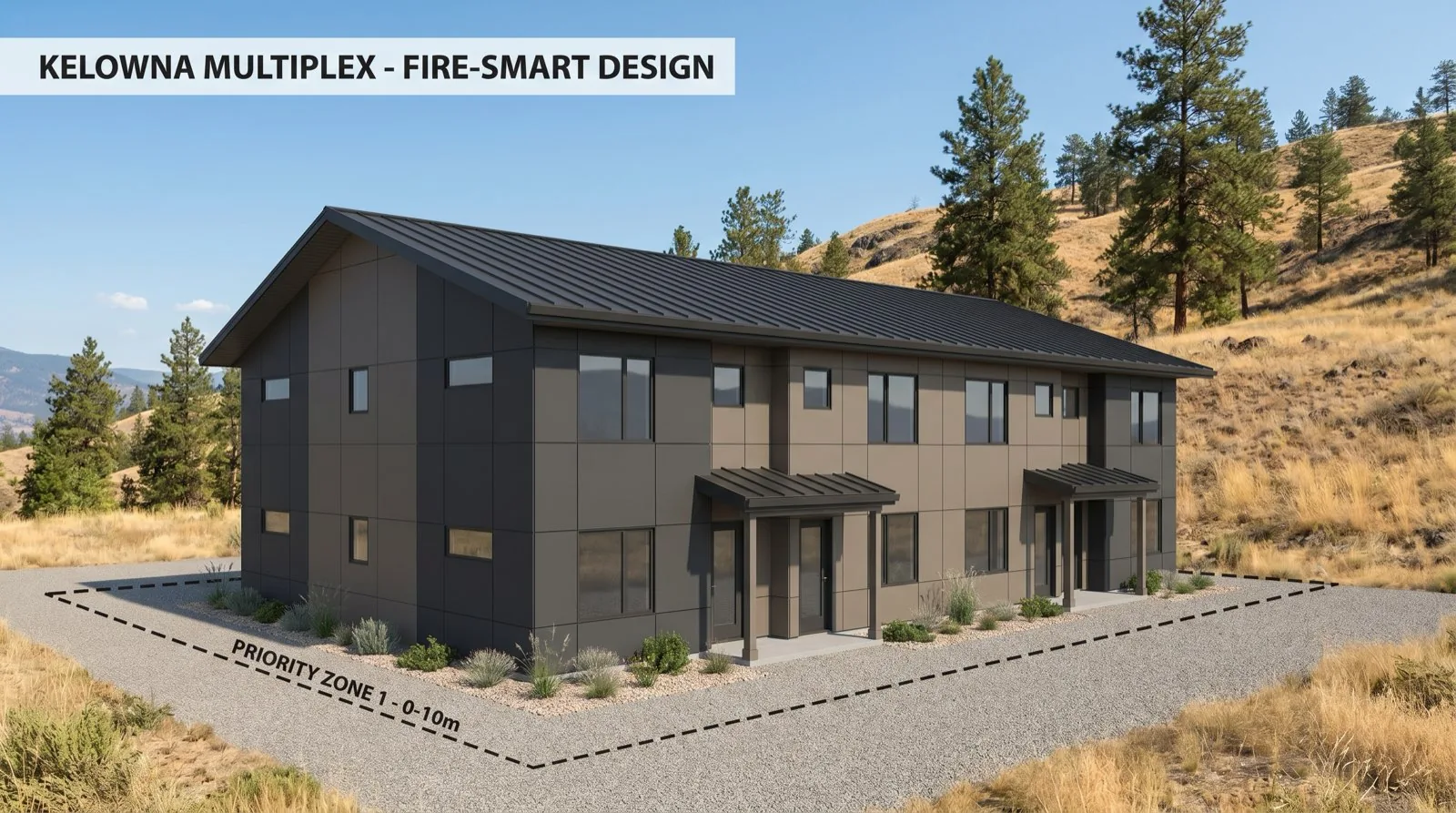
FireSmart defines three priority zones around any structure. The one that governs mandatory design choices is Priority Zone 1 — the 0 to 10 metre ring around the building footprint.
Within Priority Zone 1:
- No coniferous trees or shrubs — cedars, junipers, pines, firs, ornamental spruces
- No combustible mulch — bark mulch, wood chips
- No wood-pile storage against exterior walls or under decks
- No combustible fencing attached to the structure
- Non-combustible ground cover preferred — gravel, stone, fire-resistant grasses
- Irrigated deciduous vegetation only for ornamental planting
The 10 m rule doesn’t stop at the rear property line. If your neighbour’s cedar hedge sits within 10 m of your exterior wall, it counts. That’s where multiplex builders in tight-lot neighbourhoods run into real coordination problems — FireSmart compliance sometimes requires cross-property conversations your lawyer has to document.
The envelope requirements that govern the build
Priority Zone 1 handles the site. The envelope handles the structure itself. The City’s FireSmart guidance and BC Building Code combine to shape what cladding, roofing, soffits, and deck systems actually work.
Cladding
Acceptable:
- Fibre cement lap or panel (Hardie, Allura, similar)
- Stucco on masonry or cement board substrate
- Metal cladding — standing-seam, corrugated, or flat panel
- Stone and brick veneer
Not acceptable for wildfire-interface multiplex work:
- Cedar lap siding
- Wood shake cladding
- T1-11 or other combustible panel
- Untreated wood trim at ground level
Cedar-look alternatives — composite boards, printed fibre cement, metal that mimics wood — handle the aesthetic expectation without triggering envelope failure.
Roofing
Class A roofing is the baseline. That means:
- Asphalt shingle (Class A rated)
- Metal roofing — standing-seam or corrugated
- Concrete tile
- Slate
Not acceptable: cedar shake, cedar shingle, or any wood roofing. The 2023 fire season consumed several Okanagan homes via roof-ember ignition specifically because of wood shake. Insurers know this.
Soffits and venting
- Non-combustible soffit material — aluminum, steel, fibre cement
- 1/8-inch ember-resistant vent screening on every attic, crawlspace, and dryer vent
The 1/8-inch screen spec is specific. Standard 1/4-inch vent screening passes embers. 1/16-inch screens clog with lint and dust and become maintenance disasters. 1/8-inch is the compliant middle.
Gutters
- Metal gutters (not vinyl)
- Gutter guards to prevent debris accumulation
Vinyl gutters deform under ember exposure and drop flaming debris against the cladding. The cost delta to metal is trivial on a 4-plex or 6-plex.
Decks and balconies
- Non-combustible deck boards — composite, aluminum, or concrete pavers
- Closed deck undersides — no open wood framing exposed underneath
- No combustible storage beneath
Open-underside decks are ember traps. Closing in the underside with fibre cement or metal panel is cheap insurance.
The climate envelope compounds
Wildfire isn’t the only envelope input in Kelowna. The City’s Energy Step Code page lays out two more constraints that every multiplex build has to solve alongside FireSmart.
HDD 3,715
Kelowna’s Heating Degree Day total is 3,715 — meaningfully higher than Vancouver’s heating load. Step Code compliance at higher HDD means:
- Tighter envelope air-sealing
- Higher R-values in wall and roof assemblies
- Better window specifications (double- or triple-pane, low-U)
- HRV or ERV ventilation systems
The wall-assembly choices that satisfy FireSmart cladding requirements (fibre cement, metal) also happen to pair well with continuous exterior insulation — which is how most Step Code-compliant Kelowna builds achieve their thermal performance.
The 26°C overheating rule
Kelowna’s overheating rule requires that at least one living space in each dwelling unit stay at or below 26°C during peak summer conditions. In practice, that rules out passive-cooling-only designs for most Kelowna multiplex builds.
Active cooling — heat pumps, ductless mini-splits, or central A/C — is the typical compliance path. Heat pumps are usually the best answer because they satisfy both the Step Code heating load and the overheating cooling requirement with one mechanical system.
Key takeaway: FireSmart dictates what goes on the outside of the wall. Step Code dictates what goes inside the wall. Overheating rules dictate what goes in the mechanical room. All three have to resolve on the same drawing set.
The neighbourhoods most exposed
Not every Kelowna multiplex lot carries the same wildfire interface risk. The parcels with the most exposure — and the most stringent FireSmart scrutiny — sit in the wildland-urban interface zones on the city’s margins:
- Glenmore — upper slopes backing onto undeveloped grassland and forest
- Clifton — hillside interface at the north end of Glenmore
- Wilden — planned hillside community with direct forest adjacency
- Upper Mission — hillside slopes above Okanagan Lake
- Crawford Estates — upper Mission interface, steep lot grades
- McKinley — north-end hillside, direct interface
- Lakestone — West Kelowna hillside community, Route 97 accessible
Interface lots don’t just trigger FireSmart Priority Zone rules — they often add driveway grade requirements, secondary egress considerations, and setback buffers that further shape the buildable envelope.
What does this mean for Core Area lots?
Lots in Kelowna South, Pandosy, Capri-Landmark, and Rutland face lower direct wildfire interface risk but still have to meet Priority Zone 1 rules on their own property. The envelope requirements (cladding, roofing, soffits) apply citywide, not just in interface zones.
The operational difference: interface lots get more scrutiny on site plan review. Core Area lots get the same envelope requirements but less friction at Planning review.
Insurance: the enforcement mechanism
Municipal bylaws set the floor. Insurance sets the ceiling.
Kelowna-area insurers have tightened underwriting materially since August 2023. For new multiplex builds in interface zones, expect:
- Quote conditions requiring FireSmart home-assessment documentation
- Roof-age and roof-material attestation
- Vegetation-management attestation on Priority Zone 1
- Premium loadings on cedar-adjacent properties, even compliant ones
- Non-renewal risk for buildings that let FireSmart compliance drift over time
Builders who design the envelope correctly from day one avoid the insurance retrofit problem. Builders who spec cedar cladding and then try to place insurance post-completion find out how much the market has moved.
A note on the mechanical stack
The 26°C overheating rule plus the HDD 3,715 heating load together push most Kelowna multiplex builds toward variable-refrigerant-flow (VRF) or ducted heat-pump systems. A cold-climate air-source heat pump (ASHP) sized for Kelowna’s design low delivers heat efficiently through most of the winter and handles the overheating cooling requirement in summer with the same unit.
Electrification also helps on the envelope math. A gas furnace plus central A/C requires two separate mechanical systems, two flue/vent penetrations, and a gas service connection. A heat-pump system collapses that to one piece of equipment, one ducting run, and an electrical-only service. Fewer penetrations in a FireSmart envelope means fewer ember-entry points. The wildfire and energy codes land in the same place: simpler, tighter, electric.
Heat recovery ventilators (HRVs) or energy recovery ventilators (ERVs) are standard on Step Code builds. They pair with high-efficiency heat pumps without conflict. Mechanical cooling for the overheating rule is then built into the same system rather than bolted on as a second stage.
Combining FireSmart with Step Code on the same wall
One of the efficiencies available to Kelowna multiplex builders is that FireSmart-compliant envelopes and Step Code-compliant envelopes overlap more than they compete.
- Fibre cement cladding satisfies FireSmart AND is commonly paired with continuous exterior insulation for Step Code compliance
- Metal roofing satisfies FireSmart AND handles the roof-assembly R-value requirements when paired with interior attic insulation
- Non-combustible soffits satisfy FireSmart AND enable the airtight ceiling assemblies Step Code wants
- Closed-underside decks satisfy FireSmart AND reduce thermal bridging at the deck-to-wall connection
The builds that fail both codes simultaneously are the ones that try to save money by speccing combustible materials. The builds that satisfy both codes simultaneously are the ones that spec for performance from concept.
Flood overlay — worth naming
Separate from wildfire but equally binding for certain Kelowna lots: Mill Creek Flood Plain Bylaw 10248 governs minimum finished floor elevations and basement construction restrictions on lots in the Mill Creek floodplain. If your lot sits near the creek, the flood overlay stacks on top of wildfire and Step Code in your design review.
The position
Kelowna multiplex builders who treat FireSmart as optional, aesthetic-preserving, or “handleable later in landscaping” will run into envelope review failures, insurance placement problems, or — worst case — post-delivery loss events.
The builders who design to FireSmart, Step Code, and overheating simultaneously from concept through envelope spec deliver buildings that:
- Pass Planning review cleanly
- Place insurance without retrofit
- Survive the next wildfire season without headline risk
- Carry rental demand through climate-conscious tenant profiles
The cost delta between a compliant envelope and a non-compliant envelope on a 6-plex is smaller than most Vancouver-trained builders assume. The rework cost on a non-compliant design is not.
Key takeaway: Cladding spec, roof material, soffit venting, deck undersides, and Priority Zone 1 vegetation are design decisions, not landscaping afterthoughts. Lock them at concept.
Related reading
- Wildfire and FireSmart for Kelowna multiplex
- Kelowna climate and Step Code
- Glenmore neighbourhood deep dive
What’s next for your Kelowna lot
The Kelowna Multiplex hub covers zoning, rental market, neighbourhood profiles, and envelope design considerations for every Kelowna submarket. If your lot sits in a wildfire interface zone — Glenmore, Upper Mission, Wilden, Clifton, McKinley, or Lakestone — run the address through the analyzer to see which FireSmart requirements stack on top of your SSMUH envelope.