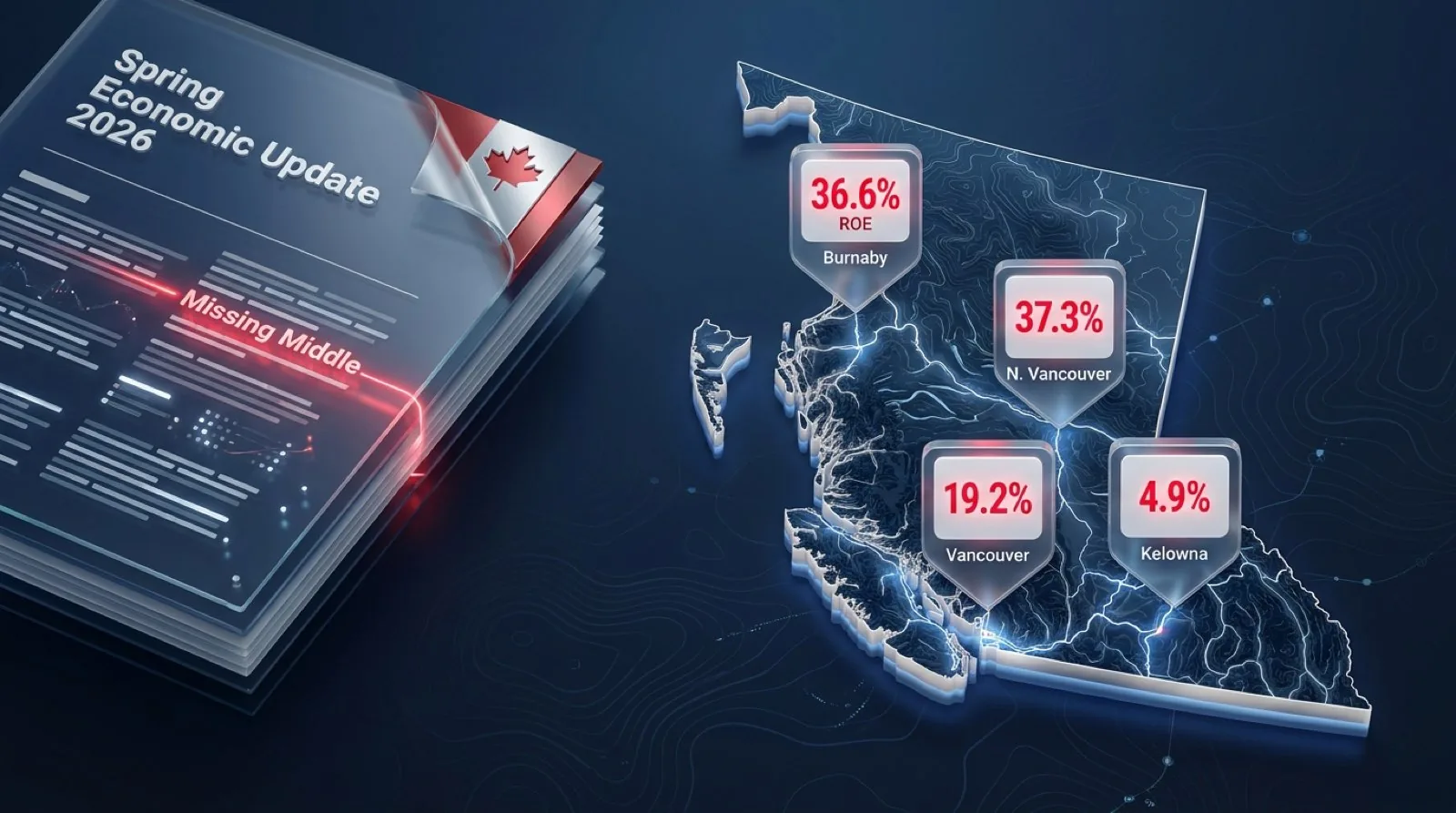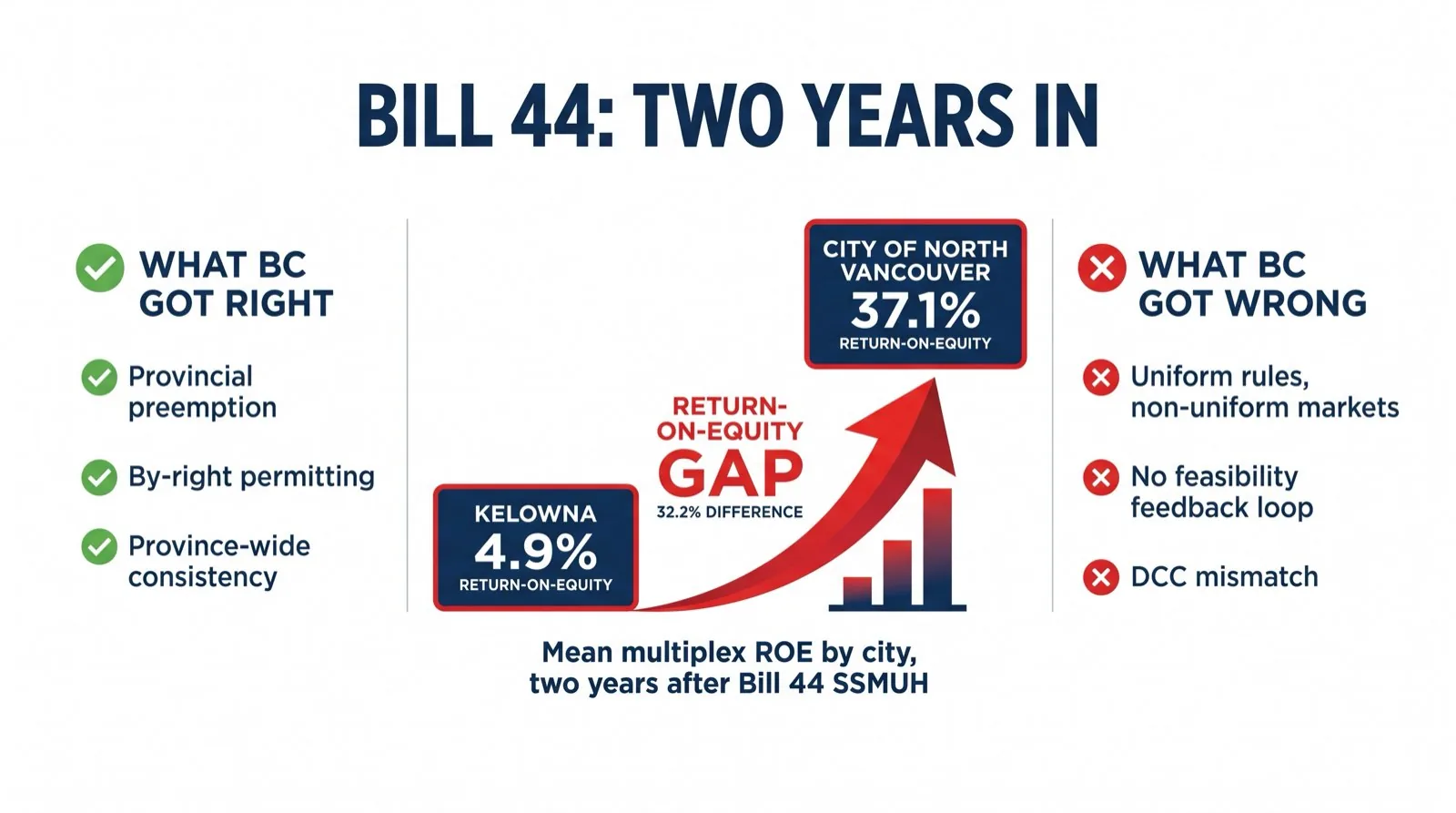

Two years after Bill 44 eliminated single-family zoning across BC, the data tells a split story. In the City of North Vancouver, mean return on equity for a new multiplex is 37.1%. In Kelowna, it’s 4.9%. Same legislation. Same zoning rights. A 32-point gap in outcomes. And now, twenty-four months in, the province and individual cities are starting to claw back the fees that made it that way.
What BC got right
Let me start with what I think the province nailed.
Before Bill 44, every missing middle debate was a local one. Each municipality ran its own hearings, absorbed its own neighbourhood opposition, and ended up either making no change or making a compromise narrow enough that nothing actually got built. For a homeowner who just wanted to add two rental doors to their paid-off home, the process was unreachable.
Bill 44 collapsed that patchwork into a single statute on November 30, 2023. The province settled the unit-count question once. Municipalities kept authority over setbacks, heights, parking, and design. They lost the ability to say no to density itself.
The practical effect for homeowners: the question moved from can I to should I, and how.
The second thing BC got right was replacing discretionary approval with by-right permitting for small projects. If your plans meet zoning, design guidelines, and building code, your permit issues. No council vote. No public hearing. No rezoning application. The process is clerical, not political.
The real cost of discretionary approval was never the fee. It was the many months of uncertainty and the tens of thousands in consultant and legal spend absorbed before you even knew if your project could proceed. That friction screened out individual homeowners entirely. It handed the opportunity to professional developers who had the capital to absorb it. By-right permitting made missing middle accessible to the family, not just the developer.
Third: province-wide consistency let capital show up at scale. A single rule set means a lender, builder, or investor evaluating your lot applies the same baseline framework anywhere in BC. That’s why, two years in, you see construction financing products, pre-designed multiplex plans, and specialist builders emerging. None of that could have existed in a patchwork environment.
What BC got wrong
Here’s the part the province still hasn’t addressed.
Across four BC cities we’ve scored at the parcel level with PlexRank™, mean return on equity on a new multiplex ranges from 4.9% in Kelowna to 37.1% in the City of North Vancouver. Same legislation. Same zoning rights. A 32-point gap in outcomes.
The driver is not the local rules. Kelowna’s FSR caps, setbacks, and parking requirements are broadly comparable to Burnaby’s. The driver is market math: what a new multiplex unit sells for per square foot, versus what it costs to build plus the value of the land.
| Market | Approx. new multiplex $/sq ft |
|---|---|
| Vancouver West | $1,290 |
| City of North Vancouver | $1,100 |
| Vancouver East | $1,050 |
| Burnaby | $950 |
| Kelowna | $570 |
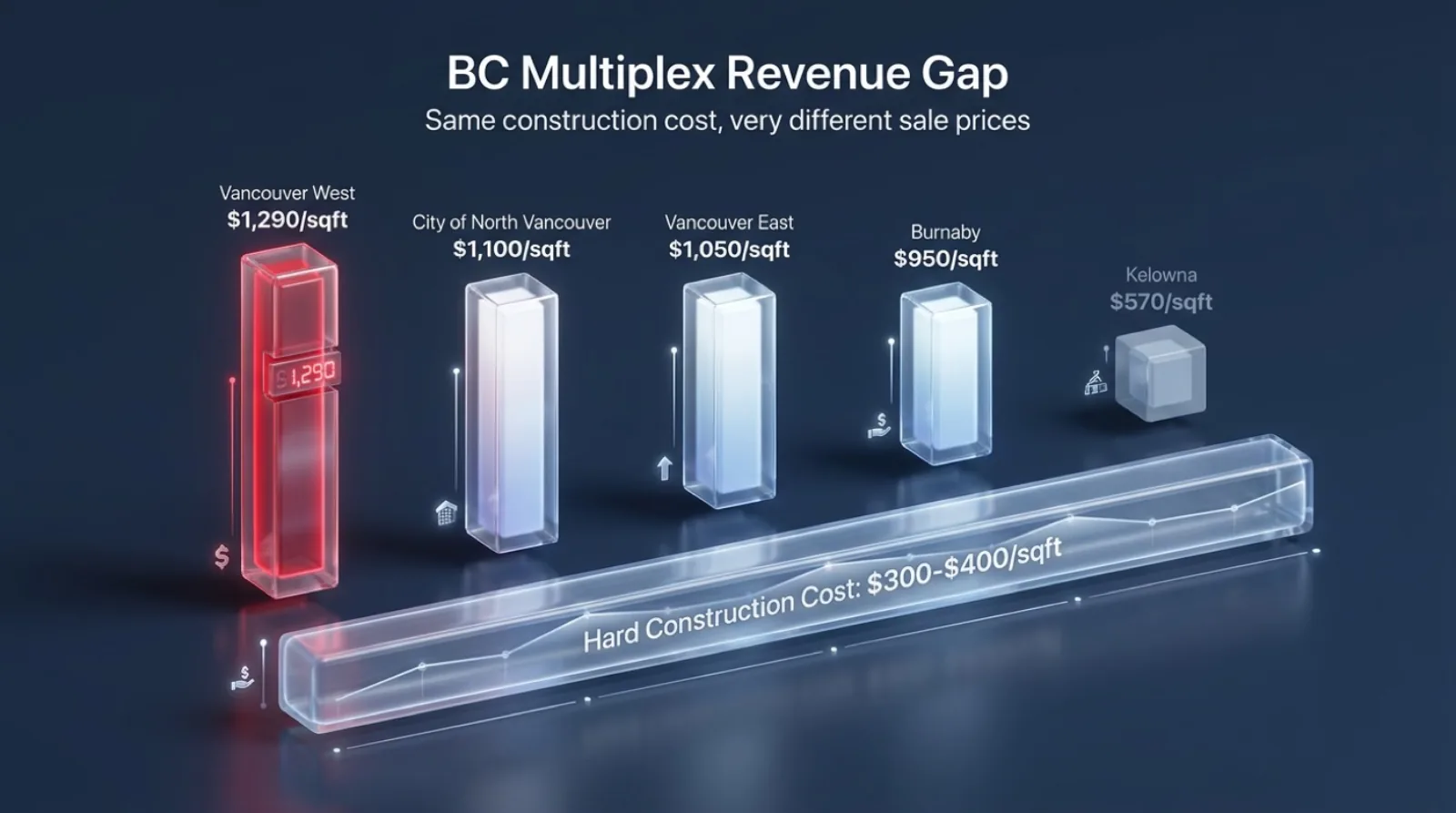
Construction cost, by contrast, varies far less. Altus Group’s 2025 Canadian Cost Guide, the standard reference in Canadian real estate, pegs Vancouver hard costs at $180 to $240 per square foot for four-storey wood-framed condo product. Small multiplexes on single residential lots run higher in practice, typically $300 to $400+ per square foot in hard costs, because per-unit systems like kitchens, bathrooms, and mechanicals don’t scale the way they do in larger buildings.
Either way, the point holds. Kelowna’s all-in development cost is only about 25 percent lower than Vancouver’s, while new multiplex unit sale prices are roughly half. A 50 percent revenue gap against a 25 percent cost gap produces exactly what the data shows. Homeowners in Kelowna adding units under the new rules often lose money. Homeowners in Burnaby often see strong returns. Bill 44 gave every homeowner the same tool. The tool doesn’t work the same way in every market.
The second thing BC got wrong was not building a feedback loop. Cities track permits issued. They track units completed. What they don’t track is the much larger universe of parcels where the zoning permits development but the economics don’t. Without that visibility, the gap between what policy promised and what the market can deliver stays invisible until construction either happens or it doesn’t.
This is the gap PlexRank™ was built to close. It’s also the lesson every other province watching BC should be taking notes on.
The clawback chapter
Twenty-four months in, both the province and individual municipalities are starting to claw back fees and friction that turned out to be bigger drags on feasibility than anyone modeled. The signals are small but they are directional.
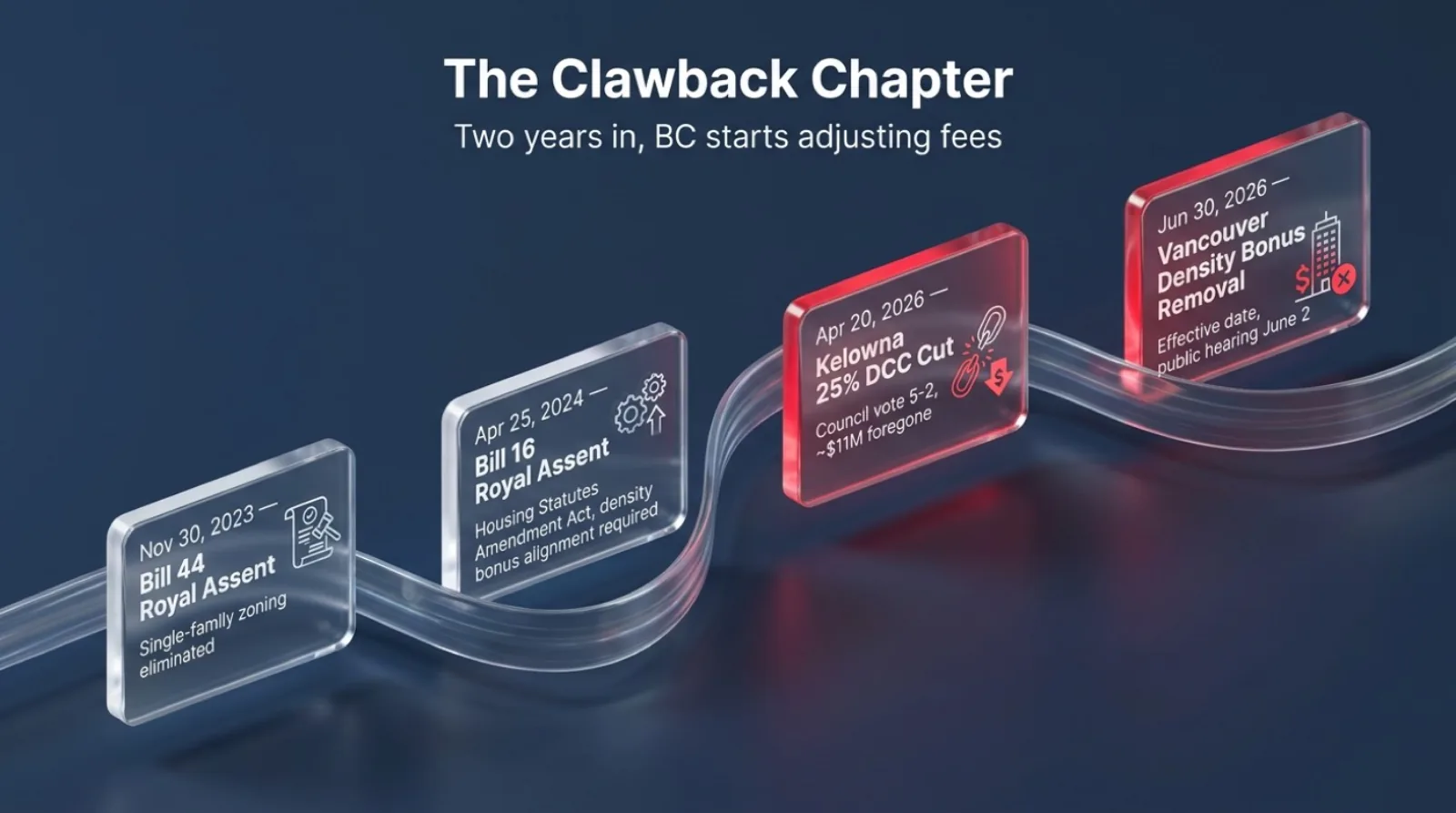
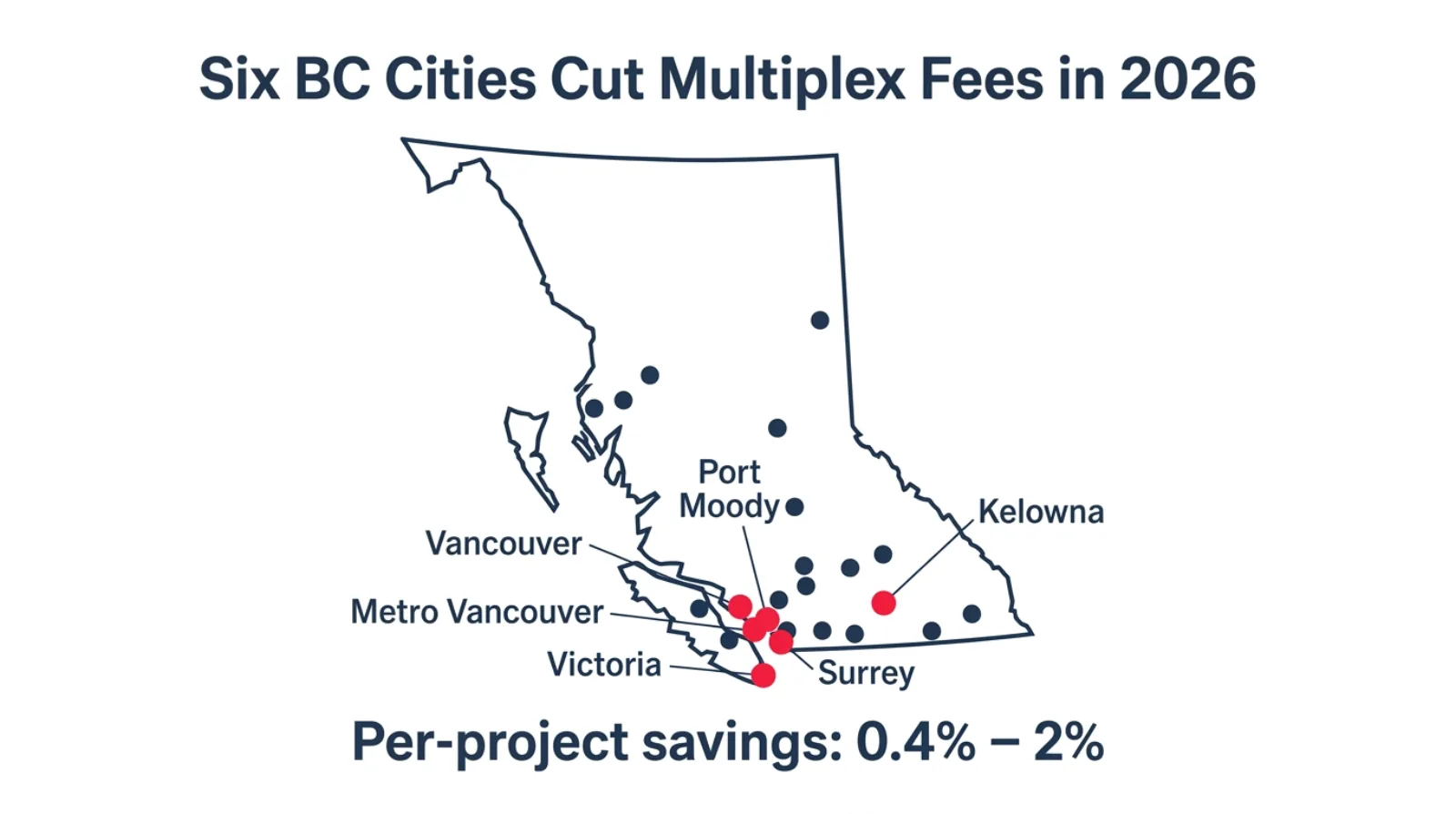
Kelowna. On April 20, 2026, Kelowna council voted 5-2 to approve a 24-month temporary 25% reduction in Development Cost Charges. Mayor Tom Dyas’s original proposal from staff was a 20% reduction for one year. Council went deeper and longer. The city estimates the move will cost roughly $11M in foregone revenue over two years. Facing parcel-level data showing most of its residential lots don’t pencil, Kelowna is trying to shift the math. That’s a real acknowledgment that the first round of rules didn’t produce what the city hoped for.
Vancouver. BC’s Bill 16, the Housing Statutes Amendment Act, received royal assent on April 25, 2024. It required municipalities to review and align their density bonusing frameworks with new provincial requirements. Vancouver got the extended deadline of June 30, 2026. This month, the City of Vancouver notified in-stream permit applicants that it plans to remove density bonusing conditions from a range of zoning districts. Council will consider the report on May 5, 2026. A public hearing is scheduled for June 2, 2026. If approved, any building permit issued on or after June 30, 2026 would no longer carry a density bonus contribution.
| Jurisdiction | Change | Effective date | Approximate magnitude |
|---|---|---|---|
| Kelowna | 25% DCC reduction, 24 months | April 20, 2026 (approved) | ~$11M foregone revenue |
| Vancouver | Remove density bonusing from many districts | June 30, 2026 (if approved June 2) | Per-lot, varies |
On a marginal multiplex project, removing that density bonus contribution can make a meaningful difference. See our earlier analysis of Vancouver’s density bonus fee stack for the per-unit math.
None of this is enough on its own. A 25% DCC cut in Kelowna doesn’t close a 50% revenue gap. Removing density bonus contributions in Vancouver helps, but it doesn’t turn a marginal lot into a signature one. Market math is still the gravitational force underneath all of this.
But directionally, it matters a great deal. Two years in, the posture is shifting from we passed the policy, now go build to let’s actually measure what happened and adjust. That is a meaningfully different stance than most Canadian housing policy has taken in a generation. Whether other municipalities follow Kelowna’s DCC move or Vancouver’s density bonus pathway is the question worth watching over the coming policy cycle.
What this means if you own a home in BC
Three things, if you’re sitting on a paid-off residential lot somewhere in BC and trying to figure out whether any of this applies to you.
First, your property is not the average. The city-level averages above hide enormous parcel-level variation. Within Burnaby, there are lots that project 100%+ ROE and lots that lose money under identical zoning. A west-facing corner with 40-foot frontage on a short block near a SkyTrain station is a different asset from a 33-foot interior lot backing onto a lane. The only thing that tells you which one you own is a parcel-level analysis, not a city-level headline. Do not decide anything based on the average. Decide based on your lot.
Second, the window is moving, not closing. The fee reductions rolling in now are part of a larger recalibration that will continue over the coming policy cycle. If your parcel sits on the marginal line today, further DCC relief, density bonus removal, and possibly envelope adjustments could change the picture for your specific property. Staying informed is worth more than rushing.
Third, the homeowners capturing the most upside are the ones who understand the full stack. Zoning, submarket pricing, construction cost, fee structure, and the specific quirks of their lot. Not any one of those things in isolation. The policy conversation has matured over the last two years. The analytical tools available to homeowners have matured alongside it.
Two years ago, the question was whether BC would do anything bold on missing middle. Today, the question is how to participate in it thoughtfully. That’s a much better place to be standing.
This piece covers the return-on-equity gap and the fee clawback. For the underlying permit counts and which cities complied first, see the one-year implementation scorecard.
Run the numbers on your specific lot
Every homeowner I talk to wants the same thing: a real answer for their specific property, not a city-level headline.
VanPlex runs PlexRank™ analysis at the parcel level across BC’s main multiplex markets. If you want to see what your home actually pencils to under current zoning, current market pricing, and current fee structure, request a free property analysis. Send us the address. We’ll send back what the numbers say. No obligation. VanPlex also co-develops with homeowners and investors where the math works.
David Babakaiff is Co-Founder of VanPlex, a Vancouver-based multiplex development company. 25+ years scaling BC construction. 2024 HAVAN Award winner for best multiplex unit in the GVRD. VanPlex’s PlexRank™ algorithm scores residential parcels across BC for multiplex conversion potential under Bill 44.