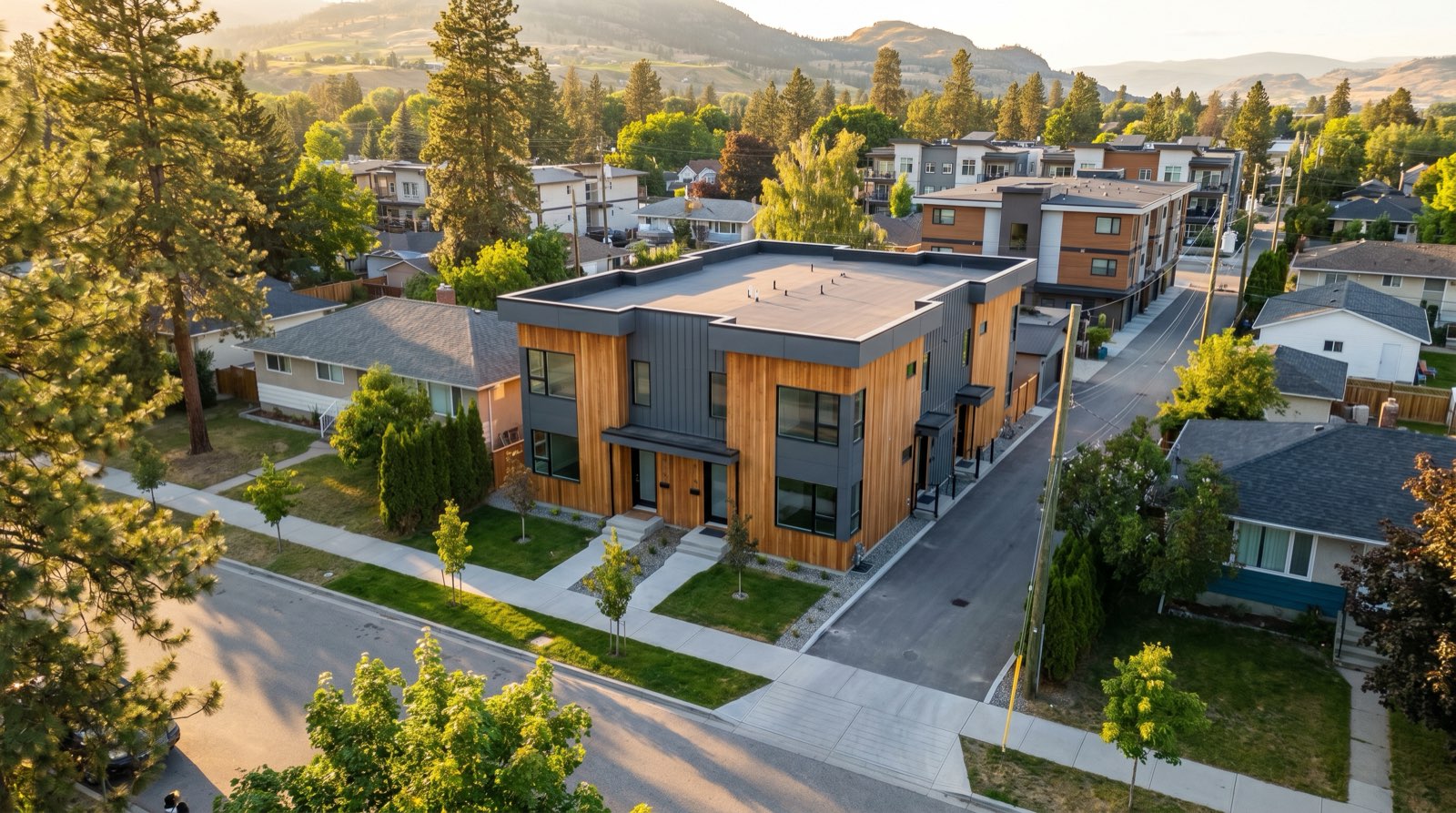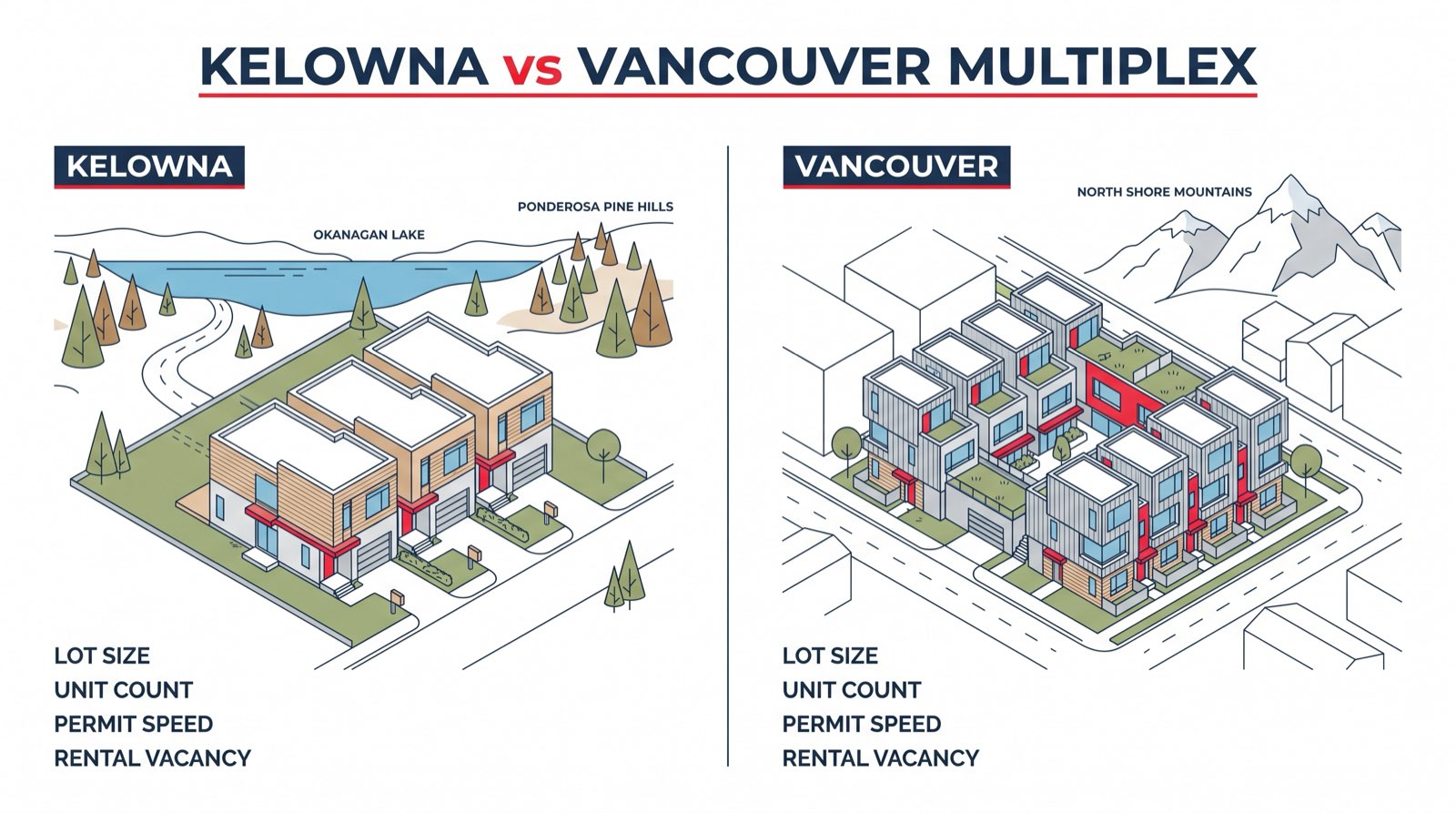

Bill 44 worked as zoning policy. The market is absorbing it slower than the planners expected.
One year on from Kelowna pre-zoning its residential map to meet BC’s Small-Scale Multi-Unit Housing floors, the report card is split. On paper, the policy is a clean win — the city beat the June 30, 2024 compliance deadline by three and a half months, every eligible lot carries a higher unit ceiling, and public hearings are off the table for conforming applications. On the ground, vacancy is up, rents are flat, and the builders who survive this cycle will be the ones who underwrote for the lag.
This is the honest read on year one.
What Kelowna actually pre-zoned on March 18, 2024
The City’s planning legislation page confirms the pre-zoning action. The entire residential map — tens of thousands of lots previously zoned RU1, RU2, RU3, RU5, MF1 — inherited the Province’s minimum unit counts in a single council action:
- 3 units on lots 280 m² or smaller
- 4 units on lots larger than 280 m²
- 6 units on lots larger than 280 m² within 400 m of a qualifying frequent-transit stop
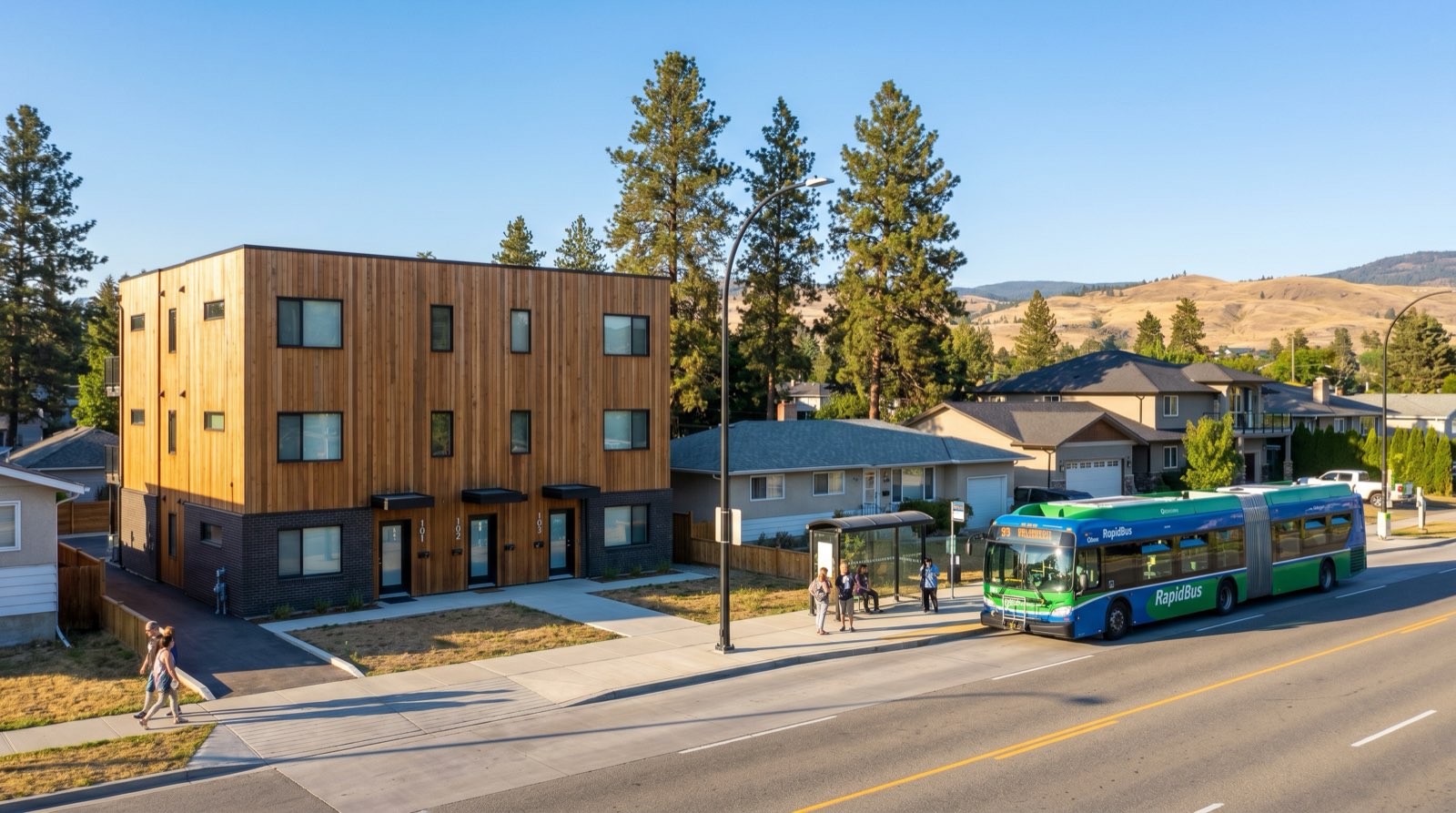
The transit-adjacent 6-unit floor matters most. Kelowna’s Route 97 Okanagan RapidBus is the primary frequent-transit corridor, running 15-30 minute headways along Harvey Avenue. Lots within a four-minute walk of Route 97 stops unlock the highest SSMUH floor and the parking exemption that comes with it.
Public hearings are gone for SSMUH-consistent applications, which was the operational change that actually compressed timelines. The Housing Statutes (Residential Development) Amendment Act made that mandatory.
What happened in year one
Two numbers tell most of the story.
The vacancy rate moved
The CMHC 2025 Rental Market Report, reflected in the Province’s housing data release, put Kelowna CMA vacancy at 6.4% — well above the 3% balanced market threshold and a sharp move from the sub-2% environment of the 2021-2023 cycle. City of Kelowna sits at 6.9%, Rutland at 7.5%, West Kelowna at 5.3%.
Rents held:
| Unit type | 2025 average rent |
|---|---|
| Studio | $1,395 |
| 1-bed | $1,596 |
| 2-bed | $2,118 |
| 3-bed | $2,895 |
Source: CMHC 2025 Kelowna Rental Market data.
Flat rents in a 6.4% vacancy environment means landlords aren’t testing pricing power. They’re absorbing supply.
The application pipeline filled
Kelowna’s 2040 OCP allocates 48% of new units to the five Urban Centres (Downtown, Pandosy, Capri-Landmark, Midtown, Rutland) and 25% to the Core Area. Those allocations concentrate where SSMUH applications are landing — which is exactly what Planning intended. Applications in peripheral single-family areas remain thin, because the economics of a 4-plex don’t always pencil on a 1,000 m² lot with no transit access and full setback and parking demands.
The Province set the city a target of 8,774 new homes over five years. Year-one permit volume suggests Kelowna can hit the zoning-capacity side of that target. Whether it hits the delivery side depends on the next two years of absorption. Kelowna has pre-zoned for density; the construction cycle has to catch up.
The density target behind the target
The 2040 OCP sets a density target of 150-250 residents plus jobs per hectare in the five Urban Centres. That’s a specific urban form — street-oriented multi-storey residential, neighbourhood retail at grade, reduced surface parking, walkable to frequent transit. SSMUH 6-plexes on Urban Centre lots directly contribute to that density floor. 4-plexes in peripheral RU zones don’t move the density needle the same way.
Planning staff know this. Year one review priority tracked the OCP allocation map: Urban Centre applications moved fastest, Core Area next, peripheral lots slowest. That’s not bias — it’s policy alignment.
Why the absorption is slower than the policy
Three forces compounded in 2025 to slow delivery faster than anyone wanted.
Interest rates reset multiplex math
The sub-3% mortgage era funded a generation of small-scale rental projects. Rates at 5%+ on construction financing and 4.5%+ on CMHC MLI Select takeouts changed the debt service math on every proforma. Builders who locked pricing at 2022 rent forecasts and 2022 rates are now delivering into a 2025 market where neither assumption held.
Construction cost didn’t come down
Material and labour costs elevated during the 2021-2023 cycle and largely stayed elevated. A 4-plex or 6-plex in Kelowna still costs what it cost 18 months ago, even though exit cap rates widened and stabilized rents didn’t.
The vacancy itself suppresses new starts
A 6.4% CMA vacancy rate tells lenders to haircut pro-forma rents, extend lease-up assumptions from 3 months to 6-9 months, and question whether the next 20 units in Pandosy will actually absorb. That feedback loop is self-correcting — vacancy this high usually crushes new starts, which tightens the market 18-24 months later — but the pause is real right now.
Key takeaway: Bill 44 created the policy capacity for 8,774 new homes. Interest rates and construction cost compression are deciding how many actually get built in the 2024-2029 window.
Where the applications are concentrating
The Urban Centres are doing their job
Pandosy and Capri-Landmark are the two Urban Centres absorbing the most infill volume. Both sit on the Route 97 corridor, both have mature neighbourhood retail, and both have the lot sizes (550-750 m²) where SSMUH 4-plex and 6-plex math works.
Downtown is pulling the larger site-consolidation plays — MF3, MF4, and rezoned high-rise — rather than SSMUH single-lot builds. That’s consistent with the OCP intent: SSMUH fills Core Area lots, Downtown takes vertical.
Rutland is the outlier
Rutland carries the CMA’s highest vacancy rate at 7.5% and, separately, the lowest multiplex land basis in the city. That combination attracts two very different operators:
- Patient-capital builders underwriting for 2027 absorption at normalized vacancy
- Velocity builders using CMHC MLI Select takeouts to exit at stabilization
It punishes anyone who needs 3-month lease-up. Run your proforma at an 8% vacancy floor if Rutland is on your shortlist.
See our standalone piece on the Rutland multiplex opportunity for the neighbourhood-level economics.
The Core Area is doing the zoning job, not the delivery job
Kelowna South, North Glenmore, and South Pandosy all saw heavy application volume in year one. Actual shovel-in-ground numbers lag — normal for infill in a high-rate environment, where pre-construction sales and investor pre-commits are thin.
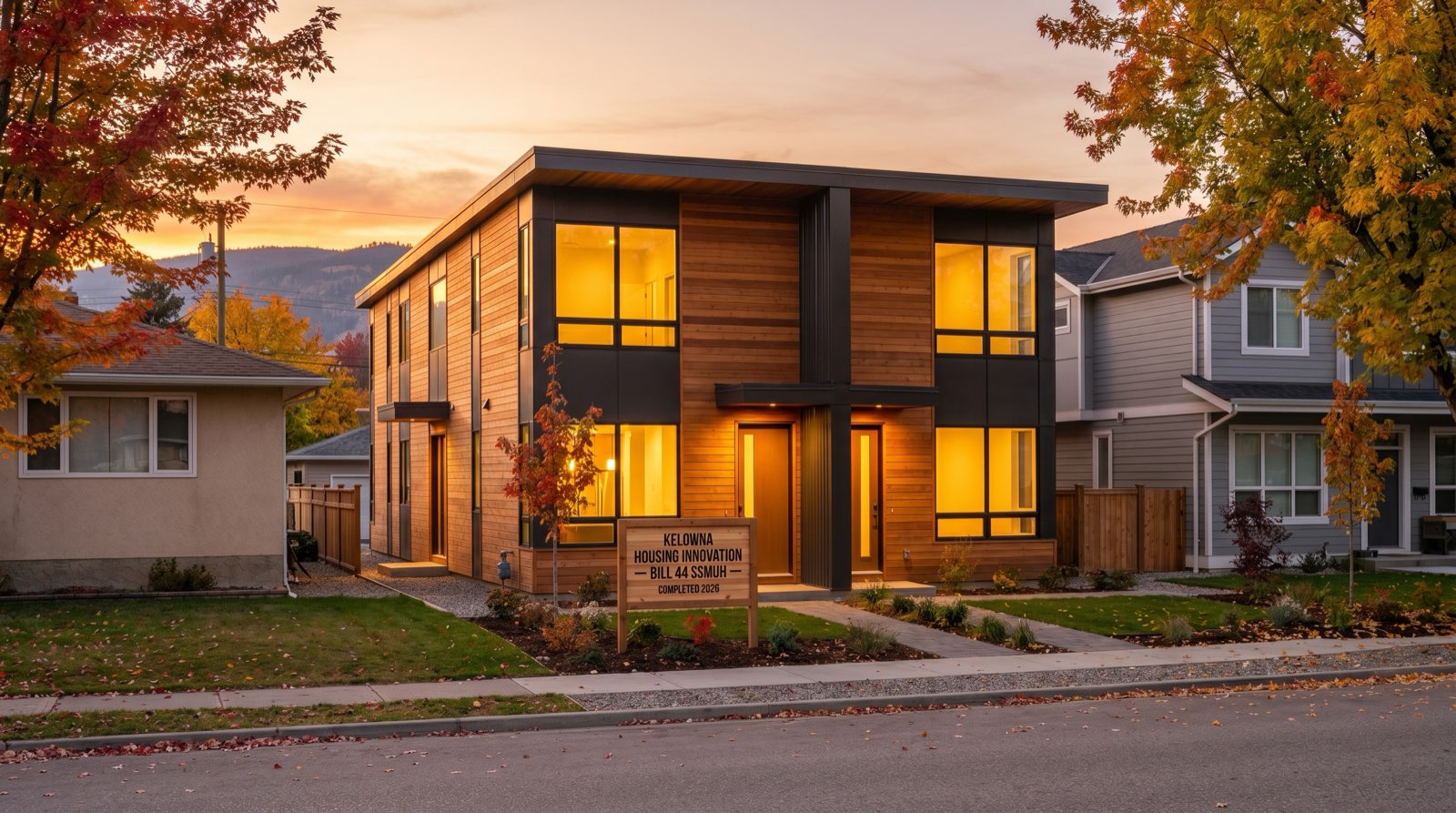
The application-to-completion gap is the year-one artifact most worth watching. An application filed in mid-2024 typically permits in late 2024 or early 2025 and completes in 2026. Year-one SSMUH applications will show up as year-two and year-three completions. The report card is going to read differently in 2027 than it does right now.
A note on Bill 47 and transit-oriented areas
Bill 47 — the companion legislation to Bill 44 — applied separately to Transit-Oriented Areas, layering higher density allowances near qualifying bus exchanges and rapid transit nodes. Kelowna’s TOA work centres on the Route 97 corridor and Downtown terminal. SSMUH 6-plexes pick up the 400 m frequent-transit boost; TOA densification goes beyond that for larger sites. Different policy, different buildings, same corridor. Operators evaluating Harvey-adjacent sites should check both frameworks.
What the policy did and didn’t solve
Bill 44 did what zoning can do
- Raised the as-of-right unit count on every eligible lot
- Killed the public hearing on SSMUH-consistent applications
- Removed mandatory parking near Route 97 stops
- Compressed permitting timelines from 12-18 months to weeks for conforming applications
That’s the full scope of what zoning reform can deliver. It creates capacity; it doesn’t force delivery.
Bill 44 didn’t solve the financing stack
- It didn’t lower construction loan rates
- It didn’t bring down material costs
- It didn’t shorten CMHC underwriting queues
- It didn’t change lender vacancy assumptions
Margin compression in 2025 is cyclical. It reflects the debt market, not the zoning code.
The position we’d take on year one
Bill 44 gets a pass on policy execution and an incomplete on market delivery — but the delivery grade isn’t a policy grade. Zoning did what zoning does. The 8,774-unit target over five years is still achievable if rates normalize and construction cost eases, and it’s missable if neither happens.
For owners looking at their own lot, the practical read is simpler: the policy capacity is there. The window to break ground at current construction pricing before the next rate cycle reprices land is finite. The builders exiting year one with entitled sites and construction financing locked are going to look very smart in 2027 when vacancy tightens and rents finally test.
Key takeaway: Don’t confuse cyclical margin compression with policy failure. The zoning is fine. The capital stack is what’s binding.
Related reading
What’s next for your Kelowna lot
The full Kelowna Multiplex hub maps zoning, rent data, neighbourhoods, and proforma math. If your lot is in a Core Area or Urban Centre and you want to see whether year-two conditions make sense for you, run it through the analyzer.