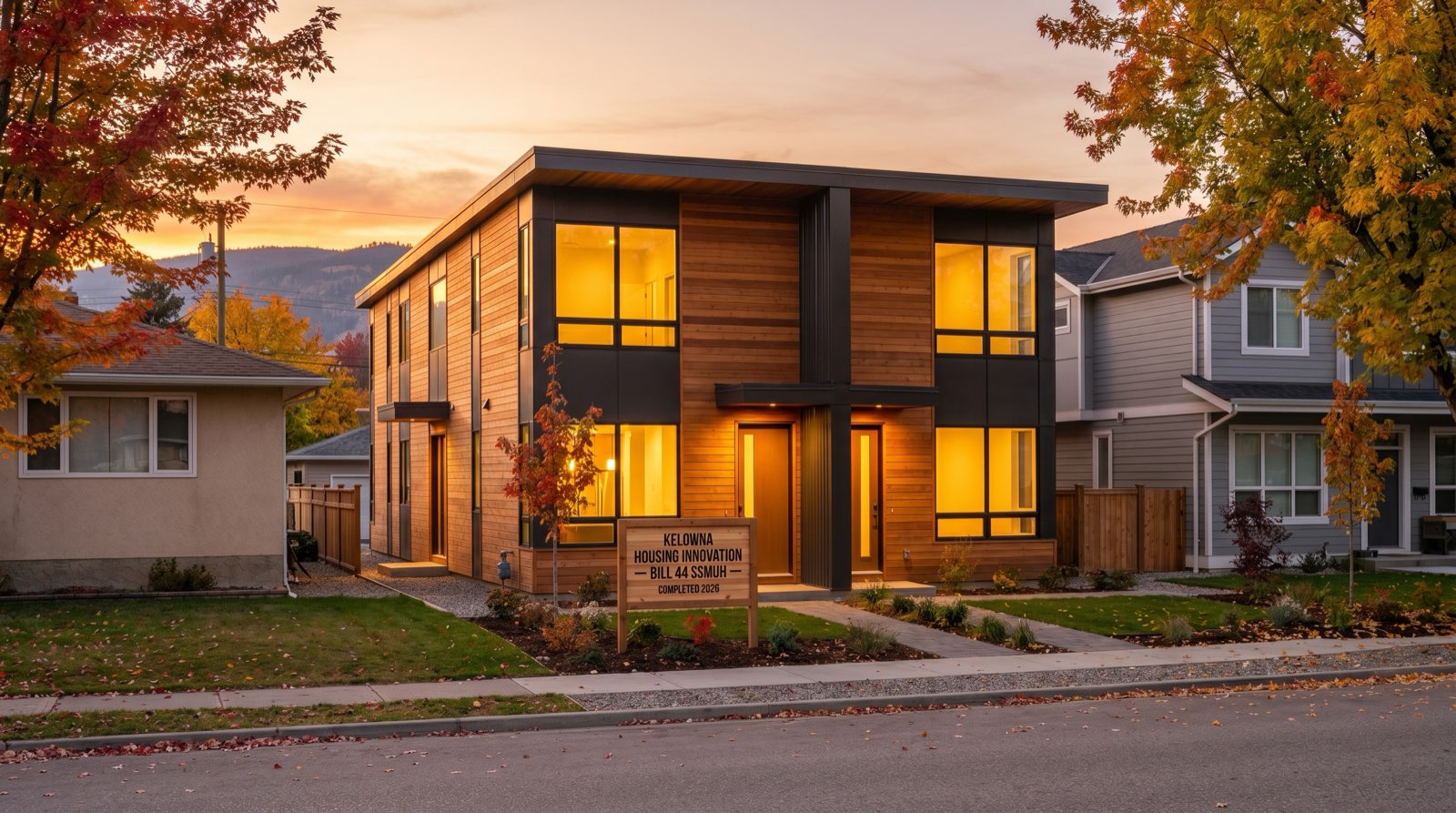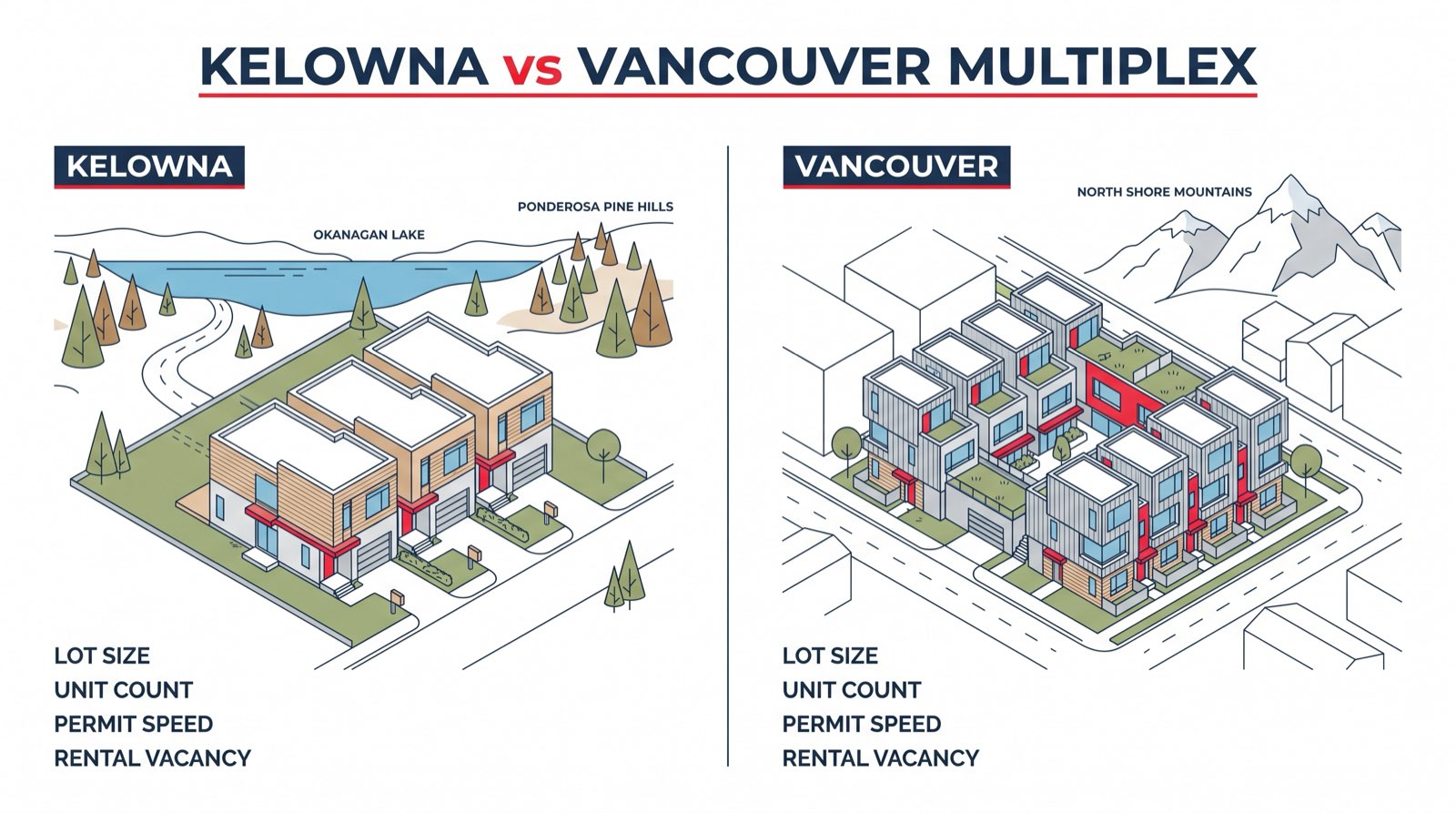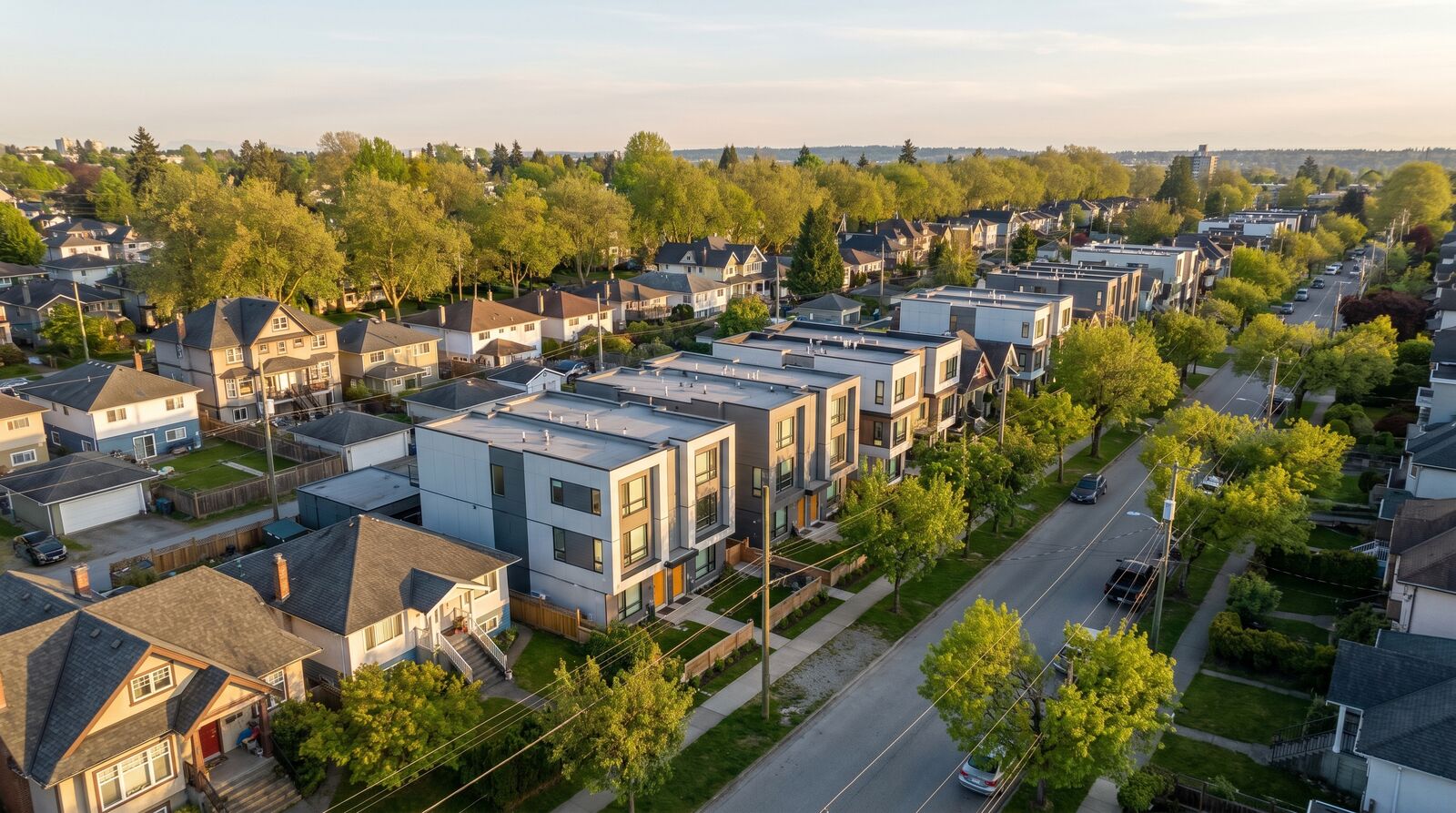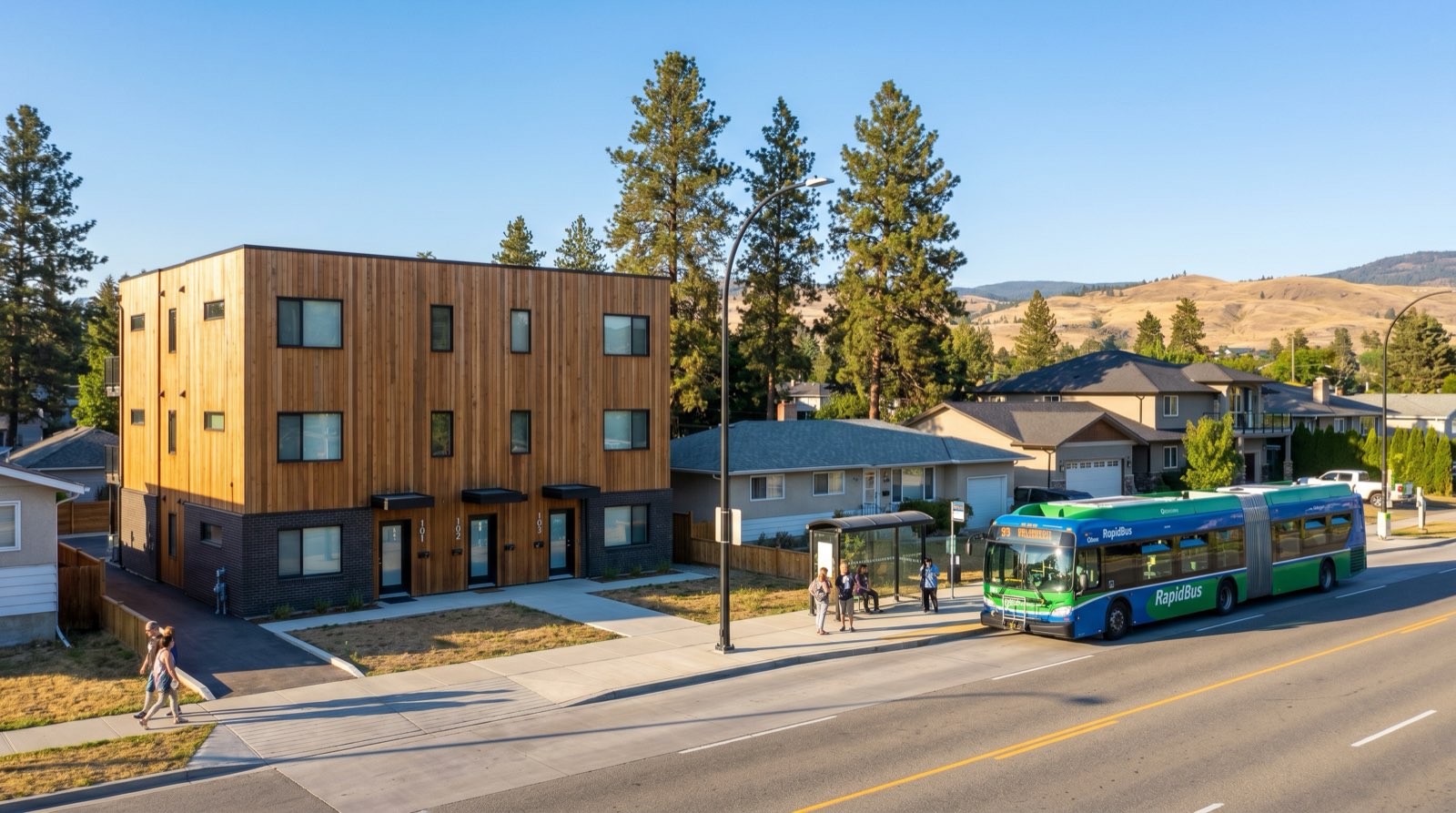

Rutland has Kelowna’s cheapest multiplex land AND the highest vacancy. Both facts are true at the same time.
You don’t have to pick one side of that sentence. Rutland genuinely offers the lowest land basis for SSMUH-eligible lots in the Kelowna CMA, and Rutland genuinely carries the region’s tightest vacancy math at 7.5% according to the CMHC 2025 Rental Market Report. Operators who treat those facts as a contradiction will miss the opportunity. Operators who treat them as two inputs to the same proforma will underwrite the play correctly.
This is the Rutland read.
Why Rutland is zoned for multiplex velocity
Rutland is one of the five Urban Centres in Kelowna’s 2040 OCP, alongside Downtown, Pandosy, Capri-Landmark, and Midtown. That designation channels 48% of new citywide unit growth into the five centres combined, with Rutland capturing a meaningful share of that allocation.
When Kelowna pre-zoned the map on March 18, 2024 to comply with BC’s SSMUH legislation, Rutland’s RU-family lots inherited the Province’s unit-count floors:
- 3 units on lots ≤ 280 m²
- 4 units on lots > 280 m²
- 6 units on lots > 280 m² within 400 m of a qualifying frequent-transit stop
The 6-unit rule is the one that matters in Rutland.
Two transit corridors, one 6-unit unlock
Rutland sits on BC Transit’s Route 97 Okanagan RapidBus — the spine that runs Harvey Avenue from UBC Okanagan down through Downtown and out to West Kelowna. Route 97 qualifies as frequent transit under the SSMUH test. Route 8 connects Rutland directly to UBC Okanagan and pulls student demand into the neighbourhood’s rental stock.
A meaningful chunk of Rutland’s residential lot inventory sits within 400 m of a Route 97 stop. Those lots unlock the 6-unit SSMUH floor with no public hearing and reduced parking requirements. That’s the structural reason Rutland shows up in application queues disproportionate to its size.
The UBCO rental driver
UBC Okanagan runs roughly 12,000 students. The university’s residence capacity is well below enrolment, which pushes thousands of students into off-campus rental every fall. Route 8 transit access plus proximity to the UBCO campus makes Rutland one of the primary off-campus catchments — alongside North Glenmore and the campus periphery itself.
Student demand is imperfect demand. It’s seasonal, it’s turnover-heavy, it’s leveraged to enrolment growth. But it’s reliable for multi-bedroom units, and it keeps three-bedroom rents supported even in a high-vacancy CMA.
The vacancy problem, honestly
Now the other side.
7.5% isn’t a typo
The CMHC 2025 Rental Market Report, confirmed in the Province’s data release, put Rutland vacancy at 7.5% — the highest number in the Kelowna CMA:
| Submarket | 2025 Vacancy |
|---|---|
| Kelowna CMA | 6.4% |
| City of Kelowna | 6.9% |
| Rutland | 7.5% |
| West Kelowna | 5.3% |
Rents by unit type across the CMA:
| Unit type | 2025 average rent |
|---|---|
| Studio | $1,395 |
| 1-bed | $1,596 |
| 2-bed | $2,118 |
| 3-bed | $2,895 |
Rutland trends below the CMA average on 1-bed and 2-bed rents, and closer to the average on 3-bed — consistent with the UBCO demand profile.
What 7.5% does to a proforma
A standard Kelowna multiplex proforma at 3% vacancy delivers materially different numbers than the same building at 7.5% vacancy. The difference isn’t just lost rent — it’s:
- Longer lease-up from delivery to stabilized occupancy (6-9 months, not 3)
- Lender haircuts on pro-forma rents (stress-tested at 10-12% vacancy, not 5%)
- Thinner debt service coverage ratios at MLI Select takeout
- More tenant concessions and turnover cost
If you underwrite Rutland at CMA-average vacancy, you will be wrong. Underwrite at 8%.
Key takeaway: Rutland’s land is cheap because Rutland’s vacancy is high. The discount is priced. Underwrite both.
The position: Rutland rewards two operators and punishes everyone else
Operator profile #1: Patient capital
Builders who can hold stabilized assets through a softer absorption window win in Rutland. The math:
- Buy the lot at today’s discounted basis
- Build to the 6-unit SSMUH floor where transit qualifies
- Accept 6-9 month lease-up without panic
- Hold through the next vacancy cycle (historically 18-24 months from a peak)
- Exit at normalized vacancy and tighter cap rates in 2027-2028
This is a small-builder or family-office play. It dies under aggressive equity-return timelines.
Operator profile #2: CMHC MLI Select velocity
The CMHC MLI Select takeout program — accessed via standard CMHC-insured refinance — is the other way Rutland math works. Builders who:
- Qualify the build for affordability, energy, or accessibility point thresholds
- Lock the takeout financing early
- Exit to a stabilized CMHC-insured loan at 50-year amortization
Can absorb a softer lease-up because the takeout rewards unit count and building attributes, not trailing-12-month NOI alone. The 6-unit SSMUH allowance feeds MLI Select point scoring well in Rutland’s transit-adjacent lots.
Who Rutland punishes
- Operators with 3-month stabilization assumptions and hard equity-return dates
- Flippers expecting comparable sales lift before lease-up
- Anyone who underwrites at CMA-average vacancy instead of submarket-specific
Don’t confuse cheap land for easy math.
Proforma sensitivity: the 8% vacancy floor
Here’s the practical underwriting rule for Rutland in 2026:
- Start with CMHC 2025 rent comps for the specific unit mix
- Apply an 8% vacancy floor (not the 3-5% national default)
- Stress-test lease-up at 9 months from completion
- Add a 2% reserve on top of normal operating expenses for turnover cost
- Run the IRR at both 5.25% and 6.0% takeout rates
A Rutland 6-plex that still pencils under those assumptions is a real project. One that only works at 4% vacancy and 4.75% takeout is a bet on conditions you don’t control.
The lots that actually work in Rutland
Not every Rutland lot triggers the 6-unit unlock. The three tests, in order:
- Zoning: RU family or MF1, confirmed via the Kelowna Zoning Bylaw
- Lot size: larger than 280 m² (roughly 3,000 ft²) for the 4-unit minimum; same threshold for 6-unit where transit qualifies
- Transit adjacency: within 400 m walking distance of a Route 97 RapidBus stop
Lots that fail test 3 default to the 4-unit SSMUH floor. That’s still a usable multiplex project — just a different economic envelope than the 6-unit unlock.
The corridor lots are overbought
Route 97-adjacent lots carry a visible premium in 2026 pricing. The secondary-street lots within the 400 m walkshed — one or two blocks off the corridor — often carry similar zoning upside at materially lower land cost. That’s where patient-capital operators find alpha.
How Rutland fits the 2040 OCP framework
Rutland’s Urban Centre designation under the 2040 OCP matters for two reasons operators often overlook.
First, the density target of 150-250 residents-plus-jobs per hectare is a Planning-alignment signal. SSMUH 6-plexes on Rutland lots move that number in the right direction, which keeps those applications in the priority queue at Planning review.
Second, the 48% OCP allocation to Urban Centres is cumulative across all five centres — it’s not guaranteed evenly split. Rutland’s share of that allocation reflects land availability, existing infrastructure capacity, and political appetite for neighbourhood change. All three favour Rutland right now. Land availability is better than Pandosy or Capri-Landmark; infrastructure capacity (water, sewer, storm) is adequate for small-scale infill; the political conversation around Rutland density has been relatively quiet compared to more visible Urban Centres.
That’s a quiet tailwind. Operators underwriting Rutland in 2026 are building into a policy environment where Planning wants the units delivered.
Against the Province’s 8,774-unit target
The Province set Kelowna a housing target of 8,774 new homes over the five years from 2024-2029. Rutland is expected to carry a meaningful slice of that. Not because anyone has assigned a quota to the neighbourhood, but because the combination of SSMUH 6-unit unlocks, transit-corridor access, Urban Centre designation, and lower land basis concentrates the proforma-viable lots in Rutland at a higher rate than in higher-basis neighbourhoods.
Year one of the target saw applications flow in; year two will test how many actually reach completion. Rutland’s 7.5% vacancy is both the obstacle and the opportunity: obstacle because lease-up is slower today, opportunity because completed product delivered into the 2027-2028 absorption window meets a market that’s had two years without meaningful new supply.
What Rutland owners should do
If you own a house in Rutland — particularly anything within four blocks of Harvey Avenue — your lot carries a different value than it did in 2023. Whether to build, sell to a builder, or hold depends on:
- Your lot’s distance to the nearest Route 97 stop
- Whether SSMUH allows 4 units or 6 units on your parcel
- Your capital timeline and cost of equity
- Your appetite for underwriting an 8% vacancy floor
Key takeaway: The three levers that make Rutland work are the 6-unit transit unlock, a patient-capital or MLI Select exit, and honest underwriting on vacancy. Miss any of the three and the cheap land basis won’t save you.
Related reading
- Rutland neighbourhood deep dive
- Kelowna neighbourhoods by multiplex potential
- Kelowna rental market data
What’s next for your Kelowna lot
If your lot is in Rutland or any of the Kelowna Urban Centres, the Kelowna Multiplex hub maps the zoning, transit, and proforma math lot-by-lot. Run an address through the analyzer to see which SSMUH floor applies and what the 8% vacancy stress test looks like on your parcel.