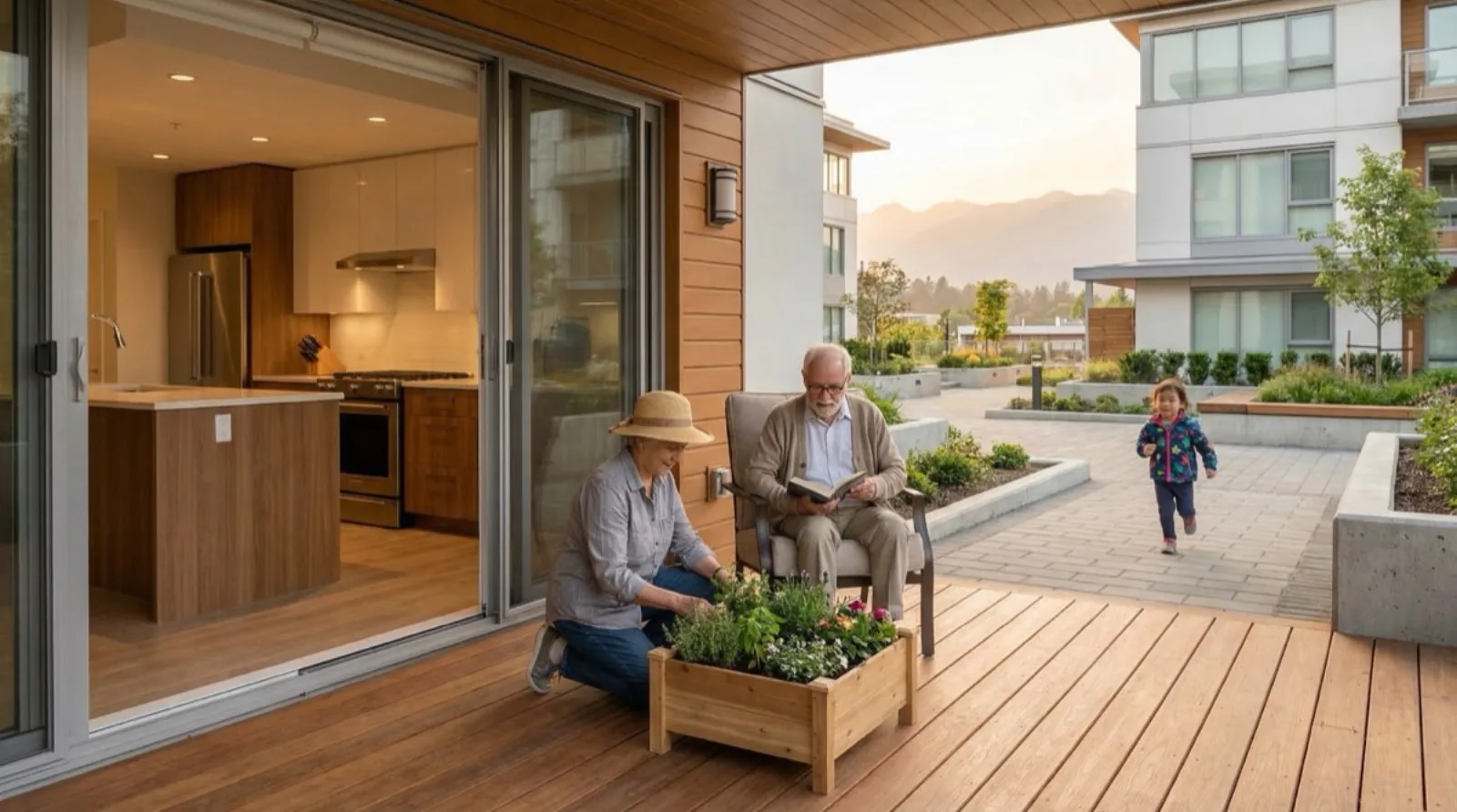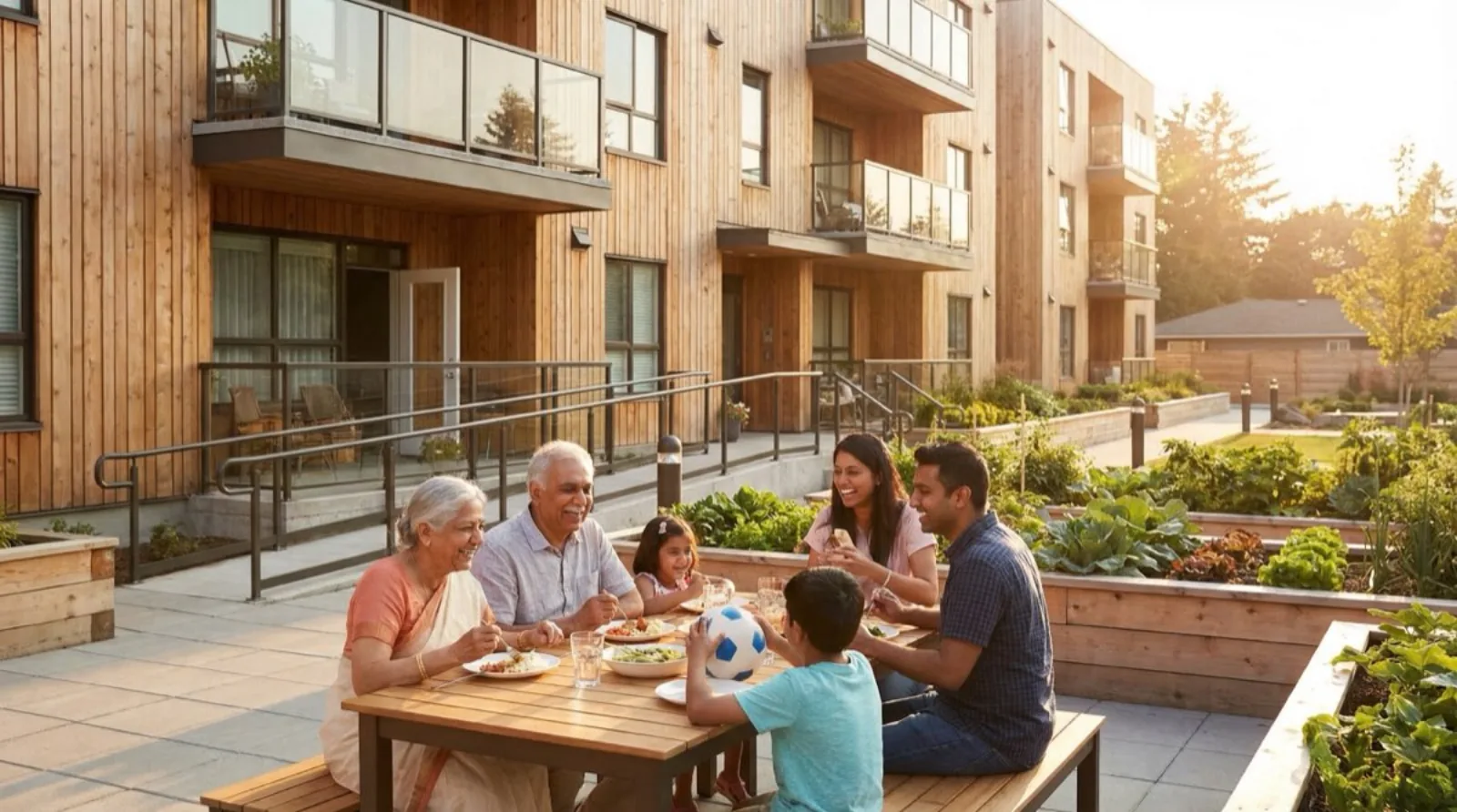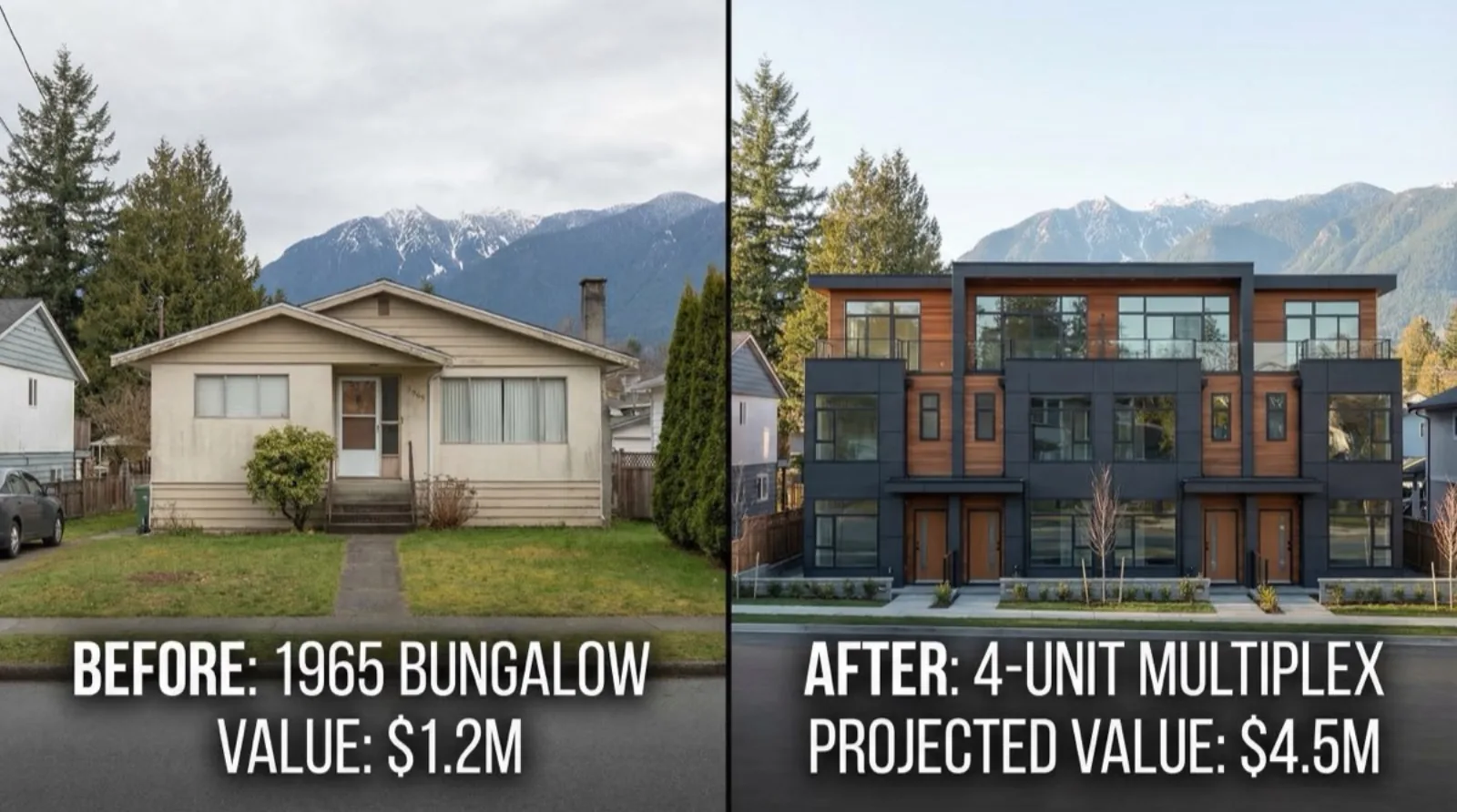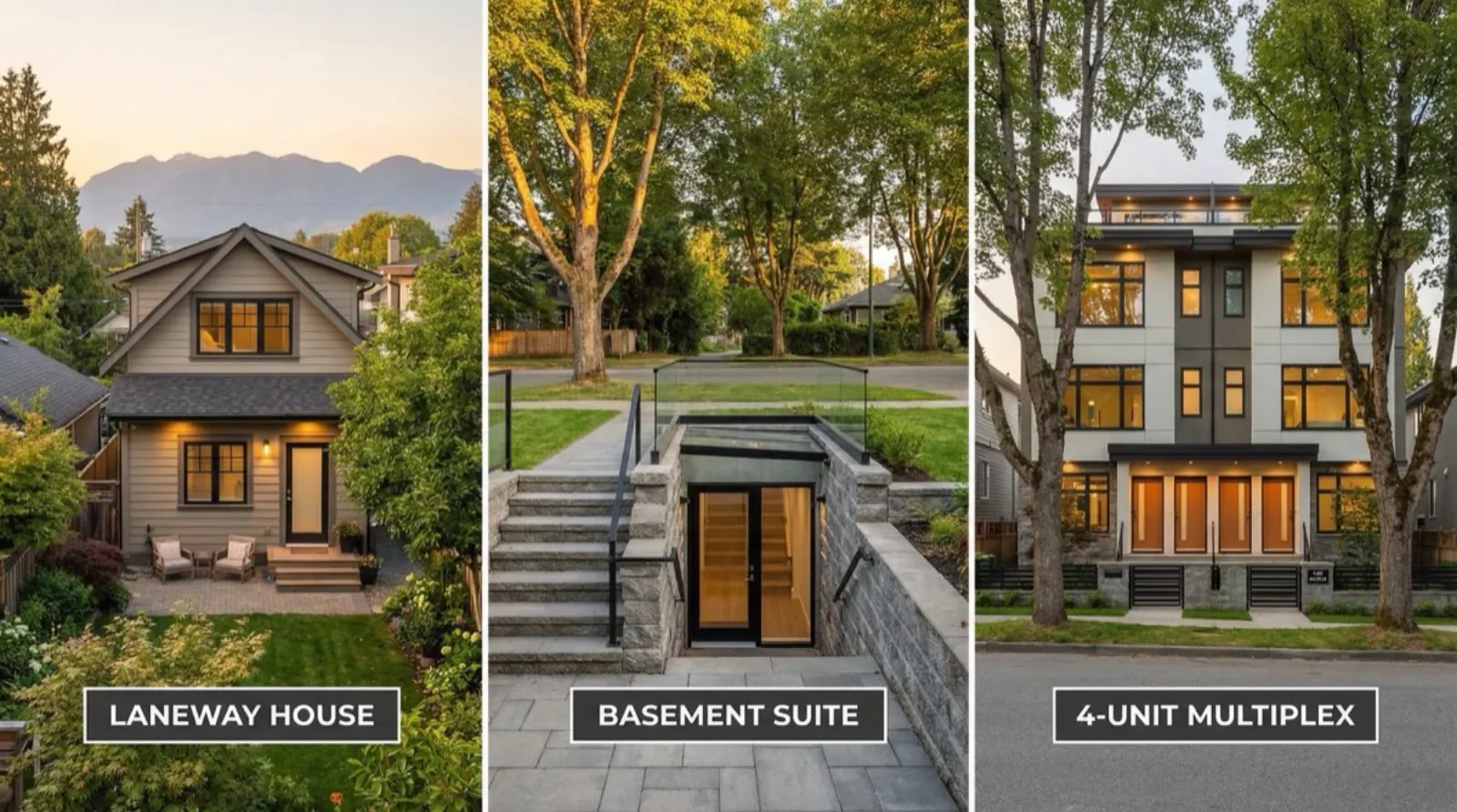

If you want to keep your family close in Metro Vancouver, you have three realistic options in 2026: a laneway house ($550-900K, one 800 sf unit), a secondary suite ($80-150K renovation, one 600 sf basement unit), or a full multiplex (3-6 independent units, $1.6-2.1M build cost). The multiplex is the only option that houses multiple generations in separate, dignified living spaces while generating rental income and building equity. Here is the definitive comparison.
The Three Paths to Keeping Family Close
In March 2026, Metro Vancouver families face a housing crisis that makes multigenerational living not just cultural preference but financial necessity. The average detached home in Vancouver sits at $2.1M (REBGV, February 2026), while the average rental for a two-bedroom apartment has reached $3,400/month (CMHC Rental Market Survey, October 2025). Adult children, aging parents, and young families are all squeezed.
Three housing strategies keep family on the same property. But they differ dramatically in cost, capacity, and long-term value creation.
| Factor | Laneway House | Secondary Suite | Full Multiplex |
|---|---|---|---|
| Typical Size | 750-900 sf | 500-700 sf | 3,500-5,500 sf total |
| Units Created | 1 | 1 | 3-6 |
| Build Cost | $550,000-$900,000 | $80,000-$150,000 | $1,600,000-$2,100,000 |
| Timeline | 10-14 months | 3-6 months | 18-24 months |
| Privacy Level | High (detached) | Low (shared structure) | High (separate entrances) |
| Accessibility | Limited (often 2-storey) | Poor (basement stairs) | Excellent (ground-floor units) |
| Rental Income | $2,200-$3,200/month | $1,500-$2,200/month | $8,000-$14,000/month |
| ROI on Investment | 35-55% | 50-80% | 60-100%+ |
| Stratification | No | No | Yes (in Burnaby) |
| Families Housed | 1 additional | 1 additional | 2-5 additional |
Option One: The Laneway House
Vancouver legalized laneway houses in 2009. As of January 2026, the city has permitted over 4,200 laneway homes (Vancouver Open Data). They are allowed in most RS-zoned lots with lane access and minimum lot widths of 32.8 feet.
What You Get
A detached dwelling unit at the rear of your property, typically 750-900 sf across one or two storeys. The main house remains untouched. Your family member or tenant gets a separate entrance, kitchen, bathroom, and living space.
Financial scenario (Vancouver East Side, 2026):
| Component | Amount |
|---|---|
| Construction (800 sf at $450/sf) | $360,000 |
| Design, permits, site prep | $55,000 |
| Landscaping and connection fees | $25,000 |
| Total Investment | $440,000 |
| Property value increase | $600,000-$700,000 |
| Net equity gain | $160,000-$260,000 |
| Monthly rental income | $2,500-$3,000 |
Where It Falls Short for Families
Laneway houses work well for one additional household. But most multigenerational families have more complex needs. If grandparents need ground-floor accessibility, an adult child needs a starter home, and you want to retain rental income, one 800 sf unit cannot solve all three problems. The 2-storey design common in laneway houses also creates accessibility barriers for seniors (CMHC Universal Design Guidelines, 2024).
Option Two: The Secondary Suite
Since November 2023, BC’s Housing Statutes Amendment Act requires all municipalities to allow at least one secondary suite on every residential lot. This made suites legal province-wide, removing the patchwork of municipal restrictions.
What You Get
A self-contained unit within your existing home, usually in the basement. Typical size is 500-700 sf with a separate entrance, kitchen, and bathroom. Renovation costs range from $80,000 for basic conversions to $150,000 for high-quality finishes with separate mechanical systems (HomeStars contractor estimates, 2025).
Financial scenario (typical Metro Vancouver home):
| Component | Amount |
|---|---|
| Renovation cost (600 sf suite) | $120,000 |
| Permit and design fees | $10,000 |
| Separate entrance construction | $15,000 |
| Total Investment | $145,000 |
| Property value increase | $120,000-$180,000 |
| Monthly rental income | $1,800-$2,200 |
Where It Falls Short for Families
Secondary suites share walls, floors, and ceilings with the main dwelling. Sound travels. Privacy is limited. Most critically, basement suites require stair access, making them unsuitable for aging parents with mobility challenges. According to BC Housing’s accessibility data (2024), fewer than 8% of basement suites meet basic universal design standards.
A secondary suite houses one additional person or couple. It does not solve the needs of a three-generation family.
Option Three: The Full Multiplex
Bill 44, fully implemented in Vancouver since June 2024 and being adopted across BC under Bill 25 (compliance deadline June 30, 2026), allows 3-6 units on standard single-family lots. The for homeowners guide explains how to read your lot’s potential before talking to an architect. This is the transformational option.
What You Get
A purpose-built building with 3-6 fully independent units, each with separate entrances, kitchens, bathrooms, and living spaces. Ground-floor units can be designed for accessibility. Upper units serve younger family members. Remaining units generate rental income or can be sold as strata (in Burnaby, where full stratification is permitted).
Financial scenario (Vancouver, 6,000 sf lot):
| Component | Amount |
|---|---|
| Existing property value | $2,200,000 |
| Demolition and site prep | $80,000 |
| Construction (4,200 sf at $425/sf) | $1,785,000 |
| Design, permits, soft costs | $185,000 |
| Total Development Cost | $2,050,000 |
| End value (4-unit multiplex) | $5,200,000-$5,800,000 |
| Net equity created | $950,000-$1,550,000 |
| Monthly rental income (2 units rented) | $5,500-$7,000 |
Why Multiplex Wins for Multigenerational Living
The advantages compound across every dimension that matters to families:
Capacity: A fourplex houses four separate households. Grandparents on the ground floor. Your family on the second floor. An adult child in unit three. A rental unit generating income in unit four. No other option provides this flexibility.
Privacy: Each unit has its own entrance, kitchen, and living space. Family members are close but not on top of each other. According to a 2024 CMHC survey, 67% of multigenerational household conflicts stem from shared kitchen and bathroom spaces. Separate units eliminate this friction.
Accessibility: Ground-floor units can be designed with zero-step entries, wider doorways, roll-in showers, and aging-in-place features from day one. This is architecturally impossible in a laneway house attic or basement suite. BC Building Code 2024 includes enhanced accessibility requirements for ground-floor multiplex units.
Financial sustainability: Rental income from non-family units offsets carrying costs. A multiplex with two rented units at $3,000/month generates $72,000 annually, covering property taxes, insurance, and maintenance with surplus.
The Zoning Reality in 2026
Each option has different zoning requirements across Metro Vancouver:
| Zoning Factor | Laneway House | Secondary Suite | Multiplex |
|---|---|---|---|
| Vancouver | Most RS zones with lane | All residential zones | R1-1 (Bill 44) |
| Burnaby | Limited zones | All residential zones | R1 SSMUH (no FSR max) |
| Surrey | Select zones | All residential zones | Drafting bylaws (June 2026) |
| Provincial mandate | Not mandated | Required province-wide | Required via Bill 25 |
| Parking required | 1 space | 0-1 space | 0 near transit, 1/unit otherwise |
| Stratification | Not permitted | Not permitted | Permitted in Burnaby |
Burnaby stands out for multiplex families because of full stratification rights. You can build a fourplex, keep two units for family, and sell two as strata condos to recover development costs. Vancouver does not currently permit this for standard Bill 44 multiplexes.
Which Option Matches Your Family?
Choose a Laneway House If:
- You need housing for one additional family member
- Your lot has lane access and meets minimum width
- Budget is under $500,000
- The family member does not need ground-floor accessibility
Choose a Secondary Suite If:
- Budget is tight (under $150,000)
- You need a quick solution (3-6 month timeline)
- The family member is comfortable with shared-structure living
- Accessibility is not a primary concern
Choose a Multiplex If:
- You have multiple generations to house (parents, children, grandparents)
- Accessibility and aging-in-place design are priorities
- You want rental income to offset costs or fund retirement
- You are building long-term generational wealth
- Your lot is 5,000+ sf in an eligible zone
The Generational Wealth Calculation
Over a 10-year horizon, the financial gap between these options widens dramatically:
| Metric (10-Year) | Laneway | Suite | Multiplex |
|---|---|---|---|
| Initial investment | $440,000 | $145,000 | $2,050,000 |
| Cumulative rental income | $330,000 | $230,000 | $780,000 |
| Property appreciation (3%/yr) | $180,000 | $60,000 | $1,750,000 |
| Total value created | $510,000 | $290,000 | $2,530,000 |
| Return per dollar invested | $1.16 | $2.00 | $1.23 |
The suite wins on return per dollar for budget-conscious families. But the multiplex wins on absolute wealth creation by a factor of five. For families planning across generations, that absolute number is what matters.
Your Property, Your Decision
Every lot in Metro Vancouver has different constraints. Lot size, lane access, zoning designation, proximity to transit, and soil conditions all affect which option is feasible and optimal.
The SSMUH rules that govern what each lot can support vary by municipality — check your city’s page before assuming province-wide rules apply uniformly. Visit VanPlex.ca to enter your address and see exactly what your lot supports. The eligibility checker analyzes your specific property against current municipal zoning, lot dimensions, and Bill 44/Bill 25 requirements. You will see whether your lot qualifies for a laneway house, how many multiplex units it supports, and a personalized proforma showing projected costs, rental income, and ROI for each option.
The best decision is the informed one. Start with your address.
VanPlex Team PlexRank™ | Profit with Multiplex