South Asian Canadians have always understood something the housing market is only now catching up to: families thrive when they live together. With 20.4% of South Asian households in Canada living multigenerationally (Statistics Canada, 2022), this community has spent decades building the social infrastructure of extended family housing. Now, Bill 44 and provincial SSMUH rules are making that vision legal, profitable, and architecturally purpose-built across Metro Vancouver.
TL;DR (Key Takeaways)
- 20.4% of South Asian Canadians live multigenerationally, 3x the national average (Stats Canada, 2022)
- South Asian homeownership in Metro Vancouver: 72.4%, above the 66.5% regional average (2021 Census)
- Surrey, Delta, and Burnaby have the highest South Asian populations and multigenerational rates
- Bill 44 and Bill 25 now legalize the multiplex configurations these families have always wanted
- Cultural design priorities: larger kitchens, prayer rooms, multiple living areas, ground-floor elder suites
- Financial advantage: multigenerational families pool resources, reducing per-household development costs by 30-40%
A Cultural Advantage Decades in the Making
The multigenerational household is not a trend for South Asian families. It is a foundation. Three generations sharing a roof is standard practice across Punjabi, Gujarati, Tamil, and other South Asian communities. What changed in 2024-2026 is that BC housing policy finally caught up with what these families have been doing informally for decades.
Before Bill 44, South Asian families in Surrey and Delta were converting basements, building unauthorized additions, and cramming extended families into homes never designed for the purpose. According to Surrey bylaw enforcement data (2023), over 1,200 secondary suite violations were reported annually, many in neighbourhoods with high multigenerational populations. The demand existed. The legal framework did not.
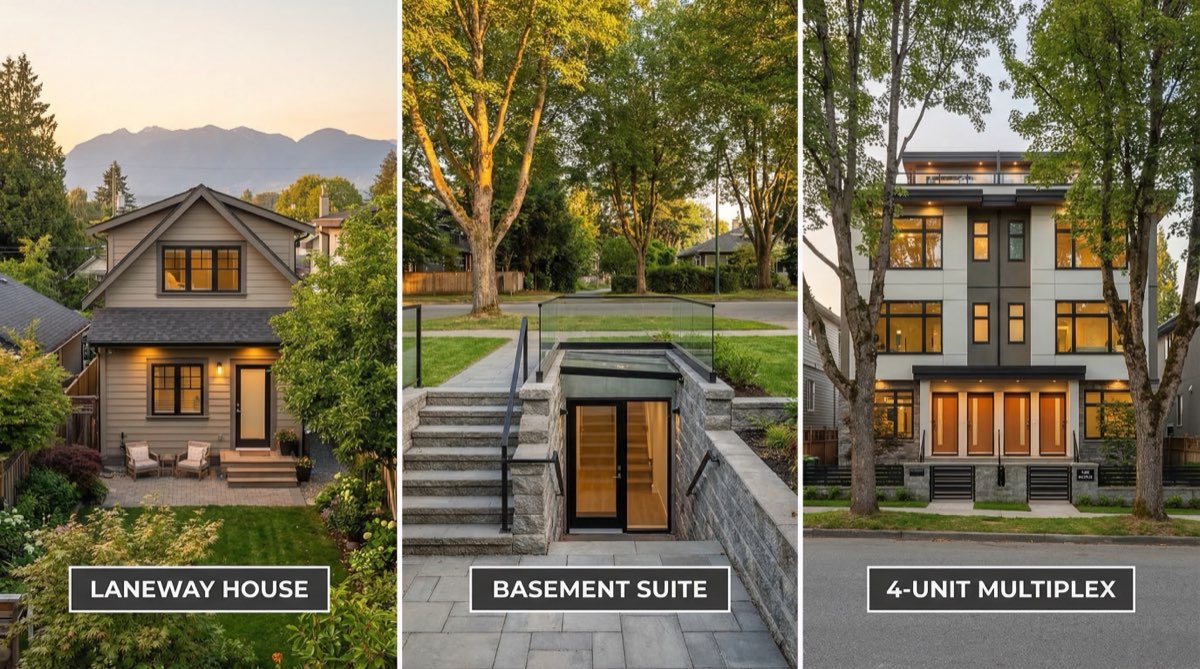
Now it does. Bill 44 (Vancouver, implemented June 2024) and Bill 25 (province-wide, compliance deadline June 30, 2026) allow 3-6 units on standard residential lots. For families that already want to live together, this is not a lifestyle change. It is a building permit.
The Numbers Behind the Cultural Shift
South Asian families in Metro Vancouver are uniquely positioned for the multiplex opportunity:
| Metric | South Asian Households | Metro Average | Advantage |
|---|---|---|---|
| Multigenerational rate | 20.4% | 6.4% | 3.2x higher |
| Homeownership rate | 72.4% | 66.5% | +5.9 percentage points |
| Average household size | 3.8 persons | 2.4 persons | 58% larger |
| Property ownership in Surrey | 41% of detached homes | N/A | Dominant market presence |
| Intergenerational wealth transfer | 68% plan to pass property | 43% national avg | 1.6x more likely |
Sources: Statistics Canada 2021 Census, 2022 Multigenerational Housing Report, CMHC Housing Survey 2024
The homeownership rate is critical. To develop a multiplex, you need to own property. South Asian families in Metro Vancouver own homes at higher rates than the general population, and they own them in the right places: Surrey (32.6% South Asian population), Delta (26.8%), Burnaby (14.2%), and Abbotsford (23.4%).
Where South Asian Families Are Leading Multiplex Development
The intersection of South Asian population density and multiplex-eligible properties creates a heat map of opportunity:
Surrey: The Epicentre
Newton, Fleetwood, and Panorama Ridge have multigenerational rates of 11-14%, more than double the Metro average. With 65,000+ SSMUH-eligible lots and average lot sizes of 6,000-8,000 sf, Surrey offers the most developable inventory for family-oriented multiplexes. Typical Surrey proforma: $1.5M lot + $1.8M build = $5.2M end value.
Delta: Agricultural Roots, Urban Opportunity
North Delta’s Scott Road corridor and Nordel area have significant South Asian populations with multigenerational rates of 8-10%. Delta’s SSMUH compliance is progressing, and many lots in the 7,000-10,000 sf range will qualify for 4-6 units. The community’s agricultural heritage means many families already own substantial land parcels.
Burnaby: Transit-Oriented Multigenerational Living
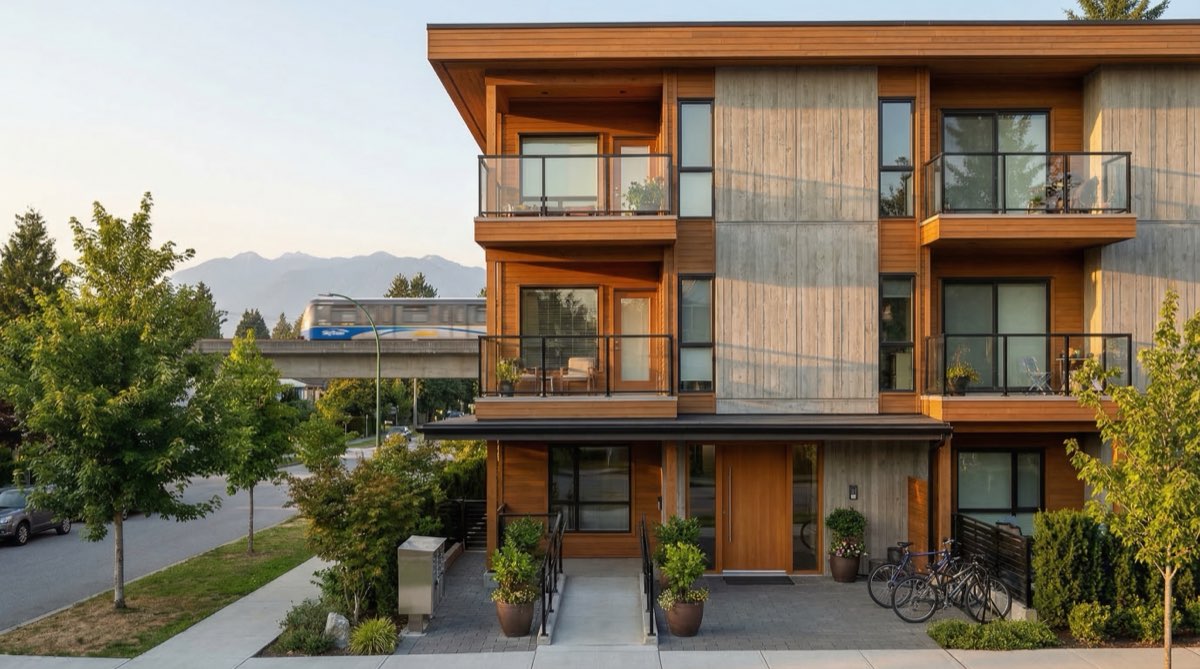
Burnaby’s Edmonds and Metrotown-adjacent neighbourhoods have growing South Asian populations. Burnaby offers a unique advantage: full stratification of multiplex units under R1 SSMUH zoning with no FSR maximum. This means South Asian families can build, keep family units, and sell remaining units as strata to recover costs.
Abbotsford and Beyond
While this analysis focuses on Metro Vancouver, Abbotsford’s 23.4% South Asian population and large lot inventory (many exceeding 10,000 sf) represent a significant future multiplex market once SSMUH compliance takes effect.
Designing for Multigenerational South Asian Families
Multiplex architecture must honour cultural needs to succeed. Cookie-cutter designs fail because they ignore how these families actually live. Based on interviews with South Asian families and design professionals across Metro Vancouver, the following features are priorities:
The Kitchen as Gathering Space
South Asian families cook together. Kitchens in multigenerational multiplexes need to be 150-200 sf minimum, with space for multiple people working simultaneously. Open-concept designs connecting the kitchen to a dining area that seats 8-12 are essential. Standard condo-sized kitchens (80-100 sf) do not work for families that prepare meals for gatherings of 15-25 people regularly.
Separate Prayer and Meditation Rooms
Many South Asian families maintain a dedicated prayer room (puja room for Hindu families, or a space for Sikh morning prayers). In multiplex design, a flex room of 60-80 sf on the ground floor, with natural light and east-facing orientation where possible, serves this need. This room can alternatively function as a home office or reading nook for families with different preferences.
Ground-Floor Elder Suites
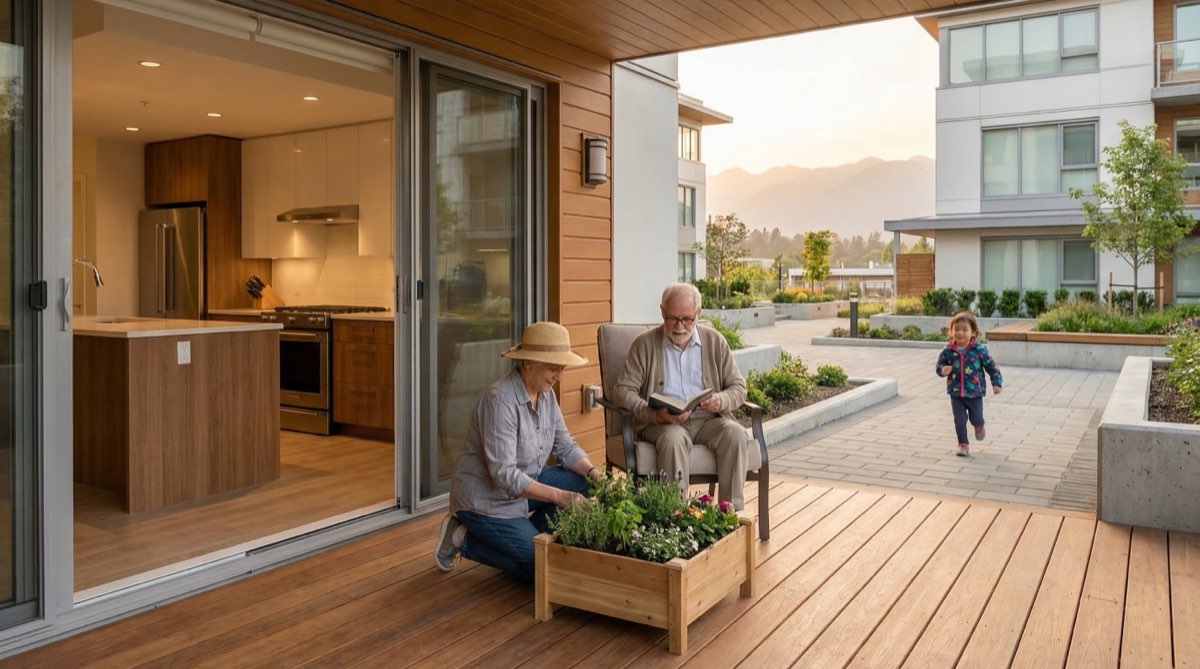
Elders are central to South Asian family structure. Ground-floor units with zero-step entries, wider doorways (36 inches minimum), walk-in showers, and proximity to shared outdoor space are non-negotiable for multigenerational designs. According to CMHC’s Aging in Place guidelines (2024), ground-floor accessible units reduce elder care costs by $18,000-$24,000 annually compared to institutional care.
Multiple Living Areas
Extended family dynamics require separate spaces for different activities: a formal living room for guests, a family room for daily use, and quiet areas for study or rest. In a well-designed fourplex, the family can have access to two living areas within their own unit, plus a shared outdoor gathering space.
Outdoor Gathering and Garden Space
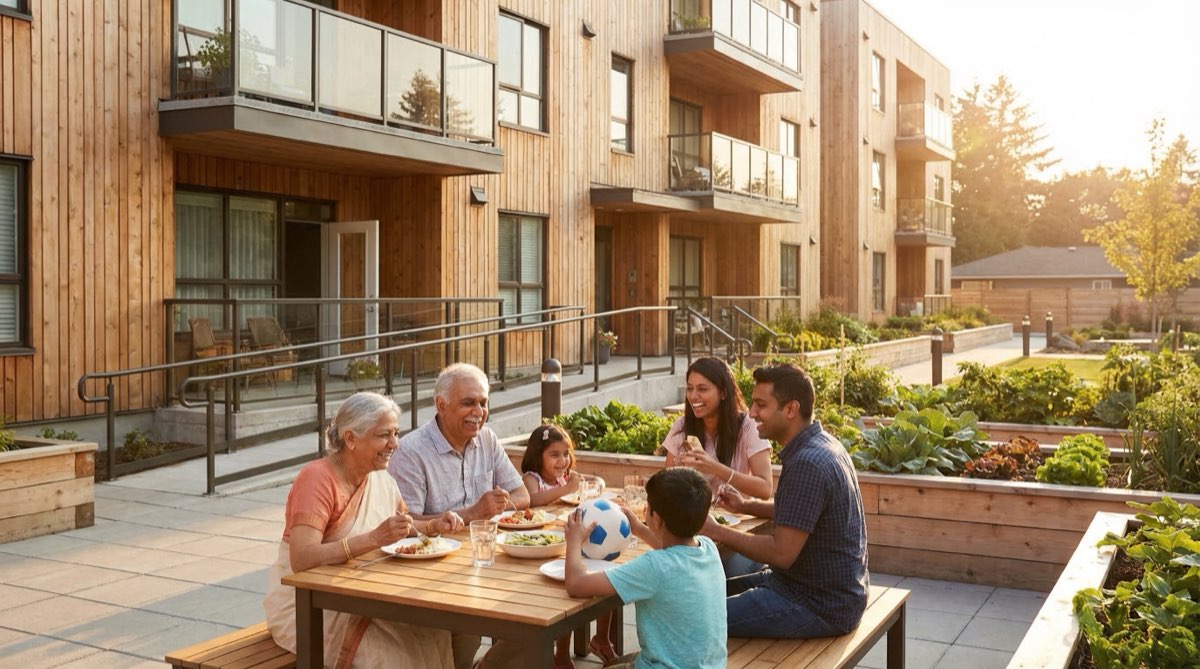
South Asian families use outdoor space extensively for barbecues, celebrations, and gardening. Surrey’s larger lots (6,000-8,000 sf) allow multiplex designs that incorporate a central courtyard, individual balconies, and dedicated garden beds. These features are not luxuries. They are functional requirements for how these families live, celebrate, and grow food.
The Financial Advantage of Pooled Family Resources
Multigenerational families have a structural financial advantage in multiplex development: they can pool resources across generations.
Typical resource pooling scenario:
| Resource | Contribution | Source |
|---|---|---|
| Land equity | $1,500,000 | Parents’ existing home |
| Construction financing down payment | $200,000 | Adult children (combined savings) |
| Monthly carrying costs during build | $4,000/month | Split across 3 households |
| Post-completion rental income | $4,800/month | 2 rental units |
This pooling reduces the per-household cost of development by 30-40% compared to a single household bearing the full burden. The parents contribute land. The children contribute cash for construction financing. Everyone benefits from the equity created.
A single family developing a $3.5M multiplex project needs to carry the entire cost. Three households in a multigenerational arrangement each carry roughly $1.2M of effective exposure. At today’s construction lending rates of 6.5-7.5% (major Canadian banks, Q1 2026), that difference in carrying cost is significant.
Celebrating Heritage While Building Wealth
The South Asian multigenerational tradition is not just culturally rich. It is financially brilliant. Families who live together share childcare (saving $1,500-$2,500/month per child in Metro Vancouver daycare costs), elder care (avoiding $4,000-$8,000/month institutional care fees), and household expenses (shared utilities, bulk food purchasing, vehicle sharing).
When you add multiplex equity creation on top of these savings, the generational wealth impact is extraordinary:
| Wealth Factor (10-Year Projection) | Multigenerational Multiplex | Separate Households |
|---|---|---|
| Property equity | $5,200,000+ | $2,100,000 (one home) |
| Childcare savings | $300,000 | $0 |
| Elder care savings | $480,000 | $0 |
| Shared expense savings | $120,000 | $0 |
| Rental income | $576,000 | $0 |
| Total family wealth impact | $6,676,000 | $2,100,000 |
The difference is not incremental. It is transformational. This is generational wealth creation operating at a level that individual households cannot match.
The Policy Window Is Open
Bill 44 and Bill 25 created a policy window that aligns perfectly with South Asian family structures. But policy windows can narrow. Municipal implementation varies. Construction costs are rising at 4-6% annually (Statistics Canada Construction Price Index, Q4 2025). And as more families pursue multiplex development, contractor capacity will tighten.
For South Asian families in Surrey, Delta, Burnaby, and across Metro Vancouver, the question is straightforward: you already live this way. You already value multigenerational closeness. The law now supports building purpose-designed housing that honours your family structure while creating substantial wealth.
Start With Your Property
Visit VanPlex.ca to enter your address and see your property’s multiplex potential. The analysis shows how many units your lot supports, estimated build costs, projected end value, and rental income projections. Over 86,000 Metro Vancouver properties have been analyzed. Yours is likely already in the database.
Your family has been practicing multigenerational living for generations. Now you can build for it.
VanPlex Team PlexRank™ | Profit with Multiplex