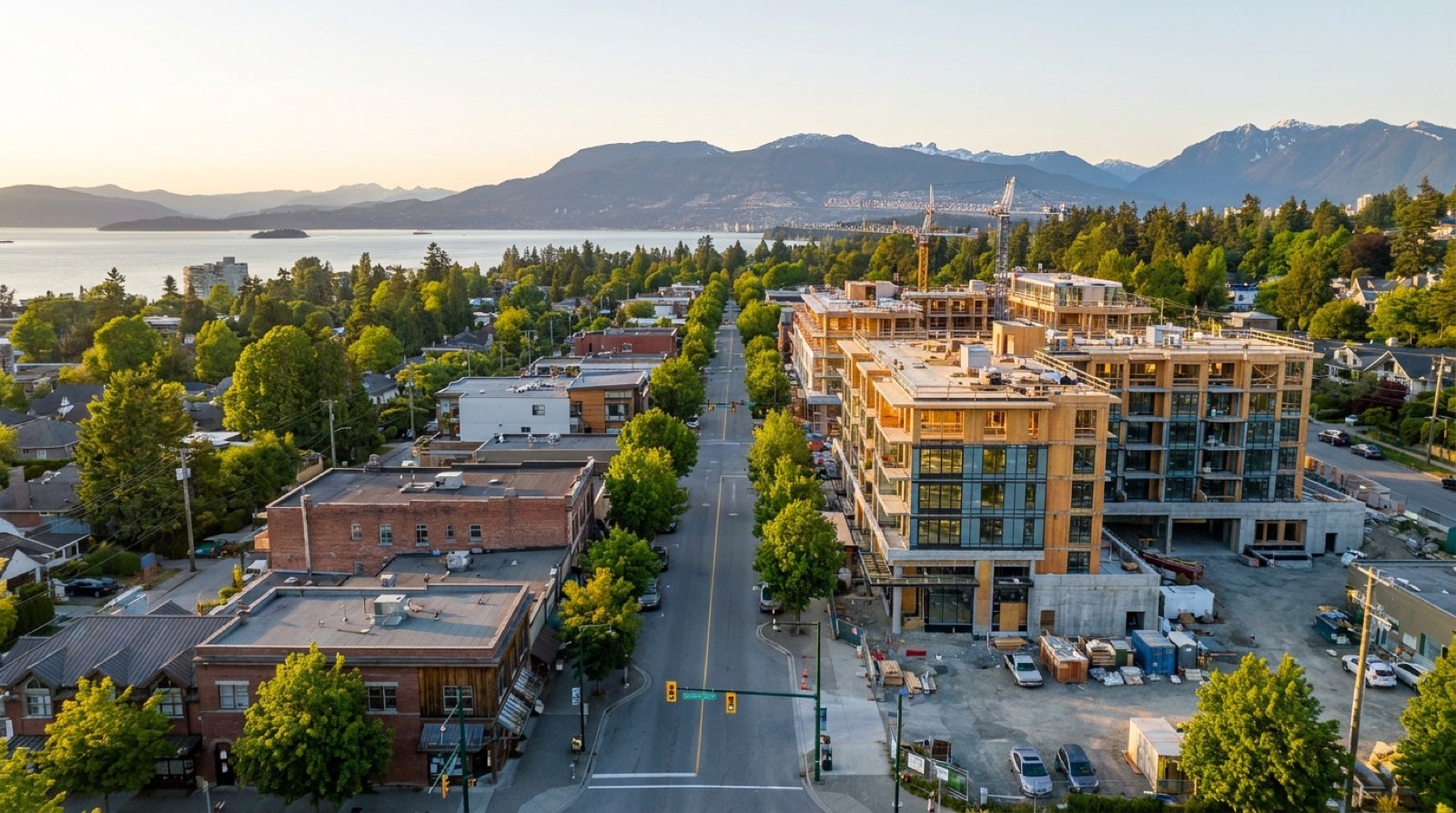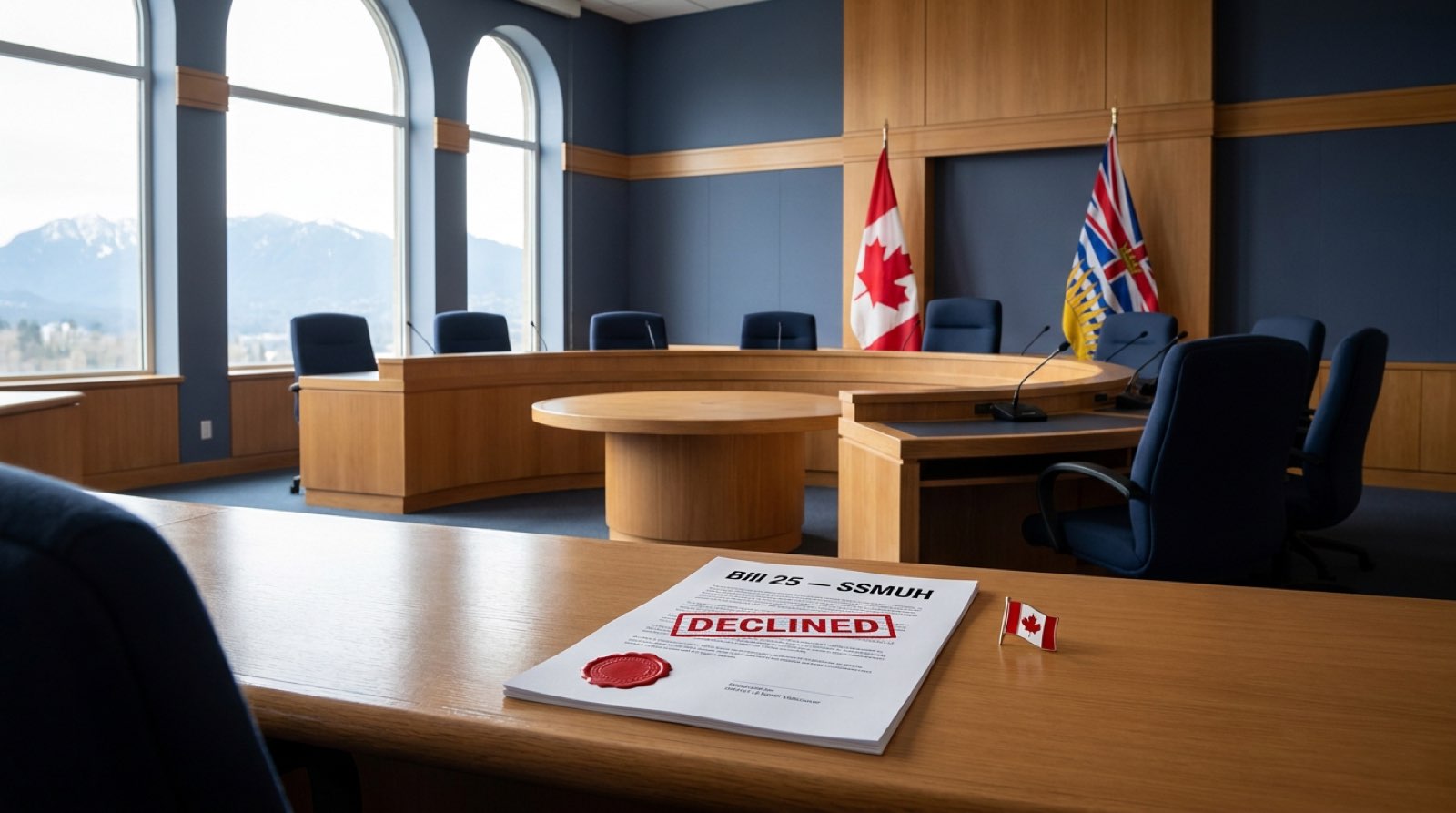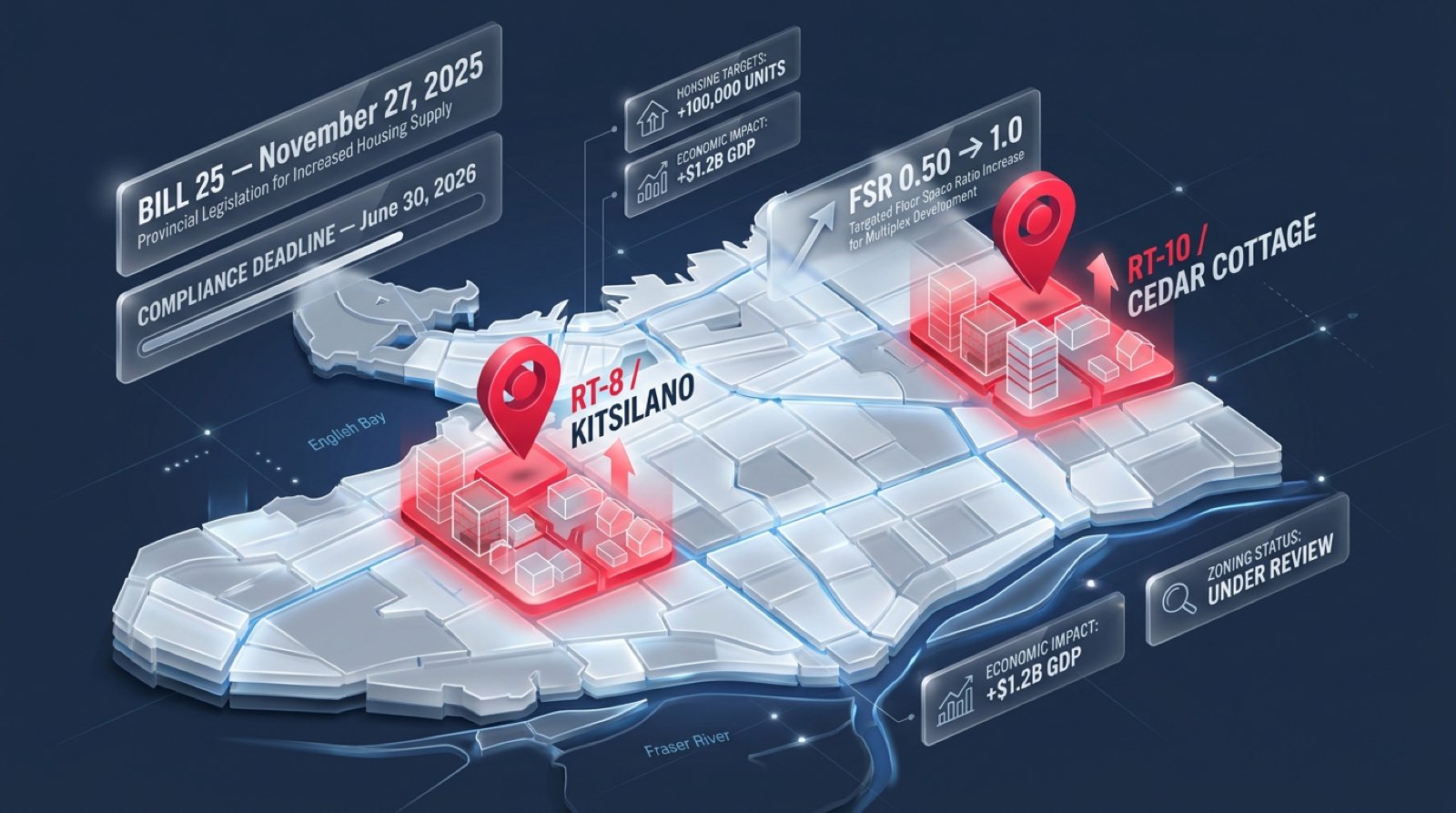

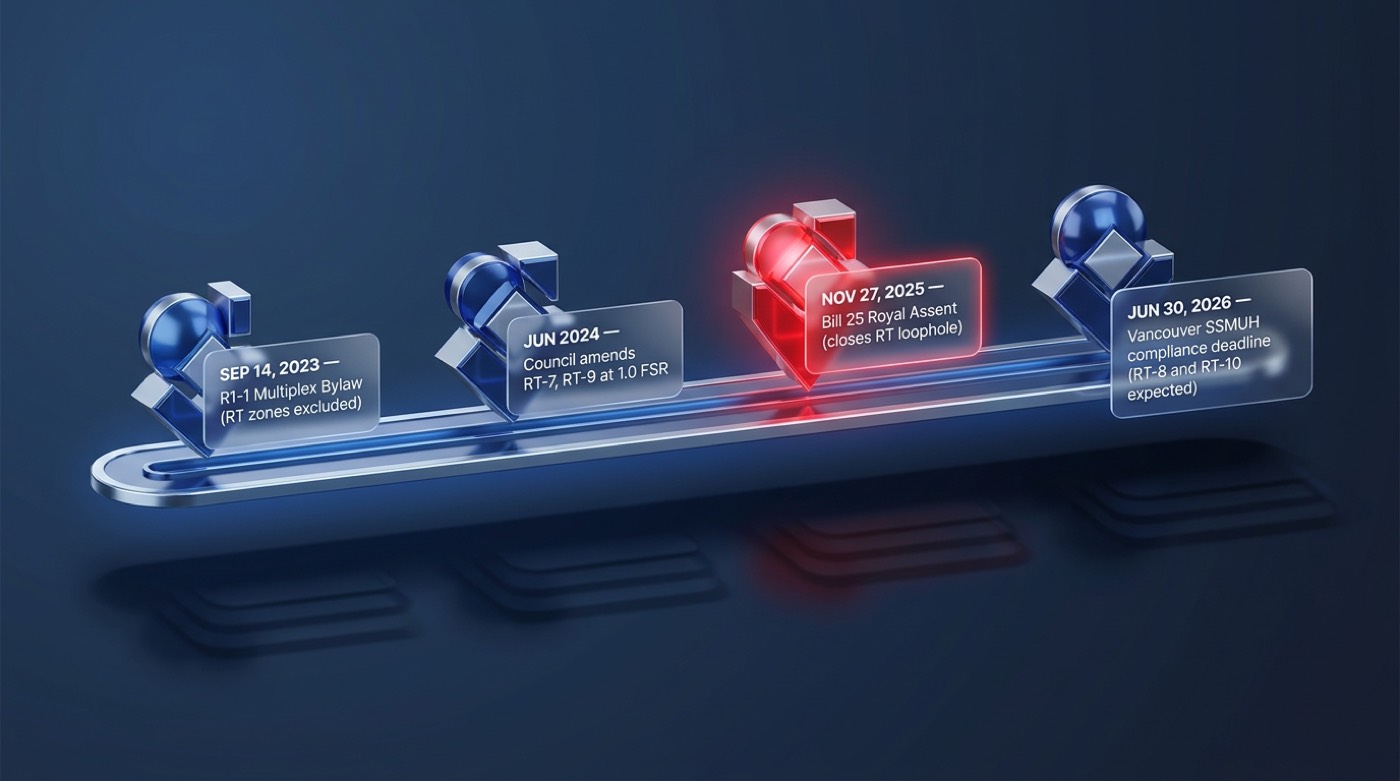
Something quiet happened on November 27, 2025. Bill 25 got Royal Assent in Victoria, and one clause in a long piece of legislation redefined what counts as a “Restricted Zone” under BC’s SSMUH rules. That single change puts RT-8 in Kitsilano and RT-10 in Cedar Cottage squarely on Vancouver’s June 30, 2026 compliance to-do list — zones the city excluded from its 2023 multiplex bylaw on a staff interpretation that Bill 25 now closes. If you own in one of these districts, you’re sitting on the next wave of multiplex-eligible land in Vancouver.
TL;DR
- Bill 25 passed November 27, 2025 and broadens the SSMUH “Restricted Zone” definition. (Province policy bulletin)
- Vancouver’s deadline to comply is June 30, 2026. (City page)
- RT-8 (parts of West Kitsilano) and RT-10 (Kensington–Cedar Cottage) were excluded from the 2023 R1-1 multiplex bylaw. Bill 25 undoes that exclusion.
- Council already amended five zones in June 2024 (RT-7, RT-9, FSD, CD-1 371, CD-1 463) to align with SSMUH at 1.0 FSR. That’s the template for what’s coming to RT-8 and RT-10.
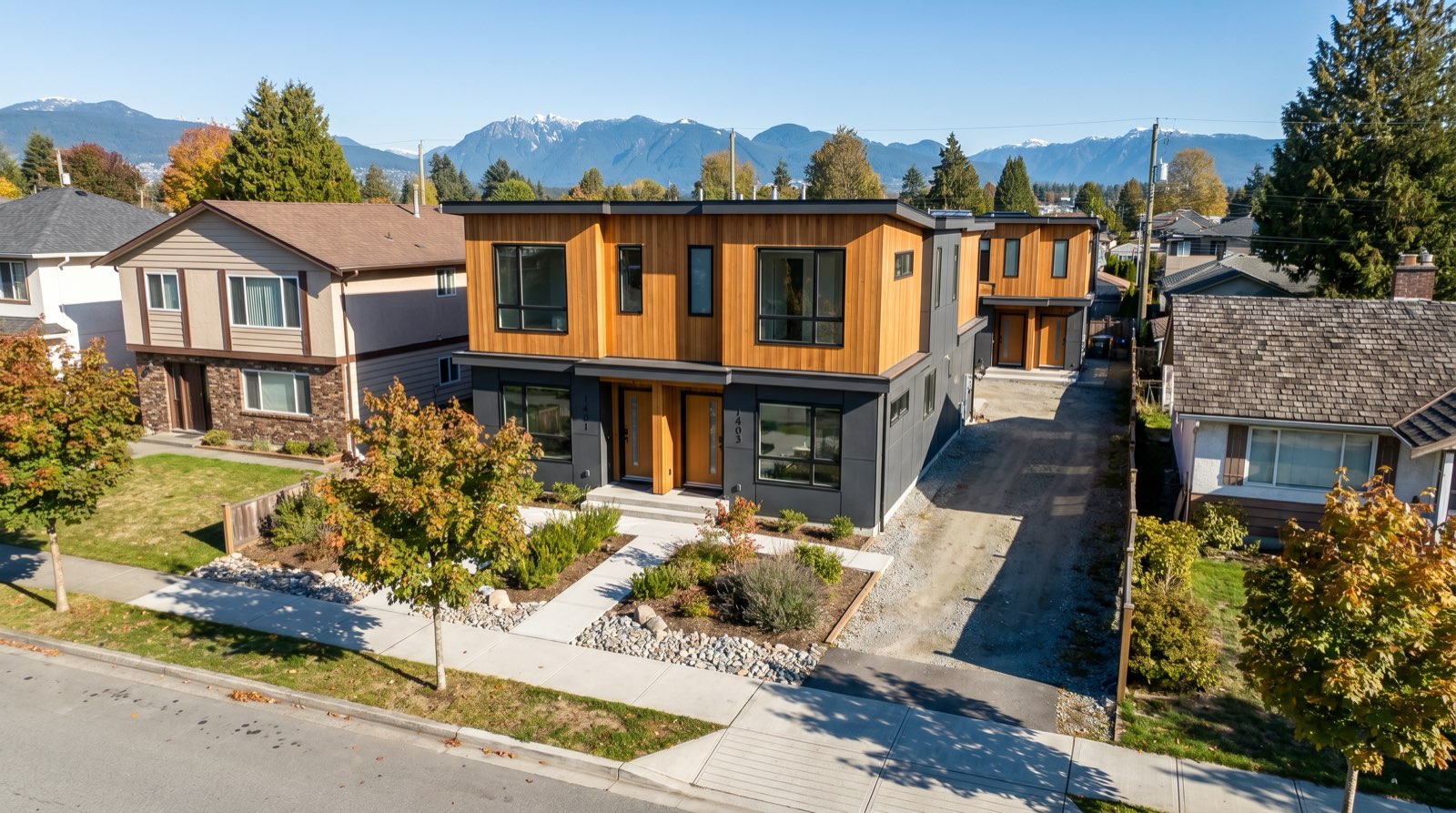
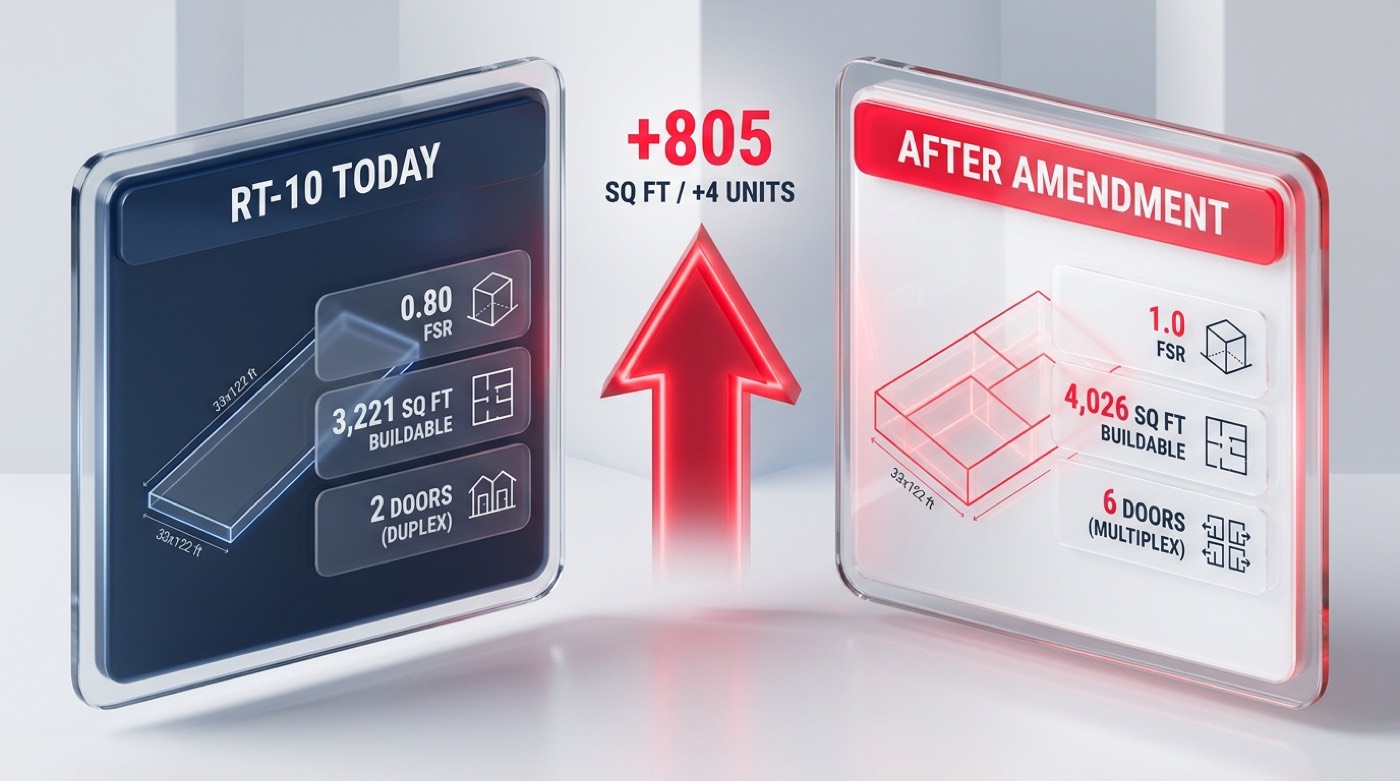
- Owner math: a 33 × 122 ft RT-10 lot at 1.0 FSR allows ~4,026 sq ft of buildable floor area. Four to six rental doors on a lot currently zoned for a duplex is a real equity event.
What RT-8 and RT-10 allow today
RT-8 sits in select West Kitsilano blocks, rezoned out of RT-5 back in May 1994. It’s technically a “two-family” district, and while it allows multiple dwellings conditionally, the outright maximum density is 0.50 FSR with a requirement that at least half the units contain two or more bedrooms. (RT-8 district schedule)
RT-10 covers most of Kensington–Cedar Cottage. It allows one- and two-family dwellings outright, with apartment buildings, townhouses, infill buildings, and small-house/duplex developments permitted conditionally. Maximum density is 0.80 FSR with 45% site coverage. More than half the lots are the classic Vancouver 33 × 122 ft configuration. (Eye on Norquay on KCC RT-10)
Neither zone permits the six-unit multiplex that R1-1 owners got in 2023. That’s the gap Bill 25 closes.
The “Restricted Zone” loophole — and why Bill 25 closed it
When Vancouver passed R1-1 on September 14, 2023 (in effect October 17, 2023), it only applied to former RS zones. (Shape Your City – Multiplexes) Staff argued the RT zones already allowed “multiple dwellings” conditionally, so they didn’t meet the SSMUH definition of “Restricted Zone” and weren’t subject to the provincial mandate.
That interpretation always sat on shaky ground. The policy intent of Bill 44 was to make 4-to-6 unit housing an outright right, not a discretionary ask buried inside a conditional approval process. RT-8’s 0.50 FSR and RT-10’s 0.80 FSR — even with the conditional multiple-dwelling language — don’t deliver what SSMUH was designed to deliver.
Bill 25 rewrote the definition. A Restricted Zone now includes any zone where single-detached dwellings, suites, or detached accessory dwellings are the primary allowed use. (UDI Bill 25 summary) RT-8 and RT-10 fit cleanly inside that.
The template: what council did to RT-7 and RT-9 in June 2024
This isn’t speculation. Vancouver Council has already processed this type of amendment. In June 2024, staff brought forward changes to bring RT-7, RT-9, FSD, and two CD-1 sites into SSMUH compliance, proposing 1.0 FSR in RT-7 and RT-9 to match R1-1. (Shape Your City)
That’s the playbook. When RT-8 and RT-10 come back to council under Bill 25 — and they have to, before June 30 — expect the same treatment: 1.0 FSR outright, multiplex as a permitted use, the same stacked-and-mirrored forms R1-1 owners have been building since 2024.
What’s probable under the amendment:
| Feature | RT-8 today | RT-10 today | Likely post-amendment (R1-1 template) |
|---|---|---|---|
| Max FSR (outright) | 0.50 | 0.80 | 1.0 |
| Multiplex (4–6 units) | Not permitted outright | Not permitted outright | Permitted outright |
| 8-plex rental variant | N/A | N/A | Permitted on qualifying lots (with secured rental) |
| Process | Conditional / rezoning | Conditional / rezoning | As-of-right building permit |
The 8-plex language matters. Under R1-1, properties that commit units to secured market rental can unlock additional density beyond the six-unit multiplex baseline. If RT-8 and RT-10 get the R1-1 template, that door opens in both neighbourhoods.
The equity unlock — Kits and Cedar Cottage math
This is where it stops being policy and starts being your balance sheet.
Take a standard 33 × 122 ft RT-10 lot in Cedar Cottage. At 0.80 FSR, you’re looking at roughly 3,221 sq ft of buildable area — realistically a duplex with a suite. At 1.0 FSR under the R1-1 template, that same lot gets 4,026 sq ft of buildable — six rental doors becomes achievable.
The same arithmetic applies in RT-8 Kitsilano, except the base land value is higher. Kitsilano listings averaged around $2,033,000 across all housing types in April 2026 (Zolo – Kitsilano trends). When a Kits duplex lot gets the as-of-right to hold six units instead of two, the land’s highest and best use changes. So does the appraisal.
Here’s the part most owners miss: equity shows up before you build. Appraisers price land to its zoned capacity. The day RT-8 and RT-10 are amended to R1-1 terms, your refinance number moves — whether you intend to build or not.
Why the “insider” view sees this as close to certain
Three things make this less of a prediction and more of an arithmetic problem:
One. The Province has already demonstrated it will override municipalities. West Vancouver got an Order in Council on April 7, 2026 forcing through the Ambleside Centre Local Area Plan after council refused to adopt it. That’s the first municipal override in BC housing history, and it wasn’t subtle.
Two. Vancouver’s own Vancouver Plan (2022) already names multiplex as “the new baseline to be included in all neighbourhoods.” (Shape Your City) RT-8 and RT-10 sit inside “all neighbourhoods.” The city doesn’t have a policy reason to keep them excluded — only a staff interpretation of a word Bill 25 just redefined.
Three. Council has the amendment template ready. RT-7 and RT-9 were processed in June 2024 using the R1-1 FSR and form standards. Staff don’t need to invent anything new. They need to extend an existing bylaw to two more zone schedules and bring it forward before June 30.
The only real variable is when during Q2 2026 the amendment lands. The deadline doesn’t move.
What Kitsilano and Cedar Cottage owners should do now
Four moves worth making in the next eight weeks:
- Pull your lot’s exact frontage and area. 33 × 122 is typical in RT-10; Kits lots vary more. Your lot’s dimensions drive what’s buildable under the new FSR.
- Order a PlexRank on the property. The ranking tells you whether your lot is in the top decile under the new zoning — that decides whether you build, partner, or sell at re-priced land value.
- Talk to a lender before council does anything. The refinance window opens the day the amendment passes. Lenders move slower than appraisers. Line up your financing team early.
- Don’t list before the amendment. If you sell a duplex lot today at 0.80 FSR pricing and the amendment lands in June at 1.0 FSR, you’ve handed the uplift to the buyer. Unless you have a reason to transact now, wait for the bylaw.
The homeowners who captured the biggest gains from the 2023 R1-1 rollout were the ones who knew it was coming. RT-8 and RT-10 owners are roughly six weeks from having the same window.
Frequently asked
Has the City of Vancouver announced RT-8 and RT-10 amendments yet? Not as of April 18, 2026. No council report specifically naming RT-8 or RT-10 has been made public. The pressure comes from Bill 25’s redefinition of Restricted Zones combined with the province’s June 30, 2026 compliance deadline. Expect the public report between now and early June.
What if council refuses, the way West Vancouver did on Ambleside? The Province has the authority — and has now used it — to impose zoning directly under the Local Government Act by ministerial order. Refusing doesn’t prevent the outcome. It just changes who signs the bylaw.
Does this mean every RT-8 and RT-10 lot becomes a six-plex site? No. Zoning is necessary but not sufficient. Site-specific factors — servicing, lot geometry, trees, slope, heritage — still drive what’s buildable. That’s why the PlexRank score matters more than the zoning alone.
Will existing RT-8 heritage areas be treated differently? Possibly. RT-7 and RT-9 amendments carried forward specific form-based controls for character streets. Expect similar carve-outs in the RT-8 amendment for Kitsilano blocks with heritage inventory. RT-10 has less heritage overlay to work around.
The window here is narrow, and it’s specific to the zone you own in. If you’re holding in RT-8 or RT-10, the question isn’t whether the rules are changing — Bill 25 already decided that. The question is whether you’ve run the numbers on your own lot before the amendment lands.
Run your RT-8 or RT-10 lot through PlexRank and see where your property sits under the likely amended zoning. It takes two minutes and tells you whether this is a build, a partner, or a pre-rezoning sale.
— Vassi Balatico, Vancouver Multiplex Realtor | PlexRank™ | Profit with Multiplex