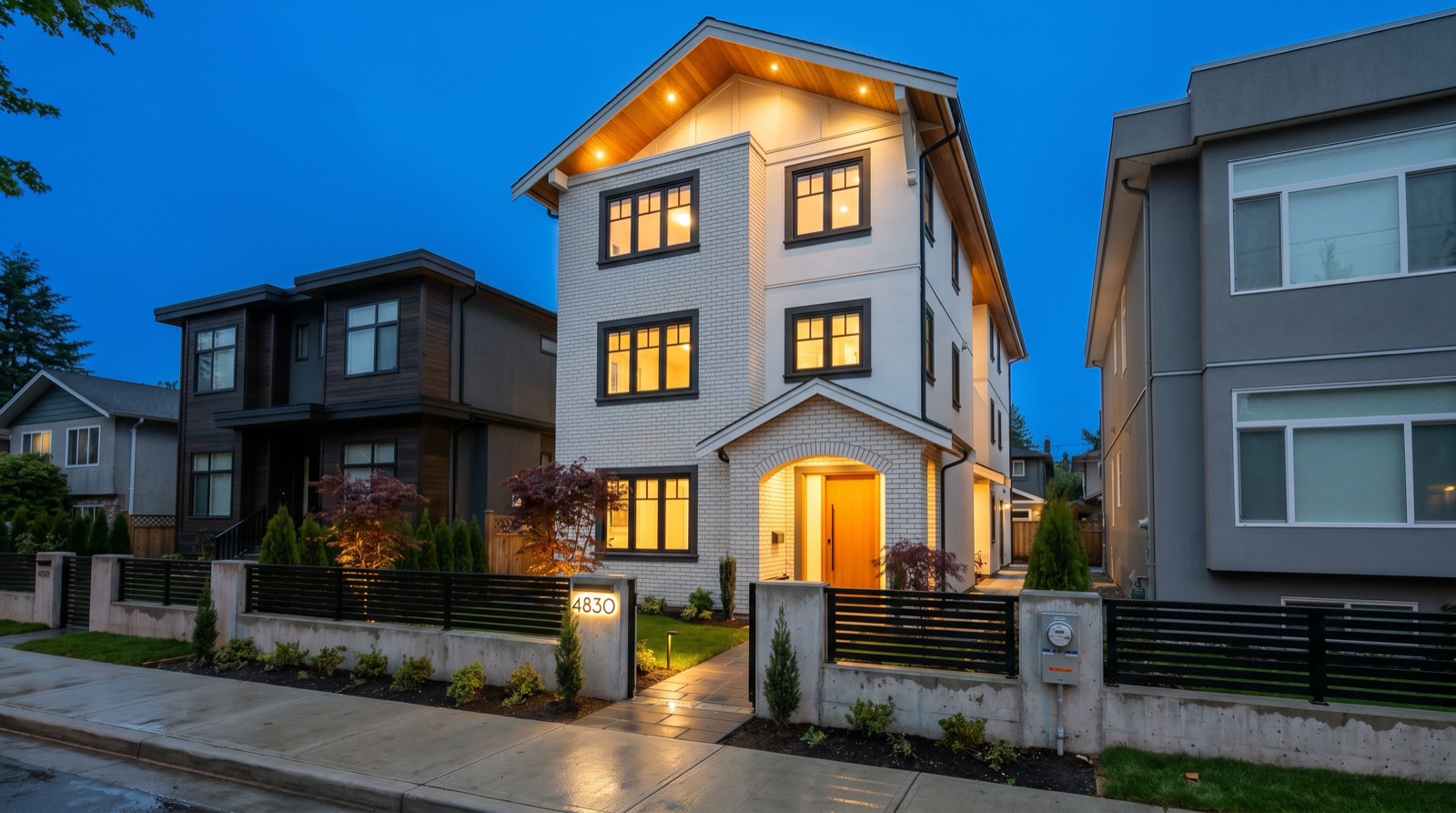
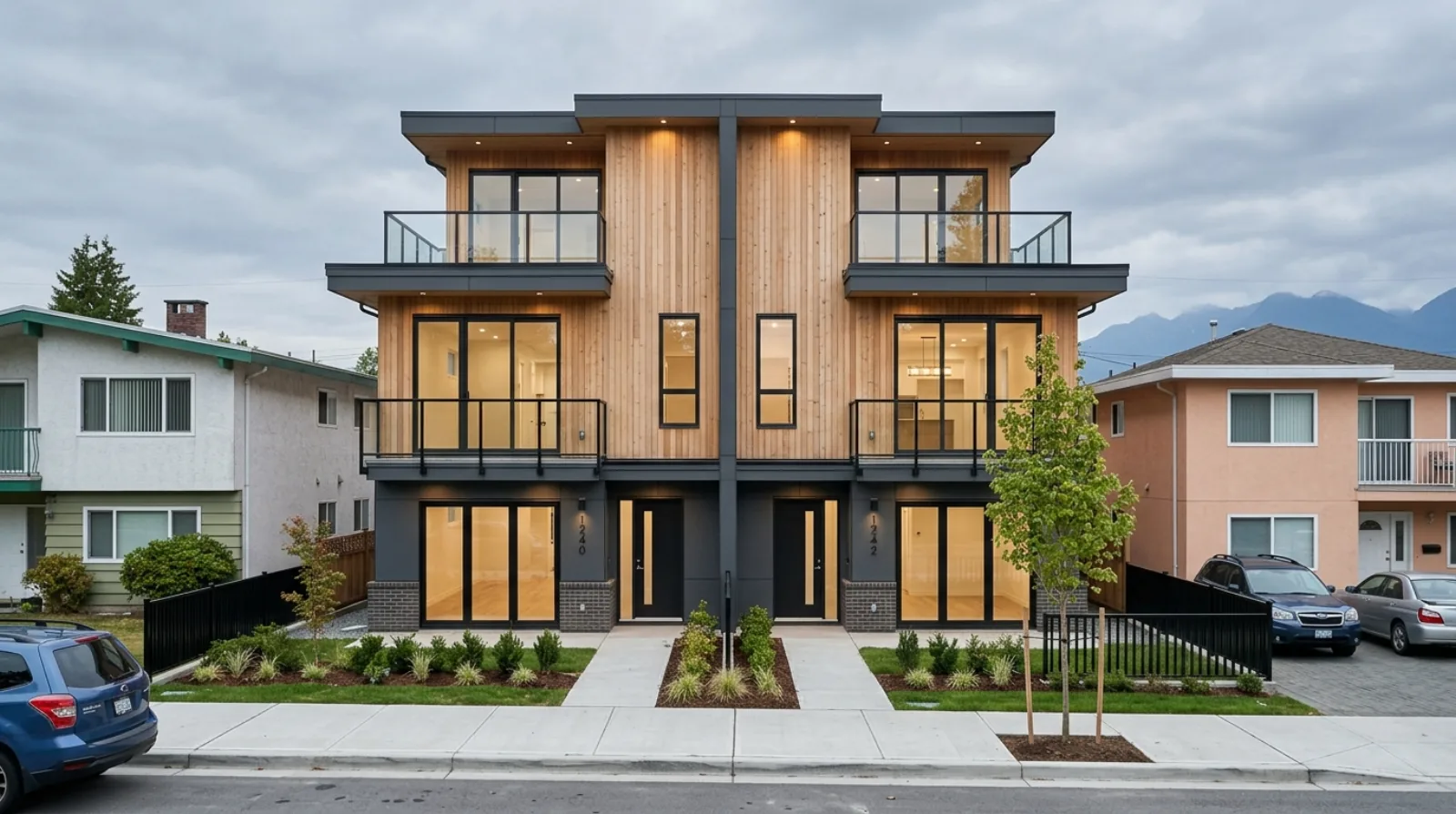
A pad-mounted transformer (PMT) on your multiplex site costs around $50,000, eats roughly 80 square feet of buildable area, forces a structural jog in the rear of the building, and — because BC Hydro’s transformer lead times now run up to a year — can delay your project by months. It also redraws your site plan after the architect has already done it.
If you can stay below the BC Hydro service threshold that triggers a PMT, you skip all of that. Solar panels are one of the cleanest ways to get there.
This post explains how — and why solar isn’t a magic bullet on its own.
TL;DR (Key Takeaways)
- A PMT costs $50,000+ to install in BC and takes up at least 80 sq ft of your site
- BC Hydro’s transformer lead time is up to a year — and engineering design adds more
- A PMT redraws the site plan after the architect is done: structural jog in the rear, lost parking stall, aesthetic compromise
- BC Hydro decides if you need a PMT based on proposed service load, not number of units
- The escape route: stay on a 400A overhead service by reducing peak demand — solar PV + smart panels + power-efficient envelope + heat pumps all push in this direction
- Solar alone won’t get you there; solar paired with battery storage and a smart load panel is the meaningful tool
- Vancouver published a Multiplex Electrical Process Guide using Power Efficient Design (PED) — designed precisely to help projects avoid PMTs
What a PMT actually costs you (it’s not just the $50K)
The dollar number gets quoted often. The full cost is more painful.
Direct cost: $50,000 or more for the transformer install in BC.
Site plan impact:
- 80+ square feet of buildable lot consumed
- Typically requires a structural jog in the rear of the building
- Often takes one parking stall
- Hard clearance rules around landscaping, fencing, and adjacent structures
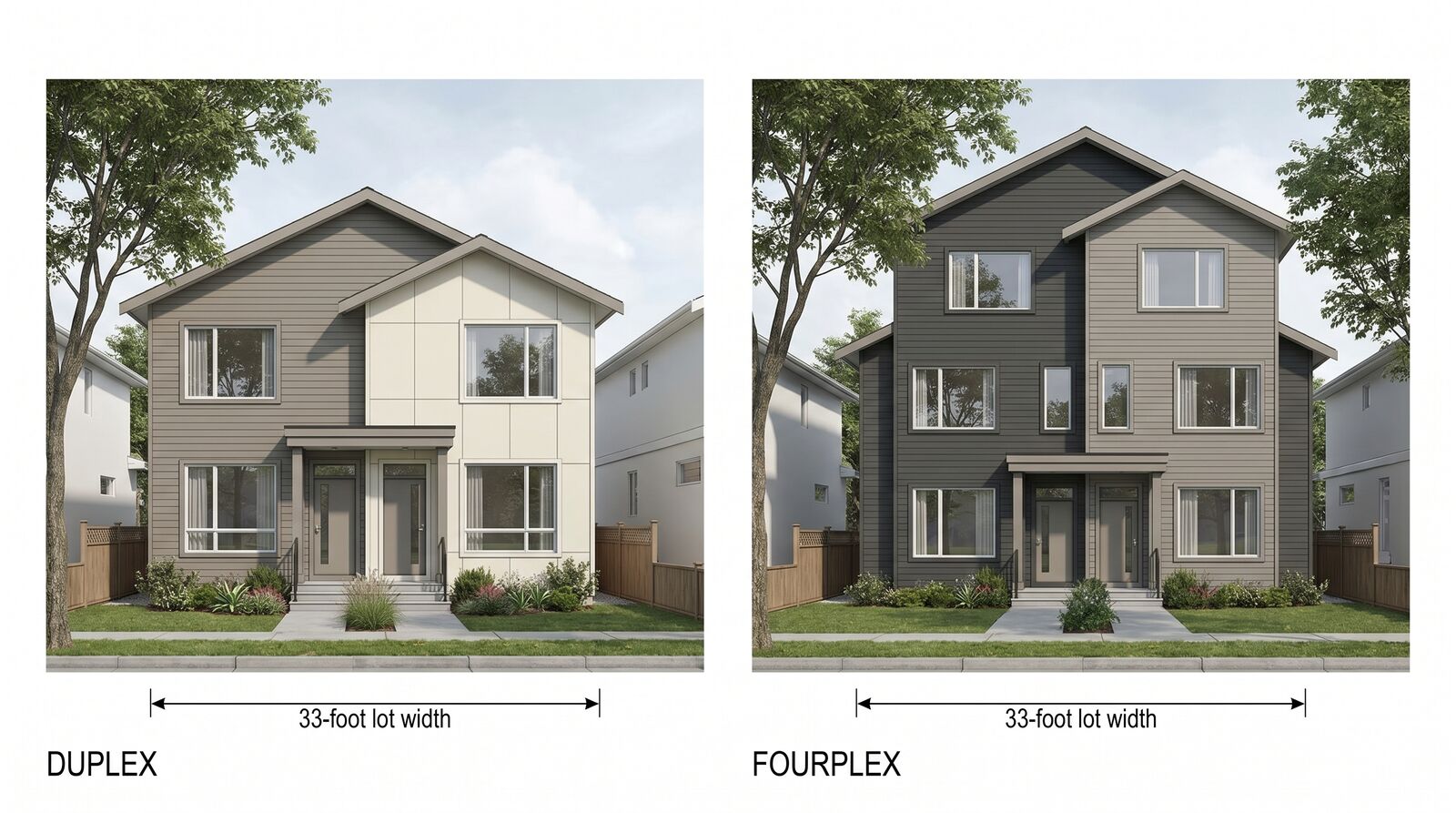
- Conflicts with protected trees, easements, and tight side yards on standard 33 ft Vancouver lots
Schedule impact:
- BC Hydro transformer lead times running up to a year
- Engineering and design time on top of that
- Can push permit issuance and project completion sideways by months
Design impact:
- Architect has to redraw the site plan after PMT requirement is confirmed
- Often happens late in permitting, after design fees are largely spent
- Can force loss of a unit, loss of a parking stall, or a less-rentable building geometry
If you can avoid it, the savings compound — money, schedule, square footage, and design integrity all at once.
Why BC Hydro requires a PMT in the first place
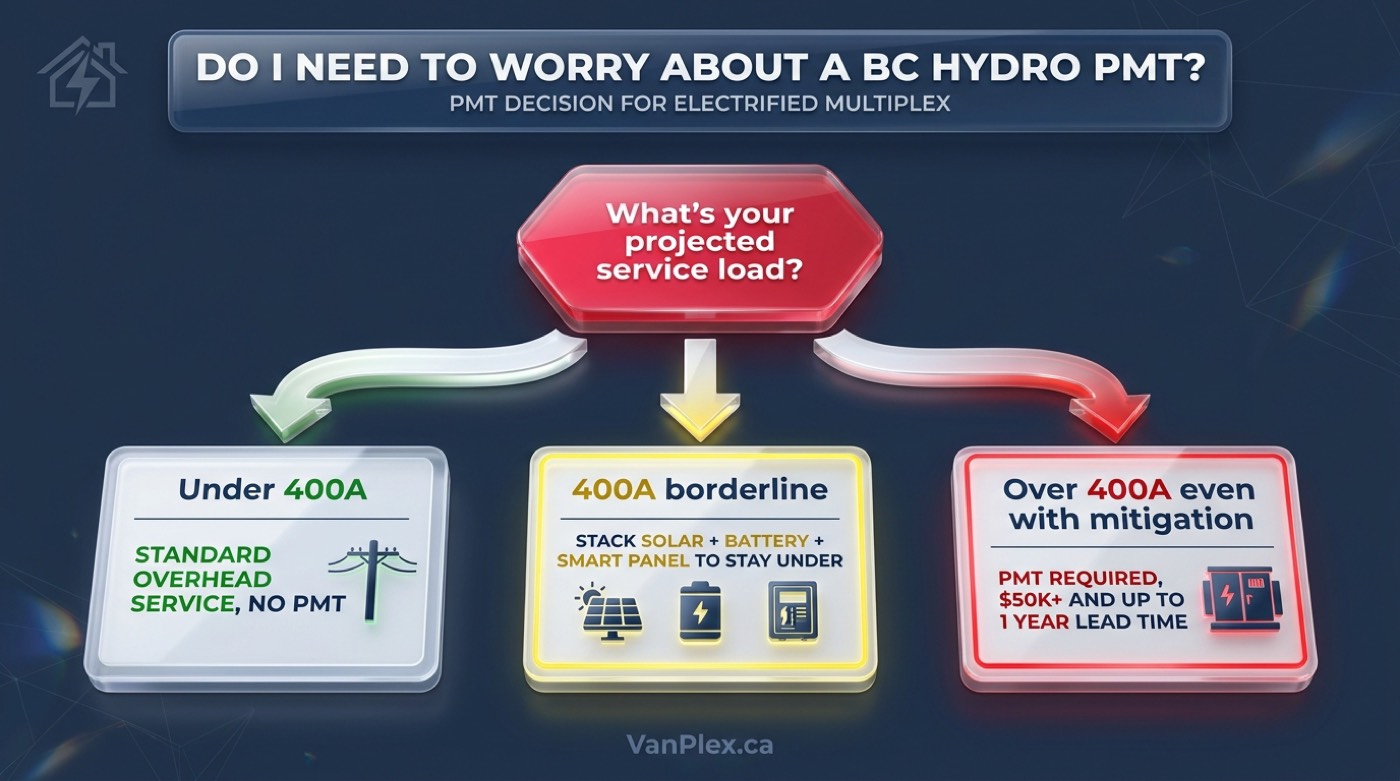
BC Hydro doesn’t require a PMT because you have four units. It requires one because your proposed service load is too high for the existing single-phase, pole-mount infrastructure on your block.
The threshold most projects bump into: 400 amps.
A standard 400A overhead service is what BC Hydro can deliver to most Vancouver lots without upgrading to a PMT. If your multiplex’s connected load and projected peak demand push you past 400A, BC Hydro will require either a 600A or 800A service, which typically means a transformer.
What pushes a multiplex over 400A? The usual suspects:
- All-electric heating and cooling (heat pumps in every unit)
- Electric vehicle charging on multiple stalls
- Induction cooking, electric water heating, and electric dryers in every unit
- Multiple units running simultaneously during peak hours
Bill 44 multiplexes are increasingly all-electric — gas connections are being phased out in Vancouver new construction. The result: a fully-electrified six-unit project on a standard lot routinely exceeds 400A unless you actively design around it.
Where solar fits — and what it does to the BC Hydro calculation
This is where the user’s question matters: can solar panels help avoid a PMT?
The honest answer: yes, but not on their own.
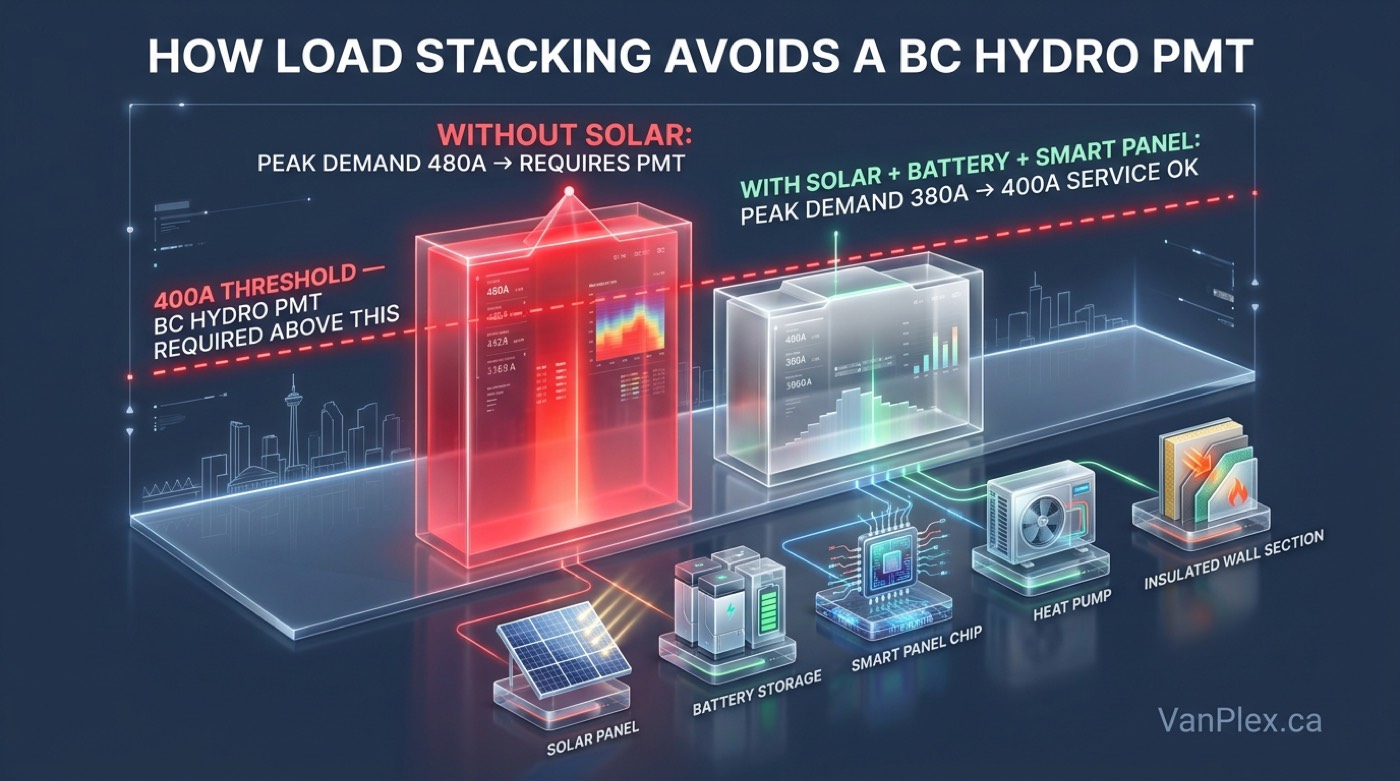
BC Hydro sizes your service based on peak demand, not annual energy consumption. A solar array that produces 8,000 kWh per year reduces your annual import from the grid — but if your peak demand on a January evening at 6 pm (when nobody’s PV is producing and everybody’s heat pump is running) is still 480A, you still need 600A service. You still need a PMT.
What changes the math is solar plus a smart electrical setup:
- Solar PV generates significant load during daytime hours — reducing what BC Hydro sees at the meter during summer afternoons (when EV charging and AC also peak)
- Battery storage (paired with solar) stores midday solar production and discharges during evening peak — directly cutting the peak BC Hydro sees, which is the number that determines service sizing
- Smart load panels (e.g., Span, Lumin, others) actively manage which loads run when, capping peak demand at a configurable ceiling
- Heat pumps (especially cold-climate inverter-driven units) draw far less than resistance heating
- Power Efficient Design envelope (triple glazing, continuous insulation, air barriers) reduces heating/cooling load year-round, lowering the baseline demand the heat pumps need to satisfy
When BC Hydro evaluates your service load, it’s looking at the building’s expected peak. If your design submission can credibly demonstrate that solar + battery + smart panel + envelope keeps the peak below 400A, BC Hydro can issue a 400A overhead service. No PMT.
That’s the case to make.
What Vancouver’s Multiplex Electrical Process Guide says
The City of Vancouver and BC Hydro jointly published the Multiplex Electrical Process Guide specifically because PMTs were stalling multiplex projects. The guide pushes builders toward Power Efficient Design (PED) — a coordinated set of strategies designed to keep multiplexes under the threshold that triggers a PMT.
Three points worth knowing:
- Engage BC Hydro early. Submit a service load assessment before final design, not after. The process is designed to give you a yes/no on PMT before you’ve committed to drawings that depend on the answer.
- PED tactics stack. No single tactic — solar, smart panel, heat pump — is enough on its own for a fully-electrified 6-unit project. Stacking them is.
- The goal is a 400A overhead service. Frame every load-related design decision against whether it keeps you below that bar.
The numbers on solar specifically
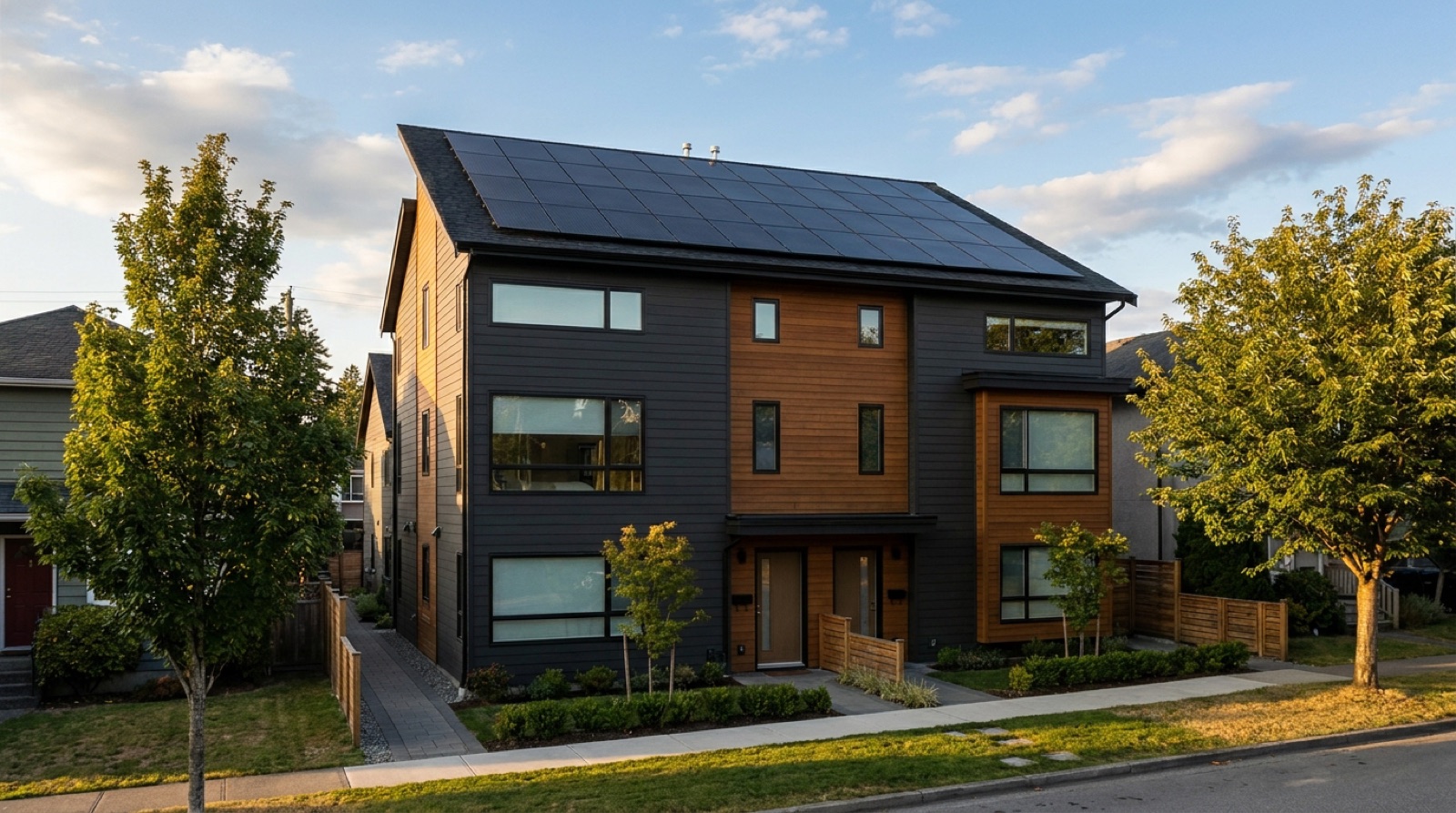
For a typical 4–6 unit Vancouver multiplex, a roof-mounted solar PV system in the 8–15 kW range fits on the available roof footprint without dominating the design. Costs vary, but a 10 kW system in BC currently lands roughly in the $25,000–$35,000 range installed (incentives and rebates can move this).
When paired with a 10–15 kWh battery and a smart load panel, the system contributes meaningfully to peak shaving — the demand reduction that BC Hydro cares about.
The trade math is straightforward:
- PMT cost avoided: $50,000+ direct, plus site plan, schedule, and design impact
- Solar + battery + smart panel cost: $40,000–$60,000 typical, depending on system size
If the solar package keeps you under 400A, you’ve spent roughly the same money but kept your site plan, your unit count, your rentable square footage, and your schedule intact. And you own an asset that produces electricity for 25 years.
If it doesn’t quite get you there on its own, you’ve still meaningfully reduced your annual operating costs and improved your CMHC MLI Select energy efficiency scoring (see our CMHC MLI Select September 30, 2026 Energy Deadline post for what that’s worth in premium discounts and amortization).
What to do this week if you’re designing a multiplex
Three concrete actions:
1. Get a real service load estimate before final drawings
Before you commit to all-electric heating, EV charging on every stall, and induction cooking in every unit, have your electrical engineer model the projected peak demand. Submit a service load inquiry to BC Hydro. The answer determines whether PMT mitigation matters for your project at all.
2. Stack the right strategies — not just solar
If you’re at risk of a PMT, the path that works is:
- High-performance envelope (the cheapest watts are the ones you don’t need)
- Right-sized cold-climate heat pumps with smart thermostats
- Solar PV sized to your roof footprint
- Battery storage if PMT avoidance is the goal (not just energy savings)
- A smart load panel that actively caps peak demand
- EV charging on a managed circuit, not a hard-wired load
Each of these does part of the work. Together they routinely keep a six-unit electrified multiplex under 400A.
3. Check your current proforma against the PMT scenario
If your proforma assumed standard service and you turn out to need a PMT, that’s $50K+ direct cost, lost square footage, and months of schedule. If your proforma assumes PMT and you avoid one with a solar package, that’s a meaningful upside.
For a quick check on whether your specific Vancouver or Burnaby lot is at PMT risk — and what the load-displacement strategy looks like in dollar terms — drop the address into the VanPlex proforma. It models the BC Hydro service path alongside the rest of the project.
Author: David Babakaiff, Co-Founder of VanPlex PlexRank™ | Profit with Multiplex
Sources:
- City of Vancouver — Multiplex Electrical Process Guide (Power Efficient Design)
- BC Hydro — Pad-Mounted Transformer Installation on Private Property
- BC Hydro — Why solar is a bright idea for load displacement
- BC Hydro — Small-scale, multi-unit housing guide for local governments
- DClark Architect — The Simplest Path to an Energy-Efficient Multiplex (and How to Avoid a Costly PMT)