
In 1971 the City of Vancouver counted 76,140 single-detached houses, half of all the homes in the city. The 2021 census counted 44,755, which is 14.7 percent of the city’s 305,335 occupied homes. Builders started 2,138 detached homes across the whole Vancouver region in 2025, the lowest full year in a Statistics Canada series that begins in 1972.
Those three numbers describe the same shift from different angles. The detached house is now a small share of Vancouver’s homes, and the supply of new ones has nearly stopped.
The famous number is partly a counting change
You have probably seen the line that Vancouver lost 35,000 detached houses. It comes from comparing the 1971 census count of 76,140 with the 2016 count of 41,330. The drop is real on paper. The reason behind it is worth knowing before you repeat it.
Statistics Canada counts a house with a legal secondary suite as two dwellings in a duplex. Vancouver legalized secondary suites across its single-family areas in 2004, and each census since has found more of them. The demographer who published that 1971 to 2016 chart, Jens von Bergmann of CensusMapper, says plainly that most of the decline came from this reclassification rather than from demolition.
Here is what the 2021 numbers show for the City of Vancouver.
| Type of home, 2021 census | Count | Share |
|---|---|---|
| Apartment in a building under five storeys | 95,120 | 31.2% |
| Apartment in a building of five storeys or more | 94,820 | 31.1% |
| Apartment or flat in a duplex | 54,305 | 17.8% |
| Single-detached house | 44,755 | 14.7% |
| Row house | 10,820 | 3.5% |
| Semi-detached house | 4,805 | 1.6% |
| Other single-attached house | 700 | 0.2% |
| Movable dwelling | 20 | 0.0% |
| Total occupied private dwellings | 305,335 | 100% |
Source: Statistics Canada, table 98-10-0041-01, Structural type of dwelling and household size, 2021 Census.
Look at the 54,305 in the duplex row. A large share of that number is ordinary Vancouver houses with a suite downstairs. Physically they are detached houses standing alone on their own lots.
Between the last two censuses the count rose: 41,330 in 2016 and 44,755 in 2021. The share kept falling over the same period, from 50 percent of the city’s homes in 1971 to 14.7 percent in 2021, because Vancouver added apartments and townhouses far faster than it added houses.
The share is the number that matters here, and it has fallen in every census since 1971.
Replacement houses are barely being built
The census tells you what exists. Housing starts tell you what is coming. This is where the picture stops being a debate about definitions.
| Year | Single-detached starts, Vancouver region |
|---|---|
| 2016 | 5,169 |
| 2019 | 3,426 |
| 2022 | 3,392 |
| 2023 | 2,832 |
| 2024 | 2,176 |
| 2025 | 2,138 |
| 2026, January to July | 1,093 |
Source: Statistics Canada table 34-10-0154-01, CMHC housing starts, Vancouver census metropolitan area, single-detached units, monthly, summed by year.
From 5,169 in 2016 to 2,138 in 2025 is a fall of 58.6 percent in nine years. That 2025 total is the lowest of any full year in the series, and the series starts in 1972. Fifty-four full years of records, and 2025 sits at the bottom of all of them.
The provincial picture matches. British Columbia started 5,355 detached homes in 2025, the lowest annual total in a Statistics Canada series running back to 1955.
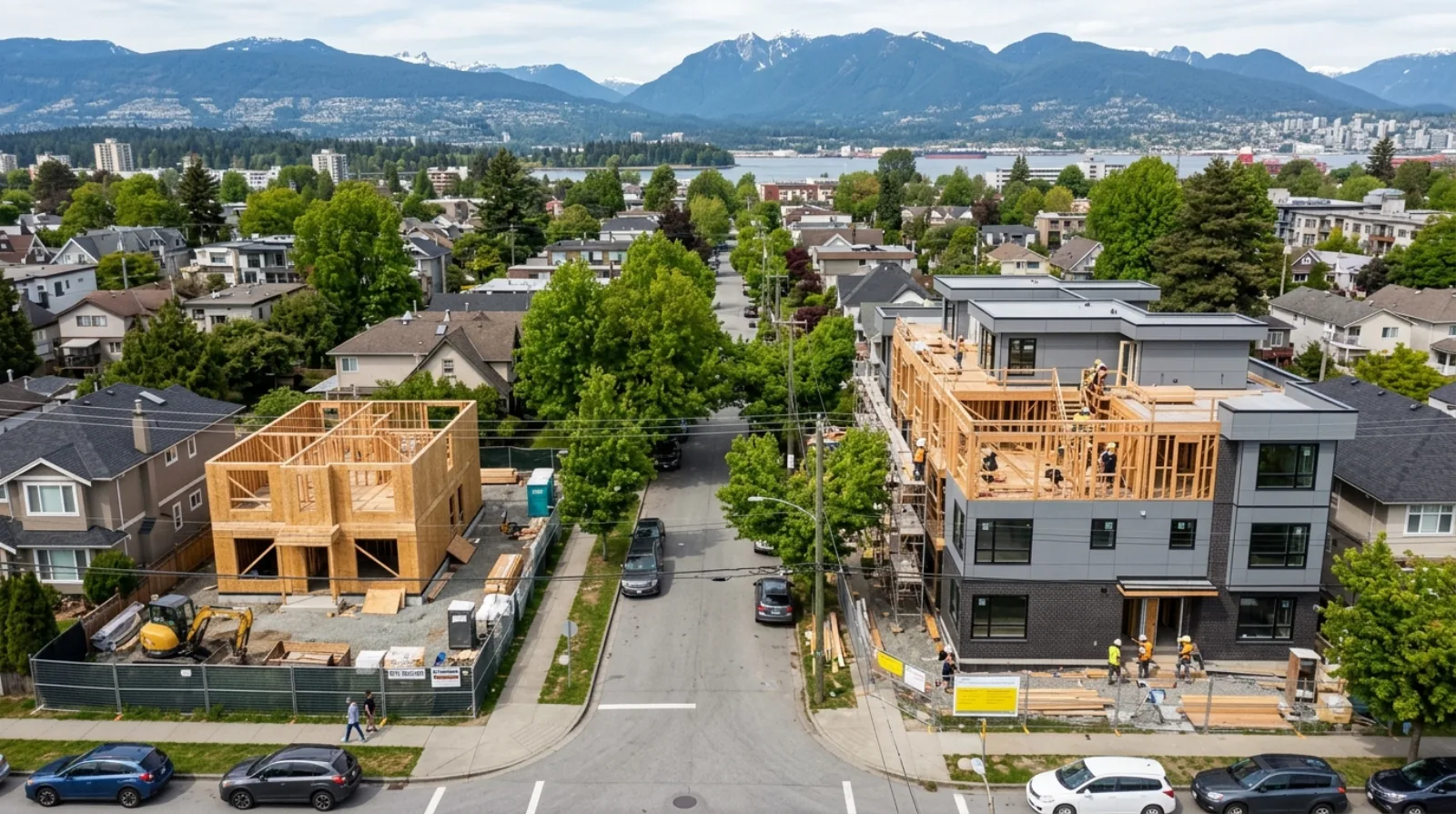
A detached house that reaches the end of its life in Vancouver is rarely replaced by another detached house. Something else goes up on the lot.
What is going up on those lots instead
VanPlex tracks every multiplex project in the city, from development permit through to completion. Here is what the tracker held on September 11, 2026.
| Vancouver multiplex tracker | Figure |
|---|---|
| Total projects tracked in the City of Vancouver | 791 |
| Projects with a permit dated July 1, 2024 to September 1, 2026 | 602 |
| Average rate over that window | 5.3 new projects per week |
| Projects at construction or near-completion today | 332 |
| Homes across the 737 projects that list a unit count | 2,900 |
Source: VanPlex permit tracker, measured September 11, 2026. Counts change as new permits are issued.
The size mix tells you what shape these buildings take. Fourplexes lead with 264 projects, then triplexes at 195, then six-unit buildings at 113. Most of them fit on a single standard Vancouver lot.
Work through what that means. Those 2,900 homes sit on 737 sites, which works out to 3.9 homes per site. On a lot that held one house, that is close to four families where there was one.
The video below is Dan Wurtele, a Vancouver REALTOR®, working through the VanPlex permit map. It starts at 5 minutes 45 seconds, where the map segment begins.
Dan Wurtele walks through the VanPlex permit map, starting at 5:45. Open the live version at vanplex.ca/multiplex-projects.
The price gap that pays for the switch
Builders choose a multiplex because of the gap between two benchmark prices.
| Greater Vancouver benchmark, August 2026 | Price | Change from August 2025 |
|---|---|---|
| Detached | $1,799,400 | down 7.2% |
| Attached (townhouse and multiplex home) | $1,028,800 | down 4.4% |
| Apartment | $686,200 | down 6.6% |
Source: Greater Vancouver REALTORS®, August 2026 statistics package, released September 2, 2026.
The distance between the detached and attached benchmarks is $770,600. Land that supports one home at $1,799,400 can support four homes near $1,028,800 each. Four times $1,028,800 is $4,115,200 of finished value from one lot. The comparison holds while prices fall, because both benchmarks fall together.
That gap also sets what a detached lot sells for. A Vancouver lot is now priced on the three, four, or six homes the rules allow on it.
The market for a detached house got much thinner
Fewer detached homes exist as a share of the city, fewer are being built, and fewer are changing hands.
| Detached sales, Greater Vancouver | Full year | Monthly average |
|---|---|---|
| 2005 | 16,665 | 1,389 |
| 2024 | 7,542 | 629 |
| 2025 | 6,725 | 560 |
Sources: Real Estate Board of Greater Vancouver news release, January 2006 (2005 full year); Greater Vancouver REALTORS® year-end 2025 statistics package, released January 5, 2026.
Detached sales fell 59.6 percent between 2005 and 2025. In August 2026 the region recorded 557 detached sales, and total home sales of 1,869 sat 20.7 percent below the ten-year average for that month of 2,356.
A thin market has a cost for sellers, and honest advice has to say so. In a slow year there are fewer buyers for a detached house, and the price shows it. Detached benchmarks fell 7.2 percent over the year to August 2026, which is a larger drop than either townhouses or apartments recorded.
Scarcity works on a timescale of decades. It says nothing about what a house sells for this month. Treat any claim that a Vancouver lot can only rise in value as a sales pitch.
What this actually means if you own one
Three practical readings, depending on where you sit.
If you own a detached house in Vancouver and are thinking about downsizing. Selling means giving up a lot in a category the city has stopped adding to. You can buy another one, and you will pay the market price for something the region produced 2,138 of last year. Check what your lot supports under the current rules before you list it. A lot that can hold four homes is worth more than the house standing on it, and the difference is often large enough to change the plan.
If you want to buy a detached house. You are shopping in a market with fewer sales than at any point in twenty years. In August 2026 the sales-to-active-listings ratio for detached homes was 9.6 percent, which GVR treats as buyer’s market territory, and prices are down year over year across all three property types. You are also buying into a category that new construction has nearly stopped adding to.
If you are deciding between a detached home and a new multiplex home. They are separate products with separate math. A multiplex home costs $770,600 less than the detached benchmark at August 2026 prices and arrives new, so the big repair bills sit decades away. A detached lot gives you land you control by yourself and the option to build on it later. Pick the one that fits how you plan to live, and be honest about which mortgage you can carry.
The part that is genuinely uncertain
The Vancouver region held 3,088,036 people on July 1, 2025, up from 2,771,430 in 2021, while its detached stock stayed flat. Whether that turns into a price premium for detached homes depends on interest rates, immigration, incomes, and whether the province keeps pushing density. None of those is knowable from a census table, so anybody publishing a 2046 house-count forecast is guessing.
What is knowable is on the record above. The share fell from 50 percent to 14.7 percent. Detached starts hit their lowest level in the 54 years the count has existed. Vancouver permitted 5.3 multiplex projects a week over the past two years, and each one replaces a house.
Want to know what your Vancouver lot supports and what the numbers look like? Check your address on the Vancouver multiplex page, browse what is on the market at multiplex lots for sale, or open the live Vancouver multiplex project tracker. For the permit side of the same story, read what Vancouver’s building permits say about the next decade.
Sources: Statistics Canada, table 98-10-0041-01, Structural type of dwelling and household size, 2021 Census of Population; Statistics Canada, table 34-10-0154-01, CMHC housing starts, under construction and completions in selected census metropolitan areas, monthly; Statistics Canada, table 34-10-0135-01, CMHC housing starts, under construction and completions, all areas, quarterly; CensusMapper, Single-detached Dwellings timeline (Jens von Bergmann), 1971 and 2016 census counts for the City of Vancouver; Real Estate Board of Greater Vancouver news release, January 2006, full-year 2005 sales and December 2005 benchmark prices; Greater Vancouver REALTORS®, year-end 2025 statistics package, released January 5, 2026; Greater Vancouver REALTORS®, August 2026 statistics package and market report, released September 2, 2026; VanPlex permit tracker, measured September 11, 2026.
David Babakaiff, Co-Founder, VanPlex | PlexRank™ | Profit with Multiplex