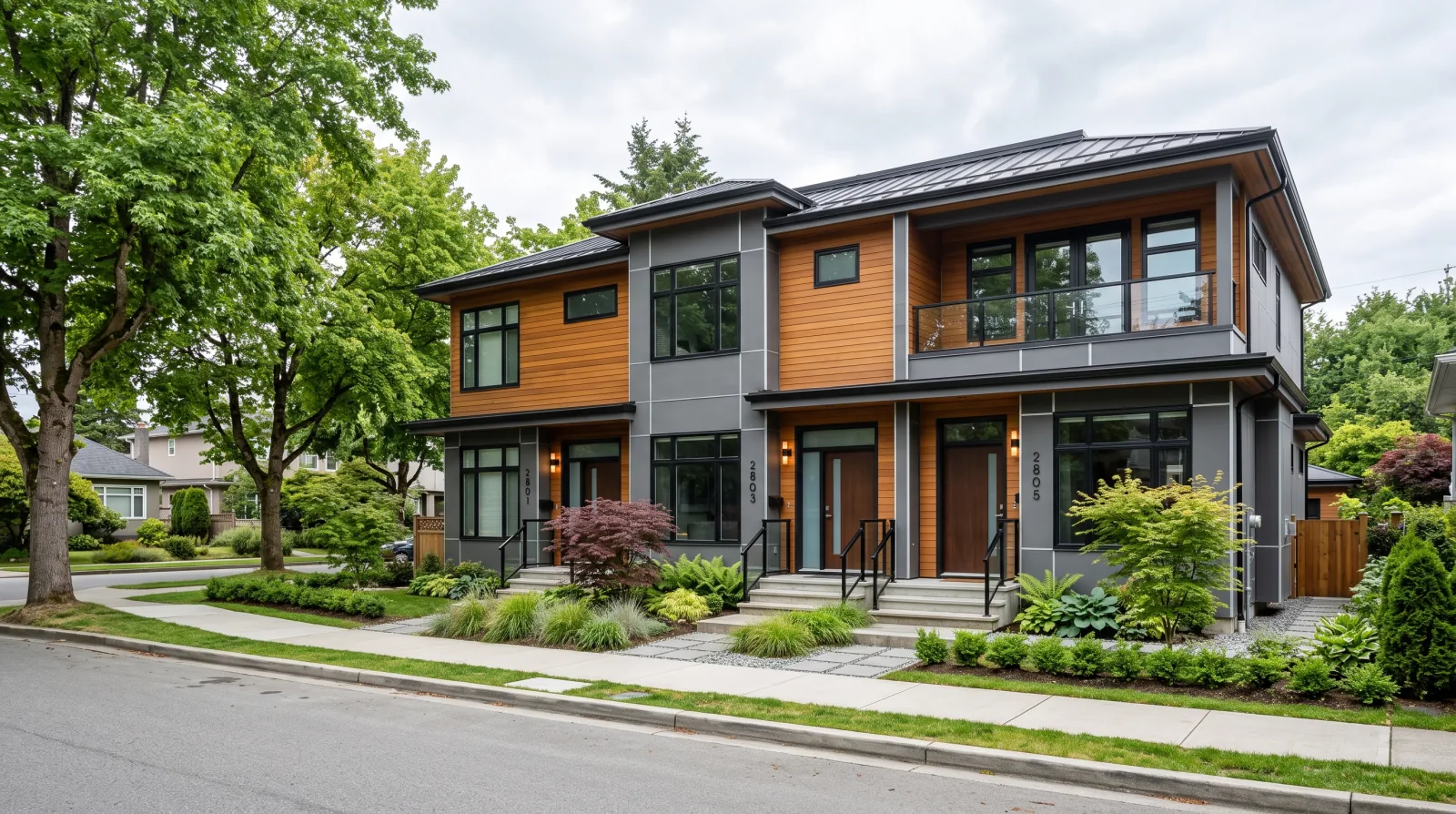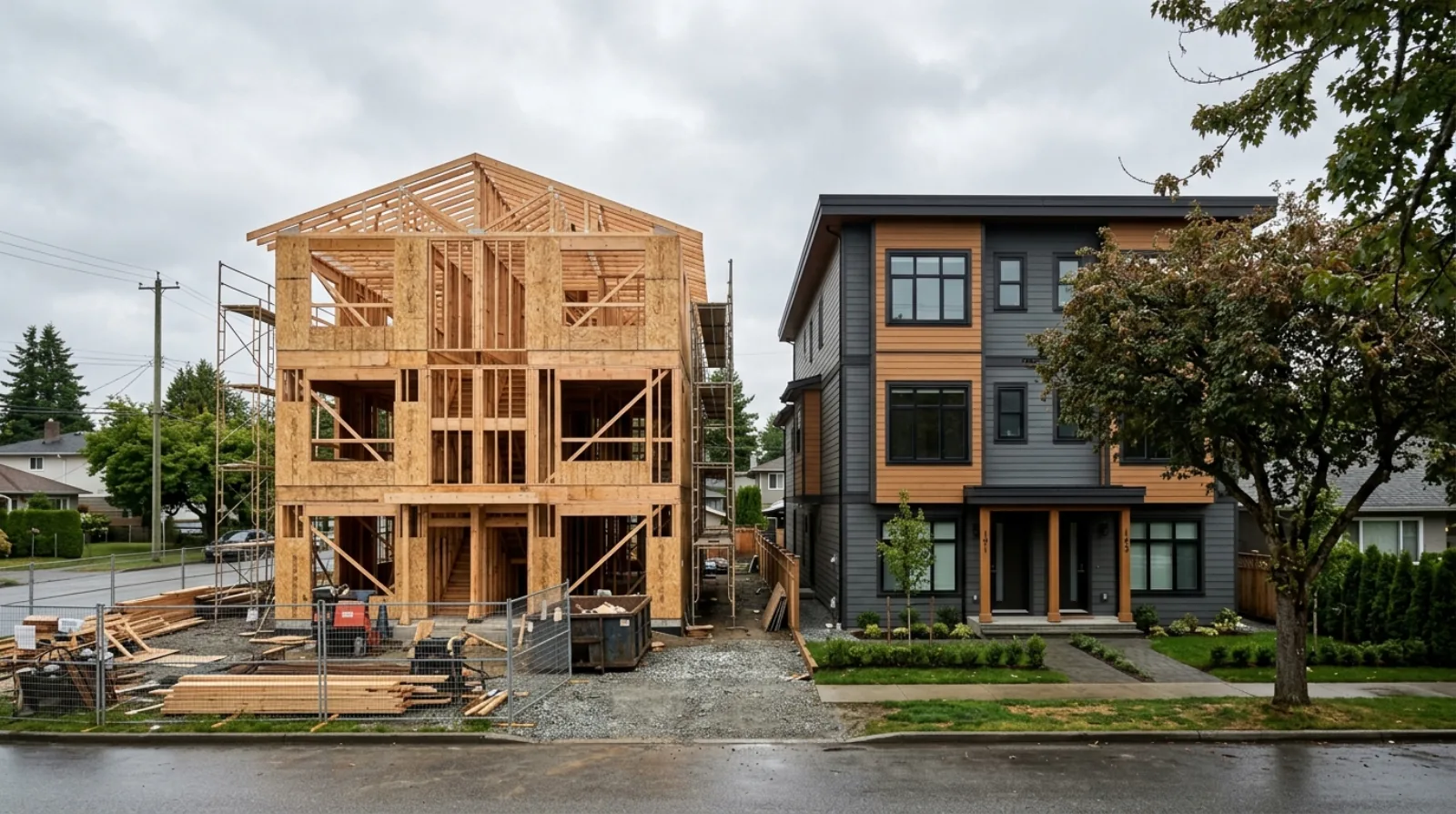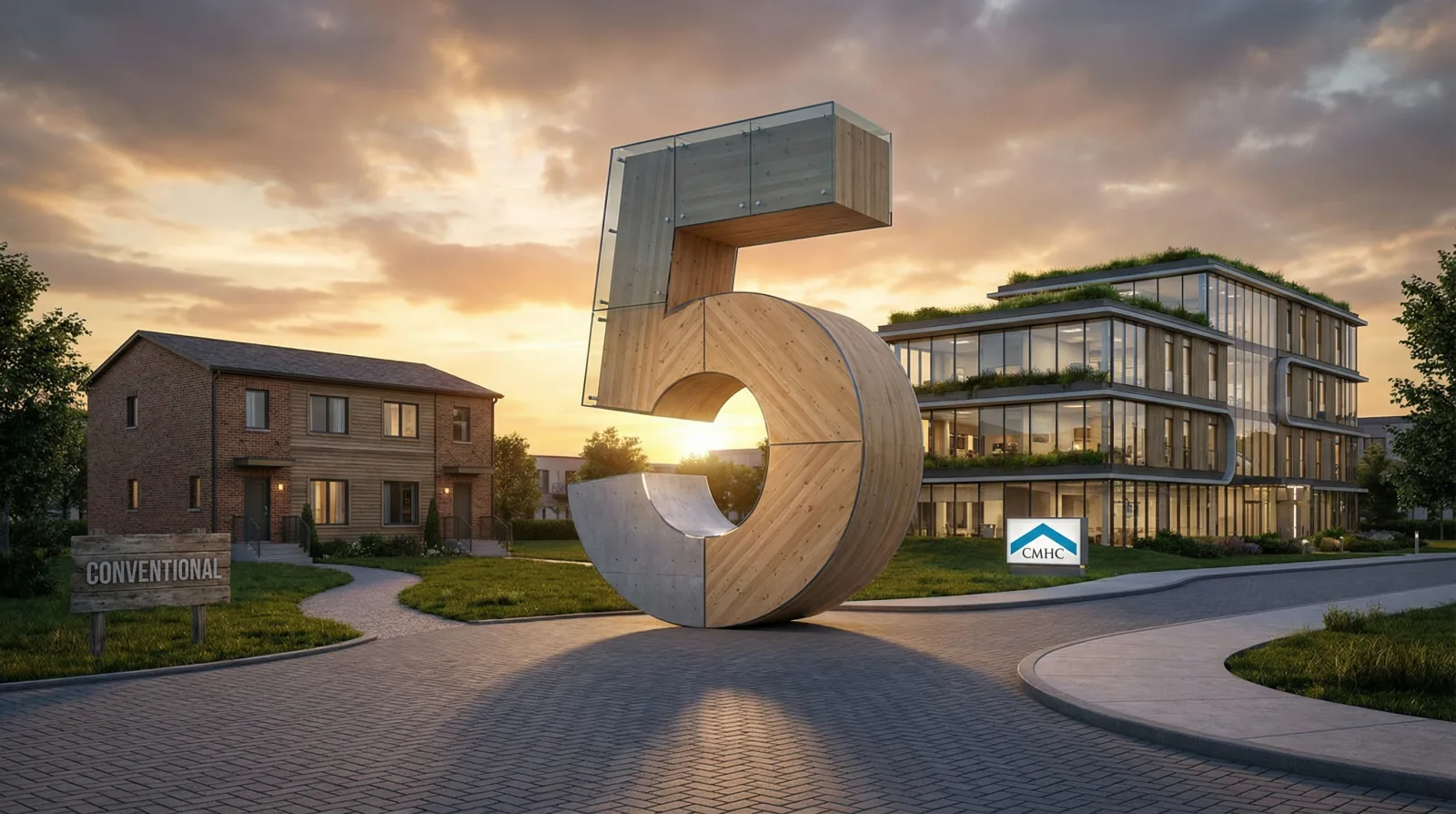

Four units and five units are not one unit apart. They are two entirely different financial universes. This is the single most important number in multiplex development, and most people building their first project don’t know it exists.
The Two Worlds
In Canada, residential mortgage lending operates under two regimes separated by a bright line at 5 units.
1-4 units: Residential rules. These properties are financed through standard residential mortgages. If you’re an owner-occupant of a 1-2 unit property, you can put as little as 5% down with CMHC homeowner insurance. But for 3-4 units, the minimum is 10% down (owner-occupied) or 20% (non-owner-occupied rental). Maximum amortization: 25 years for insured, 30 years for conventional uninsured. The stress test applies. Your personal income and debt ratios matter.
5+ units: Commercial multi-unit rules. These properties qualify for CMHC’s Multi-Unit Mortgage Loan Insurance, including the MLI Select program. The underwriting shifts from personal income to property income. CMHC looks at the building’s net operating income, debt service coverage ratio (minimum 1.10x), and project economics — not your T4 slip. You can access up to 95% loan-to-value and amortizations up to 50 years.
This isn’t a gradual spectrum. It’s a cliff.
What the Numbers Look Like
Take a $2.5M multiplex project — land, hard costs, soft costs all in.
Illustrative example, not a rate quote. Rates and terms change; confirm current numbers with your lender.
4-unit scenario (conventional):
- LTV: 80% maximum (non-owner-occupied)
- Mortgage: $2,000,000
- Equity required: $500,000
- Amortization: 25 years
- Interest rate: ~5.0% (conventional commercial)
- Monthly payment: ~$11,650
- Annual debt service: ~$139,800
5-unit scenario (CMHC MLI Select, 70 points):
- LTV: 95%
- Mortgage: $2,375,000
- Equity required: $125,000
- Amortization: 45 years
- Interest rate: ~4.25% (CMHC-insured)
- Monthly payment: ~$10,850
- Annual debt service: ~$130,200
Read those numbers again. The 5-unit project requires $375,000 less equity and has $9,600 lower annual debt service — despite borrowing $375,000 more. That’s the combined effect of higher leverage, longer amortization, and lower rates from government insurance.
The equity difference alone changes who can do these projects. At $500,000, you need serious capital or partners. At $125,000, a homeowner sitting on an $800,000 HELOC can self-finance.
Why Amortization Matters More Than Rate
Most people fixate on interest rates. The amortization period matters more for cash flow.
On a $2.375M mortgage at 4.25%:
- 25-year amortization: $12,890/month
- 40-year amortization: $11,150/month
- 45-year amortization: $10,850/month
- 50-year amortization: $10,600/month
The jump from 25 to 40 years saves $1,740/month — $20,880/year. That’s often the difference between passing and failing the DSCR test.
Yes, you pay more total interest over the life of the loan. On a 45-year amortization you’ll pay roughly $3.5M in total interest vs $2.4M on 25 years. But BTR is a hold strategy. You’re not planning to carry the original mortgage for 45 years. You refinance, you pay down, the rents rise. The extended amortization is a cash flow tool for the critical first 5-10 years when the building is stabilizing.
What Counts as a “Unit”
CMHC defines a self-contained unit as a dwelling with its own:
- Kitchen or kitchenette (with cooking facilities)
- Bathroom
- Sleeping area
- Separate entrance (or access from a common hallway)
A basement suite with a hot plate and a bar fridge does not qualify. A lock-off room within a larger unit does not qualify. Each unit must be independently habitable.
For Vancouver R1-1 multiplex, the units are typically self-contained by design — each is a complete apartment with its own kitchen, bath, living space, and entrance. But confirm this with your architect and your CMHC-approved lender early. If your design has 4 full units plus a “flex space” or “studio” that doesn’t meet CMHC’s definition, you’re in 4-unit territory regardless of what the marketing materials say.
How This Changes Lot Evaluation
The 5-unit threshold should be the first filter on every lot you evaluate for build-to-rent.
Step 1: Can this lot support 5+ self-contained units under the applicable zoning? In Vancouver R1-1, lots 557 m2+ with 15.1m frontage can do 6-8 units. Smaller lots may be capped at 3-4 units — which means conventional financing only.
Step 2: If yes, what’s the maximum unit count? More units = more rental income = better DSCR. An 8-unit secured rental on a large R1-1 lot has fundamentally different economics than a 5-unit building on a minimum-size lot.
Step 3: Do the rents support a 1.10 DSCR at 95% LTV? Run the numbers with conservative rent estimates. If a lot can physically support 5 units but the rents don’t clear the DSCR floor, it doesn’t work for BTR — even though it technically qualifies for MLI Select.
Lots that max out at 4 units aren’t bad investments. They’re just different investments. You’re in build-to-sell territory, or owner-occupied territory, or conventional rental with 20% equity. The returns can be excellent. But you don’t get the leverage advantage that makes BTR’s compounding math work.
The Municipal Wrinkle
Not every municipality in BC has implemented Bill 44’s full density provisions. Some allow 4 units on lots that should support 6 under the provincial mandate. Burnaby, for example, revised its bylaws in 2025 to reduce building heights and increase setbacks, which effectively limits unit counts on smaller lots.
Check the actual municipal bylaw, not just the provincial legislation. The Province says you’re entitled to 6 units near frequent transit. The municipality’s implementation determines whether those 6 units actually fit on your lot given height, setback, parking, and FSR constraints.
If a municipal bylaw effectively caps your lot at 4 units despite Bill 44, you have two options: challenge the bylaw (slow, expensive, uncertain) or accept conventional financing and run a different proforma.
The First Question
Before you run a proforma. Before you engage an architect. Before you talk to a lender. Ask this:
Can this lot support 5 or more self-contained rental units under current zoning?
If yes, you’re in CMHC territory. Run the BTR model. (See the full CMHC MLI Select guide)
If no, you’re in conventional territory. Run the strata or owner-occupied model.
Everything else follows from this answer.
(Explore the BTR financial guide | Compare BTR vs sell on the same lot)
Related reading
- CMHC MLI Select for small builders — the program that opens up once you cross 5 units
- Vancouver zoning codes explained: RT-8, RM, R1-1 — which zones allow enough units to clear the threshold
- The complete guide to Burnaby multiplex development — unit counts and lot rules in Burnaby
Disclaimer: This post explains financing differences between 4-unit and 5+ unit residential projects based on publicly available lending and CMHC program information. It is not financial, mortgage, or investment advice. Lending thresholds, program eligibility, and qualification criteria change — confirm current details with a CMHC-approved lender or qualified mortgage broker before making any project decisions.
David Babakaiff is the Co-Founder and CEO of VanPlex, a Vancouver-based company specializing in multiplex development and Missing Middle housing. VanPlex uses its AI-powered PlexRank system to identify and underwrite multiplex conversion opportunities under BC’s Bill 44 zoning reforms.
Check whether your lot crosses the 5-unit threshold at VanPlex.ca.