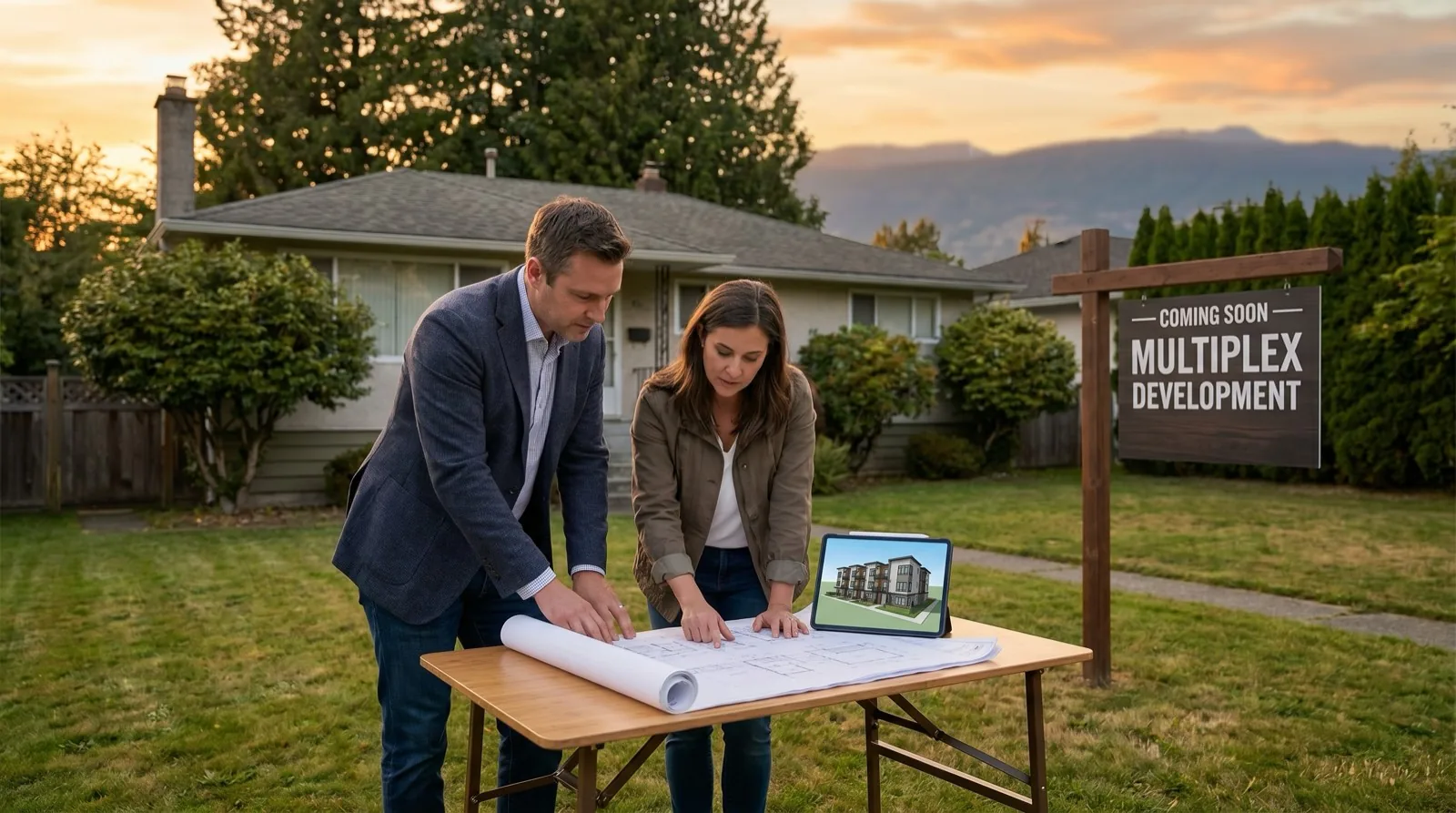

“Should I build a multiplex on my property… or just sell?”
I hear that question more often now, and it’s a fair one. Since Bill 44 came into force across BC, a lot of homeowners suddenly discovered their lot may support four, five, even six homes where it used to support one. So naturally, people start wondering if there’s hidden value sitting in their backyard.
After looking at thousands of properties across Vancouver, Burnaby, Kelowna, and other BC cities, here’s what I keep coming back to: just because a property can support a multiplex doesn’t mean it should be developed. And co-development isn’t easy money. It’s not even close.
TL;DR
- Bill 44 lets most BC lots support 3 to 6 units. That doesn’t automatically mean yours pencils.
- Done well, co-development is genuinely life-changing — keeping kids in the neighbourhood, downsizing into a finished unit, retirement income, generational wealth.
- Done wrong, it’s two or three years of complexity, capital exposure, taxes, financing headaches, and design fights — to land somewhere worse than a clean sale would have put you.
- The homeowners with the best outcomes don’t move fastest. They get clarity first on four things: what the lot supports, whether the economics actually work, what kind of build makes sense, and what they want their life to look like 2–3 years from now.
- Some owners want maximum upside. Others want simplicity and peace of mind. Both are valid — and both lead to very different decisions on the same lot.
Quick check: Before you spend on architects, lawyers, or proforma consultants, run your address through VanPlex. If the numbers say sell, the rest of this conversation gets a lot shorter.
What Bill 44 actually changed
Bill 44 — formally the Housing Statutes (Residential Development) Amendment Act — required most BC municipalities to allow 3 to 6 units on lots previously zoned single-family or duplex. Larger lots and lots near frequent transit get more density. Smaller lots get less. Compliance deadlines varied by municipality, but the rules are live across the province now.
What that means in practice: a lot that used to support one house may now support three, four, or six. That’s the part everyone has heard.
What gets less airtime is the next layer down. Allowable units is the ceiling, not the floor. Setbacks, height, site coverage, FSR, parking, tree retention, drainage, and grade all combine to decide what actually fits on your lot. And then you still have to make the financing, the build cost, and the end-value pencil. A lot of properties that “qualify” for 4 units under the new zoning won’t carry 4 units on the proforma.
Co-development isn’t easy money
I want to say this plainly because the LinkedIn version of this story always glosses over it.
Co-development means you’re agreeing to spend 24 to 36 months turning your home into a multiplex. During that time you’ll deal with:
- Legal structuring (sell? JV? vend-in? SPV vs LP?)
- Tax exposure on the land contribution (Principal Residence Exemption, Section 85 or 97(2) rollover elections, GST treatment)
- Financing (construction loan covenants, personal guarantees, draw schedules)
- Design decisions you don’t have intuition for (unit mix, strata vs rental, accessibility, parking, suite layout)
- Permits and city process
- A construction schedule, with weather and trades and material price risk
- And — assuming you didn’t move in with family — a temporary place to live for two years
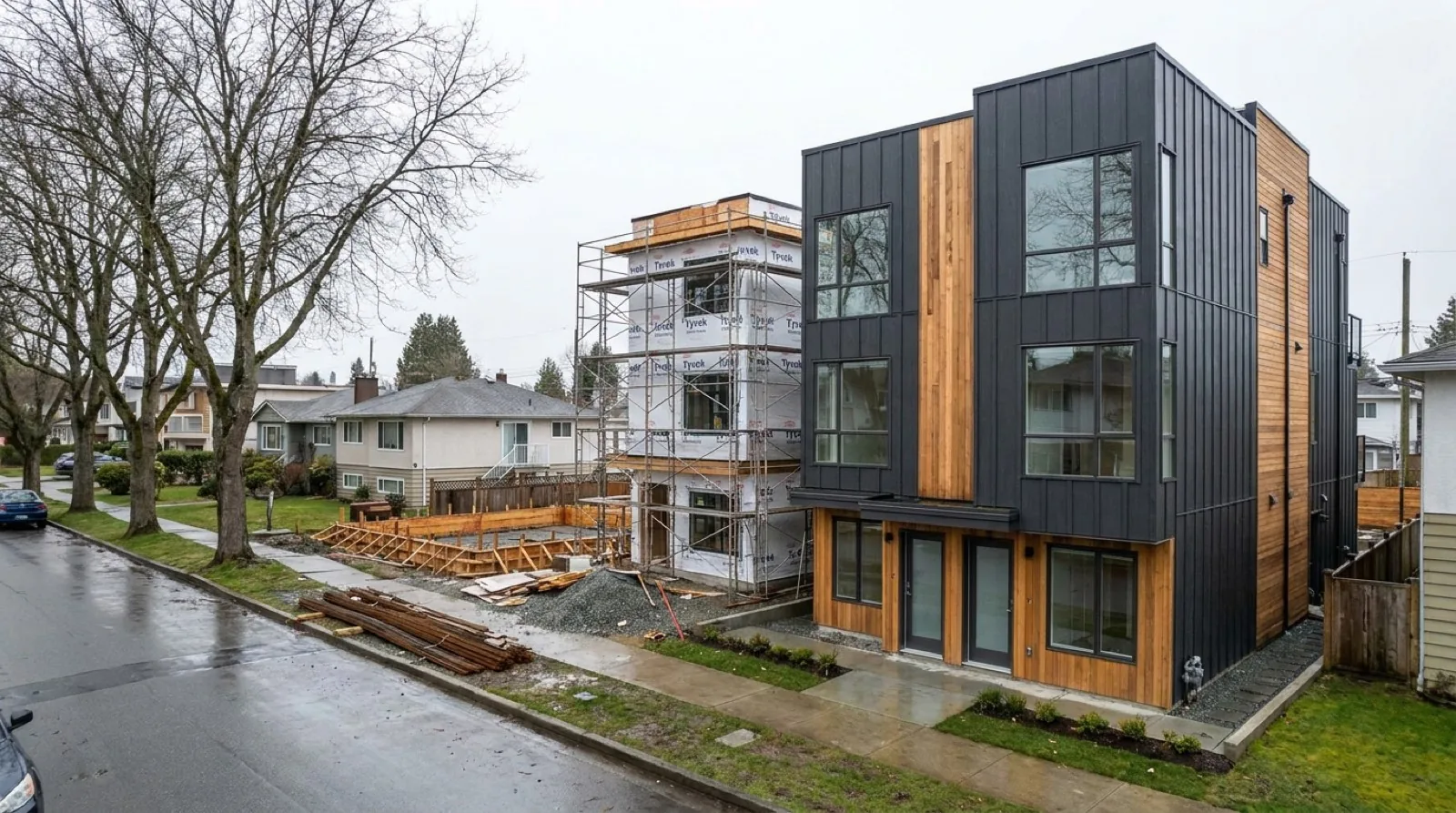
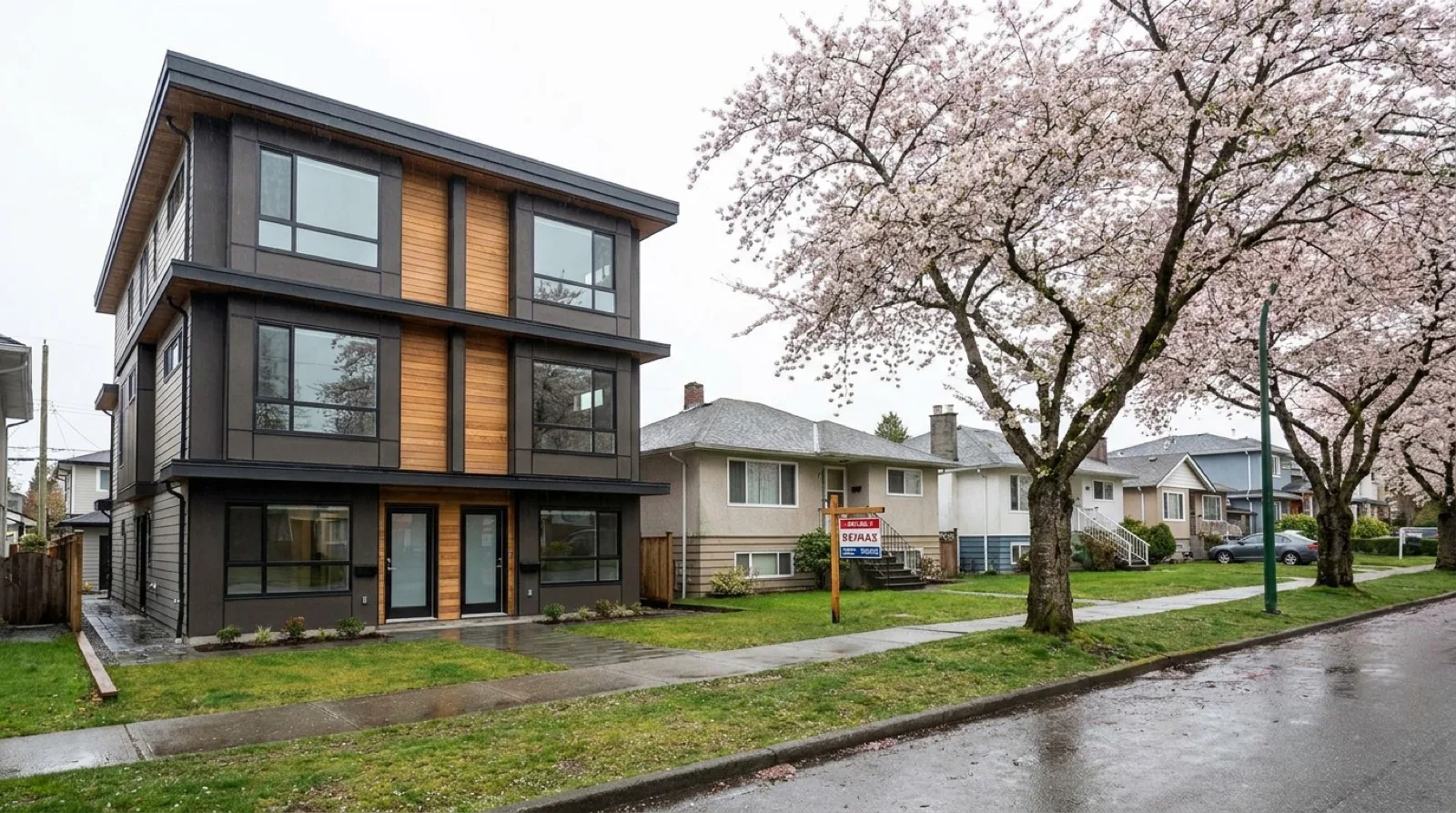
Done well, the upside is real. A family I worked with last year is now sitting on a 4-unit multiplex where the parents kept one unit, two adult children moved into two more, and the fourth covers most of the mortgage. That’s the dream version. Multi-generational living, neighbourhood retention, long-term equity. Like this 4-unit multiplex Nick Bray Architecture designed for a 33-foot lot — exactly the kind of build that actually delivers on what Bill 44 was supposed to make possible.
But the dream version isn’t the default version. The default version is: someone sees the headline density number, falls in love with a render, signs a JV without understanding the structure, and ends up underwater on time, money, or both.
For some homeowners — and I mean this — a clean sale is just the better option.
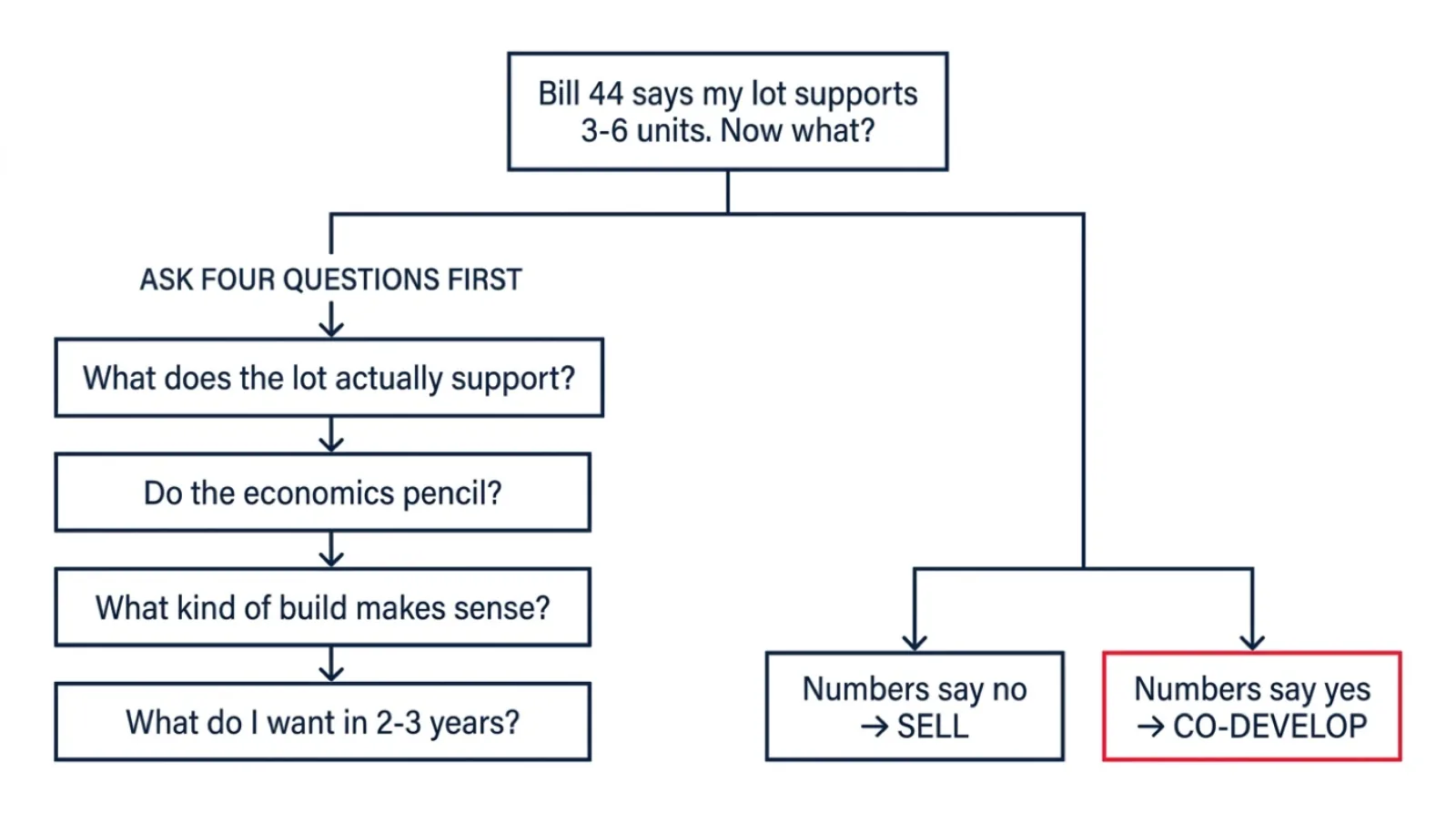
The first move isn’t excitement. It’s clarity.
The homeowners who get the best outcomes are the ones who slow down. Not stop. Slow down. Long enough to actually understand four things:
1. What the lot actually supports. Not what the headline density says. What the lot — given its specific dimensions, slope, trees, frontage, setbacks, and servicing — actually supports as a buildable proforma. A 33-foot lot with a steep grade and a heritage tree is a different conversation than a 50-foot flat corner lot two blocks from a SkyTrain station.
2. Whether the economics actually work. Add up land value (which on most upzoned BC lots has moved up post-Bill 44), build cost, financing cost, soft costs, DCCs, taxes, and contingency. Compare to a realistic end value. On a lot of lots, that math doesn’t pencil — and the answer is sell. On other lots it pencils handsomely, and the answer is build.
3. What kind of build makes sense. A family-oriented multiplex with 3-bed units is a different product than a 6-unit strata project with 1-beds. The choice depends on the neighbourhood, your goals, and your tolerance for complexity. Most owners don’t know they have this choice until someone walks them through it.
4. What you want your life to look like in 2–3 years. Are you trying to keep your kids close? Downsize without leaving? Generate rental income through retirement? Maximize cash on exit? Each goal points to a different structure and a different build.
That last one is the one homeowners skip. They start with “what’s possible” and never ask “what do I actually want.” That’s how families end up with the wrong outcome on a project that technically succeeded.
Why spreadsheets aren’t enough
One thing we’ve noticed at VanPlex: numbers alone don’t really help people decide.
Spreadsheets matter — you need the proforma, the cash flow projection, the sensitivity analysis. But most homeowners don’t emotionally connect to a zoning table or a feasibility report. They connect to seeing the thing.
A family-oriented multiplex. A modern west-coast build. A multi-generational setup where the parents are in the rear unit and the kids are in the front ones. A downsized future where they stay on the same block they’ve lived on for 30 years.
That’s why we’ve started building visualization tools directly into VanPlex. Not because the numbers don’t matter — they do — but because most decisions are made with the gut after the head signs off. If you can’t picture it, you won’t commit to it.
Some lots are exceptional. Most aren’t.
BC is entering a different housing era. Some properties will become exceptional opportunities under Bill 44. Others won’t perform anywhere near as well as people expect.
The key is understanding the difference before you’ve spent hundreds of thousands of dollars and two years of your life moving in the wrong direction.
If you’re curious whether your lot is one of the exceptional ones — or one of the ones where selling is the smarter play — the cheapest, fastest way to start is to put the address through VanPlex and look at what comes back. It’s free. It takes about two minutes. And it’ll tell you more than three coffee meetings with three different opinions.
What to do if the numbers say yes
If your lot does pencil and you’re seriously considering co-development, the next steps are:
- Get a second proforma. The first one is always optimistic. The second one is usually closer to reality.
- Talk to a real-estate lawyer about structure before you talk to a developer about partnership. Knowing the tax shape of your contribution changes which deals you’ll accept.
- Interview at least three developers. Ask each of them for line-by-line proforma transparency, recent multiplex projects they’ve actually delivered (not just the website renders), and the structure they’re proposing for the JV.
- Decide what you want to walk away with. Cash? A unit? Two units? Recurring rental income? Write it down before the meetings.
And if the numbers say no — sell. Cleanly. That’s not a failure. That’s the right call on most lots, honestly. Bill 44 created opportunity; it didn’t repeal arithmetic.
— David Babakaiff, Co-Founder, VanPlex
Explore your property free at VanPlex.