
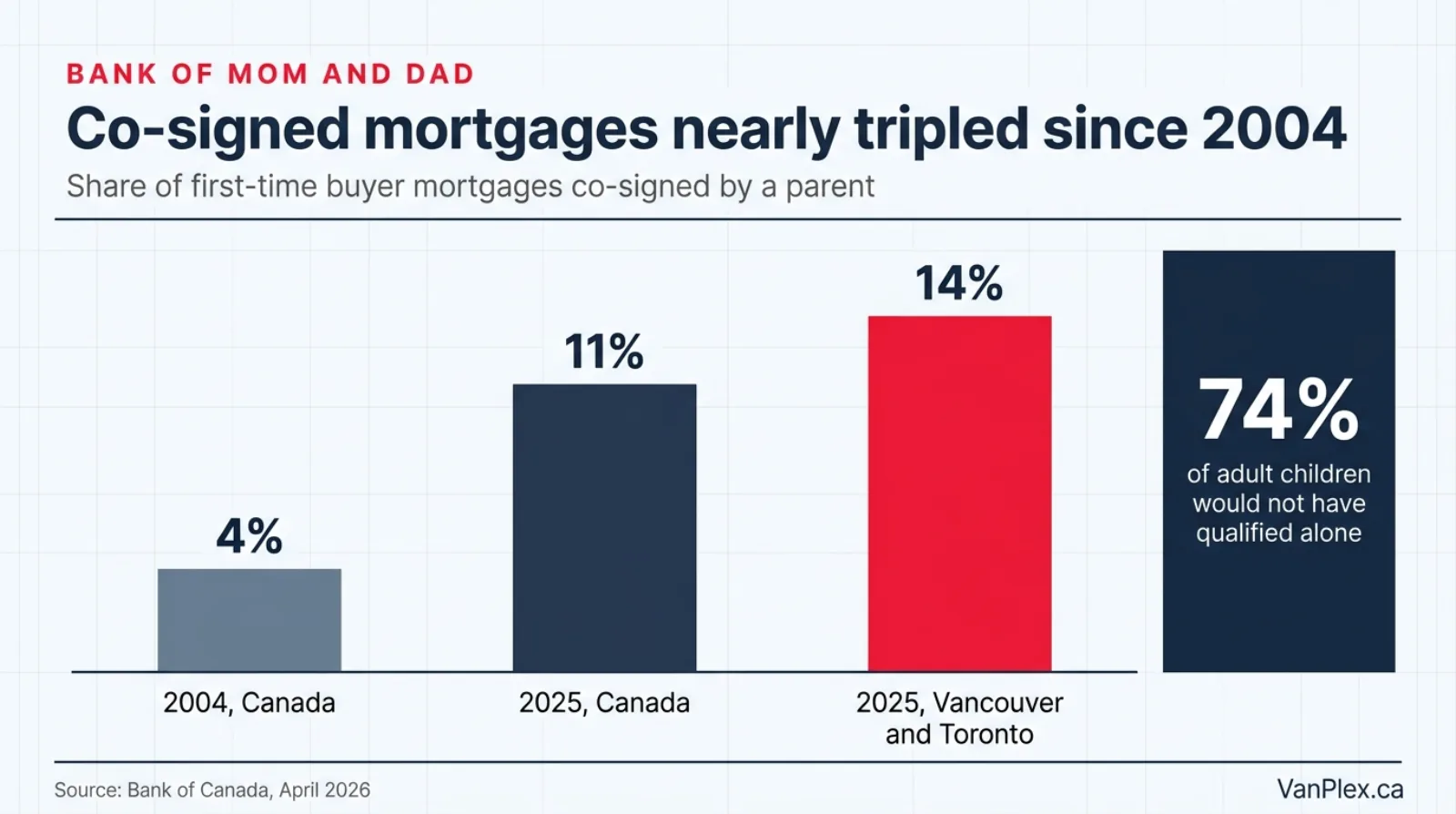
74%. That is the share of adult children in the Bank of Canada’s April 2026 analysis who would not have qualified for their current mortgage without a parent co-signing it. Co-signed mortgages went from 4% of first-time buyer loans in 2004 to about 11% in 2025. In Vancouver and Toronto, they are close to 14%. The family cheque is no longer a cheque. It is a signature, and it stays on the parent’s credit file for years.
The Bank of Mom and Dad stopped writing cheques
“The Bank of Mom and Dad” used to mean money moving one way. Parents helped with a down payment, or advanced part of an inheritance early so an adult child could buy a place of their own. The parent’s balance sheet took the hit once and the transaction ended.
That is not what the data shows anymore.
Shaoteng Li’s April 2026 analysis for the Bank of Canada tracked what happens when a parent co-signs instead. Co-signing is not a gift. It is a legal promise to repay the whole loan if the child cannot, and it counts against the parent’s own borrowing capacity for as long as the mortgage exists.
| Measure | Finding | Period |
|---|---|---|
| First-time buyer mortgages co-signed by a parent | 4% | 2004 |
| First-time buyer mortgages co-signed by a parent | About 11% | 2025 |
| Same share in Vancouver and Toronto | Close to 14% | 2025 |
| Adult children who would not have qualified alone | 74% | 2026 analysis |
Source: Bank of Canada, “When parents co-sign a mortgage to help their adult children buy their first home,” April 2026, and The Globe and Mail’s coverage of the same research, April 16, 2026.
What the signature actually buys
The research put a number on the difference a parent makes.
| Buyer | Maximum attainable purchase price |
|---|---|
| Adult child on their own | $458,000 average |
| Adult child with a parent co-signing | $787,000 average |
| Difference | About 72% more buying power |
Source: Bank of Canada research as reported by The Globe and Mail, April 16, 2026.
In a market where the entry price for a detached home in most of Vancouver sits far above $787,000, that jump is what gets a family into a condo or a townhouse. It is real help. But look at what the family now owns after all that effort: one more unit of housing, financed by two generations, with the older generation’s credit tied to it.
The same research found that the deeper a family went into co-signing, the more likely the borrowers were to eventually fall behind on credit cards and lines of credit. That is the part most families do not price in. The purchase closes, everyone is relieved, and the risk sits quietly on two balance sheets instead of one.
I think this is where the conversation usually stops too early. Families debate how much to give and how to structure it. Very few ask whether buying another property is the right move at all.
More adult children are staying home longer
Statistics Canada released an analysis on May 6, 2026 comparing millennials with earlier generations at the same age. The Vancouver numbers are the ones worth sitting with.
| Group | Share living with a parent | Year |
|---|---|---|
| Vancouver residents aged 25 to 29 | 36.9% | 2021 |
| Baby boomers aged 25 to 29 | 16.7% | 1991 |
| Millennials aged 25 to 39, Canada-wide | 16.3% | 2021 |
| Baby boomers aged 25 to 39, Canada-wide | 8.2% | 1991 |
| Millennials aged 25 to 39, Vancouver | 19.3% | 2021 |
Statistics Canada also found 49.9% of millennials owned a home at ages 25 to 39, against 56.2% of Gen X and 55.9% of baby boomers at the same ages. One of the study’s authors noted that housing cost is only one of several factors behind the change, so this is not a single-cause story.
Still, in Vancouver, more than one in three people in their late twenties were living in a parent’s home in 2021. That is the practical backdrop to every co-signing conversation happening at kitchen tables in Dunbar, Renfrew-Collingwood and Burnaby Heights right now.
Together does not have to mean under one roof
When people hear “multigenerational housing,” they usually picture one house with three generations sharing a kitchen. That works well for some families. For plenty of others it does not, and pretending otherwise is how these arrangements fall apart in year two.
There is a middle option that single-family zoning never allowed: close together, separately housed.
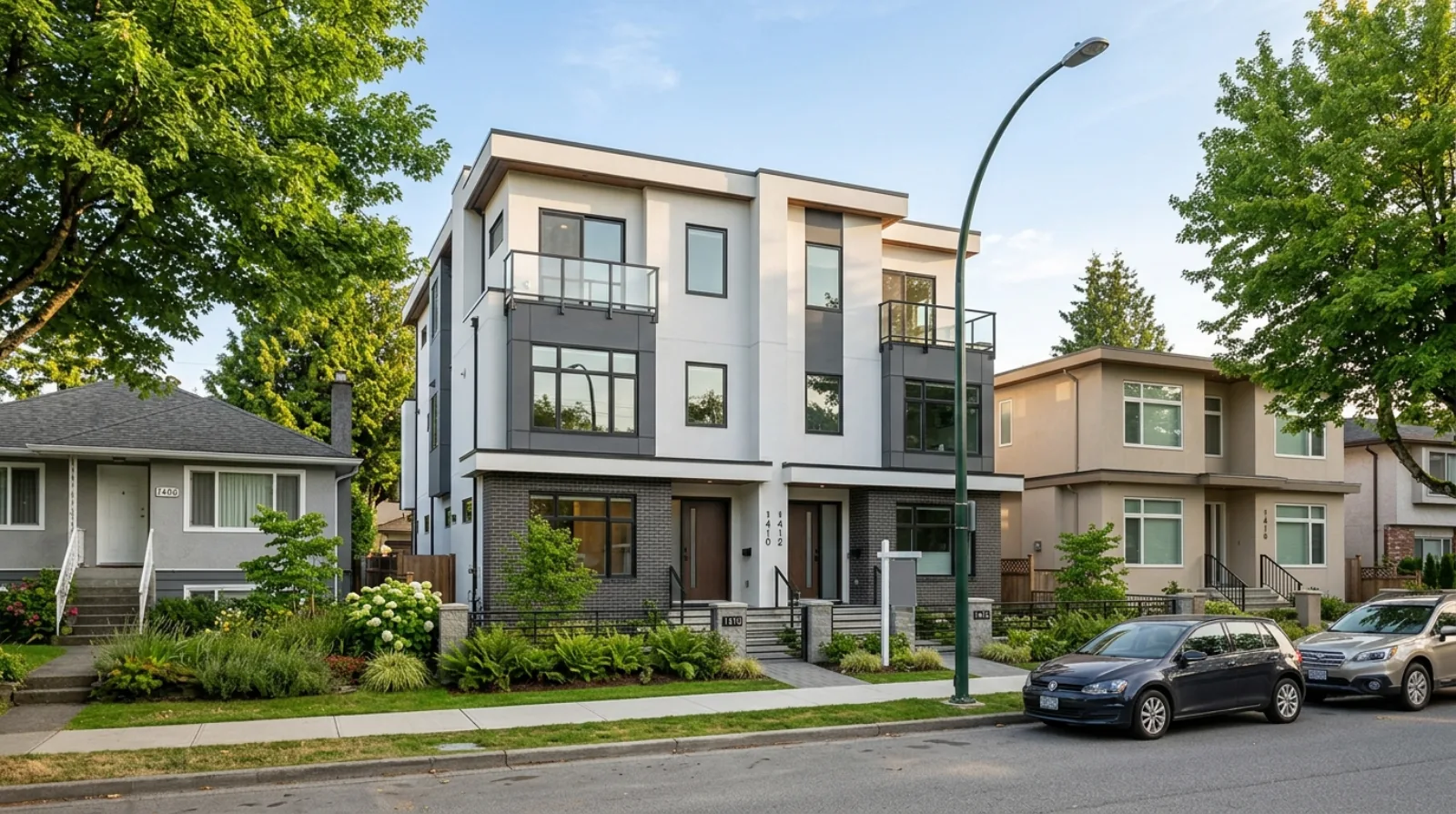
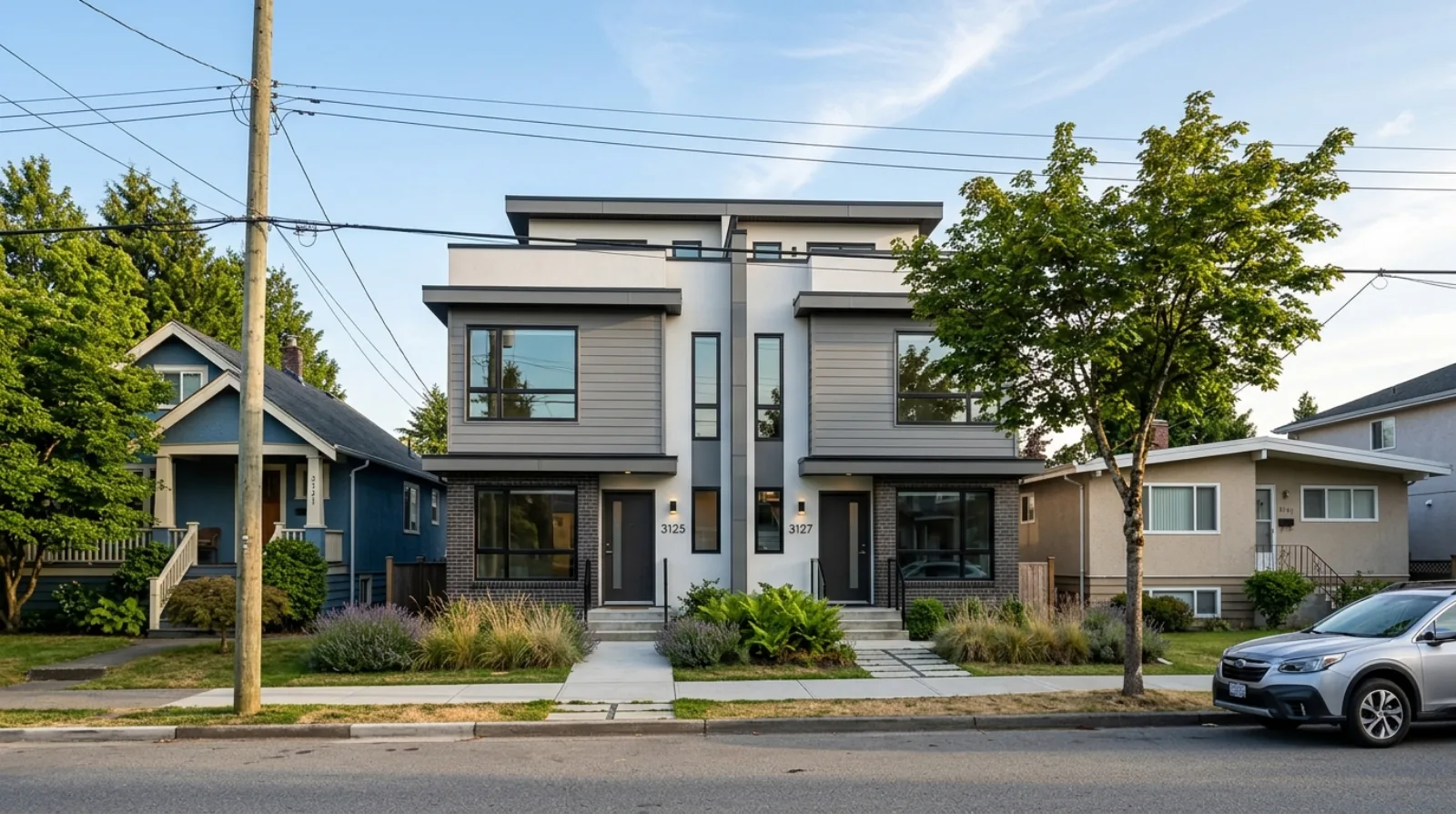
Parents get their own front door, their own kitchen, their own space. An adult child and their family get theirs. A third home might house another relative, or be rented, or serve a different purpose in ten years than it does today.
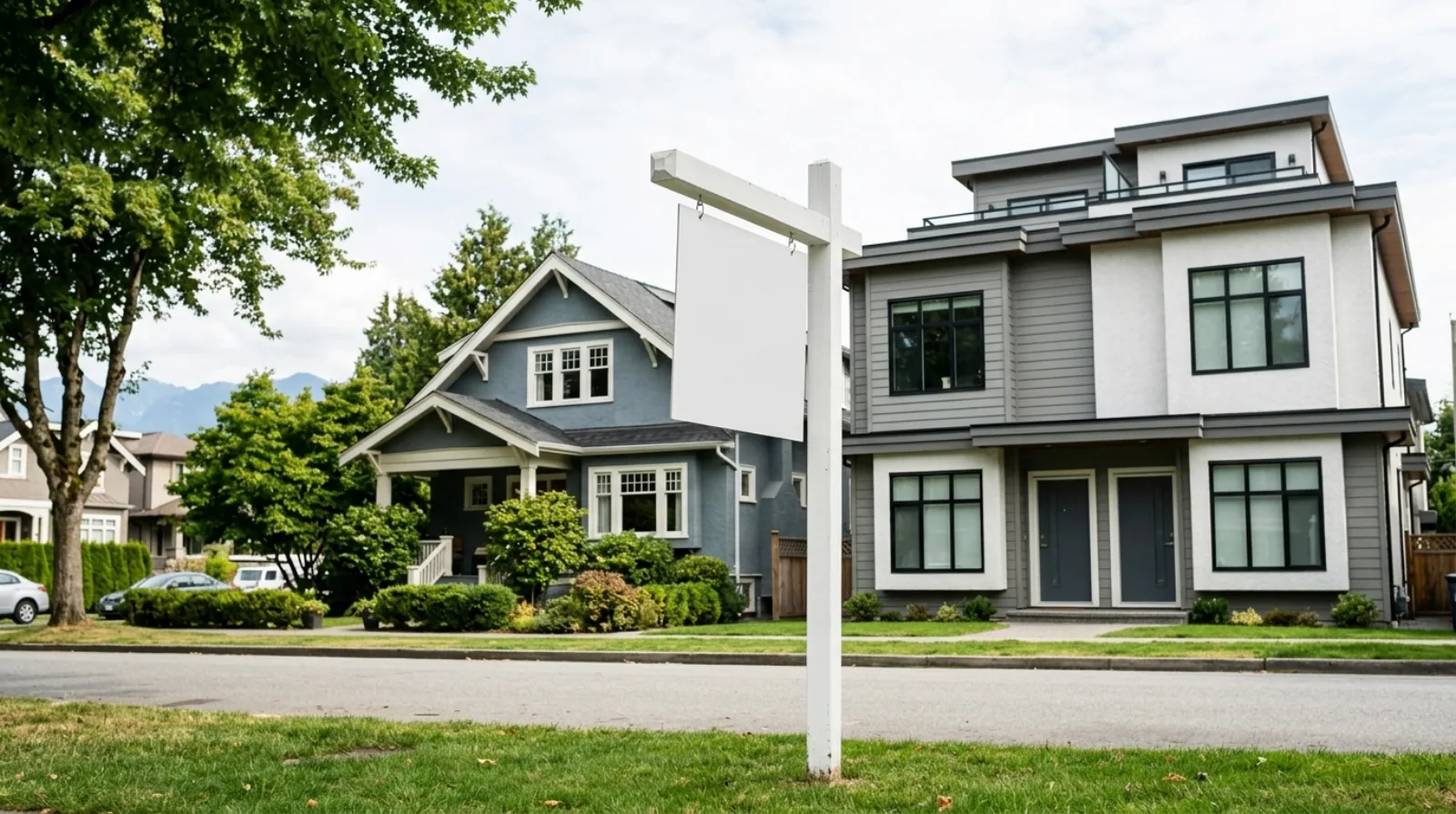
The exact shape depends on the lot, the zoning, the financing, the design and the numbers. What changed is that the option exists at all. Under the old rules, a Vancouver family with one house and one lot had one home to work with. Under Bill 44 and the City’s R1-1 zoning, that same lot can hold several. Our SSMUH and Bill 44 guide covers what the legislation actually permits in plain language.
That flexibility matters over time. A house that suits a family at 55 often does not suit them at 75. Children move out. Sometimes they move back. Grandchildren arrive. Parents eventually want fewer stairs and more help nearby. A building can either force a family to adapt to it, or it can be designed to adapt to the family.
Two ways to spend the same family capital
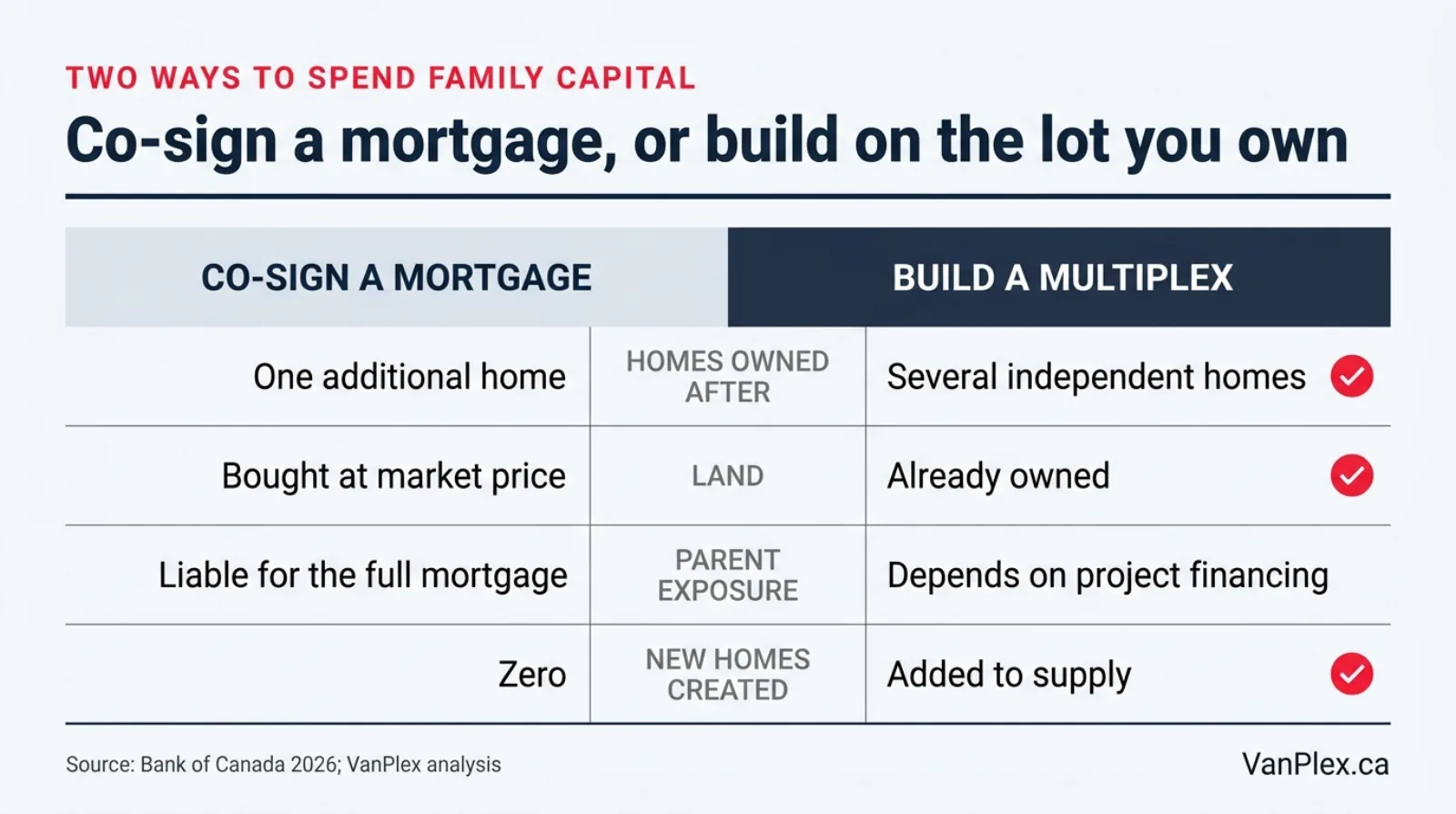
Here is the choice, side by side, using only what is verified above.
| Co-sign a mortgage on another property | Build a multiplex on the family lot | |
|---|---|---|
| What the family owns after | One additional home | Several independent homes on one lot |
| Land required | Bought at market price | Already owned |
| Parent’s exposure | Legally liable for the full mortgage, for years | Depends on how the project is financed |
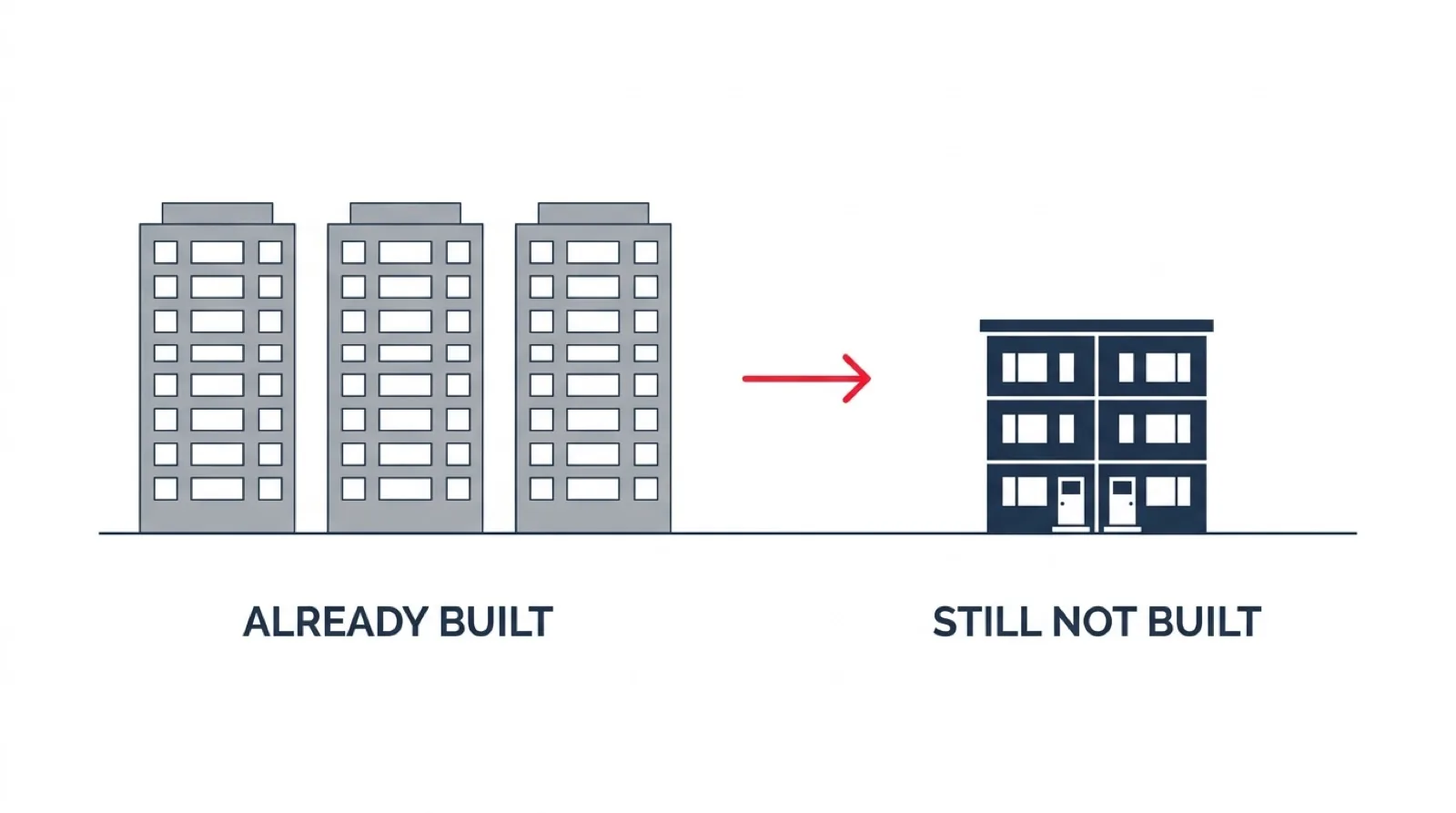
| Homes created for the city | Zero new homes | New homes added to supply |
| Verified risk signal | Co-signed borrowers more likely to later fall behind on credit cards and lines of credit (Bank of Canada, 2026) | Construction, financing and approval risk, which varies by project |
| Flexibility later | Sell or refinance the second property | Units can change use as the family changes |
Neither column is automatically right. Building carries real risk, real cost and a real timeline, and there are lots where the numbers simply do not work. But a family that has only ever considered the left column has not actually compared its options.
The approval path got shorter
This used to be a fair objection: even if the zoning allows it, the permit takes so long that the plan is not practical for a family with a timeline.
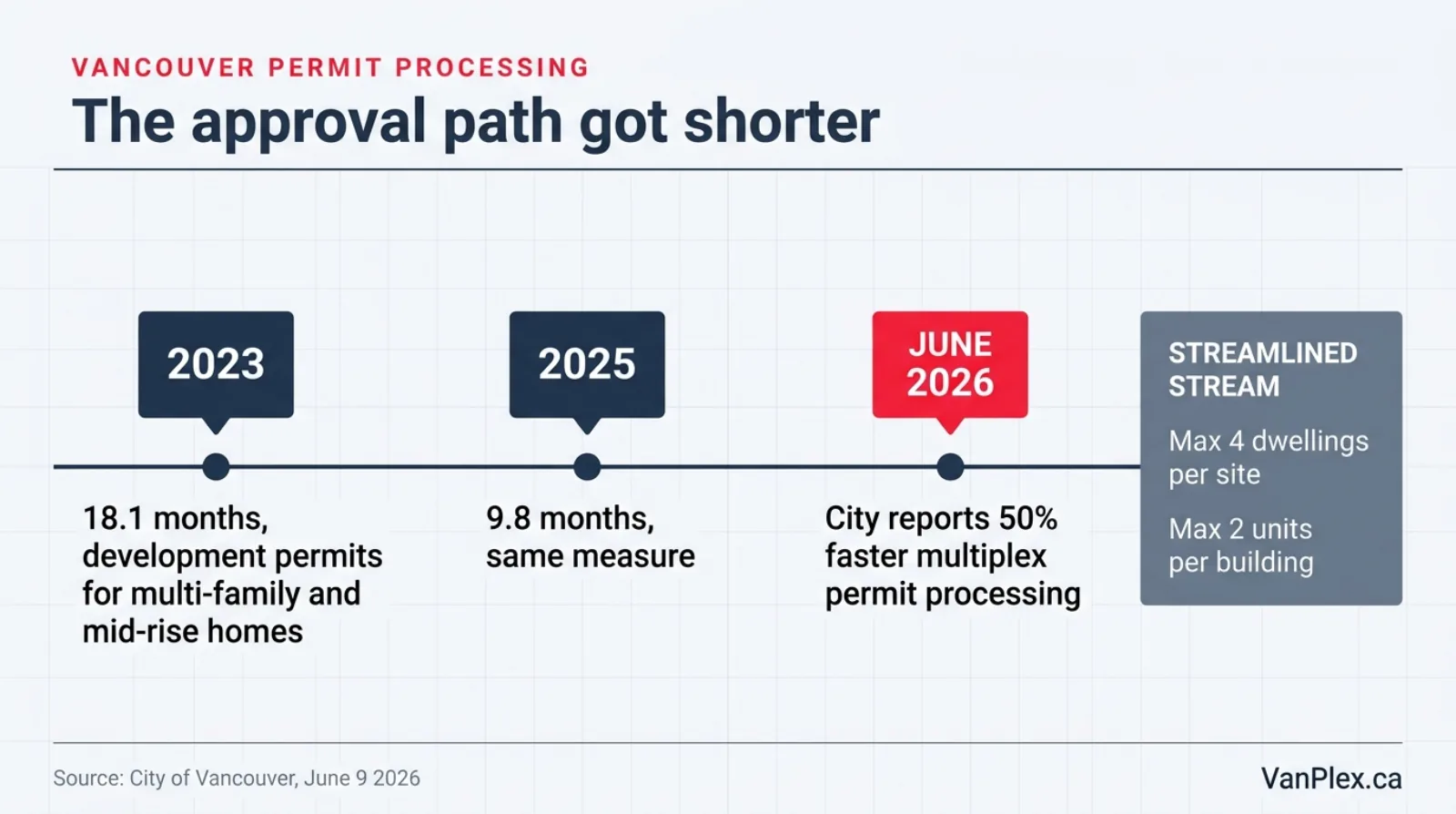
That gap has narrowed. On June 9, 2026, the City of Vancouver reported a 50% decrease in permit processing time for multiplex projects as a result of its streamlined multiplex application stream. The City also reported that development permits for multi-family and mid-rise homes were processed in 9.8 months in 2025, compared with 18.1 months in 2023.
The streamlined stream is not open to every project. It combines the development permit and the building permit into one application, and it applies to sites with a maximum of four dwellings and no more than two units per building, with drawings that comply with both the Zoning and Development By-law and the Building By-law.
That does not mean every homeowner should build. It means the idea has moved out of the theoretical column. If you want to see what has actually been submitted near you, the VanPlex permit map shows real Vancouver multiplex permit records by address.
Questions worth answering before you sell
The useful questions here are not technical. They are personal, and they are the ones families skip.
- Where do you want to be living in ten years?
- Where will your children be able to afford to live?
- Do you want grandchildren within walking distance or within driving distance?
- Could this lot hold several independent homes instead of one?
- What would that actually cost, and what would it be worth when it is done?
The first four are family questions. The fifth is a numbers question, and it is the one that decides whether any of this is real. Zoning capacity, construction cost, financing terms, family circumstances and future resale values all have to line up. Plenty of times they will not.
But selling a long-held Vancouver property because the family has outgrown the way the house currently works, without ever checking what else the land could do, is a decision made with half the information. If you want to see how families have structured the money side, our multigenerational financing guide walks through the options, and multigenerational mortgage programs in Canada covers the lending products built for this.
Housing intelligence principle
A property’s value is not only what someone will pay for it today. It is also the range of future housing choices that property gives a family.
The Bank of Mom and Dad may end up being something more useful than a lender. It may be a place where several generations can build their own lives, on the same piece of land, behind separate front doors.
Check what your lot can hold
Enter your address at VanPlex.ca and see what multiplex potential exists on your property. The analysis covers unit count eligibility under current zoning, estimated construction costs, projected values and return math. It takes about two minutes, and it is a better starting point than a co-signing conversation you cannot take back.
For the wider picture on family housing strategy, start with the multigenerational living hub.
David Babakaiff PlexRank™ | Profit with Multiplex