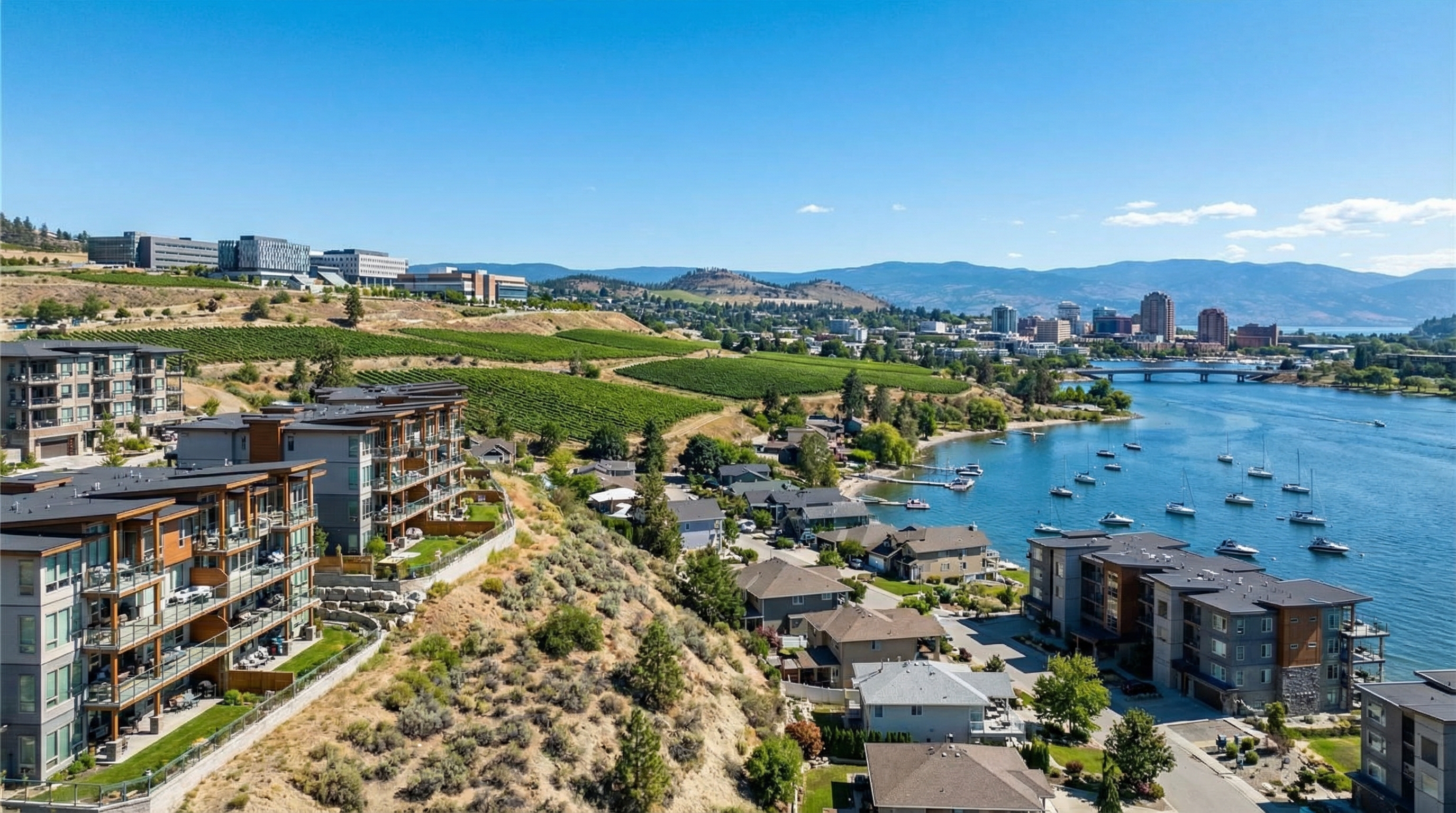
Kelowna’s rental vacancy rate just hit 6.9%. City proper. Not the broader CMA — the city itself.
A year ago it was 3.7%. Two years ago it was under 2%. The Okanagan rental market flipped faster than any market in Canada.
This changes the BTR calculus entirely. And not in the direction most people assume.
TL;DR (Key Takeaways)
- Kelowna city vacancy surged to 6.9% from 3.7% the prior year — the highest of any Canadian metro over 100,000 population
- UBC Okanagan enrollment sits at 11,791 students — a structural demand floor, but international student outflows are compressing it
- Land costs run $600K-$900K for qualifying infill lots in the Core Area — the cheapest of any BC city analyzed
- The Infill Fast-Track program delivers building permits in 10 business days for pre-approved designs on 1,300+ MF1-zoned lots
- Rents are still rising despite vacancy: 2-bedroom average up $183 to $2,118/month — a paradox that won’t last
- BTR underwriting in Kelowna requires a fundamentally different risk model than Vancouver or Surrey
The Vacancy Paradox
Here’s what’s strange about Kelowna’s market. Vacancy hit 6.9% and rents went up.
Studios rose $25 to $1,395. One-bedrooms jumped $85 to $1,596. Two-bedrooms increased $183 to $2,118. Three-bedrooms surged $500 to $2,895.
How? Because the new supply — purpose-built rentals completed in 2024-2025 — came online at higher price points than existing stock. The average gets pulled up by new completions even as older units sit empty. Turnover rents (what new tenants pay) are higher than in-place rents (what existing tenants pay under BC’s rent increase cap).
This is a lagging indicator. When vacancy is 6.9%, landlords don’t have pricing power. Concessions are coming. Free months. Reduced deposits. Flexible lease terms. The rent increases on existing stock will slow or stop. The asking rents on new builds will come down.
If you’re underwriting a Kelowna BTR project today, do not use $2,118 for 2-bedroom rents. Use $1,850-$1,950. Budget for 6-8% vacancy, not the 3-4% you’d use in Vancouver. The market has flipped and your proforma needs to reflect the market you’re building into, not the market you’re reading about in last quarter’s data.
What Drove the Flip
Three forces hit simultaneously.
Supply surge. Kelowna approved a wave of purpose-built rental projects in 2021-2022 when vacancy was under 2% and developers saw a sure thing. Those projects delivered in 2024-2025. Supply increased by roughly 1,200 units in a metro of 224,000 people. That’s a 5.4% increase in rental stock in two years.
Non-permanent resident outflows. Federal immigration policy changes in 2024-2025 reduced temporary foreign worker admissions and tightened international student visa requirements. Kelowna — with its tourism economy and UBC Okanagan campus — felt this disproportionately. BC saw three consecutive quarters of non-permanent resident outflows, and the Okanagan took a larger per-capita hit than Metro Vancouver.
Economic softening. Kelowna’s unemployment rate climbed above the provincial average. The tourism and hospitality sectors that drive the Okanagan economy are cyclical. When they contract, so does rental demand from seasonal workers, service industry employees, and the transient workforce that fills Kelowna’s apartment buildings from May through October.
UBC Okanagan: The Structural Floor
UBC Okanagan enrolls 11,791 students — 10,406 undergraduate, 1,342 graduate. The campus added 2,500+ new undergraduates and 250+ graduate students in Fall 2025 alone. Domestic enrollment hit a record.
This is Kelowna’s rental demand floor. Students need housing from September to April (eight months) and a significant portion need it year-round. On-campus housing covers a fraction of demand. UBC Okanagan’s residence rates run $9,694-$12,105/year for graduate apartments — roughly $1,200-$1,500/month. That’s competitive with off-campus rents, which means the university doesn’t fully absorb its own demand.
But the floor has cracks. International student enrollment is declining due to federal visa policy changes. And “record domestic enrollment” needs context: domestic students are more likely to be local, living with family, not renting.
Underwrite UBC demand as a stabilizer, not a growth driver. It keeps vacancy from hitting 10%. It doesn’t prevent 6-7%.
Kelowna’s Infill Fast-Track: The Permitting Edge
The City of Kelowna launched its Infill Fast-Track program targeting 1,300+ MF1-zoned lots in the Core Area. These lots qualify for 4-6 units per property with a streamlined approval process.
The headline number: 10 business days from complete application to approved development and building permit. That’s not a typo. Ten business days. Vancouver’s R1-1 process takes 6-8 months. Burnaby takes 12-18 months.
The catch: you need to use a pre-approved standardized multiplex design from the Fast-Track catalogue. Custom designs go through the standard process. CMHC Housing Design Catalogue templates were added to the Fast-Track catalogue in Q1 2026, which means you can use federal pre-approved plans and get Kelowna municipal approval in two weeks.
For BTR developers, this is a genuine competitive advantage. Time is money in construction. Every month of permit delay costs carrying charges on land. In Kelowna, at $800K land value and 5.5% carrying cost, that’s $3,667/month. Saving 5-6 months of permit time versus Vancouver saves $18,000-$22,000. Not transformative, but it shifts marginal deals.
The Fast-Track program’s stated potential: up to 7,000 new homes over time across those 1,300 lots. That’s ambitious. But even at 10% uptake, 130 new multiplexes would add 520-780 units to a market that just demonstrated it can’t absorb 1,200 in two years.
The Tourism Economy Factor
Kelowna isn’t Vancouver. Its economy doesn’t run on tech, finance, and professional services. It runs on tourism, agriculture, construction, healthcare, and the university.
Tourism is seasonal. Winery visits peak May through October. Ski traffic at Big White peaks December through March. The shoulder months — November, April — are quiet. This seasonality directly affects rental demand.
Short-term rental operators absorbed some of this variability. Kelowna had one of the highest Airbnb densities in Canada per capita. Provincial short-term rental regulations tightened in 2024, pushing some units back to long-term rental — which contributed to the vacancy spike. Now the city is considering easing those restrictions again because vacancy is so high.
The whiplash is real. Two years ago: “We need more rental supply.” Today: “We have too much.” Kelowna’s small market size means supply additions have outsized impact.
Running the Numbers: Core Area 4-Plex
A lot in Kelowna’s Core Area. 5,400 sq ft MF1-zoned lot. $750,000 land value.
| Line Item | Amount |
|---|---|
| Land acquisition | $750,000 |
| Buildable area (~3,200 sq ft) | 3,200 sq ft |
| Hard costs ($380/sq ft) | $1,216,000 |
| Soft costs, permits, GST | $380,000 |
| Total project cost | $2,346,000 |
| CMHC mortgage (95% LTV) | $2,228,700 |
| Equity required (5%) | $117,300 |
| Annual gross rent (4 units avg $2,000/mo) | $96,000 |
| Vacancy (7%) + OpEx ($36,000) | -$42,720 |
| NOI | $53,280 |
| Annual debt service (4.2%, 45-yr am) | $103,700 |
| DSCR | 0.51 |
Four units at Kelowna rents. It fails badly. The unit count is too low for the land cost, and rents don’t compensate.
At zero land basis (existing homeowner), total project cost drops to $1,596,000. CMHC mortgage: $1,516,200. Debt service: $70,500. DSCR: 0.76. Still fails. Four units in Kelowna do not generate enough revenue to service even a construction-only mortgage.
You need 6 units minimum. And that requires a lot that qualifies under the MF1 zone for 6-unit density — larger lots in the Core Area. At 6 units and zero land basis, with $2,000/month average rent, NOI hits $80,000 and debt service on $2.1M construction cost is $97,700. DSCR: 0.82. Still short.
Kelowna BTR requires either significantly higher rents (new-build premium in the $2,200-$2,400 range) or a fundamentally different financing structure.
The Honest Assessment
Kelowna has three things going for it as a BTR market:
- Cheap land. $600K-$900K for qualifying lots. That’s 40-60% below Vancouver.
- Fast permits. 10 business days through Infill Fast-Track. Nothing in BC compares.
- Structural demand from UBC Okanagan. 11,791 students provide a floor.
Kelowna has four things working against it:
- 6.9% vacancy. The highest of any Canadian metro over 100K population. This isn’t temporary — absorption of current supply will take 18-24 months.
- Tourism-dependent economy. Seasonal demand swings. Vulnerable to recession.
- Lower rents. $2,118 average 2-bedroom. Not enough to clear DSCR on most proformas unless land basis is near zero.
- Small market risk. Any individual project adds meaningful supply. A 6-unit building in a market this size moves the needle.
Who Should Be Looking at Kelowna BTR
Existing homeowners on MF1-zoned lots in the Core Area who want to build a 6-unit rental for long-term income. Zero land basis. Use the Fast-Track program with pre-approved designs. Budget $1.8-$2.2M total construction cost. Underwrite at $1,900-$2,100/month average rent. Accept 7-8% vacancy in your model.
This is not a market for speculators buying land to develop BTR. The current vacancy rate means your lease-up risk is real. One empty unit on a 6-unit building in Kelowna’s 6.9% vacancy market could stay empty for 30-45 days, not the 15-21 days you’d expect in Vancouver.
Kelowna BTR is a patience play. Buy (or already own) the land now while prices are soft. Use the Fast-Track program to minimize permit costs and timelines. Build in 2027-2028 when vacancy has absorbed. Hold for 20 years.
If you need cash flow in year one, look at Vancouver’s 8-unit secured rental path instead. If you have time and own the land already, Kelowna’s cost structure is the most forgiving in BC.
Explore the full Kelowna BTR analysis for lot-level data and Fast-Track eligible properties.
David Babakaiff is the Co-Founder and CEO of VanPlex, a Vancouver-based company specializing in multiplex development and Missing Middle housing. VanPlex uses its AI-powered PlexRank system to identify and underwrite multiplex conversion opportunities under BC’s Bill 44 zoning reforms.