
Surrey doesn’t give you a rental density bonus. No extra units for choosing rental tenure. No FSR bump. No special incentive program that rewards you for keeping units off the strata market.
And it might not matter.
Because Surrey has something Vancouver doesn’t: land you can actually afford.
The Land Basis Argument
Every BTR proforma has the same structure. Revenue minus operating expenses = NOI. NOI divided by debt service = DSCR. CMHC wants 1.10 minimum.
The variable that kills most Vancouver deals is land cost. At $2.5M for a West Side lot, you need astronomical rents to clear DSCR. At $1.7M for an East Vancouver lot, you’re still fighting uphill.
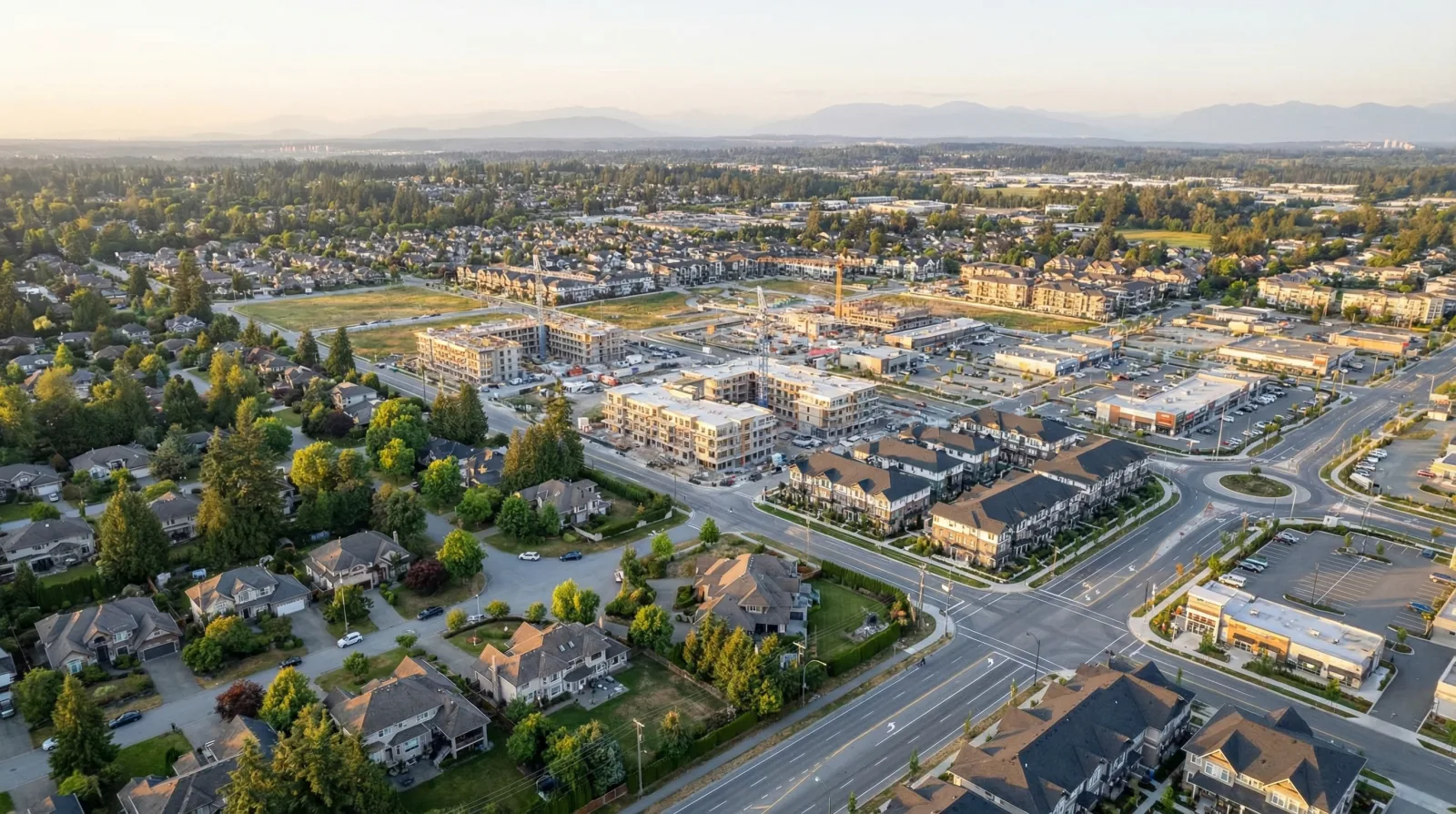
In Newton, a 6,000 sq ft single-family lot lists for $1.0-$1.2M. In Whalley — Surrey’s densifying city centre — lots trade at $900K-$1.1M. The benchmark home price in Newton is $1,022,900. Whalley averages $738,000 for older homes on redevelopable lots.
That’s a $700,000-$1,500,000 land cost advantage over Vancouver. On a $4-5M total project, land basis is the difference between a passing DSCR and a failing one.
Running the Numbers: Newton 6-Plex
A real lot profile: 6,200 sq ft lot in Newton. Within 400m of a frequent bus stop on King George Boulevard. Qualifies for 6 units under SSMUH.
| Line Item | Amount |
|---|---|
| Land acquisition | $1,050,000 |
| Buildable area (~3,800 sq ft at 0.61 FSR) | 3,800 sq ft |
| Hard costs ($400/sq ft) | $1,520,000 |
| Soft costs, permits, DCC, GST | $480,000 |
| Total project cost | $3,050,000 |
| CMHC mortgage (95% LTV) | $2,897,500 |
| Equity required (5%) | $152,500 |
| Annual gross rent (6 units avg $2,100/mo) | $151,200 |
| Vacancy (4%) + OpEx ($54,000) | -$60,048 |
| NOI | $91,152 |
| Annual debt service (4.2%, 45-yr am) | $134,800 |
| DSCR | 0.68 |
Still doesn’t work at market purchase price. The rents in Surrey are lower and the FSR is lower. Six units at $2,100/month generates $151,200 — not enough to service the CMHC debt.
So who does Surrey work for?
The Existing Homeowner Advantage
Same lot. Zero land basis. The owner bought in 2005 for $380,000. The lot is now worth $1.05M, but it’s paid off.
| Line Item | Amount |
|---|---|
| Land acquisition | $0 |
| Hard costs ($400/sq ft) | $1,520,000 |
| Soft costs, permits, DCC, GST | $480,000 |
| Total project cost | $2,000,000 |
| CMHC mortgage (95% LTV) | $1,900,000 |
| Equity required (5%) | $100,000 |
| Annual gross rent (6 units avg $2,100/mo) | $151,200 |
| Vacancy (4%) + OpEx ($54,000) | -$60,048 |
| NOI | $91,152 |
| Annual debt service (4.2%, 45-yr am) | $88,400 |
| DSCR | 1.03 |
Close. Still below 1.10. But push rents to $2,250/month — achievable for new-build units near transit in Newton — and NOI hits $100,800. DSCR: 1.14. It passes.
The math is tighter than Vancouver’s 8-unit path. But the equity requirement is $100,000 versus $258,000. For a homeowner with a paid-off lot and limited liquid savings, Surrey’s lower total project cost is the enabling factor.
The DCC Freeze: Why Timing Matters
Surrey rolled back residential Development Cost Charges to 2023 rates in 2025. The freeze holds through May 2027. No escalation. No surprise fee increases mid-project.
This matters because DCC increases have been a consistent pain point across Metro Vancouver. Metro Vancouver itself is pushing updated DCC categories for multiplex and purpose-built rental. Those new rates — when they arrive — will likely be higher.
Building before May 2027 locks you into today’s DCC schedule. After that date, you’re exposed to whatever the new framework looks like. For a 6-unit project, DCCs typically run $15,000-$25,000 total in Surrey (plus Metro Vancouver regional charges). That’s a fraction of Vancouver’s $66,000-$80,000 DCL range.
The DCC advantage compounds with the construction cost advantage. Hard costs at $380-$420/sq ft versus $400-$500/sq ft in Vancouver. Trades charge less in Surrey because commute times are shorter and competition is less intense. Material delivery is easier. Site access is typically better on Surrey’s wider streets.
The 13,000 Lots Near Frequent Transit
Bill 44 allows up to 6 units on lots within 400 metres of a frequent bus stop — defined as a stop with 15-minute service frequency.
Surrey has approximately 13,000 eligible lots in frequent bus stop areas. That’s roughly 18% of all SSMUH lots in the city. The densest clusters line King George Boulevard, 104th Avenue through Guildford, and Fraser Highway through Fleetwood.
These corridors also happen to be where Surrey’s strongest rental demand concentrates. Newton and Whalley are transit-oriented by necessity — Surrey’s SkyTrain extension along Fraser Highway will add stations, but even the existing bus rapid transit network generates consistent ridership.
On lots within frequent transit areas, Surrey eliminates off-street parking requirements entirely. No parking stalls means no underground or surface parking costs. On a typical 6-unit build, eliminating 6 parking stalls saves $150,000-$240,000 in construction costs (underground parking runs $40,000-$60,000 per stall; surface parking consumes buildable area).
Surrey’s Rental Demand Profile
Surrey isn’t Vancouver. Tenant demographics are different. Rents are lower. But demand is structural.
Surrey’s population is 614,000 and growing. One in ten Surrey families already lives multigenerational — the highest rate in Metro Vancouver. The South Asian community, concentrated in Newton, Fleetwood, and Panorama Ridge, drives significant demand for larger units.
Average 2-bedroom rent in Surrey: $1,950/month as of February 2026. That’s down 5.8% year-over-year — the same rental softening hitting all of Metro Vancouver. The 25,855 purpose-built rental completions in BC in 2025 flooded every submarket.
But Surrey’s rental decline is from a lower starting point. The absolute rent levels are lower, which means the tenant pool is broader. A $1,950/month 2-bedroom in Newton targets a household earning $78,000/year at 30% gross income ratio. In Vancouver, a $3,170/month 2-bedroom targets $126,800/year. Surrey’s addressable market is simply larger.
Where Surrey BTR Actually Pencils
Three scenarios where the Surrey numbers work:
1. Existing homeowners on paid-off lots near transit. Zero land basis. Total project cost under $2.2M for 6 units. DSCR clears at $2,200+/month average rent. This is the sweet spot — Newton and Fleetwood homeowners who bought 15-20 years ago.
2. Family compounds that generate some rental income. Build a 6-plex, live in one unit, rent five. You don’t need CMHC MLI Select if you’re occupying a unit. Conventional financing at 20% down with a 25-year amortization. The math works differently because you’re also eliminating your own housing cost.
3. Investors buying distressed or below-market lots. They’re rare, but the current slow market has increased inventory. If you can acquire a qualifying lot under $850,000, the BTR math starts to work even as a purchase.
What Surrey Doesn’t Give You
No secured rental density bonus. You get 6 units maximum near transit, 4 units everywhere else. No FSR increase for rental tenure. No DCL waiver for rental. No city-funded incentive program.
Surrey’s SSMUH compliance is still being finalized. The province mandated compliance by June 30, 2026, and Surrey is implementing — but the permitting process isn’t as streamlined as Vancouver’s R1-1 track. Expect longer permit timelines. Budget 10-14 months from application to building permit, versus 6-8 months in Vancouver.
The rental market is also more sensitive to economic conditions. Surrey’s economy is more exposed to logistics, construction, and service sectors. In a recession, vacancy spikes faster in suburban markets than urban cores.
The Bottom Line: Land Basis as Strategy
Surrey’s build-to-rent proposition is simple. You don’t get policy incentives. You get cheaper land. Cheaper construction. Cheaper DCCs. Cheaper everything except the thing that matters most: tenant quality and rent stability.
For existing homeowners with zero land basis on qualifying lots near transit, Surrey is arguably the easiest BTR entry point in Metro Vancouver. The total project cost is low enough that even moderate rents clear CMHC’s DSCR threshold.
For purchasers, it’s harder. The rents don’t support the acquisition cost at current market prices. You need a below-market land deal or a family compound strategy to make the numbers work.
Explore the Surrey BTR analysis for neighbourhood-level data and lot screening results.
David Babakaiff is the Co-Founder and CEO of VanPlex, a Vancouver-based company specializing in multiplex development and Missing Middle housing. VanPlex uses its AI-powered PlexRank system to identify and underwrite multiplex conversion opportunities under BC’s Bill 44 zoning reforms.