
A cheque arrived from the City of Vancouver this summer for $121,000. It was a refund of a density bonus contribution we had already paid on one of our multiplex projects. We build multiplexes on both the west side and the east side of Vancouver. Fifteen are in development and three are finished. We watch every cost line, so a six-figure refund gets our attention.
Here is what changed at the City and at Metro Vancouver, what it paid us on real projects, and the one change that went the other way.
What actually changed at the City
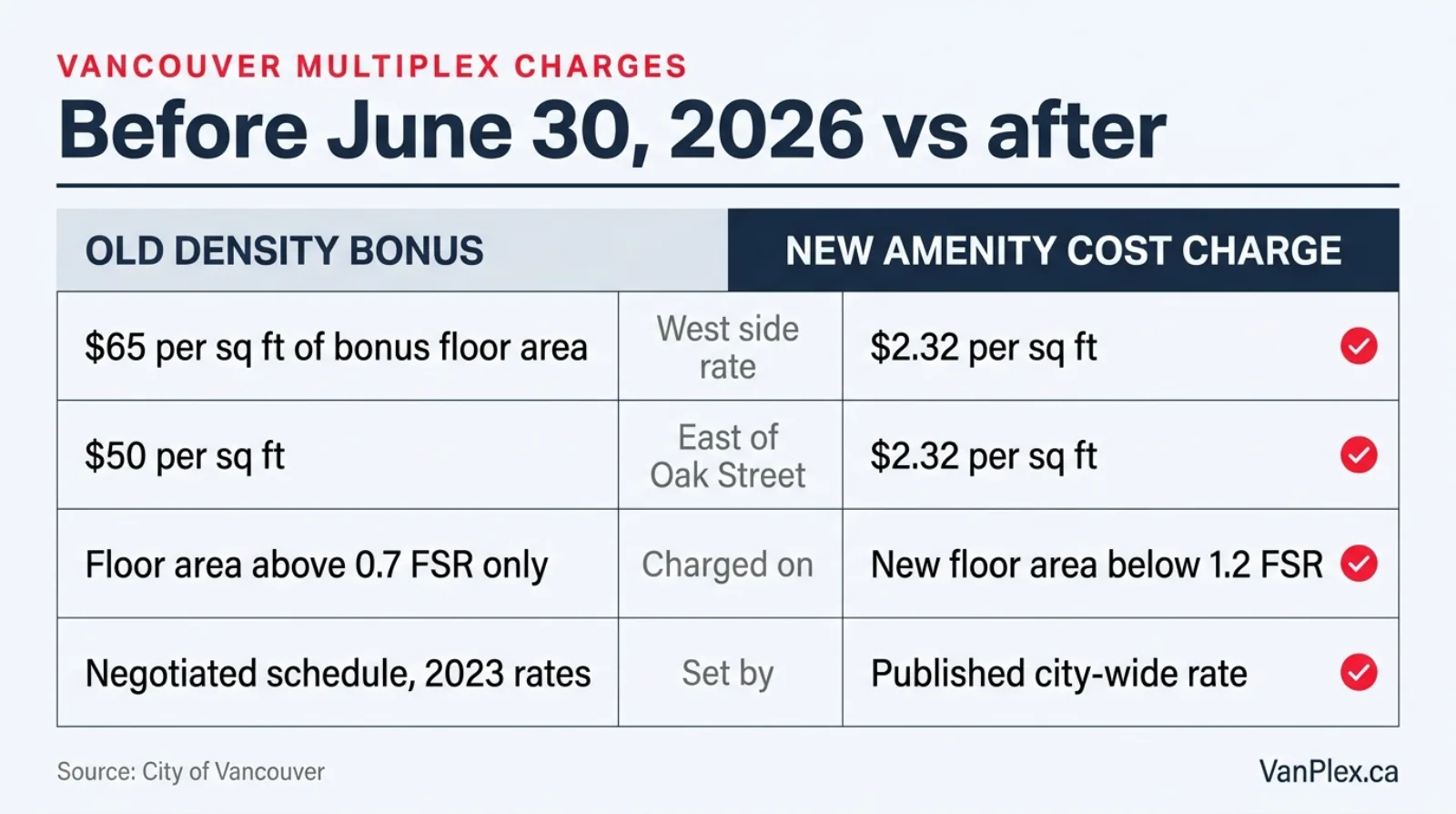
For most of the last decade, Vancouver let you build floor area above your base zoning if you paid a contribution for it. On an R1-1 multiplex lot, the first 0.7 FSR was free and the floor area between 0.7 and 1.0 FSR carried a density bonus charge. The rate depended on where the lot was and how wide it was.
The numbers came from the City’s own 2023 rate work, based on analysis by Coriolis Consulting. On a 50-foot west-side lot, the rate was $65 per square foot of bonus floor area, which worked out to about $117,000. On the same lot east of Oak Street it was $50 per square foot, or about $90,000. On a 33-foot west-side lot it was $3 per square foot, about $3,600 in total.
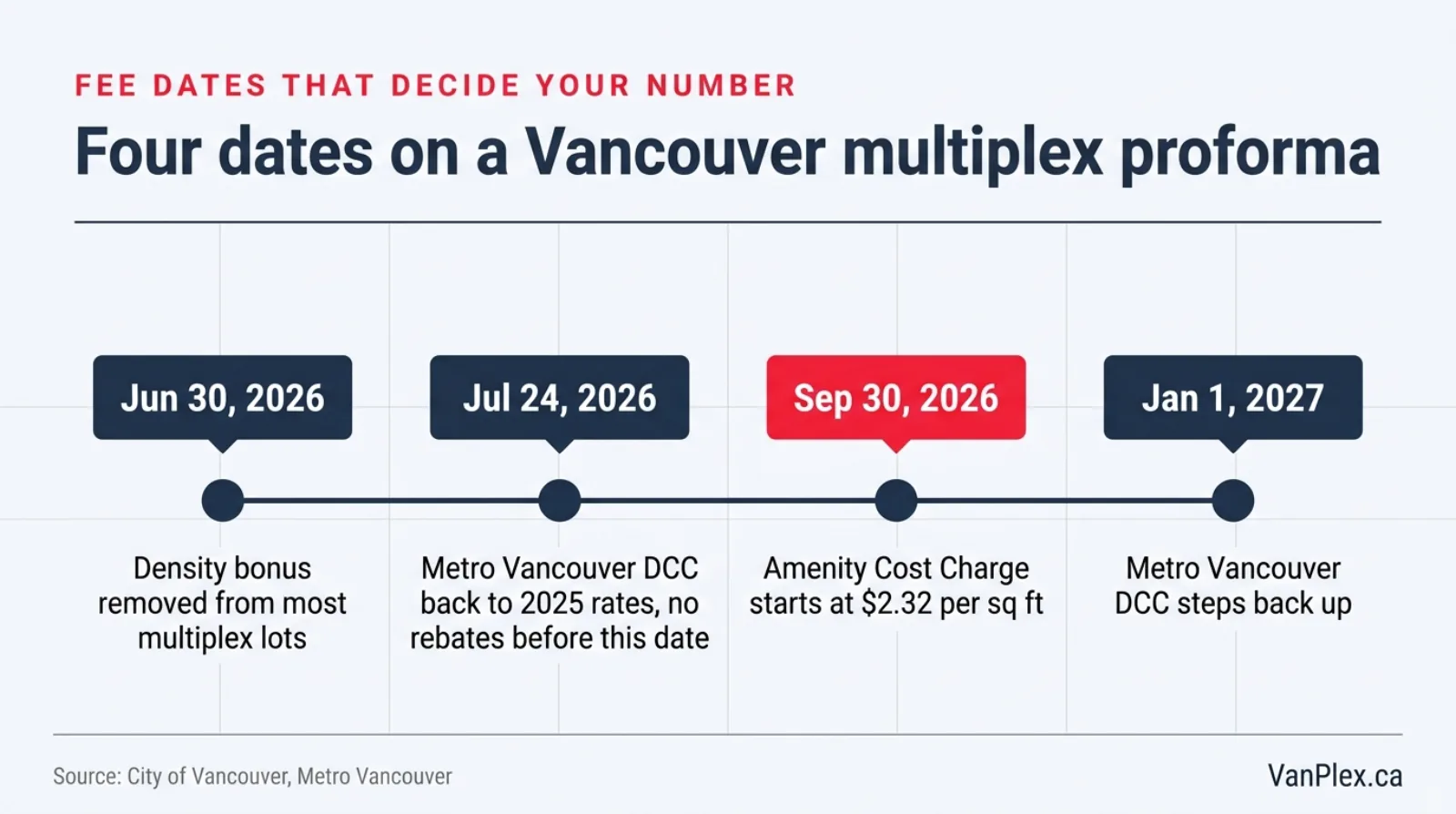
Then the province passed Bill 16, the Housing Statutes Amendment Act, 2024. It gave cities until June 30, 2026 to bring density bonus and inclusionary zoning rules into line, or replace them with a new tool called an Amenity Cost Charge. Council approved the change in June 2026 and removed density bonus contributions from the great majority of multiplex lots in the city.
The new charge, and why the rate comparison is misleading
The replacement is a city-wide Amenity Cost Charge. Council approved it in July 2026 and it starts on September 30, 2026. The rates are fixed and published rather than negotiated:
| Development type | ACC rate |
|---|---|
| Residential below 1.2 FSR (multiplex range) | $2.32 per sq ft ($24.97 per m²) |
| Residential 1.2 to 1.5 FSR | $5.00 per sq ft ($52.82 per m²) |
| Residential above 1.5 FSR | $10.00 per sq ft ($107.64 per m²) |
| Industrial and commercial uses | $1.20 to $3.00 per sq ft |
Rates then rise 3% each year on September 30 in 2027, 2028 and 2029. Applications submitted before September 30, 2026 are protected from the ACC, and after that there is a rolling 12-month rate protection period to get your permit at the rate you applied under.
Going from $65 per square foot to $2.32 per square foot looks like a 96% cut, and plenty of people are quoting it that way. Be careful with that. The two rates are charged on different things. The old density bonus applied only to the bonus floor area above 0.7 FSR, so on a 6,000 square foot lot that was roughly 1,800 square feet of chargeable area. The ACC applies to new floor area generally, which on the same lot at 1.0 FSR is a much bigger number.
Compare project totals, not rates. That is the only comparison that means anything when you are signing a cheque.
What it paid on our projects
On the smaller project, the density bonus contribution had already been paid before the June 30 change. The refund was $121,000.
On a larger west-side build, the lot is wide enough that the City kept a contribution in place. Where existing density bonusing overlapped with the density the province now requires, Vancouver replaced the bonus with an inclusionary zoning requirement instead of removing the charge. That applies to R1-1 multiplex on large west-side lots, RM-8A single lots in the Cambie Corridor, and FC-2E in the False Creek Flats. On R1-1, the threshold is a lot at least 56 feet wide, which on a standard 120-foot deep lot is about 6,700 square feet.
The rate the City’s consultant landed on for those lots is about $27.50 per square foot, which the City’s own worked example put at roughly $180,000 on a 56 by 120 lot. Our lot is larger than that example. Our old density bonus figure on that project was $450,000. The new inclusionary zone charge came in at $255,000. That is $195,000 off one project.
For context, the City’s own consultation material put the reduction for multiplex at about 35% where inclusionary zoning still applies. Ours came in at 43%. Every lot is its own arithmetic, so use your own numbers, not the average.
| Our project | Old charge | New charge | Difference |
|---|---|---|---|
| Smaller lot, contribution already paid | $121,000 | $0 | $121,000 refunded |
| Larger west-side lot, 56 ft or wider | $450,000 | $255,000 | $195,000 saved |
Metro Vancouver went backwards on purpose
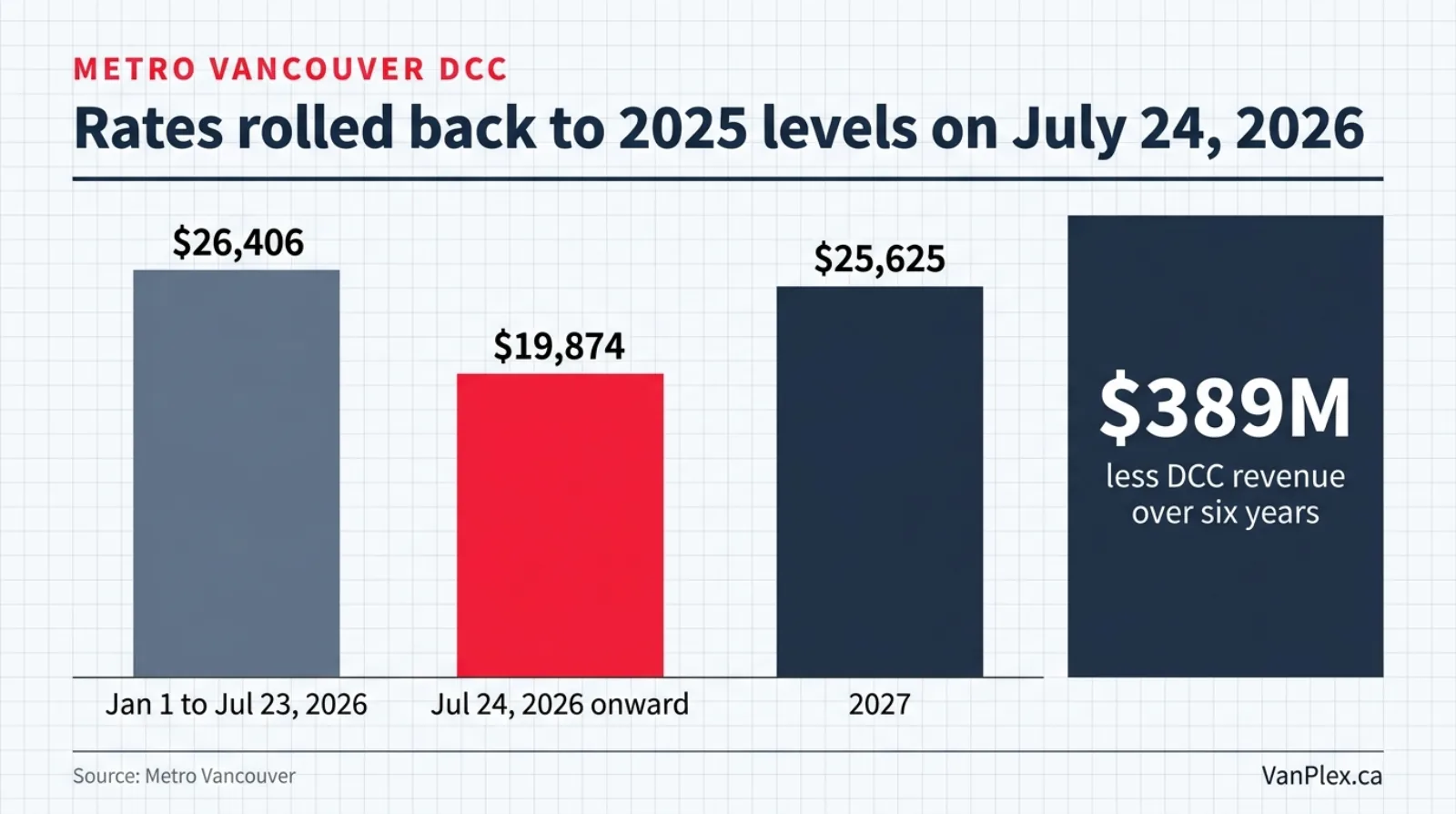
The second change came from the region. On July 24, 2026, the Metro Vancouver board gave final adoption to rolling its 2026 Development Cost Charge increases back to 2025 rates. It also cut the planned 2027 increases and pushed the move to a 1% assist factor out from 2027 to 2029.
Metro Vancouver’s DCC is charged per dwelling unit, so it scales with your unit count rather than your floor area:
| Unit type | Jan 1 to Jul 23, 2026 | Jul 24, 2026 onward | 2027 |
|---|---|---|---|
| Residential lot | $29,196 | $21,941 | $28,322 |
| Townhouse | $26,406 | $19,874 | $25,625 |
| Apartment | $17,873 | $13,392 | $17,323 |
For a ground-oriented unit charged at the townhouse rate, that is $6,532 back per unit. On a fourplex it is about $26,100. Some of our projects are saving up to $30,000 this year because of it.
Two things to know before you count on it. There is no rebate and no retroactive adjustment for permits or approvals issued before July 24, 2026, so the timing of your permit decides whether you get the lower rate. And the reduction is temporary in shape: the 2027 rates step back up, so a project that pulls its permit in 2027 pays more than one that pulls it this year.
The region is paying for this. Metro Vancouver expects to collect $389 million less in DCC revenue over the next six years, split between $270.5 million for the water district, $75.5 million for sewerage and drainage, and $43 million for regional parkland. Of that shortfall, $346 million is being borrowed and $43 million comes from higher utility fees carried by property taxes.
One cost moved the wrong way
Not everything went down. Every new multiplex now needs on-site rainwater management, and in practice that means a detention tank in the ground.
The rule sits in Article 2.4.2.5 of the Vancouver Building By-law, consolidated to July 1, 2025. A site of 1,000 square metres or less at 1.0 FSR or less follows the small site pathway, which means no engineered design is needed, but a tank is still required. The size comes straight off Table 2.4.2.5.-B:
| Site area | Minimum active storage | Orifice plate |
|---|---|---|
| Up to 400 m² | 3,400 L | 30 mm |
| 400 to 500 m² | 3,900 L | 35 mm |
| 500 to 750 m² | 4,600 L | 45 mm |
| 750 to 1,000 m² | 7,200 L | 50 mm |
Compliance is checked at the plumbing inspection, so there is no way to design around it late. On our builds the tank, the excavation, the connection and the inspection add up to roughly $12,000 per project. Against a $121,000 refund that is small. It is still real money, and it is a cost that did not exist on a project we priced three years ago.
The revenue side has not improved
This is the part that gets left out when people talk about fee relief.
Fees came down by tens of thousands of dollars per project. Sale prices came down by hundreds of thousands.
| MLS® HPI benchmark, Metro Vancouver | July 2023 | July 2026 | Change |
|---|---|---|---|
| Composite, all residential | $1,210,700 | $1,088,800 | -10.1% |
| Detached | $2,012,900 | $1,822,900 | -9.4% |
| Apartment | $771,600 | $688,000 | -10.8% |
Year over year the attached benchmark, which is the closest published reference to a finished multiplex unit, is $1,030,400 in July 2026, down 6.0% from July 2025. Those are Greater Vancouver REALTORS® figures for the whole region.
Multiplex units also still sell at a discount to a half duplex on the same street, and half duplex values have fallen too. So the discount is being taken off a smaller number.
Put it together on the projects we are running now. Between 2024 and 2026 the revenue we expect at completion has dropped by more than $1 million on some of them. A $195,000 saving on city charges does not cover a $1 million drop in what the finished homes are worth.
That is the honest picture. The City re-tested the math, found the 2023 rates did not work at today’s prices, and lowered them. That was the right call and it helps. It is not the same thing as the numbers working again.
What we changed in how we underwrite
Three practical things came out of this for us.
Model the permit date, not just the project. Metro Vancouver’s rate depends on when your permit is issued, and the ACC depends on when your application went in. Two identical projects three months apart now carry different fees. We track that date as a line item.
Re-run the fee stack on anything in stream. If you paid a density bonus contribution on a Vancouver multiplex before June 30, 2026, check whether you are owed money. Nobody at the City called us about the $121,000. We asked.
Price the exit, then work backwards. Costs are easier to estimate than revenue, which makes it tempting to spend all your time on the cost side. The cost side moved by 2% of project value this year. The revenue side moved by five times that.
If you want to see what the current fee stack does to a specific lot, our Vancouver development cost calculator runs the DCL, DCC and permit numbers by unit count, and entering an address at VanPlex.ca runs the return math against what has actually been selling nearby.
Fees are down. Ask what your finished units are worth before you decide that settles it.
David Babakaiff PlexRank™ | Profit with Multiplex