
The most useful thing a lot analysis can tell you is sometimes that the lot cannot be analyzed. Not that it scores badly. That the inputs required to score it honestly are not there. Eight specific conditions will stop the math before it starts, and every one of them is checkable in an afternoon, before you have spent anything. Most of the bad multiplex purchases I have watched went wrong at one of these eight, not at the construction estimate.
A refusal is a result
There is a strong pull, when you are looking at a property you like, to fill a gap with a reasonable-sounding number. The frontage field is empty, so you measure it off a satellite image. There are no recent multiplex sales in the neighbourhood, so you borrow a price per square foot from two neighbourhoods over.
Both of those produce a proforma. Neither produces a proforma you should act on, because the number that decided the outcome was invented rather than measured.
The discipline that avoids this is simple to state and hard to hold: if an input is missing, the output is “unknown,” not “estimated.” A lot that returns “cannot be priced, no comparable sales” has told you something real. A lot that returns “112% return on equity” built on a borrowed comparable has told you nothing, in a format that looks like it told you everything.
That is the frame for the eight checks below. They run in order, and any one of them stops the process.
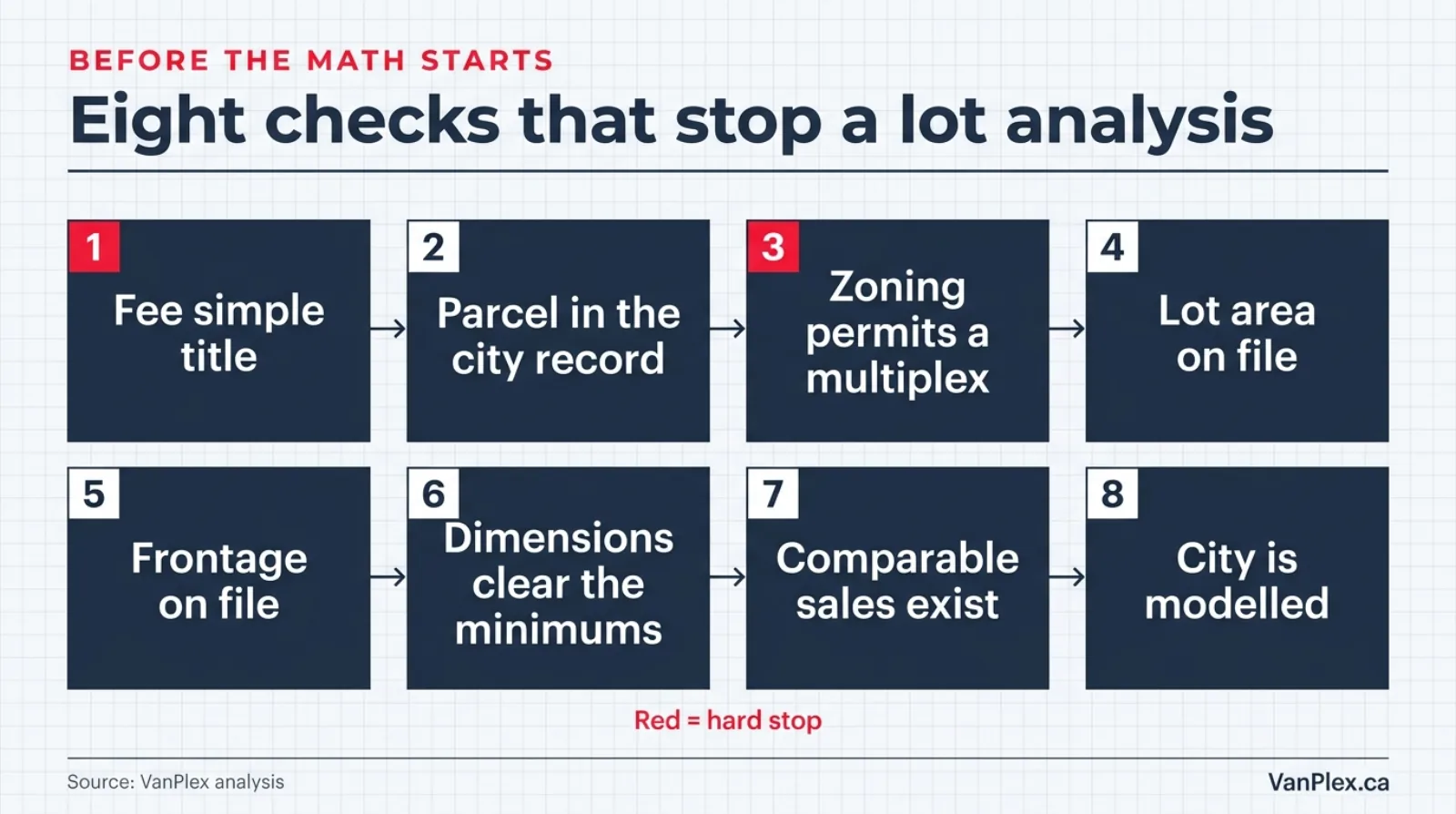
1. Is the title fee simple?
You cannot redevelop land you do not own. Leasehold land is owned by somebody else, usually a municipality, a university, a corporation or a First Nation, and held by the occupant under a lease. In BC a lease of more than 20 years counts as a long lease, and many are prepaid for 99 years, which makes them feel like ownership right up until the moment you want to demolish and rebuild.
The scale is not trivial in Vancouver. The City owns roughly 80% of the land in False Creek South, where a number of the leases expire over the next decade. UBC has been unable to sell its land since the Provincial Government set that condition when the university was established in 1908, so housing there is leasehold.
Most detached lots are fee simple. But this is a title question with a binary answer, it costs very little to confirm, and getting it wrong is unrecoverable. Check it first.
2. Is the parcel in the city’s own record?
Every serious check downstream depends on matching the address to one parcel in the municipality’s records: the parcel identifier, the registered dimensions, the zoning polygon that covers it.
When that match fails, and it does fail on newly subdivided lots, recently readdressed properties and unusual legal descriptions, everything after it is unanchored. There is a temptation to resolve it by proximity: take the nearest parcel, or the closest matching address. That is the single worst shortcut available here, because a wrong match does not return an error. It returns a confident answer about somebody else’s land.
An unmatched parcel is a research task. It is not a rounding problem.
3. Does the zoning district permit a multiplex?
Provincial legislation set a floor for small-scale multi-unit housing across BC, but the district schedule your specific parcel falls under is what governs the application. Zones that look residential do not all permit a multiple dwelling, and the zoning shorthand typed into a listing is not a reliable guide to which one you are in.
This has to be resolved against the municipality’s own zoning record for that parcel, with the date the record was read attached to it. Zoning changes. A value with no date on it is a claim about an unspecified point in the past. Our SSMUH and Bill 44 guide covers what the provincial rules require underneath whichever municipal schedule applies.
4. Is there a lot area on file?
Site area is one of the two figures every unit-count threshold is written against. No area, no band, no unit count, no floor area cap.
This is a missing-data failure rather than a disqualification, which is an important distinction. The lot may be excellent. You simply cannot rank it against other lots until the figure exists. Treating “unknown” as “average” is how a bad site ends up on a shortlist.
5. Is there a frontage on file?
Frontage is the other required figure, and it is missing far more often than lot area because it is not a field every listing bothers to complete.
It also carries the most consequence per inch. Vancouver R1-1 separates its unit bands at 10.0 m, 13.4 m and 15.1 m of frontage. A standard 50 foot lot is 15.24 m, which clears the six-unit line by 5.5 inches. Half a foot of measurement error moves that lot from six permitted homes to four. There is no other input in the entire analysis where that small a difference does that much. We covered the geometry in detail in how to find a multiplex lot, frontage first.
6. Do the dimensions clear the minimums?
Assuming both figures exist, they have to actually meet a band. In Vancouver R1-1 the smallest multiplex band requires 306 m² of site area and 10.0 m of frontage (section 3.1.2.3 of the District Schedule, June 2026 consolidation). Both, not either.
There is also a minimum site depth of 30.4 m, which is 99.7 feet (section 3.1.2.4). Shallow lots fail here regardless of how wide they are, and this one catches people because depth rarely appears in the conversation at all.
A lot that clears the minimums is eligible to apply. In R1-1 a multiple dwelling is a conditional approval use, so the Director of Planning still decides the application under section 2.2.7. Clearing the geometry gets you to the queue, not to a permit.
7. Are there comparable sales to price the finished homes?
This is the check people skip, and it is the one that decides whether the return figure means anything.
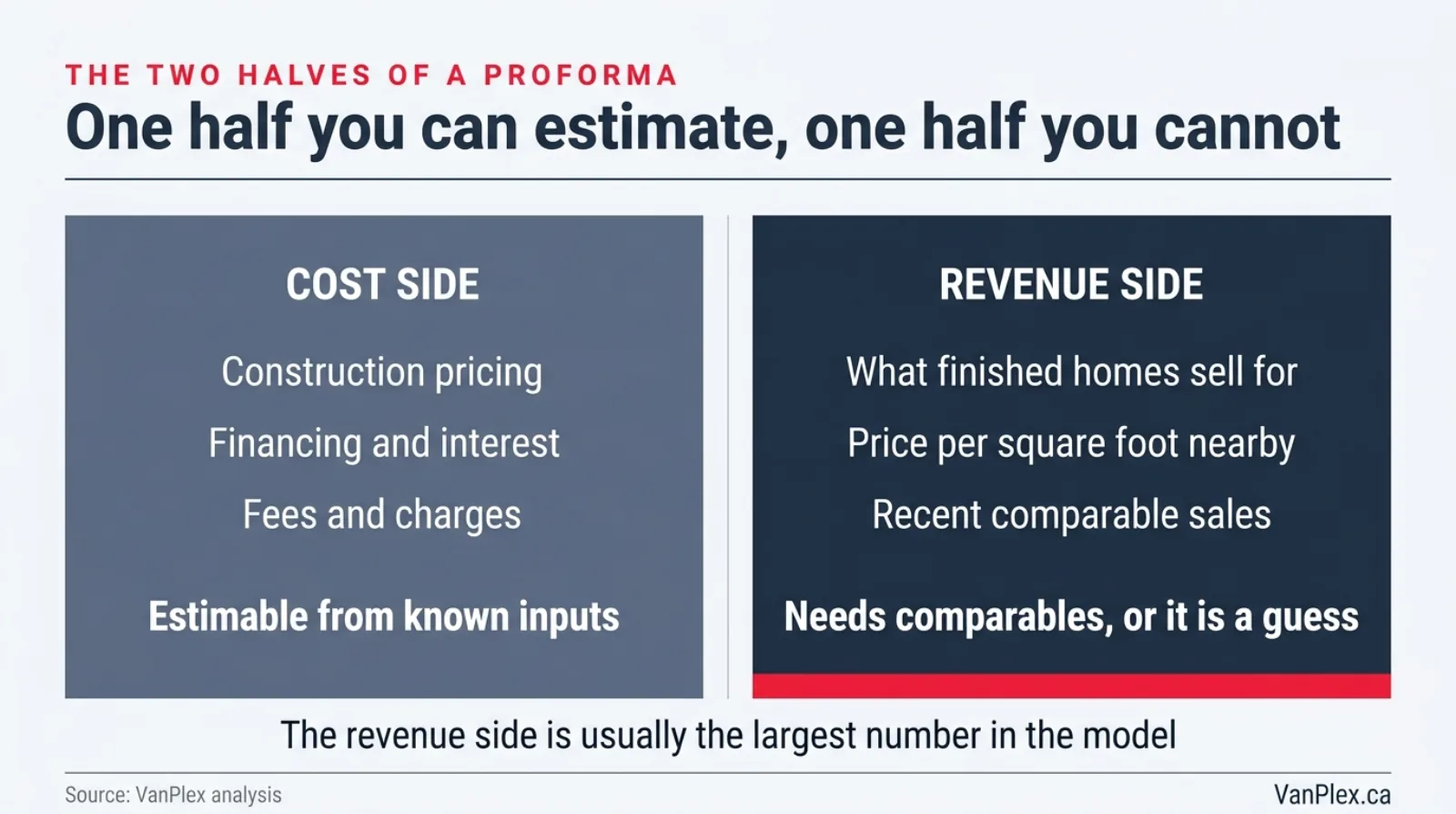
Every proforma has two halves. The cost side is estimable from construction pricing, and reasonable people land within a range of each other. The revenue side depends entirely on what finished multiplex homes actually sell for near that lot. If nothing comparable has sold nearby, that half of the model has no anchor.
Borrowing a price per square foot from a different neighbourhood feels harmless. It is not. It is usually the largest single number in the model, and moving it a few percent swings the profit far more than a construction cost error of the same size does.
When there are no comparables, the honest output is that the lot cannot be priced yet. That is worth knowing before you write an offer, not after.
8. Is this city modelled?
Every municipality has its own district schedules, its own setbacks, its own development cost charges and its own permit behaviour. A model built on Vancouver’s R1-1 numbers is wrong in Burnaby and wrong again in Coquitlam.
We only publish figures for cities where the schedule has been transcribed and cited on its own terms. That is why our lot search covers a specific set of cities rather than the whole province. Extending one city’s thresholds to another produces output that looks authoritative and is not, and there is no way for a reader to tell the difference from the outside.
What a failed check actually means
They are not all equally final.
| Check | If it fails |
|---|---|
| Fee simple title | Stop. This is not a development site |
| Parcel in the city record | Research task. Resolve the match, never approximate it |
| Zoning district | Stop, unless a rezoning is genuinely in scope |
| Lot area on file | Get the figure. Survey or municipal record |
| Frontage on file | Get the figure. Same |
| Dimensions vs minimums | Stop for that unit count. A lower band may still work |
| Comparable sales | Not yet priceable. Revisit as the neighbourhood transacts |
| City modelled | Do the work manually against that city’s schedule |
Four of the eight are missing-data problems with a clear resolution path. Two are hard stops. Two depend on what you are willing to take on.
Run the cheap checks first
None of the eight requires a consultant, a designer or a deposit. Title status, a parcel match, a zoning record, two dimensions and a look at what has sold nearby will tell you whether a lot deserves any further attention.
If you want to work through a set, our lot search carries the dimensions, resolved zoning and price context for active single-family listings across the cities we model. If you already own a property and want to see which band its own figures fall into, entering the address at VanPlex.ca runs the comparison against the published thresholds.
The lots that survive all eight are a much shorter list than the market suggests. That is the point of running them.
David Babakaiff PlexRank™ | Profit with Multiplex