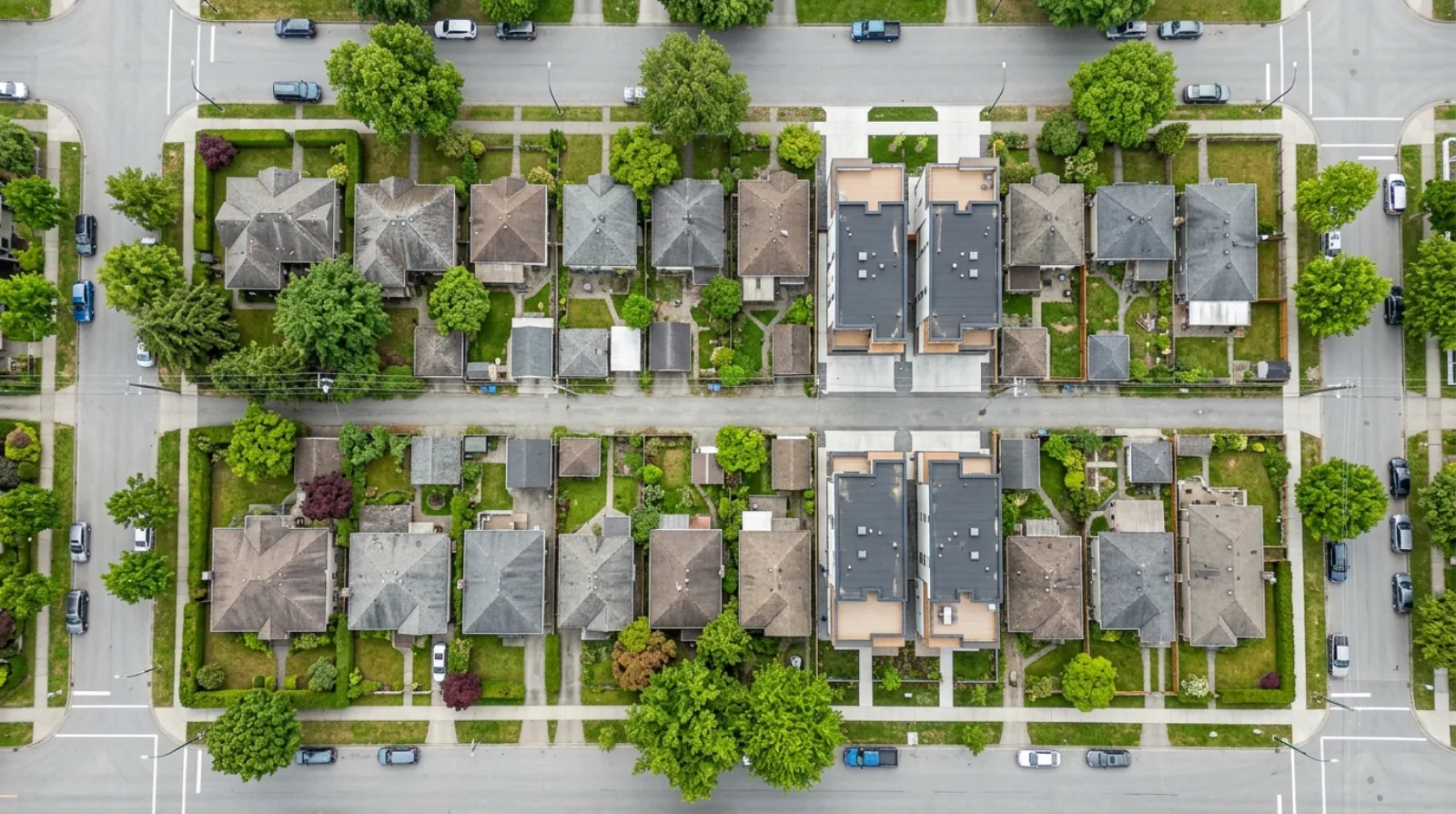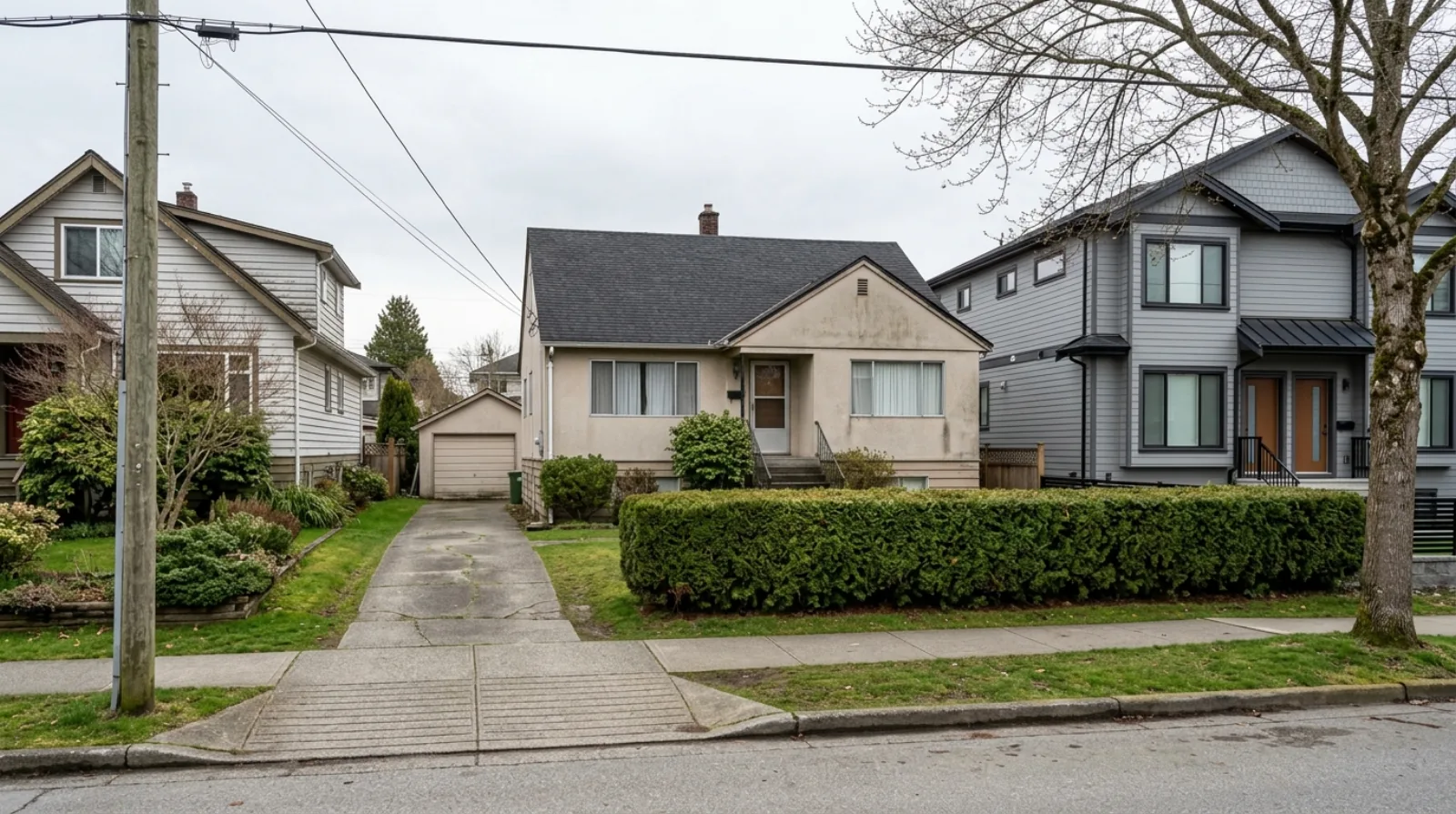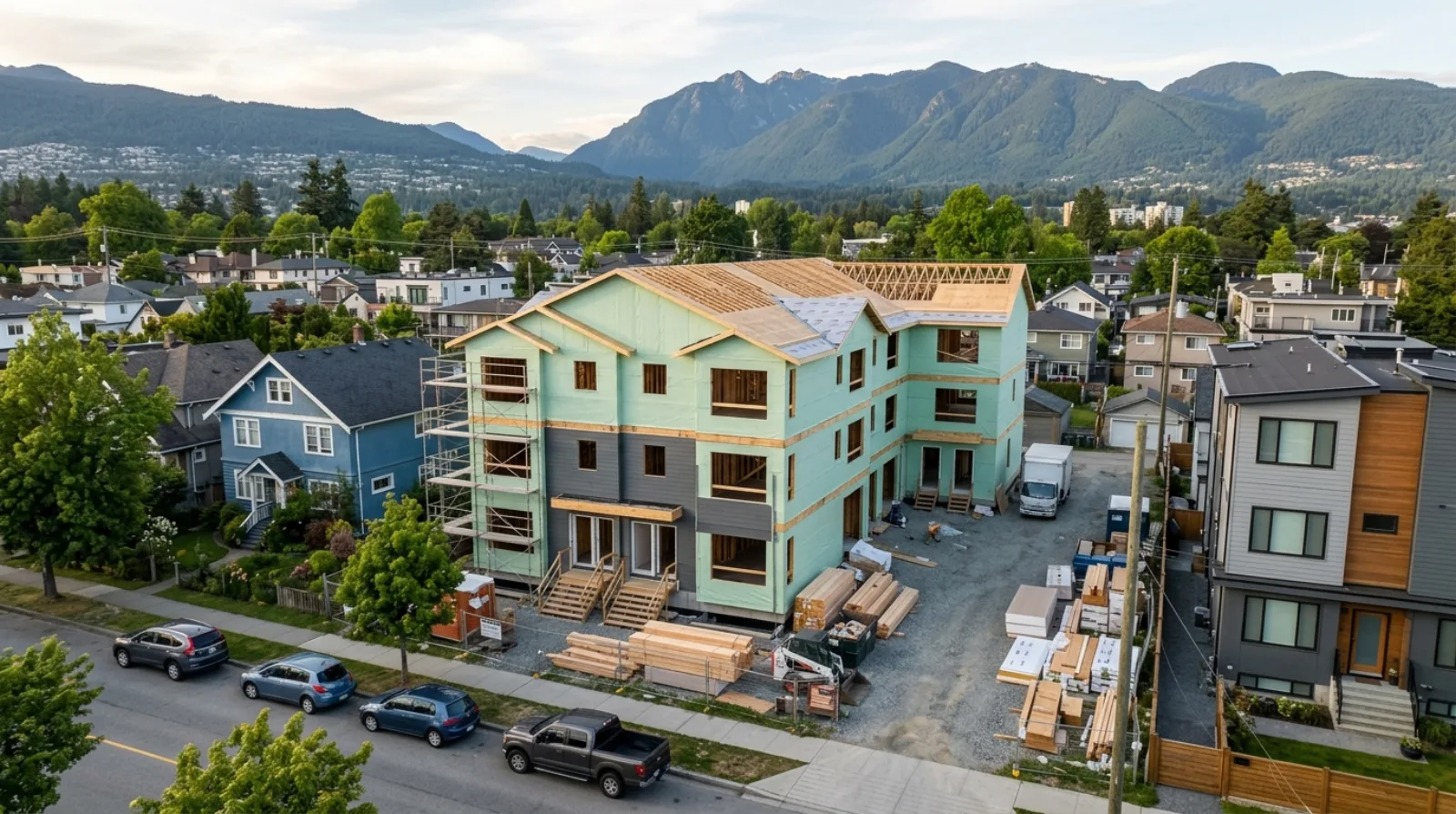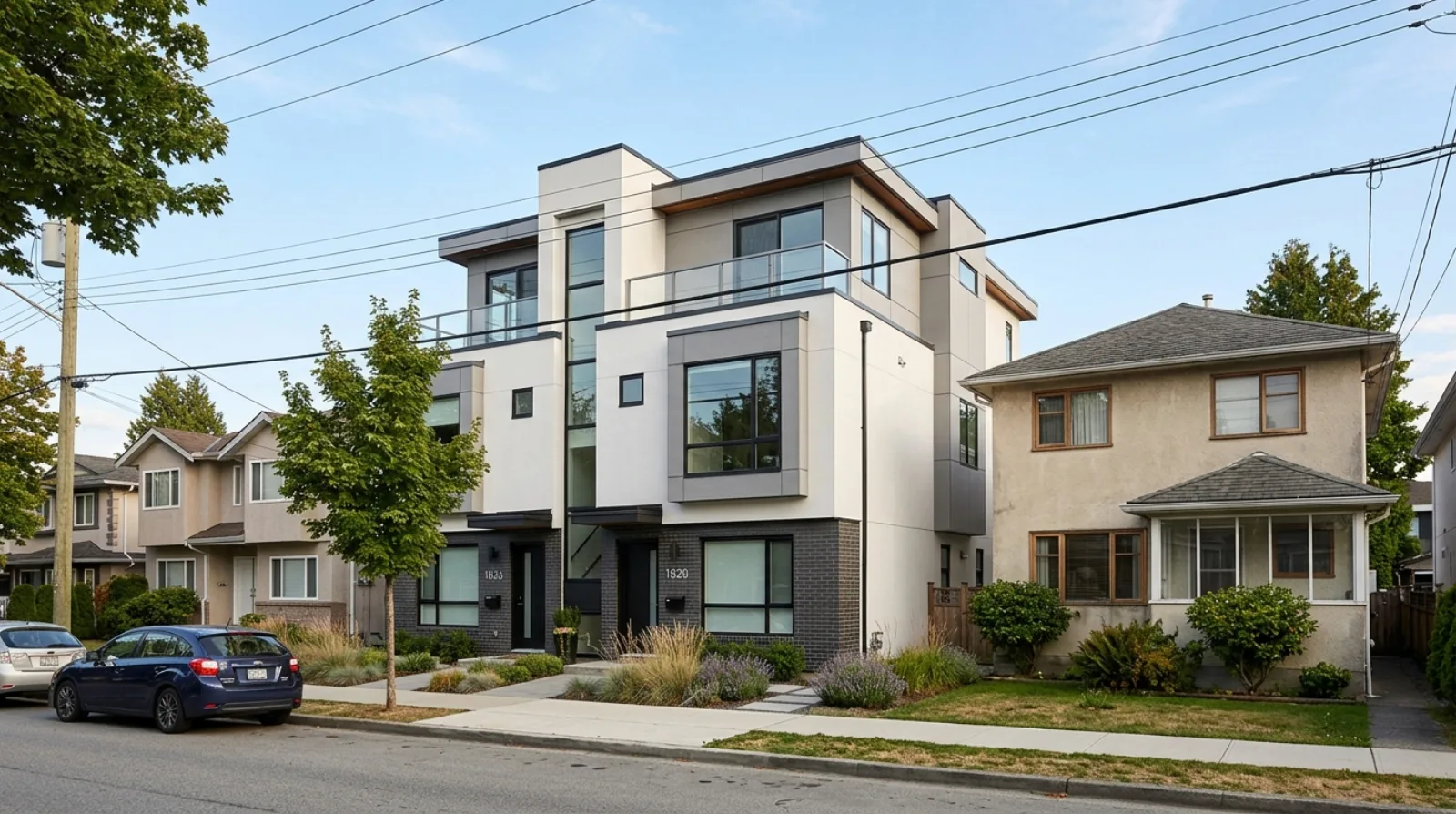

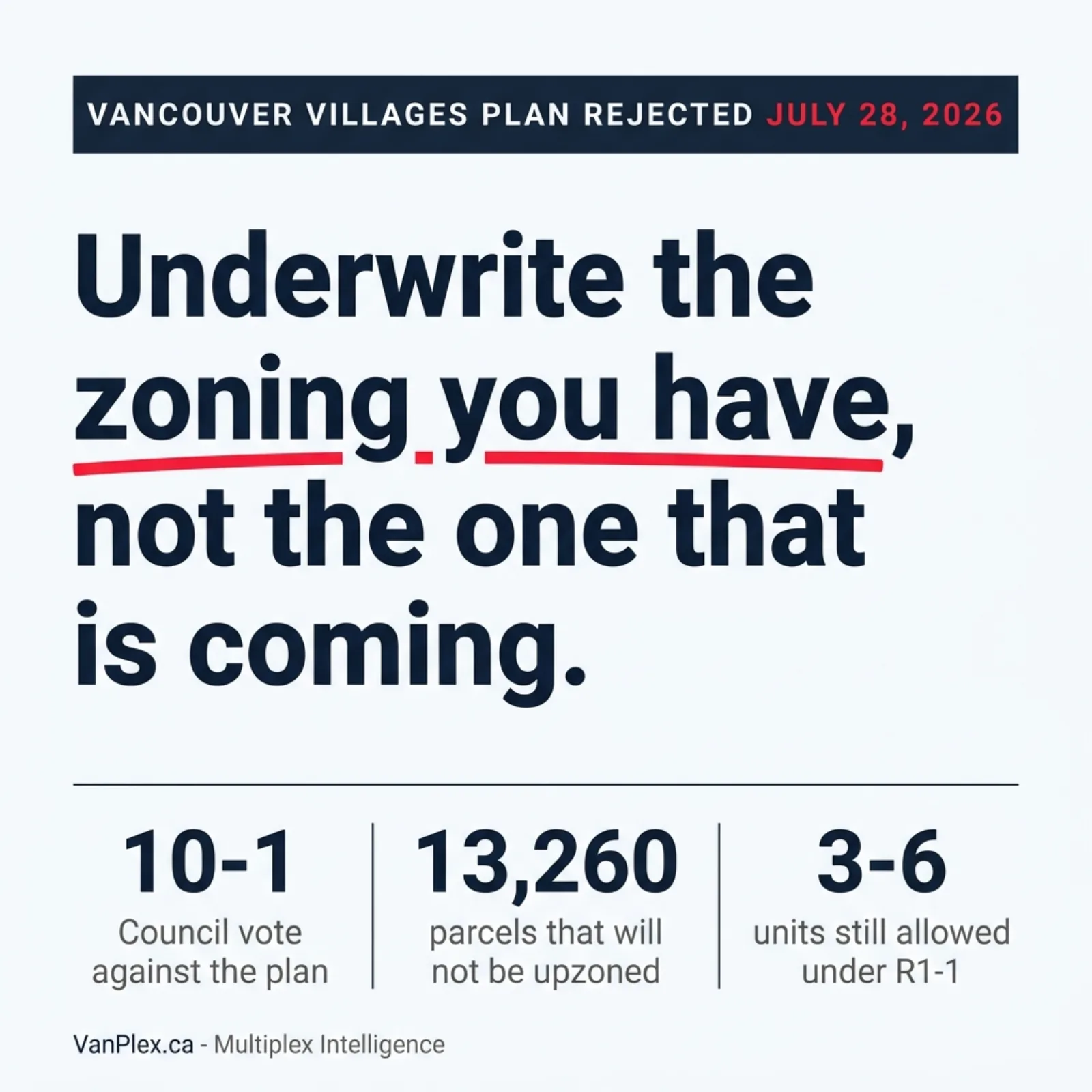
On July 28, 2026, Vancouver City Council voted 10 to 1 against the Villages Plan. That single vote removed the prospect of four, six, and near transit eight storeys from 13,260 parcels, roughly 14 percent of every parcel in the city. If you were valuing a Vancouver lot on that future, the future is gone. What is left on those lots, and on the rest of the city’s house lots, is R1-1. R1-1 has been law since October 17, 2023.
What actually died on July 28
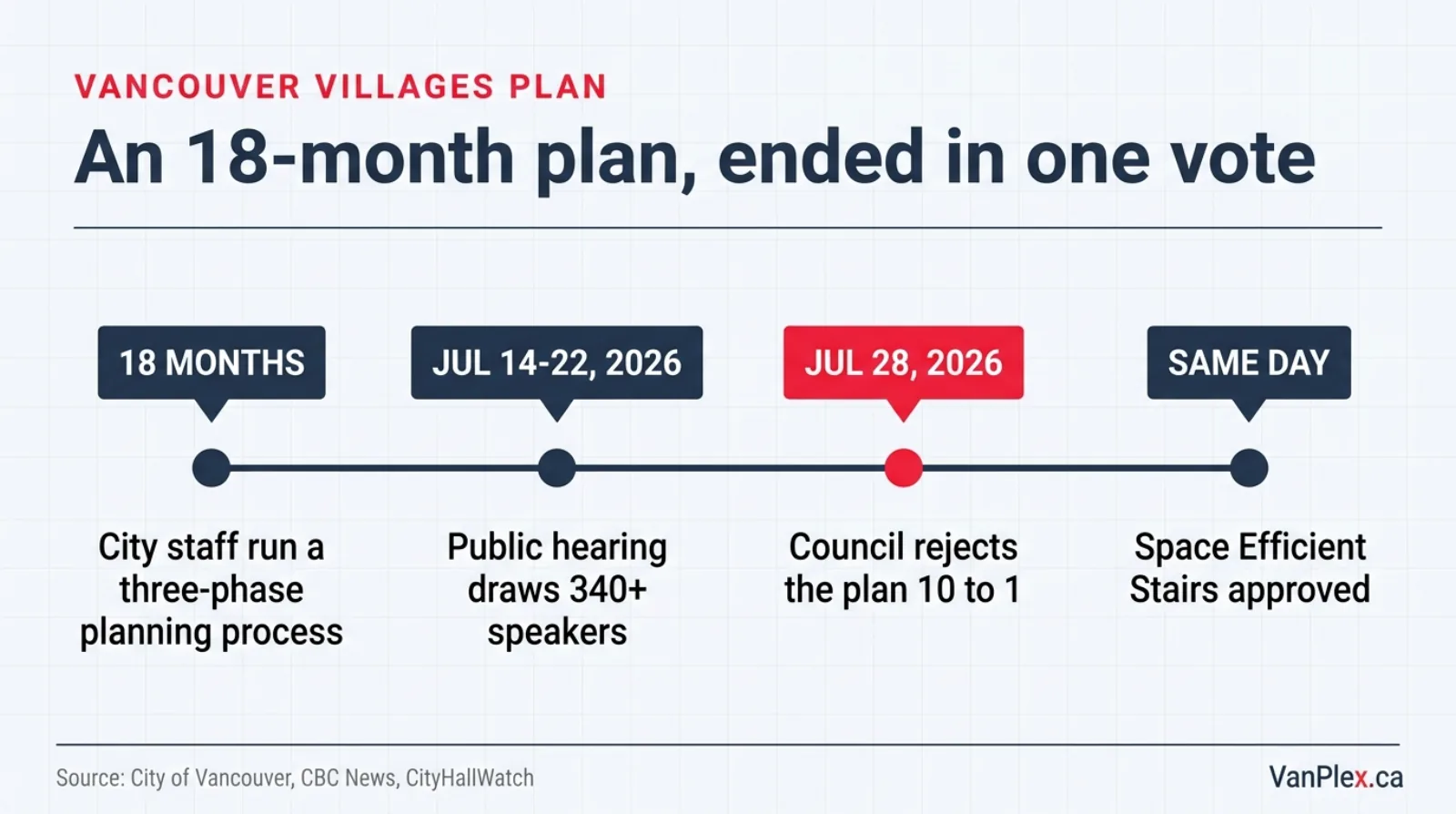
The Villages Plan came out of an 18-month, three-phase City planning process aimed at 17 pockets of the city, mostly existing house neighbourhoods clustered around small shopping streets. It would have allowed low-rise residential and mixed-use buildings of four and six storeys, and eight near transit, plus about 1 million sq ft of new retail and restaurant space. It covered 13,260 land parcels.
The public hearing ran across July 14, 20 and 22. More than 340 people registered to speak, and the City received roughly 3,000 pieces of correspondence, overwhelmingly opposed. Six days later Council voted it down 10 to 1.
One piece of the package did pass. Council approved Space Efficient Stairs, which permits single-exit stairwell layouts in 4 to 6 storey residential buildings in the multi-family and commercial zones where those heights are already allowed, together with floor space ratio increases in R-3 districts. For anyone who builds small apartment buildings on narrow lots, that is a real and quiet win. We wrote about why the single-stair rule matters for small buildings when BC first changed the code.
Why a rejected plan still changes what a lot is worth
Zoning that has not been adopted still moves prices, because sellers price the version of their property they hope to have. Once a city signals that a neighbourhood might carry six or eight storeys, some owners in that area stop thinking about the house they own and start thinking about the apartment site they might become. Asking prices drift upward to reflect it. Buyers who want to build something today end up bidding against a number that has no permit behind it.
Council just took that number away for 13,260 parcels. There is no live application, no draft bylaw, and no staff report to point at. A future Council could revive the idea, but that would mean a new plan, a new public process, and new zoning. On the calendar that is years, not months, and the civic election on October 17, 2026 makes the near-term politics worse, not better.
So the honest question a buyer should ask a seller changed. It is no longer “what might this be zoned?” It is “what does R1-1 allow here, and what does it cost to build it?”
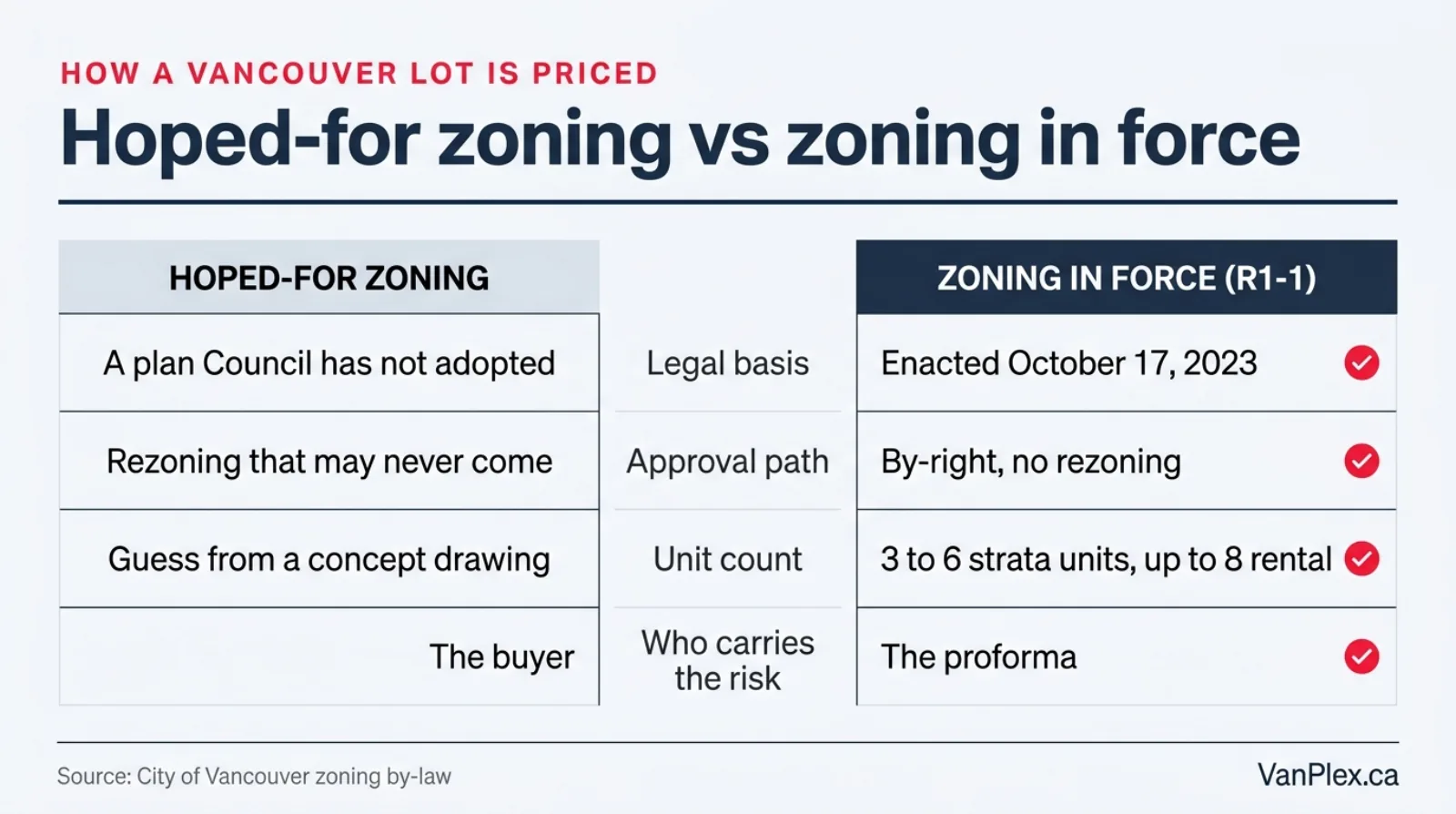
| Priced on hoped-for zoning | Priced on zoning in force |
|---|---|
| Value based on a plan Council has not adopted | Value based on R1-1, enacted October 17, 2023 |
| Assumes a rezoning or plan approval that may never come | No rezoning required, permit stream already exists |
| Unit count is a guess from a concept drawing | Unit count is set by lot size, frontage and transit distance |
| Timeline depends on a future political decision | Timeline depends on permit review and construction |
| Buyer carries the entitlement risk | Seller’s price has to survive a real proforma |
That table is the whole argument. Nothing in the right column moved on July 28. Everything in the left column did.
R1-1 is legal density, not automatic density
This is where investors get themselves into trouble, so it is worth being blunt. An R1-1 address is not a fourplex. It is permission to try.
Vancouver’s R1-1 zone allows 3 to 6 strata units, or up to 8 secured rental units, on a single lot. Which end of that range you actually reach depends on lot area, frontage, and whether you sit within 400 metres of frequent transit. Provincially, Bill 44’s SSMUH floors work the same way: 3 units on lots up to 280 m², 4 units on larger lots, and 6 units on lots larger than 280 m² that sit within 400 metres of frequent transit.
Then the site itself has an opinion. A protected tree in the wrong spot can reshape the building envelope. Peat and organic soils in parts of south Vancouver can add real money to the foundation. Servicing capacity, lane access, and grade all bite before a single unit is sold. And city fees are not a rounding error, as our breakdown of Vancouver multiplex fees shows.
Legal density tells you the ceiling. It does not tell you whether the project clears its cost of capital.
Where the development capital goes now
Had the Villages Plan passed, it would have opened thousands of potential low-rise apartment sites and created a second place for small and mid-sized development capital to go. That destination is closed for now, and the two products were never interchangeable anyway.
| Four to six storey apartment project | R1-1 multiplex |
|---|---|
| Usually needs land assembly across multiple lots | One lot, one owner |
| Rezoning or plan approval required | By-right under existing zoning |
| Larger equity cheque and construction financing | Financing sized to a small building |
| Longer approval and construction timeline | Shorter, and the permit stream is established |
| Institutional or syndicated capital | Owner, family, or small partnership capital |
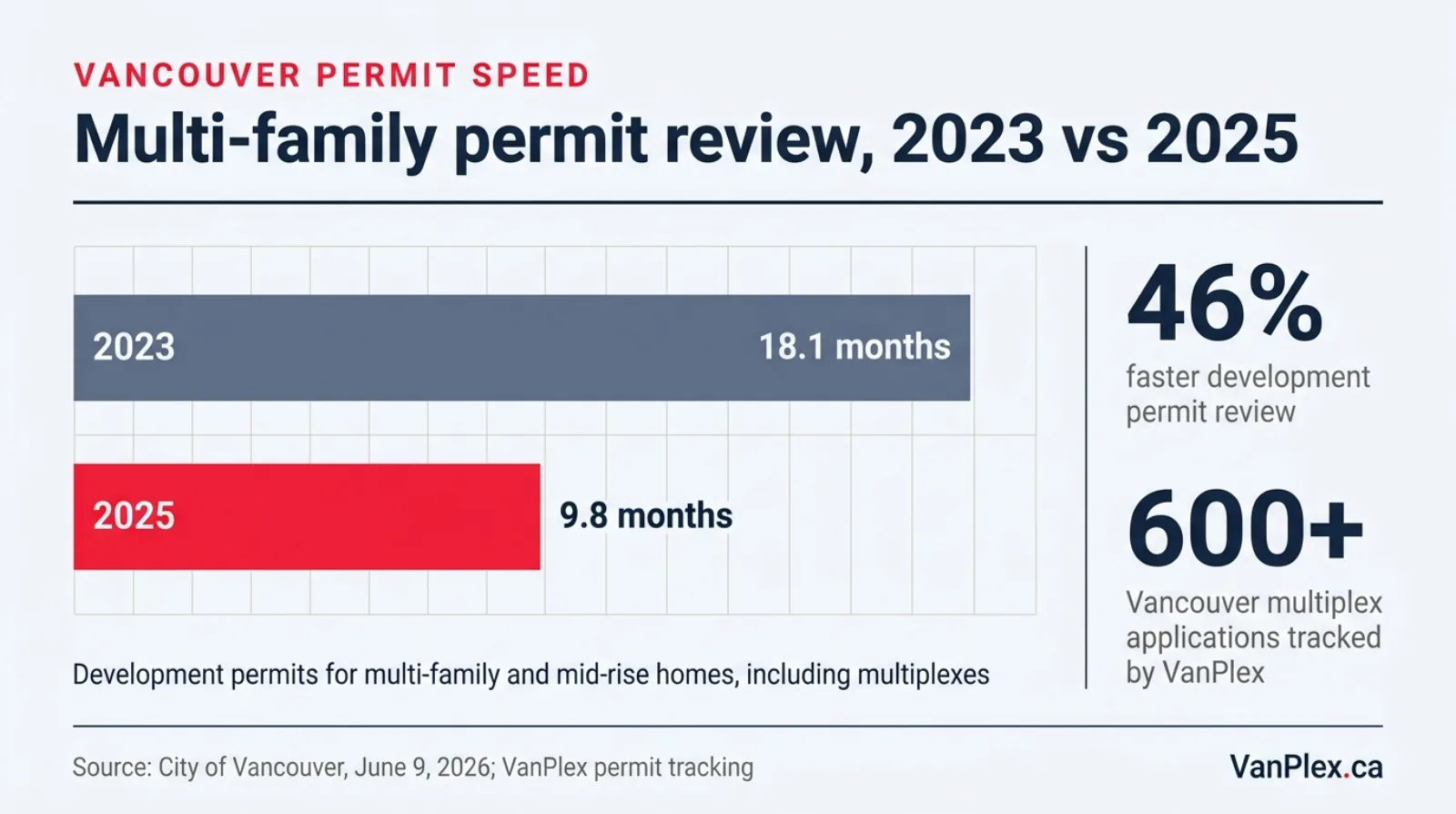
Meanwhile the multiplex path kept getting more usable. On June 9, 2026, the City reported that development permit processing for multi-family and mid-rise homes, multiplexes included, fell 46 percent, from 18.1 months in 2023 to 9.8 months in 2025, and that its streamlined multiplex stream cut multiplex permit processing time in half. VanPlex is currently tracking more than 600 Vancouver multiplex applications through our own permit monitoring.
Not all of those will finish, and plenty will not return enough to justify the risk. But that is a volume number, and volume is what tells you a policy has moved from debate into construction.
One caution worth naming: Council has already asked staff to revisit the multiplex rules. Motion 9, approved May 20, 2026, directs an expedited review of R1-1 covering massing, setbacks, and tree canopy. Projects permitting now are reviewed under today’s rules. Marginal lots whose math only works at the maximum envelope carry more risk in 2027 than they do this year.
How to underwrite a Vancouver lot this month
Nothing here says every R1-1 lot is a good buy. It says the basis for the argument changed, and the discipline has to come from you.
- Underwrite the zoning in force. Price the units R1-1 actually permits on that specific lot, at today’s construction cost and today’s selling or rental values. If it only works at eight storeys, it does not work.
- Make the seller’s expectation explicit. If an asking price assumes apartment potential, say so out loud and ask what supports it. After July 28 the answer on those 13,260 parcels is nothing.
- Test the site before the spreadsheet. Frontage, lot area, transit distance, trees, soils, and servicing decide the unit count. Run those first, then build the proforma.
- Match your capital to the real timeline. Permit review plus construction, not the optimistic version. Faster than 2023 is not fast.
- Assemble the team before the site. Designers and builders who have finished multiplexes, and cost controls that hold, are what separate a legal project from a profitable one. Execution, not the lot, decides the return.
For the political story behind the vote and what it means for homeowners specifically, see our earlier piece on why the Villages Plan rejection leaves your multiplex untouched.
Common questions
Does the Villages Plan rejection change my R1-1 multiplex rights? No. R1-1 was enacted October 17, 2023 and was not part of the Villages package. It still allows 3 to 6 strata units, or up to 8 secured rental units, on a single lot.
Could the Villages Plan come back? A future Council could revive the concept, but it would need a new plan, a new public hearing, and new zoning. Nothing about the current framework depends on that happening, and nothing you underwrite today should either.
My lot was inside one of the 17 village areas. What now? Your existing zoning applies, as it did before the plan was proposed. In most cases that is R1-1, so the multiplex path is the one to model.
What survived from the July 28 meeting? Space Efficient Stairs. Single-exit stairwell layouts are now allowed in 4 to 6 storey residential buildings in zones where that height was already permitted, alongside floor space ratio increases in R-3 districts.
See what your lot allows under the rules in force
If you own a Vancouver house lot, or you are pricing one, the useful number is not what a plan might have allowed. It is what R1-1 permits on your address and what the build costs. Run a PlexRank screen on the address and you get unit count, cost, and return under the zoning that exists today.
Investor Intelligence Principle #5: when future density is delayed, value concentrates in what is already legal, financeable, and buildable. Underwrite the zoning you have.
Author: David Babakaiff, Co-Founder of VanPlex PlexRank™ | Profit with Multiplex
Sources:
- Vancouver council decisively rejects villages plan after ‘tsunami’ of opposition | CBC News (July 28, 2026)
- Vancouver City Council kills Villages Plan after fierce public backlash | Daily Hive Urbanized (July 28, 2026)
- Vancouver Villages plan rejected: analysis, nuances, and the bigger story | CityHallWatch (July 28, 2026)
- Public Hearing agenda, July 14, 20 and 22, 2026 | City of Vancouver
- Villages planning program, 17 areas and an 18-month process | Shape Your City Vancouver
- Sept 2023: Council approves zoning changes, R1-1 and multiplex | Shape Your City Vancouver
- Permitting is getting easier in Vancouver with multiplex approvals now 50% faster | City of Vancouver (June 9, 2026)
- Council Members’ Motion 9: review and refinement of multiplex housing policies, May 20, 2026 | City of Vancouver